
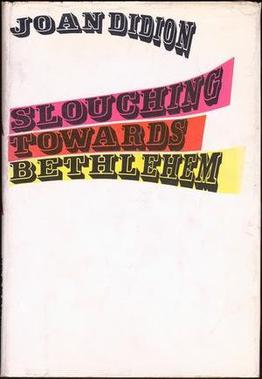
Reading Slouching Towards Bethlehem by Joan Didion didn’t feel like reading a typical book. It felt more like stepping into someone else’s way of seeing the world. The collection of essays captures America in the 1960s, a time of cultural fracture, uncertainty, and quiet unraveling, but what makes the book powerful isn’t just its historical context. It’s the way Didion observes chaos without trying to neatly explain it.
What stood out to me immediately was Didion’s voice. She writes with a kind of emotional restraint that makes everything she describes feel sharper. Whether she’s writing about California counterculture, political unrest, or her own sense of unease, she never tells the reader how to feel. Instead, she presents moments, conversations, and details, and trusts us to sit with the discomfort. That refusal to offer easy conclusions is what makes the essays feel so relevant, even decades later.
The title essay, “Slouching Towards Bethlehem,” is especially unsettling. Didion immerses herself in a community where people are searching for meaning, rejecting structure, and living in extremes. What’s striking isn’t rebellion itself, but how hollow it sometimes feels. The essay captures a loss of shared values, where freedom exists without responsibility and idealism collapses into neglect. Reading it, I couldn’t help but think about how often chaos is romanticized, especially by younger generations looking for identity or belonging.
The book feels unexpectedly familiar. Even though the essays are set in the 1960s, the emotional landscape mirrors our own: disconnection, overstimulation, and a constant search for meaning in a world that doesn’t feel stable. Didion’s work reminds us that cultural breakdown isn’t new, and that uncertainty is something every generation believes it’s facing for the first time.
What I appreciated most about Slouching Towards Bethlehem is that it doesn’t try to fix anything. Didion isn’t offering solutions or moral lessons. She’s documenting what it feels like when systems stop making sense and people are left to navigate the aftermath. That honesty makes the book more powerful than if it tried to be optimistic or reassuring.
By the end, I realized that Slouching Towards Bethlehem isn’t just about the 1960s; it’s about what happens when people lose faith in structure but haven’t figured out what should replace it. Reading it made me more aware of how fragile order can be, and how important it is to question what we’re moving toward, even when we don’t fully understand where we are.
 Mission Viejo Library Teen Voice