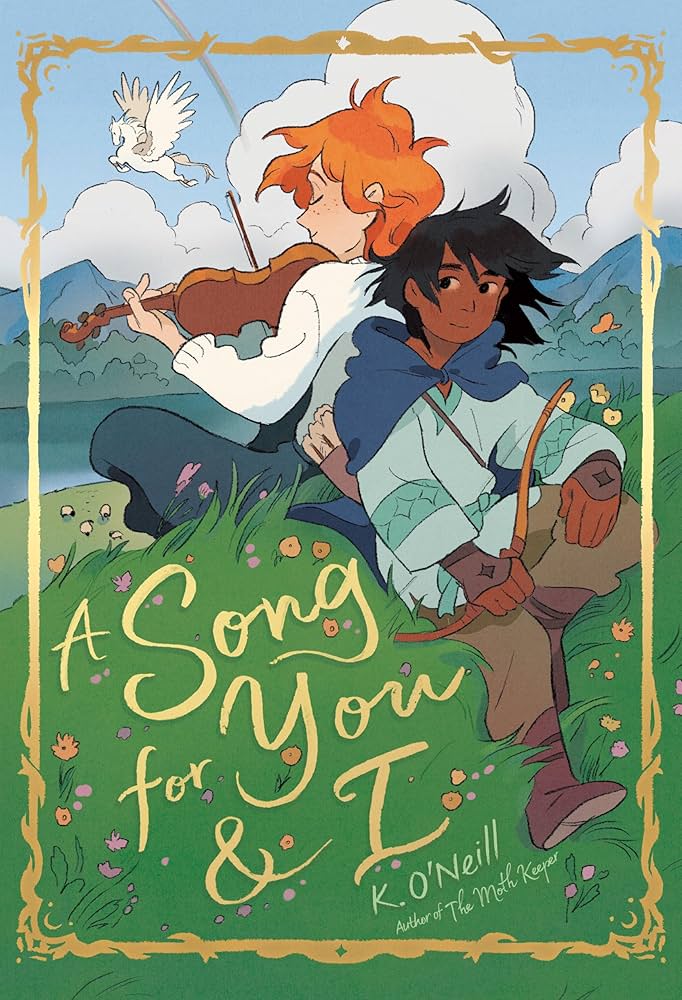
A Song for You and I

A Song for You and I: (A Graphic Novel): O'Neill, K.: 9780593182307:  Amazon.com: Books

The graphic novel, A Song for You and I, is written by Kay O´Neill, and follows the adventure of a ranger called Rowan who endures an accident that causes them to follow a new path than what they wanted to accomplish, and overcome obstacles that makes them rethink about their future. This book is beautifully illustrated with well executed and pronounced details that capture the audience´s attention.

I have loved every single book that Kay O´Neill has wrote, the first series I read from them is the Tea Dragon Society which I am obsessed with, it is such a pleasant, wonderful book to read that I would also highly recommend. This graphic novel is one of their recent books that they have released and I was so excited to start reading it, I was not surprised when I first opened it by seeing the beautifully drawn illustration by Kay O´Neill, they are a wonderful artist, and I love their style of drawing. This book I would say is not much of an action, suspenseful read, it is more of a type of comfortable, cozy fantasy book that you are searching for which is a great alternative when you want to relax and just enjoy reading a stunningly drawn book.

I would highly recommend this book for fans of fantasy books, and people who prefer reading pleasant books compared to suspenseful books. Kay O´Neill is a fantastic author that I would recommend for you to also read their other books. A Song for You and I is not currently available to check out at the Mission Viejo Library today, but you can find other books written by Kay O´Neill that are available today!

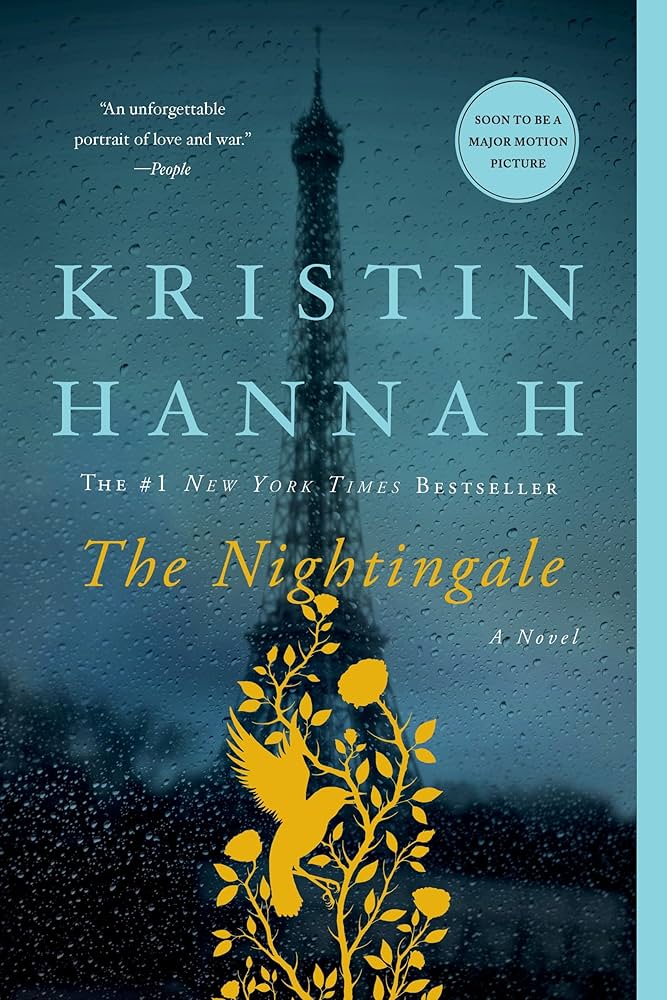
The Nightingale by Kristin Hannah

Amazon.com: The Nightingale: A Novel: 9781250080400: Hannah, Kristin: Books

Kristin Hannah’s The Nightingale is a historical fiction novel that follows two young adults in the midst of World War II. The story shifts between Paris and a small French town, capturing the life of two sisters. Vianne attempts to survive the war and protect her daughter while avoiding trouble from the Nazi regime in Nazi-occupied France. Her younger sister Isabelle refuses to remain silent or complicit and joins the resistance.

Vianne is a very dynamic character – in the start of the book she is characterized as a quiet and passive woman who dreads loss, leading to her protective nature over her young daughter Sophie. Throughout the story and the evolution of World War II, she begins to take on the nature of a more mature woman who no longer keeps her head down but actively fights for survival. 

To contrast Vianne, Isabelle is a valiant character from the beginning, refusing to let the Nazis dictate their lives in France or harm the lives of others. She begins working for the resistance to fight back, adding a sense of tension or urgency to the novel. Despite her boldness, her vulnerability shows through constantly, reminding the audience that she is still a young woman through her incessant struggle with feeling loved. 

The two sisters have a strange but realistic relationship — Vianne constantly pushes Isabelle away from her family while Isabelle pines for the feeling of familial bonds and belonging. This is my favorite part of the book because it demonstrates the effect of war on relationships. Their relationship is strained by past abandonment and fear, creating a realistic dynamic between the characters. This struggle in their connection makes their personal journeys feel more realistic and emotional. The characters speak and act in ways that are authentic, the raw emotions in their dialogue and interactions make them feel almost tangible.

Overall, this is an incredibly good read for those interested in historical fiction novels. It was insightful and introduced me to perspectives in the war that I had not considered while also remaining historically accurate in its portrayal of events. 

Historical Fiction Book Recommendations

Hello, everyone, it’s me again, and today I’ll be sharing with you three of my favorite books of the historical fiction genre. Alongside realistic fiction, fantasy, mystery, and graphic novels, just to name a few, historical fiction is one of my favorite book genres, if not my favorite.

Anyhow, on to the recommendations.

1. To Kill a Mockingbird by Harper Lee

Set during the Great Depression in a fictional sleepy old town in Southern Alabama, Lee’s novel covers several years out of the childhood of Jean Louise “Scout” Finch, a little girl living with her elder brother, Jem, Atticus, Scout and Jem’s father as they call him, Calpurnia, the family’s black housekeeper, and later, Alexandra, Atticus’s judgmental and outspoken sister.

The story focuses on several themes, many of which relate to the human condition and similar concepts, such as morality, life and death, empathy, and, most prominently, the social construct of race.

I LOVE this book. I first read this book in my first year of middle school and have been re-reading it ever since then. It gives a beautiful snapshot of life in the American South during the Great Depression. The author does a wonderful job of making the characters come alive through realistic dialogue and relatable experiences. Overall, I wholeheartedly recommend this book.

2. The Hiding Place by Corrie Ten Boom with John and Elizabeth Sherill

Co-authored by the Netherlands’ first licensed female watchmaker and later itinerant evangelist CorrieTen Boom and the Sherill couple, this book takes place during the WWll era, a time period that I, simply put, have an overinterest in, The novel primarily covers Corrie’s work in the Dutch underground, hiding Jews hunted by the Nazis inside a secret room in her funny-looking home, called the Beje (pronounced bay-yay), with the help of her elder sister and fellow spinster, Betsie, their father, Casper, an elderly watchmaker, and a whole network of underground workers including other members of the Ten Boom family.

As a Christian, I can fully relate to several challenges that Corrie faces even though the circumstances are quite different. Many times during the novel, Corrie’s faith and values are tested, yet she prevails. Another thing that I like about this book is the way it explores how life was during the WWll era in the Netherlands, although predominantly in Haarlem, Corrie’s hometown and where a good chunk of the beginning and the middle of the novel takes place. Overall, I give this novel a complete 10/10. It is written in a beautifully descriptive and informative style and is a wonderful read for Christians and non-Christians alike.

3. Jip, His Story by Katherine Paterson

Written by the author of the Newbery Medal-winning novel Bridge to Terabithia, this book takes place primarily on the poor farm of a small town located in rural Vermont during the 1850s and focuses on Jip, a twelve-year old orphan and resident of the aforementioned town poor farm.

Abandoned as a young child and thought to be of Romani descent (in actuality called the more commonly known racial slur), Jip spends most of his time caring for the animals and doing chores, that is, until one day, when a madman is brought to the farm. While taking care of Putnam “Put” (the aforementioned madman), Jip strikes up a friendship with the man and frequently enjoys Put’s wonderful singing during periods of lucidity.

Honestly, there are a lot of events that take place in this novel, but I feel it would take too long to explain all of them. All in all, I really enjoyed the experience and reading and re-reading this book!

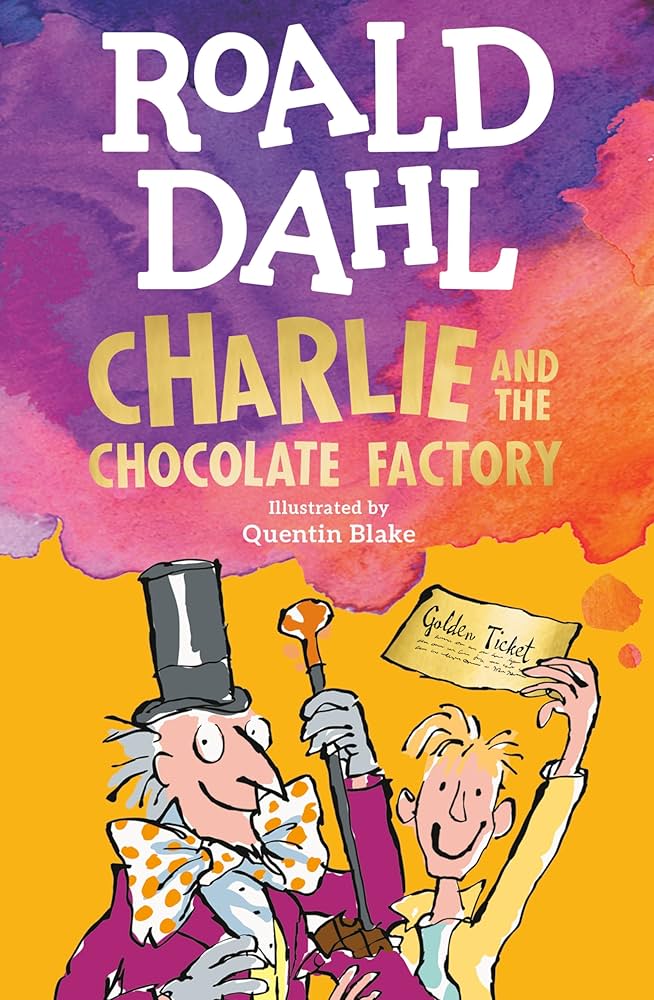
Charlie and the Chocolate Factory by Roald Dahl

Charlie and the Chocolate Factory is a short novel by Roald Dahl. The story revolves around a young boy named Charlie Bucket. Charlie lives in a tiny house with his parents and grandparents. They are very poor, and life is extremely uncomfortable for them. Charlie is almost always hungry, and even though he loves chocolate, he only gets to have it once a year. Every year, his family saves up so that Charlie can have one small chocolate bar as a special birthday gift.

Despite his challenging circumstances, Charlie is cheerful and kind-hearted. He loves to hear stories from his grandparents about a magnificent chocolate factory that is run by a man called Willy Wonka. One day, the newspaper has a huge headline that Willy Wonka will allow five lucky children to visit his factory. To select these children, he will hide five golden tickets in completely random Wonka bars. The children who find these golden tickets will be allowed to enter Willy Wonka’s factory. 

Once this exciting news gets out, everyone in town rushes to find one of the golden tickets. Charlie wishes that he could get one of the tickets, but he knows that he has very little chance. However, one day he miraculously finds a dollar bill. He uses it to buy a Wonka chocolate bar. As he opens the wrapper, he is shocked to see a brilliant flash of gold.  Against all odds, Charlie becomes the last child to discover one of the five golden tickets. The experiences that come next are more amazing than he could have ever imagined.

I really enjoyed reading this book, because I liked all of the fun and entertaining characters. I especially liked reading about Willy Wonka’s eccentric personality. I also found the story very engaging. I constantly wanted to know what would happen next. The book is filled with surprises and it was hard to put it down once I started reading. I also especially enjoyed all of the quirky inventions that Willy Wonka kept secret inside his factory. Overall, this book is exceptionally humorous and exciting, and I would recommend it to readers of all ages.

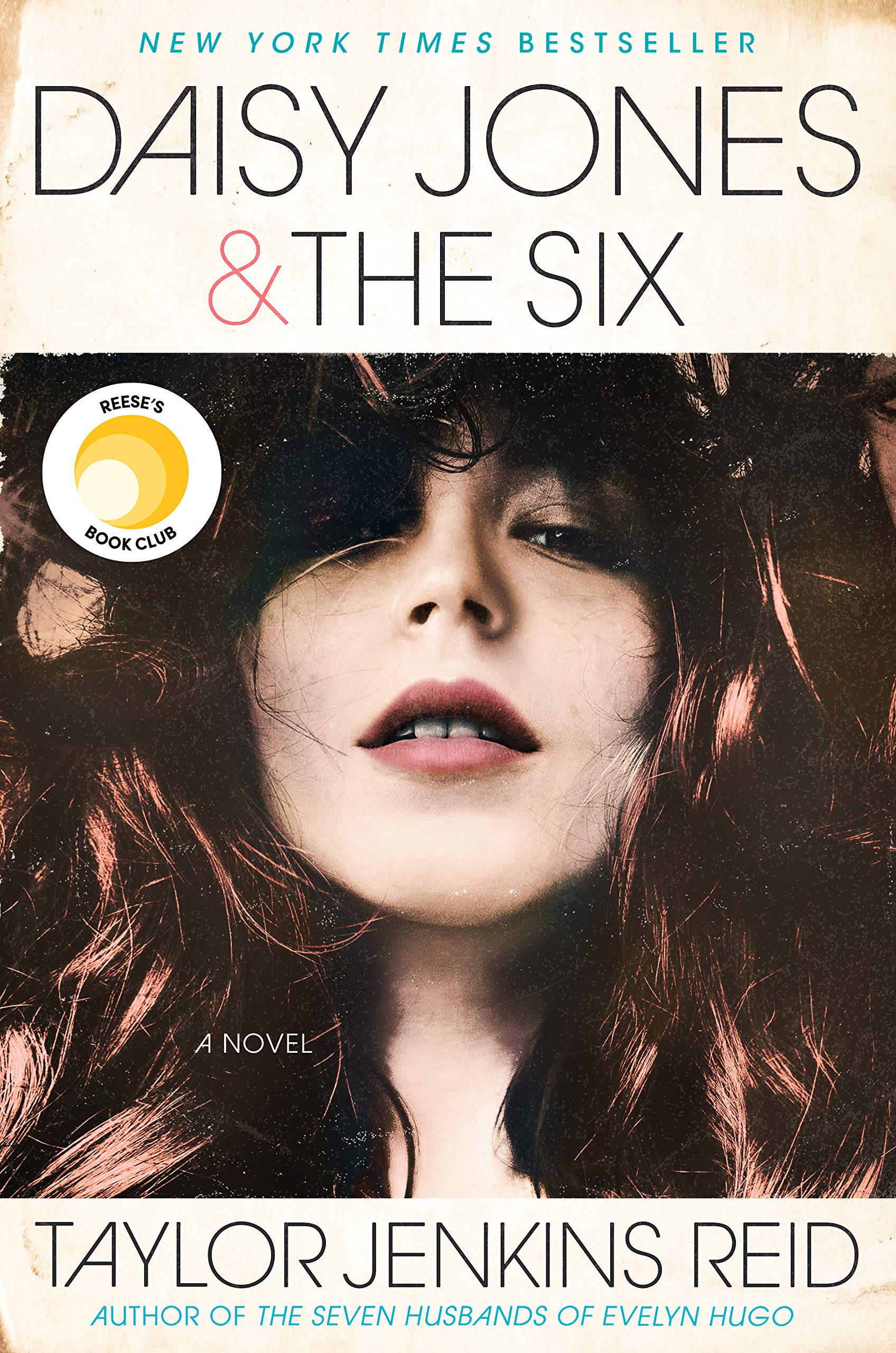
Book review: Daisy Jones & The Six

Book cover of Daisy Jones and the Six by Taylor Jenkins Reid.

Daisy Jones & The Six are one of the few books to leave a lingering ache after the last page. This book explores the lives of a band and a talented singer and songwriter Daisy Jones. The interview-style format for this book was captivating and I thought it was different.

Each character had their own internal thoughts. You really got to know what each character’s thought process was like and I thought that was interesting. I think Daisy Jones is definitely one of the most complex yet relatable characters ever written. The way Reid introduced her background story was a strategic move. It made sense she acted the way she did with how she handled addiction. It was really interesting how she seemed lost yet found with the band. I really wished Reid added more angst and interactions with Daisy and Billy. I understood that they were probably going to fall for each other but I wish there were more conversations between them before Daisy almost kissed him. Camila was also one of the most infuriating characters for me. She really got on my nerves throughout the entire book. I hate how the book made it seem like she was this extraordinary woman when really she was just a selfish woman who wanted things her way no matter what. I understand she stayed because she loved Billy and had a baby on the way. What I don’t understand is why you would stay with him knowing he loved another woman. I think Billy definitely just convinced himself he loved Camila more than he loved Daisy because of what she endured for him. The talk Camila gave Daisy before she left the band honestly gave away what type of woman she is. I honestly don’t believe Daisy would have left the band if Camila didn’t talk to her that night. She talked to her in such a manner that it seemed she wanted the best for her, when really she just wanted Daisy out of the way of her marriage. The Graham and Karen dynamic was also pretty messy. If Graham and Karen had talked the whole baby situation out I do think they would’ve been together or the very least friends. I also understand Karen’s frustration towards Graham when he insisted on her keeping the baby, considering she wanted to focus on her career. Eddie also made me kind of man. I get why he was upset at times but he’s literally not the main focus of the band. Pete and Warren were kind of in their own world. They were a part of the band but they weren’t really a part of the drama. It makes sense they all broke apart at the end but it was sad to see. Overall, this book really showed a lot of insight on what type of lives people in bands live. Looking past the romance and drama, the novel looks into how addiction and talent can create extraordinary art and destroy it. Each character goes through obstacles that test their limits. 

The Rent Collector by Camron Wright

Some books make their impact slowly. The Rent Collector by Camron Wright is one of those stories that doesn’t rely on plot twists or dramatic pacing, but instead settles into you through its ideas. Set in a Cambodian landfill, the novel follows Sang Ly, a mother whose life is defined by survival: finding food, protecting her son, and enduring poverty that feels inescapable. But the heart of the story isn’t just where she lives; it’s how she learns to see herself.

What struck me most while reading was how literacy is treated as something deeply personal, not just practical. Learning to read doesn’t immediately change Sang Ly’s circumstances, but it changes her sense of possibility. In a place where dreaming feels risky, education becomes a quiet form of hope. That idea felt especially meaningful to me, because it reframes learning as more than schoolwork or achievement; it becomes a way of reclaiming dignity.

The most unexpected part of the novel is Sang Ly’s relationship with the rent collector, Sopeap Sin. At first, Sopeap represents fear and control, someone whose power is built on intimidation. But as her love for literature and storytelling is revealed, the novel complicates the idea of good versus evil. Sopeap’s character shows how people can be shaped by trauma and still be capable of beauty. This relationship is uncomfortable at times, but that discomfort is what makes it honest.

For teen readers, The Rent Collector offers a perspective shift. It’s easy to think of education as an obligation or a burden, especially when school feels overwhelming. This novel reminds us that learning is a privilege and one that can become a lifeline. Sang Ly’s determination to learn, despite exhaustion and fear, highlights how access to knowledge can change the way someone imagines their future, even if it doesn’t change their present right away.

By the time I finished the book, I wasn’t thinking about the landfill as much as I was thinking about stories themselves. The Rent Collector suggests that stories preserve humanity when everything else is stripped away. They hold memory, identity, and hope, things that can’t be taken, even in the harshest conditions. This book didn’t leave me feeling devastated or inspired in an obvious way. Instead, it left me more aware of how powerful something as simple as a story can be and how easily we forget that.

Divergent

These rebooted Divergent book covers are cool. – That Book Broad

Divergent is the first book of the dystopian series by Veronica Roth, I first set my hands on this book when I was gifted it on my birthday. This book captured me, because of how its story line and plot follows along the same lines as Hunger Games, which is one of my favorite series. Divergent takes place in a futuristic Chicago where there are four factions, Dauntless, Abnegation, Erudite, Amity, and Candor. It follows the journey of a 16 year old girl named Beatrice, who must go through the choosing ceremony to discover which faction she belongs in and discovers she is ¨Divergent.¨

Ever since I started reading this book, I could not remove it from my hands it is such a great read! The word choice and syntax used in this book group together to create meaningful sentences, and serve to move the plot forward in a captivating, very actionable way. I especially love dystopian novels like this one, that take place in the future and create tension and dramatic effects when reading the book, all in all this is what makes a book a good read and captures the audience, which is exactly what Veronica Roth accomplished. I was excited to see that there is even a movie based on the book, which I will definitely be watching, hopefully it is as good and explains the same details as in the book. Next, I will be reading the second book in the series, which is Insurgent, which I am really excited to read because the first book leaves you in suspense, forcing you to read the remaining books in the series.

Overall, I would highly recommend this book for action seeking readers, and dystopian fans who are seeking a book that always holds you in suspense and brings you on the edge. I will definitely be writing more reviews on the remaining books of the Divergent series, so stay tuned. The Divergent book is currently available to check out at the Mission Viejo Library today!

The Metamorphosis by Franz Kafka

I’ll admit I was a bit skeptical in starting this 65-page novella, largely because I wasn’t sure how much I’d learn or capture from such a short book, a book whose premise centered upon a man who wakes up as a bug. While my impression of the novella was hesitant, the story unraveled timeless ideas that I hope many will value just as I did.

The Metamorphosis opens with Gregor Samsa’s transformation into a bug. Despite his unfamiliarity with his newfound bodily functions, Gregor immediately turns to his responsibility as the breadwinner of his family, resolving to his normal morning routine of getting ready for work. His family soon discovers Gregor’s alarming physique and are burdened with the responsibility of caring for him and undertaking the new responsibility of working to maintain their financial status.

Overtime, Gregor is outcasted by his family due to the physical loss of his humanity and his inability to fulfill a role in his family; however, Gregor spends his days in reflection and meditation and begins to understand his true role in society. Ultimately, this realization causes Gregor to shut down, finally finding peace in a slow, and bittersweet death.

The most significant moment in this novella, in my opinion, is the moment in which Gregor’s sister, Grete, begins to play the violin in the living room. Gregor’s parents watch, hoping to please their guests and disregard the artistic value of Grete’s playing. Gregor, on the other hand, losing more and more of his humanity, sits and embraces the music from the violin and no longer cares about pleasing others; he enjoys the music for the music. In this moment, I think Kafka is trying to show the reader that there is no monetary compensation for artistic appreciation and that the thing that makes us human is our ability to make art. In this way, Gregor actually becomes more human during his transformation into a bug; his family, rather, are the true insects in that they exploit Grete’s violin playing.

Kafka presents the idea that humans become obsessed with the idea that they must fulfill a role in society in order to avoid alienation; however, humans are ultimately fulfilled by the thing that only humans can do, which is making art and music.

I found this message quite beautiful, especially in today’s society. Many of us are largely obsessed with material value when it comes our status in society. Kafka shows us that our value actually comes from doing the things that makes us human.

Bleach by Tite Kubo: Manga Review

Bleach chapter cover art Kubo,Tite | Bleach manga, Bleach anime art, Bleach  anime

Even though he has the ability to see spirits, Ichigo Kurosaki strives to live as an ordinary high school student in Karakura Town, Japan. His life takes a drastic turn when he must obtain the powers of a Soul Reaper, which he receives from Rukia Kuchiki, to cleanse evil spirits known as Hollows. With these mysterious powers, he embarks on a journey to protect his loved ones and discovers hidden parts of the world and himself.

Characters and Pacing

Each character has unique thematic elements and distinct philosophies which make them stand out to me, although some aren’t obvious at first glance. Also, the character designs are super cool! Bleach is the type of manga where each page must be read carefully while taking the time for reflection, as it may be easy to overlook crucial details that give deeper insight into a character’s actions and agency.

The intense battle scenes and violence aren’t just for hype moments, but reflect conflicting ideals between its participants. Throughout his battles, Ichigo not only forms and strengthens bonds with those around him, but he gradually learns to accept the darkest and most vulnerable parts of himself.

Compared to the anime, the manga’s pacing is faster and much more consistent, though it might make the fighting scenes a little boring and anticlimactic.

Mayuri's speech on perfection, his relationship with Nemu, and the events  of TYBW: what's your take? : r/bleach
In Kurotsuchi Mayuri’s battle with Szayelaporro

Not to mention, there are some amazing antagonists and plot twists! I would’ve liked to include my top favorites in this post, but revealing their existence spoils the surprise.

However, I personally find the emotional development and impact to be lacking, as the series focuses more on presenting ideals and battles.

World Building and Themes

Much of Bleach’s world building and themes are predicated on the concepts of life and death, and encourages the reader to ponder not only the meaning behind the characters’ actions, but how those same ideas exist and can be applied to our modern society. Yes, the existence of multiple supernatural realms is fascinating, but they serve more as narrative mechanisms to demonstrate how the balance between life and death is delicate and how accepting both gives meaning to our existence.

What does white ichigo poem mean? : r/bleach

There are more poems like this at the end of each volume, and they really tie everything together.

Afterword

This is one of my favorite series ever, and I recommend it to older folks. It is highly advised that the manga be read first before watching the anime, as there are pacing issues in the animated version.

If you are planning to watch the anime, it’s okay to only watch the Thousand Year Blood War arc since there’s additional content which wasn’t in the manga.

…That’s it!

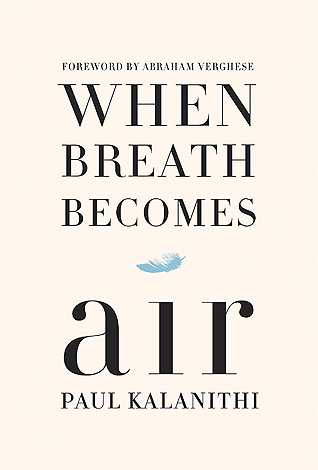
Book Review – When Breath Becomes Air by Paul Kalanithi

Cover of the book 'When Breath Becomes Air' by Paul Kalanithi, featuring a minimalist design with a blue feather.

As a pre-med, I’ve gotten into the habit of reading not just books containing relevant technical knowledge, but also the books that really show the human side of medical careers. This was the book that filled the story-shaped void in my stack of cell biology textbooks.

Dr. Paul Kalanithi, the author of this autobiography, details his journey, starting out with his experience moving to Kingman, Arizona from New York City. He didn’t have much to begin with; at the time, the school district he grew up in didn’t have the best resources, yet he pressed on. Finding solace and meaning in the classics, he built a solid foundation which ultimately got him into Stanford University. After finishing his master’s degree at Cambridge, he found his calling, and went to medical school at Yale.

Yet, the nature of this book wouldn’t be the same if it were just about his successes. The story takes a tragic turn in the middle of his neurosurgery residency. He was diagnosed with stage IV metastatic lung cancer. Reflecting on his mortality as a human, he realized that coming in such close contact with his own mortality had changed both “nothing and everything,” simultaneously realizing that thinking about death all the time was no way to live. Despite being faced this diagnosis, he didn’t stop being himself, continuing his career for as long as he can hold on.

Of all the autobiographies I have read, this one is the memorable, not because it related with a future career trajectory that I’m trying to pursue, but a rare book that addresses human mortality and the nature of life itself in a field that coexists side-by-side with death. It’s for this reason that I believe that this work is a must-read for anyone interested in pursuing a career in medicine. The one part that I simultaneously love and hate about autobiographies is their dual and fickle role— while they chronicle the herculean tasks that their authors had to go through to achieve overwhelming success, loss and sadness bleed through the pages as well. A good autobiography will have moments where one feels like they’re standing at the summit of the mountain with the author, and moments where one is crying alongside them.

Ultimately, my greatest takeaway from the book is this line, which follows me today, and will follow me as I continue to go through my own journey: “even if I’m dying, until I actually die, I am still living”.