
I’ll start off by saying one thing: this one is not for the weak.
If you’ve been a part of the anime/manga fandom for long enough (or even if not, really), you’ve definitely either seen this meme (right) lingering around the internet across multiple forms of media or have heard the song Cruel Angel’s Thesis.
Well, it’s good to know where memes and songs come from. These two insanely popular and widespread bases for lighthearted humor are actually from the existential, gut-wrenching, apocalyptic psychological drama (with a side of sick robots): Neon Genesis Evangelion.


Neon Genesis Evangelion created by Hideaki Anno, abbreviated as NGE, follows the point of view of 14-year-old Shinji Ikari in a futuristic Tokyo-3, 15 years after a worldwide cataclysm. Shinji’s flaws are extremely obvious and made known quickly (literally ten minutes into the series); he’s emotionally insecure, weak, and pathetically vulnerable to the pains of the world around him. Having had a traumatic childhood with both his passed mother and disapproving distant father, Shinji struggles with feelings of inadequacy and self-worth, making it difficult to form meaningful relationships for much of his life. However, his weak self-perception is challenged throughout the entire series as an overarching question: how do we perceive ourselves, and what is the meaning of existence and the nature of humanity?
In this apocalyptic world, beings with a 99.89% genetic affinity to humans called Angels seek to initiate a ‘Third Impact’ to reclaim Earth from humanity. To counter Angels, an organization called NERV was created, along with gigantic mecha-robots called Evangelions. These Evangelions require a pilot to ‘link’ to them, and those pilots will feel the same amount of pain of whatever pain the Evangelions feel during combat. In this sense, the Evangelions and pilots become one.
During an Angel attack, Shinji was suddenly recruited by his absent father to become a pilot for Evangelion Unit-01. This initiation is the starting point for the rest of the series as we follow Shinji’s struggles, the hauntingly relatable actions of every character, and see for ourselves the cost of advantage and greed, the instability of mental health, and the complex relationships between duty, identity, and self-worth. As Shinji and the other teenage pilots face gigantic monsters, their personal battles become intertwined with the fate of humanity, forcing them to confront not only the Angels but also the darkest parts of themselves.

So, that sounded horrifying! But trust me, walking into this piece of media will either make you question your own sanity or give you the biggest brain stretch you’ve ever had. Both aren’t that great, but you gotta believe me when I say it’s amazing. To be honest, I understood 30% of what I watched when I decided to give NGE a go for the first time. However, after delving into the intricate symbolism and trying to understand the psychology of each character, I found myself getting more and more hooked on this show’s eerie atmosphere and strangely familiar story work.
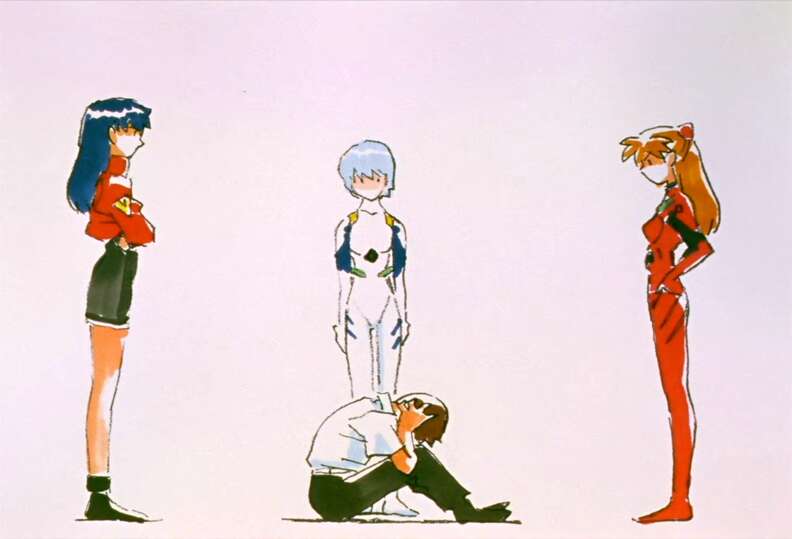
If you couldn’t tell at this point, this definitely isn’t everyone’s cup of tea. But can I tell you a secret? It clearly wasn’t mine either! I have a strong dislike for dystopian, fighting, and fantasy novels or shows, but I decided to put aside that fact and give this show a try. I can’t say that everyone I’ve recommended this show to has acknowledged or come to like NGE as a wonderful classic, but I can announce that every single person has told me they enjoyed the process of watching it. In my opinion, NGE isn’t just about understanding the show and its deep, hidden intents fully, but rather enjoying the process of watching and feeling yourself fall deeper and deeper into a world filled with questions, theories, and feelings to explore.

There are several different parts to the full story of Neon Genesis Evangelion, including multiple movies and the original series. As such, the watch order should be as follows:
1) Neon Genesis Evangelion (26 eps TV, 1995), 2) The End of Evangelion (Movie, 1997), 3) [Evangelion 1.0: You Are (Not) Alone] (Movie, 2007), 4) [Evangelion 2.0: You Can (Not) Advance] (Movie, 2009), 5) [Evangelion 3.0: You Can (Not) Redo] (Movie, 2012), 6) Evangelion 3.0 + 1.0: Thrice Upon a Time (Movie, 2021)
My personal note is that you only really need to watch the 26-episode anime and The End of Evangelion. The movie gives a more clear-cut yet tragic parallel ending to the anime finale.

I highly recommend this anime as it opened my eyes to many more abstract ideas and insights on characterization. In a way, I believe that it also challenges traditional anime plotlines. As always, I hope this overview/review was an enjoyable read, and this time, congratulations on making it to the end! Congratulations, congratulations, congratulations!
Ann
Neon Genesis Evangelion is available for checkout from the Mission Viejo Library.
 Mission Viejo Library Teen Voice
When I first watched NGE I was super confused LOL. Dissecting it was so much fun though! The characters are pretty intricate and cool. Nice blog.
that’s so fair- watching it for the first time is a crazy experience! thank you!