
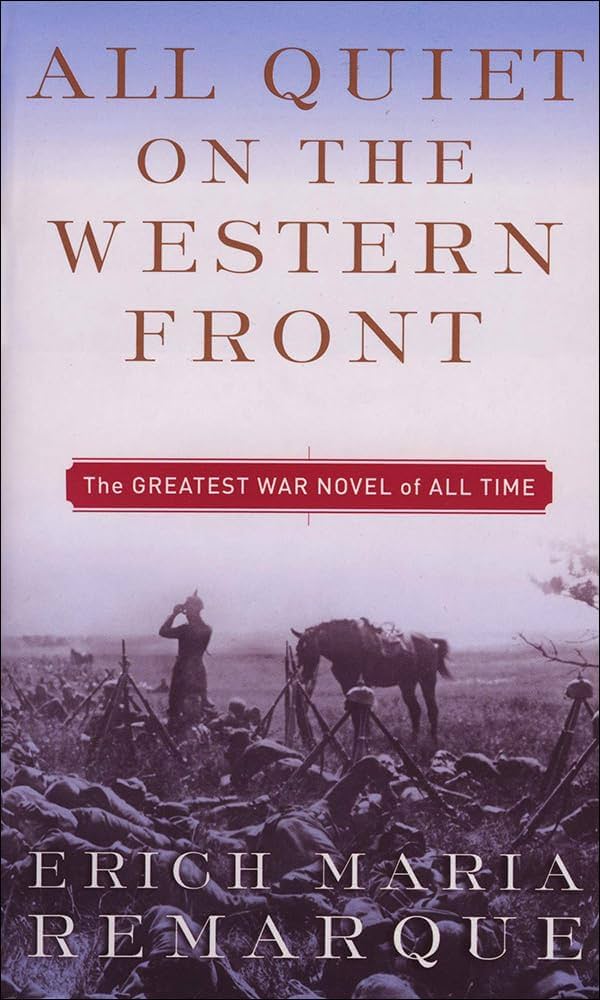
Remarque’s All Quiet on the Western Front is one of the most captivating anti-war novels ever produced. From the perspective of a veteran of the Great War, it provides a striking narrative backed by his personal experiences, resulting in a novel based on events he endured in his enlistment.
The novel follows Paul Bäumer, a German 17 year old boy who enlisted with his childhood friends to fight for the motherland, Germany. While the boys join in a state of elation and youthful idealism, it ends with both Paul and the reader questioning the validity of war. The novel creates a multitude of themes revolving around the horrors of combat – the inhumane nature, the brutality, and the collective loss of innocence. Remarque illustrates that war goes beyond a conflict between nations; it is a failure of society, creating opportunities for power systems to override morality and individuality.
Another topic frequently explored is how war kills the living. It strips them of thought and freedom, creating bitter shells of what we call a ‘man.’ Through witnessing death and mutilation of hundreds of people, the soldiers become empty, rendering them “ruined,” mind and body.
My favorite themes Remarque develops through Paul’s thoughts regard the value of human life. He instills the state’s indifference to life – the soldiers are tools, their humanity never considered. This idea explains why so many were brutally killed and why soldiers often lacked morality when taking the lives of others. They were conditioned to see others not as humans, but solely as the enemy. “But now, for the first time, I see you are a man like me. I thought of your hand-grenades, of your bayonet, of your rifle; now I see your wife and your face and our fellowship. Forgive me, comrade. We always see it too late. Why do they never tell us that you are poor devils like us, that your mothers are just as anxious as ours, and that we have the same fear of death, and the same dying and the same agony–Forgive me, comrade; how could you be my enemy?”
The book is littered with quotes strong enough to bring me to tears no matter how many times I read them. “How senseless is everything that can ever be written, done, or thought, when such things are possible.” Remarque has a profound ability to create anti-war sentiment throughout regular commentary – in the middle of the narrative come piercing questions and ideas that stick with oneself for multiple pages after.
I love this book a tremendous deal. The storytelling is powerful, well-paced, and offers an intense perspective on war. While war is often romanticized in a quest for glory, Remarque creates a striking understanding of its horrors, how it ruins lives and defiles humanity: “We are forlorn like children, and experienced like old men, we are crude and sorrowful and superficial—I believe we are lost.”
 Mission Viejo Library Teen Voice