
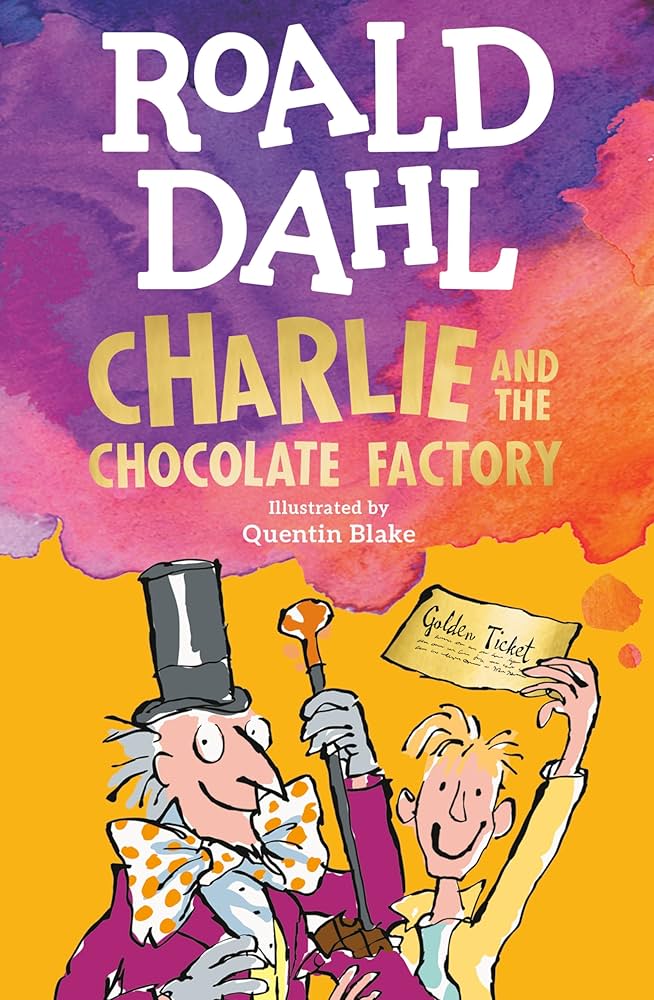
Charlie and the Chocolate Factory by Roald Dahl

Charlie and the Chocolate Factory is a short novel by Roald Dahl. The story revolves around a young boy named Charlie Bucket. Charlie lives in a tiny house with his parents and grandparents. They are very poor, and life is extremely uncomfortable for them. Charlie is almost always hungry, and even though he loves chocolate, he only gets to have it once a year. Every year, his family saves up so that Charlie can have one small chocolate bar as a special birthday gift.

Despite his challenging circumstances, Charlie is cheerful and kind-hearted. He loves to hear stories from his grandparents about a magnificent chocolate factory that is run by a man called Willy Wonka. One day, the newspaper has a huge headline that Willy Wonka will allow five lucky children to visit his factory. To select these children, he will hide five golden tickets in completely random Wonka bars. The children who find these golden tickets will be allowed to enter Willy Wonka’s factory. 

Once this exciting news gets out, everyone in town rushes to find one of the golden tickets. Charlie wishes that he could get one of the tickets, but he knows that he has very little chance. However, one day he miraculously finds a dollar bill. He uses it to buy a Wonka chocolate bar. As he opens the wrapper, he is shocked to see a brilliant flash of gold.  Against all odds, Charlie becomes the last child to discover one of the five golden tickets. The experiences that come next are more amazing than he could have ever imagined.

I really enjoyed reading this book, because I liked all of the fun and entertaining characters. I especially liked reading about Willy Wonka’s eccentric personality. I also found the story very engaging. I constantly wanted to know what would happen next. The book is filled with surprises and it was hard to put it down once I started reading. I also especially enjoyed all of the quirky inventions that Willy Wonka kept secret inside his factory. Overall, this book is exceptionally humorous and exciting, and I would recommend it to readers of all ages.

Book review: Daisy Jones & The Six

Book cover of Daisy Jones and the Six by Taylor Jenkins Reid.

Daisy Jones & The Six are one of the few books to leave a lingering ache after the last page. This book explores the lives of a band and a talented singer and songwriter Daisy Jones. The interview-style format for this book was captivating and I thought it was different.

Each character had their own internal thoughts. You really got to know what each character’s thought process was like and I thought that was interesting. I think Daisy Jones is definitely one of the most complex yet relatable characters ever written. The way Reid introduced her background story was a strategic move. It made sense she acted the way she did with how she handled addiction. It was really interesting how she seemed lost yet found with the band. I really wished Reid added more angst and interactions with Daisy and Billy. I understood that they were probably going to fall for each other but I wish there were more conversations between them before Daisy almost kissed him. Camila was also one of the most infuriating characters for me. She really got on my nerves throughout the entire book. I hate how the book made it seem like she was this extraordinary woman when really she was just a selfish woman who wanted things her way no matter what. I understand she stayed because she loved Billy and had a baby on the way. What I don’t understand is why you would stay with him knowing he loved another woman. I think Billy definitely just convinced himself he loved Camila more than he loved Daisy because of what she endured for him. The talk Camila gave Daisy before she left the band honestly gave away what type of woman she is. I honestly don’t believe Daisy would have left the band if Camila didn’t talk to her that night. She talked to her in such a manner that it seemed she wanted the best for her, when really she just wanted Daisy out of the way of her marriage. The Graham and Karen dynamic was also pretty messy. If Graham and Karen had talked the whole baby situation out I do think they would’ve been together or the very least friends. I also understand Karen’s frustration towards Graham when he insisted on her keeping the baby, considering she wanted to focus on her career. Eddie also made me kind of man. I get why he was upset at times but he’s literally not the main focus of the band. Pete and Warren were kind of in their own world. They were a part of the band but they weren’t really a part of the drama. It makes sense they all broke apart at the end but it was sad to see. Overall, this book really showed a lot of insight on what type of lives people in bands live. Looking past the romance and drama, the novel looks into how addiction and talent can create extraordinary art and destroy it. Each character goes through obstacles that test their limits. 

Book Review: Animal Farm

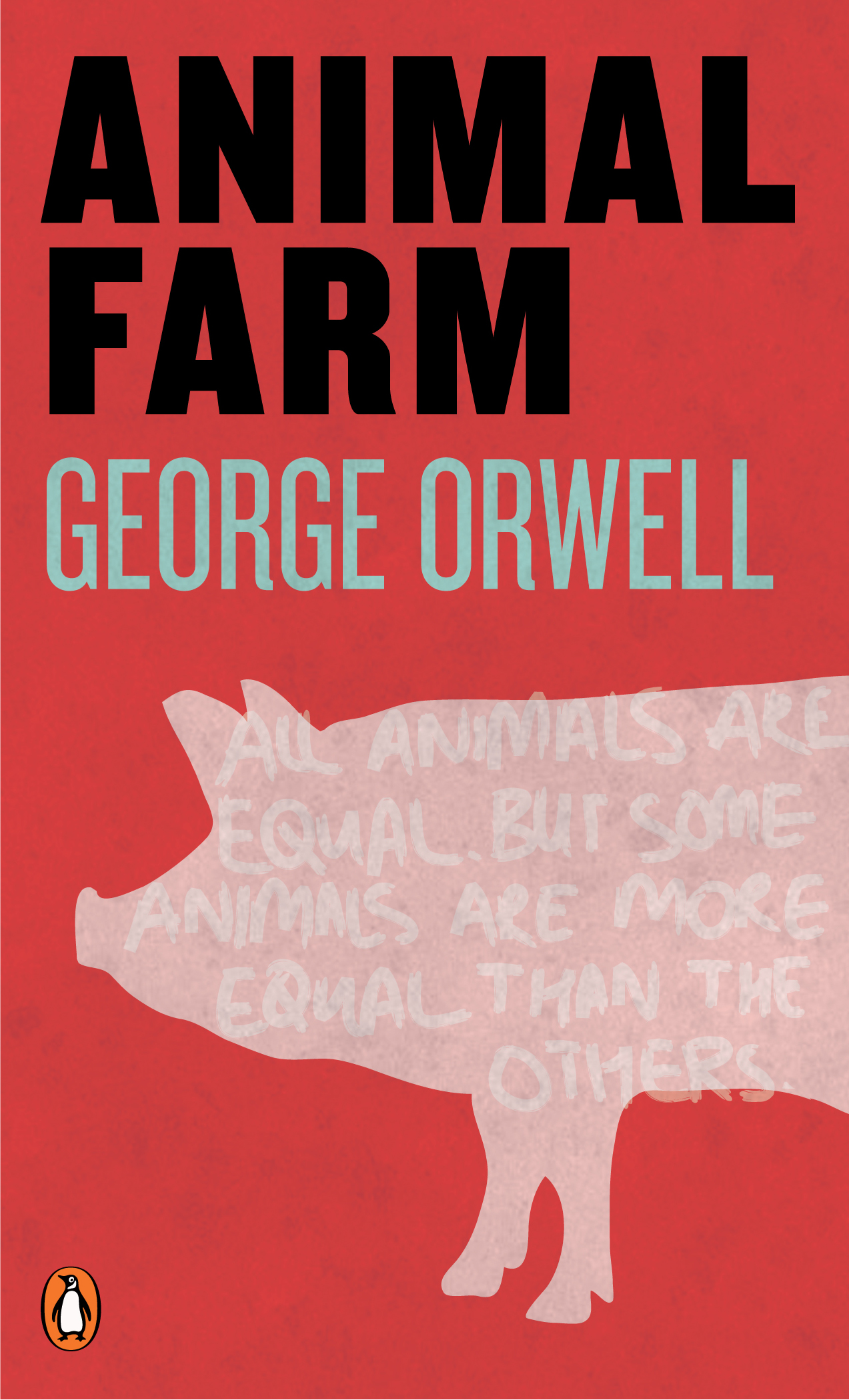
Cover of 'Animal Farm' by George Orwell featuring a silhouette of a pig and the text, 'All animals are equal, but some animals are more equal than others', against a red background.

Animal Farm by George Orwell was one of my first classics, and is one of my favorite pieces of literature. It is a dystopian novella that, despite having complex ideas and themes, is quite easy to understand, making it a great read for beginners. However, it should be noted that this story contains mature themes, such as violence.

Taking place in a mid-20th century English farm named Manor Farm, the book follows farm animals that overthrow their abusive human farmer, Mr. Jones; the animals hope to establish an equal society within the farm. However, the pigs, led by Napolean, take control and tyrannically oppress the other animals.

The plot is interesting, keeping readers engaged the entire time. Orwell’s writing style and language is a bit challenging, but still understandable. The slow build up to the pigs’ corruption is thrilling yet terrifying; the reader slowly begins to understand that the pigs are no better than the humans. Despite being published in 1975, Animal Farm‘s themes are still significant to society today. It criticizes totalitarianism, revealing how power corrupts.

“All animals are equal, but some animals are more equal than others.” This quote by George Orwell is ironic, satirizing tyrannic leaders. It means that ideals of equality can be destroyed by unchecked power. The corrupt pigs of the farm demonstrate this danger.

Perhaps I am a bit biased because it is one of my favorite books, but I cannot provide any criticism when it comes to The Animal Farm. To me, it is an amazing book that challenges readers to contemplate society and its flaws. This novella is powerful, despite its seemingly simple story.

Things Fall Apart by Chinua Achebe

Chinua Achebe’s Things Fall Apart follows a wealthy and respected warrior, Okonkwo, living in a late 1800’s Nigerian tribe. Haunted by the actions that led his father, Unoka, into exile, Okonkwo leads his life by rejecting his father’s feeble and “feminine” demeanor. To fully denounce his father’s scarred reputation, Okonkwo embodies, what he feels, is an ideal warrior to a great extreme. While Okonkwo hopes to gain the respect of his clan, his actions that reflect this warrior construct are interpreted differently by his fellow clansmen.

Achebe immerses readers in pages of pure Igbo culture, bringing readers into a full understanding of the societal customs and government of the Igbo people in Nigeria at this moment in time. However, the end of the novel is met with the growing and consuming influence of British colonial expansion. Through tactics of pacification and outward violence, the colonial missionaries successfully break apart Okonkwo’s tribe. When Okonkwo attempts to resist these abrupt changes, his clan responds indifferently to his ambition. Through this rejection, Okonkwo meets his tragic downfall as a result of his weak collective identity.

Achebe concludes in the novel with a jarring transition into the perspective of a colonial missionary, in which the missionary decides to write a novel, titled The Pacification of the Primitive Tribes of the Lower Niger, that encapsulates Okonkwo’s tragic and complex life into a single paragraph. The demeaning language used in this title, as well as the arrogance and indifference highlighted in the missionary’s brief inclusion of Okonkwo, struck me the hardest. I felt that the most significant moment of the novel occurred at the end, in which Achebe illuminates a major global issue: outsider perspectives, such as that of the missionary, diminish and flatten the depth of insider perspectives.

While insider perspectives show depth and reality, outsider perspectives can misrepresent, simplify, or erase the lived reality of underprivileged groups. The insensitivity of an outsider can strip the dignity and traditions of an insider, creating a contrast between what readers know and what an outsider records. Ultimately, Achebe’s novel presents readers with a universal message: perspective directs our knowledge and only those with first-hand knowledge and experience should have the privilege of telling their story.

Book Review: Things Fall Apart by Chinua Achebe

Last summer, I decided to explore contemporary international literature further when I discovered Chinua Achebe’s African Trilogy, starting with Things Fall Apart, a book about an Igbo warrior’s struggle against British colonialism and the devaluation of his culture. I found this book particularly interesting, as it offered a new, first-person perspective of the effects of European colonialism that no history textbook could really replicate.

The book begins with an introduction to Okonkwo, the main character of this novel, who is a wealthy warrior and a “man of title” in his hometown of Umuofia. From a young age, Okonkwo adopts an opposite view of life to that of his father, Unoka, whom he viewed as weak and “effeminate” due to his laziness and love for the arts. Due to this start, Okonkwo worked as hard as possible to rise above his condition, gaining a rigid worldview as a result.

As the story progresses, Achebe reveals more aspects of pre-colonial Africa through his storytelling. After a funeral ceremony ritual involving a gun salute goes wrong, resulting in the death of a 16-year-old, Okonkwo gets exiled for 7 years to his motherland, Mbanta, as a punishment for his direct involvement. In Mbanta, Okonkwo begins to hear stories from his friend, Obierika, about the arrival of European missionaries. As years pass in exile, Okonkwo witnesses the devaluation of their traditional religious beliefs and values.

Through Okonkwo, Achebe attempts to explore the theme of masculinity as one that is central to the novel, particularly through Okonkwo’s rigid ideals about strength and weakness, which render him stoic to a fault. Okonkwo’s rigid categorization of activities that he considers “feminine” and “masculine,” along with his struggle to remain in control throughout the novel, can ultimately be interpreted as reasons behind his inability to adapt to changing circumstances.

Overall, I found Achebe’s storytelling style, as well as the narrative that this book sends, incredibly powerful. Through his usage of proverbs and an accurate depiction of traditional Igbo culture, Achebe paints a vivid picture of pre-colonial African society and gives the reader a new perspective on the effects of European colonialism. I would recommend this book, as well as the other two books in this trilogy, to anybody who is interested in world history, particularly the history of African literature.

Scorpions by Walter Dean Myers.

Scorpions is a Newbery Honor book by Walter Dean Myers.  This novel tells the story of Jamal Hicks, a twelve-year-old boy living in Harlem.  Growing up in a challenging environment, Jamal faces tough decisions and growing pressure from his peers.  His older brother, Randy, is in jail for murder.  Randy’s absence leaves a void in Jamal’s life that other people seem to be trying to fill.  Jamal is approached by a member of Randy’s gang, the Scorpions.  He wants Jamal to take charge of the gang’s drug dealing business.  Jamal feels torn because he wants to stay out of trouble but he also needs money because his family is struggling financially.  As Jamal’s life becomes increasingly complicated and dangerous, he relies on his friendship with a loyal and thoughtful young man named Tito.  Tito helps Jamal as they navigate through difficult situations.

One of my favorite things about his book is its message about friendship and trust.  I appreciated the loyalty between Jamal and Tito.  They are just young kids trying to do the right thing in a world that keep throwing hardships and challenges at them.  This book shows the importance of having someone who has your back, especially if you are a kid dealing with things that no young person should have to deal with.  I like the way this book teaches to do the right thing even when it seems like the whole world around you is corrupt.  Unfortunately, this book has some inappropriate language and a bit of violence.  The story as a whole is also somewhat frightening and depressing, so I would not recommend this book to children.  However, older readers could benefit from the messages of this insightful book.

Book Review: Little Women

Little Women is a semi-autobiographical novel by Louisa May Alcott that explores themes of family, identity, and the tension between personal ambition and traditional expectations for women, particularly during the Civil War era. The story follows the four March sisters—Meg, Jo, Beth, and Amy—as they navigate growing up, facing hardship, and discovering who they want to become in a world that limits women’s roles and freedoms.

On the surface, Little Women might seem like a sweet, domestic tale, but it goes much deeper. Each sister struggles with her own dreams and limitations: Meg longs for stability and elegance, Jo fights to break free from gender roles to become a writer, Beth seeks peace and home, and Amy wrestles with her ambition and desire for refinement. Their journeys are rich with emotional nuance, and Jo in particular stands out as a deeply relatable character for readers who have ever questioned whether the life expected of them is the one they truly want.

One of the most powerful aspects of the book is how it presents the quiet strength and complexity of women’s lives. Alcott doesn’t dramatize the sisters’ challenges, but she writes them with compassion and clarity. Jo’s struggle with her temper, her ambition, and her resistance to conventional paths like marriage captures a sense of restlessness and yearning that still resonates today.

What makes Little Women stand out is its emphasis on choice and self-discovery within the bounds of family and society. The sisters are constantly making decisions about who they want to be—not just in terms of careers or relationships, but morally and emotionally. Jo’s internal battle between her desire for independence and her love for her family is especially compelling, and Alcott doesn’t offer easy answers.

The novel doesn’t shy away from sadness or loss—Beth’s illness and eventual death are deeply moving—but there’s also a steady current of hope and resilience. The March family endures, grows, and finds joy even in hardship. That balance between hardship and warmth is part of what makes Little Women such a lasting and beloved story.

I found this book emotionally rich and surprisingly modern in its themes. Alcott’s writing is heartfelt and honest, and she gives each sister her own voice and dignity. Little Women might not be fast-paced, but it’s deeply rewarding—especially for anyone interested in stories about women, family, and the lifelong process of becoming yourself. I’d give it a 7/10 for its timeless insight and emotional depth.

Book Review: Lord of the Flies

Lord of the Flies is a classic allegorical novel by William Golding that explores the dark side of human nature. The story begins when a group of British schoolboys are stranded on a deserted island after a plane crash. At first, they try to create their own society, complete with rules, leadership, and a sense of order. But as time passes and the boys’ civilized behavior begins to break down, the island turns into a place of chaos, fear, and violence.

What makes this book so fascinating—and disturbing—is how quickly things fall apart. Without adults to guide them, the boys are left to figure out right and wrong on their own, and it doesn’t take long before power struggles, fear, and savagery take over. The conflict between Ralph, who represents order and democracy, and Jack, who symbolizes primal instinct and the desire for control, shows how fragile civilization really is when it’s not supported by structure and values.

One of the most powerful ideas in the book is that evil isn’t something that comes from outside—it’s inside all of us. The “Lord of the Flies,” a pig’s head on a stick left as an offering to a mysterious “beast,” becomes a symbol of the darkness living in every human. The real horror of the story isn’t monsters or ghosts, but what people are capable of when rules disappear and fear takes over.

As the story progresses, the island transforms from a tropical paradise into a nightmare. Innocence is lost, friendships are broken, and the line between civilization and savagery completely disappears. The ending is shocking, but it also leaves you thinking about how thin the line really is between order and chaos.

I found Lord of the Flies intense, haunting, and incredibly thought-provoking. Even though it’s about kids, the themes feel very adult—power, fear, violence, and the struggle to stay moral in an immoral world. Golding’s message is unsettling, but important: when left unchecked, our darkest instincts can take over. I’d give this book a 8/10 for its chilling message and powerful storytelling. It’s a must-read for anyone interested in psychology, leadership, or how quickly society can fall apart under pressure.

Book Review: The Bell Jar

The Bell Jar is a semi-autobiographical novel by Sylvia Plath that explores mental health, identity, and the pressure to conform to societal expectations, especially for women in the 1950s. The story follows Esther Greenwood, a bright and ambitious young woman who wins an internship at a prestigious magazine in New York City. On the surface, Esther seems like she has everything going for her, but internally she’s struggling with depression, confusion about her future, and a growing sense of alienation from the world around her.

One of the most powerful aspects of this book is how it portrays mental illness—not in a dramatic or romanticized way, but with raw honesty. Plath’s writing pulls you inside Esther’s head, where her thoughts become darker and more fragmented as she spirals into a deep depression. The “bell jar” in the title is a metaphor for how Esther feels trapped, like she’s stuck in a glass container where she can’t breathe or connect with the world around her.

What makes The Bell Jar stand out is how well it captures the feeling of disconnection and pressure to fit into roles that don’t feel authentic. Esther is expected to be excited about marriage, children, and a stable life, but she’s unsure if that’s what she really wants. That inner conflict between personal ambition and societal expectations is something a lot of readers can still relate to today.

Esther’s journey is painful and honest. She undergoes various treatments for her mental health, some of which are disturbing, and she struggles to find a sense of meaning or identity. But the novel doesn’t end in complete despair—there’s a sense of survival, even if things aren’t neatly resolved. That balance between darkness and hope is part of what makes the book so impactful.

I found this book emotionally intense but deeply moving. Plath’s writing is poetic and sharp, and she captures what it feels like to be lost in your own mind better than almost any other author I’ve read. The Bell Jar is definitely not a light read, but it’s an important one—especially for anyone interested in mental health, feminism, or literature that dives deep into human emotion. I’d give it a 7/10 for its raw honesty and unforgettable voice.

Avatar: The Last Air Bender: a Netflix Series Review

Recently some friends and I  binge-watched Netflix Avatar: The Last Airbender. We all sang along as soon as the theme song started. It’s not the same without the sing-along. I haven’t had so much fun in a long time since school started, and we have all been busy grinding away at our test prep and homework. 

We were happy to see all the characters we recognized, like Aang, Katara, Sokka, and Zuko.

The characters were all so different but very relatable. We saw characteristics that we have and would use in day-to-day situations. Sokka’s fun and goofy jokes got us double over with laughter. At the same time, Zuko’s intense moments reminded us of the emotional rollercoaster we’re all on sometimes. Honestly, it felt like we were right there. These characters were so relatable that it got us thinking about things that happened to us in real life.

Each episode is more exciting than the next. We all kept saying let’s just watch this last one, then go to the park but it dragged on till the 5th episode, and my mom finally told us to get out and get some air. 

The Avatar: The Last Airbender animation is so beautiful. As a person who loves art, when I watch any movie, I focus on the art, especially if it’s animated. Of course, The Avatar did not disappoint. The animation is beautiful, and the storyline is just as good. It’s relatable, and I felt myself rooting for the good guys and wanting them to win. It reminds us that we all need family and friends to cheer for us. Whether you’ve been frozen for hundreds of years or are living your everyday life, you need that support system that will cheer you on to do the right thing and save the world from your evil opposition. The show defintely has a knack for making you feel like that more than you want to. 

It makes us talk about how important family, friends, and the support system help pull us through all the hard times.

The protagonist in Avatar: The Last Airbender, Aang, is only 12 years old biologically, but chronologically he’s 112 years old. He acted like a 12-year-old boy in these episodes.  He’s portrayed as a reluctant hero who spent a century suspended in an iceberg before Katara and Sokka discovered him while fishing. The three of them went on a quest to master the elements and save the world from the Fire Nation. 

This short review does nothing to prove to you how great the series is as it is animation, so watching it makes me appreciate the beauty of the art. As the writer, I love how the story tries to make it relatable to the typical person watching the show.

Being High school students, we are all busy and move through the bustle of everyday busy life. Still, it is good to remember to spend time with family and friends and just relax and catch up. A movie or series like Avatar is a great excuse to do just that. 

Happy binge-watching!

Bella H.