THE BOY IN THE STRIPED PAJAMAS (SPOILER) BY JOHN BOYNE

Imagine moving to a new home where everything feels strange, and no one will tell you why. That’s what happens to Bruno, a curious nine-year-old boy, in The Boy in the Striped Pajamas by John Boyne. One day, while exploring, he meets a boy named Shmuel sitting on the other side of a barbed-wire fence. Even though they come from different worlds, they become friends—but Bruno doesn’t realize the terrible truth about where Shmuel lives. This is a powerful and emotional story about friendship, innocence, and the horrors of the Holocaust.

One of my favorite parts of the book was Bruno’s friendship with Shmuel. Even though they live very different lives, they understand each other in a way no one else does. Bruno is curious and doesn’t see why the fence should keep them apart, while Shmuel knows more than he can say. Their friendship feels real and makes you care about both of them.

The Boy in the Striped Pajamas by Boyne, John (2006) Hardcover

Bruno’s family also plays an important role in the story. His father is a strict Nazi officer in charge of the camp, his mother starts to realize something is wrong, and his older sister, Gretel, slowly changes as she begins believing in the ideas of the adults around her. Then there’s Lieutenant Kotler, a young soldier who is always at Bruno’s house. He is cruel and harsh, especially to the people on the other side of the fence, showing just how unfair and dangerous the world around Bruno really is.

As the story unfolds, we learn that Shmuel is a prisoner in a concentration camp during the Holocaust, a time when millions of Jewish people were taken from their homes and sent to camps where they were treated terribly. Bruno, who doesn’t understand what’s happening, thinks the people in striped pajamas are just living another kind of life. The fence between him and Shmuel is a symbol of the way the world separates them.

One of the most intense parts of the book is the ending, which is both shocking and heartbreaking. It makes you think about how unfair and cruel the Holocaust was, especially for innocent people like Shmuel. The story stays with you long after you finish reading.

What I liked most about The Boy in the Striped Pajamas was how it showed the world through a child’s eyes. Bruno doesn’t see enemies or differences—he just sees a friend. This makes the story even sadder, but also more powerful. If you like books that make you think and feel deeply, I highly recommend The Boy in the Striped Pajamas.

The Boy in the Striped Pajamas by John Boyne is available for checkout from the Mission Viejo Library. It can also be downloaded from Libby

How to Bake an Apple Crisp – for ONE

Apple Crisps were a staple of my childhood, and this recipe was an adaptation of my grandmother’s recipe. This recipe creates a combination of sweet and tart, and if you love cinnamon-y desserts, then this recipe is for you.

Yields: 1 serving

Ingredients:

Filling:

  • 1 Granny Smith apple (or another baking apple)
  • 1 Tablespoon of Sugar
  • Pinch of Cinnamon (measure with your heart)

Topping:

  • 2 Tablespoons of Oats
  • 2 Tablespoons of Brown Sugar
  • 2 Tablespoons of Flour
  • 1/4 Teaspoon Cinnamon
  • 1 1/2 Tablespoon of Butter melted or very soft

Directions:

  1. Preheat oven to 350 degrees Farenheit
  2. Peel and slice apples into slices, just under 1/4″ thick and roughly 1″ in length. In a bowl, sprinkle sugar and cinnamon over the apple slices, and toss until well coated. Set aside.
  3. Combine the dry ingredients (flour, oats, brown sugar, & cinnamon)
  4. Add melted/very soft butter
  5. Mix until well combined.
  6. Place the sliced apples in a thick paper baking cup or a small oven safe bowl or ramekin.
  7. Spoon the topping “crisp” over the apples.
  8. Bake for 25 minutes or until the apples are soft (you can check with a fork) and the topping is golden and crisp.
  9. Cool as needed, but I think it tastes best while warm.

Serve with vanilla ice cream or whipped cream, and enjoy! Personally, I think this apple crisp recipe is pretty hard to beat. Try it for yourself!

-Jenna G.

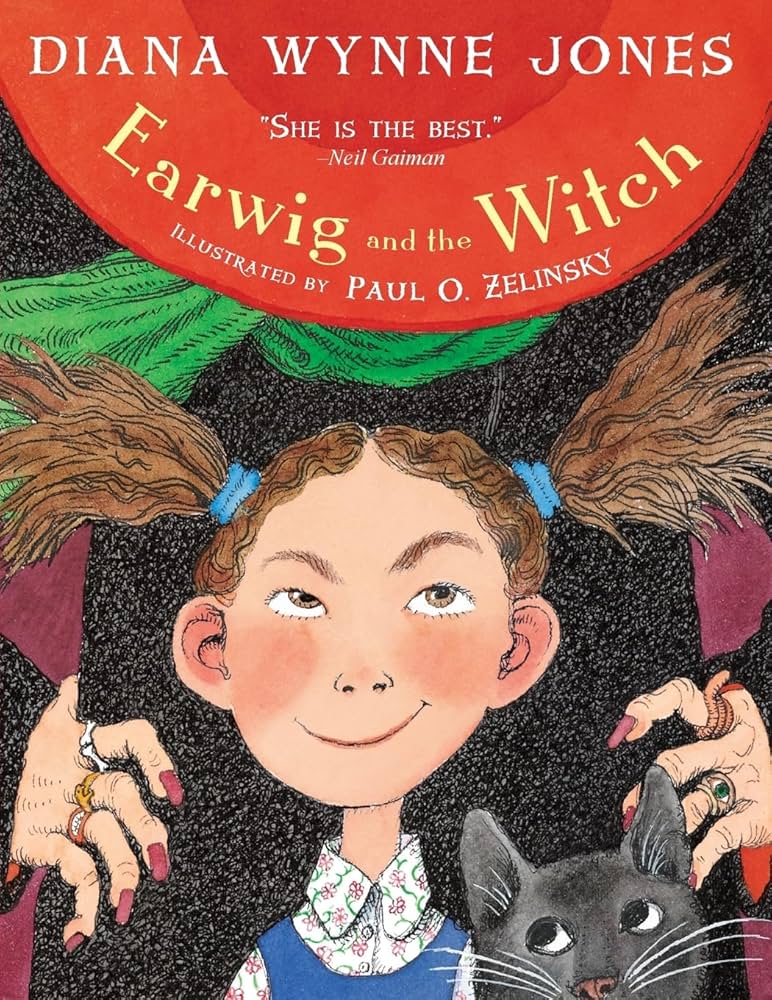
Earwig and the Witch by Diana Wynne Jones

Earwig and the Witch is a short novel by Diana Wynne Jones. This was actually the last novel written by the author, who is well-known for her books of fantasy and science fiction. This book is about a young orphan girl named Earwig who lives at St. Morwald’s Home for Children. Earwig is content living at the orphanage, so she is surprised when a peculiar couple visits one day and decides to adopt her. When she arrives at her new home, Earwig realizes that the couple is not even really human. Earwig is now living with a witch named Bella Yaga and a nine-foot-tall demon called the Mandrake. Bella Yaga immediately makes Earwig her slave, forcing her to do most of the work around the house. However, Earwig fearlessly accepts the challenge and adapts to her new surroundings in unexpected ways.

This book is quite entertaining and filled with many amusing surprises. I enjoyed the cleverness of Earwig and her ability to handle difficult circumstances with courage and resourcefulness. This book also has good illustrations by Paul O. Zelinsky. However, I was disappointed that this book did not live up to my expectations. I greatly enjoy most of the books of Diana Wynne Jones, but this one seems unfinished and lacking in details. The ending is quite abrupt. Also, I found the characters to be unlikeable overall, even though I was entertained by the Mandrake’s antics. To be fair, this book was published posthumously, so the author may not have been able to fully complete it. Despite its negative aspects, I find this to be an enjoyable book that just falls a bit short of its potential.

Earwig and the Witch by Diana Wynne Jones is available for checkout from the Mission Viejo Library.

Poached: Inside the Dark World of Wildlife Trafficking

Recently, I read a book called Poached: Inside the Dark World of Wildlife Trafficking. It was written by Rachel Love Nuwer, and it explores the illegal wildlife trade. Wildlife trafficking is  a crime that involves the illegal trading of animals, plants, and their products. I found this book both interesting and informative. 

In Poached, the author explores a variety of aspects of the illegal wildlife trade—literally! She travels to foreign countries such as Vietnam and China and interviews poachers, sellers, and buyers; exploring the issue of wildlife trafficking from all angles. This is a book that really emphasizes the human side of the issue. Nuwer focuses on individual people and their role in wildlife trafficking. Zooming in allowed me to get a deeper, more personal look at one of the world’s most profitable crimes. 

One thing I loved about this book is that Nuwer avoids oversimplifying the issue. While some may have taken a black-and-white approach, she treats the issue delicately and acknowledges the variety of factors that contribute to trade. Different financial and cultural aspects contribute heavily to wildlife trafficking. The fact that someone may participate in the illegal wildlife trade does not necessarily correlate with their individual character. For example, Nuwer speaks to a poacher in a rural part of Vietnam suffering from acidic water and soil, frequent fires, and low spirits. People in this area often make less than $1,000 a year. This particular poacher chose the profession due to the relatively high monetary potential in order to support his family. However, he does not enjoy his job. He often suffers from bouts of malaria and wishes he could do something else, “Eleven to thirteen dollars per trip [as a forest guide], and I’d quit hunting” (p. 21).

Overall, I would recommend this read to anyone who loves wildlife, is interested in conservation, or is just looking for an informative read.

Poached: Inside the Dark World of Wildlife Trafficking by Rachel Love Nuwer is available for checkout from the Mission Viejo Library.

The Black Pearl by Scott O’Dell

The Black Pearl is a novel by Scott O’Dell. The story takes place in a small coastal town in Baja California during the early 1800s. Ramón Salazar is sixteen years old, and he wants to become a pearl diver like his father. He learns about a mysterious black pearl that is believed to be the “Pearl of Heaven.” Ramón is obsessed with the idea of finding this pearl so that he can impress his father. After days of diving, Ramón finds a giant black pearl believed to be the legendary Pearl of Heaven. The pearl is extremely valuable, but it is also believed to be cursed because it belongs to an evil manta ray known as Manta Diablo. Ramón’s life is forever changed after finding the black pearl, and he must decide whether to keep it for himself or return it to the lagoon where he found it.

This book is filled with adventure and suspense. This is a coming-of-age story for the main character as he faces the challenges of his newfound wealth and the dangers it brings. This book warns about the destructive consequences of seeking riches and of being consumed by ambition. However, this book also teaches about the values of perseverance and courage. The characters are well developed and realistic, making the story vivid and engaging. I found the pacing to be somewhat slow, but this book is thought-provoking and rewarding. This may not be my favorite Newbery Honor book, but it is worth reading and could be inspirational for readers of all ages.

The Black Pearl by Scott O’Dell is available to checkout from the Mission Viejo Library. It is also available to download for free from Libby.

Jurassic Park 3 Review

I believe that this is an excellent movie for many reasons. I think the main reason why is because of the fact that we get to explore an entirely new island named Isla Sorna. In this movie, we see new dinosaurs like the Spinosaurus and the Stegosaurus.

I really like the plot since Dr. Alan Grant is tricked into flying in an airplane to Isla Sorna. While there, they hear a roar in the distance and board back onto the plane and fly away. During takeoff, the Spinosaurus comes running across the road and chips its back. This was an insane moment to see a large dinosaur right at the beginning of the movie. The group falls into a crash landing and land in a tree. The Spinosaurus comes and pulls the plane out of the trees and tries to eat the survivors. Luckily, they manage to escape.

While running away, they come across a T. Rex eating its food. I knew that from the moment the Rex came on screen, the Rex and Spino would fight. The Spinosaurus is my favorite because it absolutely DESTROYED the T. Rex. If the Spino could beat the Rex, what else could it do?

We later find out that the reason Alan Grant got called to fly the “tourists” in was to help them find their lost son. I like this part since it really adds to the suspense and drama.

The group travels the forests of Sorna and come across a bunch of eggs, Velociraptor eggs. In my opinion, the velociraptors are the most iconic dinosaur in the franchise since they make an appearance in almost all of the movies. Sneakily one of Alan’s friends steals a couple of eggs to help fund the digsite operations. The group has no clue he did this.

While on the search for the “tourist’s” son, Alan gets cornered by a couple of velociraptors. Then, out of nowhere, a green gas comes and a boy wearing a ghillie suit comes and saves Alan. It was the “tourist’s” son: Erik Kirby. I really liked his entrance into the movie. After a lot more dinosaur encounters, the group manages to save the “tourist’s” son and escape the Island.

All in all, I give this amazing movie a 5/5.

Jurassic Park III is available to check out from the Mission Viejo Library.

Leap Years: Syncing Time With The Earth

Imagine you ask someone how old they are, and they say they are 8 years old—yet their appearance says otherwise. This person looks like an adult somewhere in their 30s, especially with the presence of tattoos and the lines on their faces that reflect the harsh struggles of life. Believe it or not, this is real and applies to people who are born in Leap Years. A leap year is a year every 4 years when there is an extra day in February, in which rather than having 28 days in February, we have 29 days.

So, why do we even have a leap year? To dive deeper into this, we have to get a little scientific. Mostly everyone in the world knows that the planet Earth takes about 365 days to orbit around the sun. However, this is incorrect. The actual orbit is beyond 365 days—it takes 365 days, 5 hours, 48 minutes, and 56 seconds to orbit. This results in a leap year because every year, the calendar humans often use—the Gregorian Calendar—will start to sync out of place and slowly drift. This is why we have leap years. This extra day during the leap year, which is on February 29, actually helps sync our calendar back with our orbit so that we don’t experience winter earlier than usual, like in mid-October rather than December.

In conclusion, leap day is not only an essential part of our calendar system but it’s also extremely fascinating. It keeps our way of keeping time aligned with our Earth’s orbit so that it can be accurate and in sync, preventing significant changes in the world’s seasonal experiences. So the next time someone tells you they are 8 years old but look like they are in their 30s, you can easily assume they were born in a leap year.

Dumplin’ by Julie Murphy

Dumplin’ is one of the few novels that I’ve loved both the book and film-adaptation. In both forms, Dumplin’ depicts the raw feeling of proving one’s self-worth, not based on outward appearances, but based on one’s self-respect and confidence in one’s capabilities. While capturing the jealousy, insecurity, and self-fulfillment of a teenager navigating the superficiality of teenage social-status and norms of beauty, Dumplin’ also left me with a message that will be prevalent throughout my life.

Julie Murphy’s Dumplin’ captures small-town Texas teen Willowdean Dixon’s path to finally feeling comfortable in her own skin. Through Willowdean’s, or Will’s, narration, she illustrates how being overweight affects her relationship with her former beauty pageant winning mother, Rosie Dixon, and her conventionally pretty best friend, Ellen. Will’s mother, being obsessed with maintaining physical beauty, never pursues a close relationship with her daughter, leaving her sister, Lucy, Will’s aunt, to take her place as a mother figure. Both Lucy and Will bonded over their love for country star Dolly Parton, an affection she also shares with Ellen. Through their idealization of Dolly Parton, a figure of confidence and glamour, Lucy encouraged Will to value and love herself despite being overweight.

To me, this was the part of the novel that stood out to me the most. Dolly Parton’s music in the novel inspires and influences Will to achieve the best version of herself and to approach that moment with the highest level of confidence. Dolly’s influence enforces the idea of figuring out who you are and doing it on purpose. While Will struggles to accept her plus-size figure due to her constant comparison to Ellen, Will chooses to compete in her mother’s beauty pageant, forcing herself to discover what real beauty is.

Today, beauty is very subjective. How we define beauty differs between cultures and the kinds of societies we live in. In my opinion, beauty is not what is aesthetically pleasing to the eye, but the confidence and goodness that a person carries within. It’s true that confidence makes someone more attractive, but what makes someone beautiful is when that confidence is real and grounded in self-worth; it is when that confidence cannot be shaken by any form of social comparison or deprivation. One cannot find worth in comparing oneself to others.

Will finds her beauty in self-worth, fulfilling her aunt Lucy’s wishes and proving to her mother that there’s more to beauty than being thin. Will stops blaming others for judging her and making her feel less than and looks within herself to build that esteem to feel good about herself. Being overweight does not define her; only Will can decide what defines her and how that will shape who she is and who she wants to be in the end.

Dumplin’ by Julie Murphy is available for checkout from the Mission Viejo Library. It can also be downloaded for free from Libby.

Songs to get you into the Pop Girls

2024 has been one of the biggest years in music, almost every mainstream artist dropped a new album. With women dominating the awards ceremonies and charts in music, I thought it would be interesting to pick a song from different artists. A song that would help a person get into their music and understand their style.

Taylor Swift

Taylor Swift is arguably the biggest pop star in the world right now. With her record-breaking “Era’s Tour” and her 4th album of the year at the Grammy’s, she is at new heights in her career. I am a fan of Taylor’s earlier albums, especially when she was blending genres and making country pop/pop rock songs. “Haunted” from the album Speak Now is a beautiful song and a personal favorite of mine. The instrumentals include violins and rock-style guitars. The lyrics depict a relationship that haunts Taylor in her current life even though that person is long gone.

Olivia Rodrigo

Olivia Rodrigo is the next big thing in pop music. Her debut album of eleven tracks released three years ago is the most streamed female album on Spotify. Her thoughtful lyrics and 2000’s themed aesthetic, make her stand apart from other young up-and-coming artists. “making the bed” is a confessional ballad where Olivia discusses the issues she faces in her daily life. However, she admits that all her issues stem from her decisions. The instrumental is very simple but it also allows the message to shine through.

Lana Del Rey

Lana Del Rey, “The Queen of Alternative Pop”, is known for her iconic, unique vocals and 1950s Americana aesthetic. Her lengthy discography made one song difficult to choose. “Mariners Apartment Complex” is a romantic ballad about loving a person even though they have their own deeper issues and wanting to help them. Not only does Lana want to guide her lover through a dark time, but she wants him to do the same. This is not a typical piano ballad, the pleasant guitars coming in at certain parts of the song provide a hopeful tone.

SZA

As an R&B icon, SZA has cemented herself as a distinct vocalist and lyricist. Her switching between genres during different songs on a record allows a person to see how versatile she truly is. “20 Something” has a wonderful, ethereal instrumental like much of her debut album Ctrl. SZA sings about how she hopes her 20s won’t change her for the worse. SZA explains how she wants to keep the rest of her friends, which is a relatable feeling to growing up.

Ariana Grande

Ariana Grande is known for her incredible vocal range sung over trap beats. The song “in my head” from Thank U, Next perfectly sums up her music style. She belts out high notes that blend into the production, with braggadocious lyrics like “Boy, I invented you. Gucci tennis shoes, running from your issues”. Ariana is the typical IT girl and it is reflected on this song.

Billie Eilish

Billie Eilish is clearly the most unique artist from Gen Z. Her soft vocals and creepy production has become a signature. However, I personally find her best songs to have a more classical production. “TV” is a song about being so depressed you do not want to do anything except watch TV. The song has a gentle guitar instrumental, with heartbreaking lyrics like “I’ll stay in the pool and drown so I don’t have to watch you leave”. 

I hope you give these songs a listen and love them as much as I do.

Persepolis: The Story of a Childhood by Marjane Satrapi

In my English class, we read the graphic novel Persepolis: The Story of a Childhood by Marjane Satrapi. The French-Iranian author of children’s books, graphic novels, cartoons, illustrations, and films created Persepolis as a memoir of her childhood when she lived in Iran during the Iranian Revolution.

To put the Iranian Revolution in perspective, the Islamic Republic of Iran, a theocracy ruled by Ayatollah Ruhollah Khomeini, was founded in 1979 after a series of riots and demonstrations that overthrew the Shah of Iran. The Shah was overthrown for a number of reasons, including political repression, economic difficulties, and public dissatisfaction with his rule (such as unrest brought on by the Shah’s westernization of the nation).

At the age of 10, Marjane Satrapi was forced to transfer from a coeducational French school to a girls-only school during the revolution. She was also required to cover her hair because the new Islamic regime enacted a law that, for religious reasons of modesty and dignity, required women to wear veils in public. The veil is a powerful symbol in the story because it stands for feminism, identity, and the oppression of women in Iran. Other struggles her family endured, like the Iraq War and her uncle’s execution for opposing the Shah and holding communist beliefs, are also covered in the book.

In AP World History, I formally learned about the Iranian Revolution and the overthrowing of the Shah. Once I read the book, I realized that people actually lived through the revolution and had to undergo the harsh conditions and the changes the new Islamic Republic established. Some of my friends’ parents experienced the revolution and describe it as fearful and deadly, and its long lasting outcome as a royal disaster for the Iranian people.

Persepolis: The Story of a Childhood by Marjane Satrapi is available to check out from the Mission Viejo Library.

Happy reading!

– Sophia B