Globalization is all around us— our electronics, food, popular culture, literature, and much more are all the result of intermingling between many different countries across the world. Different cultures and people will continue to share spaces, creating diversity within our communities. The Mission Viejo Library recognized the need to understand and appreciate diversity, which is why they hosted their Diversity Circle event with Don Han on 4/7.
When I signed up to participate in this event, I was unsure of what to expect. Although I had participated in various diversity events at school, most of them consisted of students watching a powerpoint and being taught about how to be mindful of our differences. However, the Diversity Circle immediately struck me as different. I actually walked right past the event as I was trying to find it— the set up was like that of an intimate conversation, and I thought that a meeting was going on as a glanced through the open door. When I finally found my way in, I saw the seats arranged in a small circle so that everyone could hear each other as they spoke.
Our conversation started with the question of why we thought diversity was important. As we went around in a circle, I was impressed by the unique responses from each of my peers, some of whom I recognized and others whom I did not. As we took turns speaking, we passed around a small ladybug rock, which indicated whose turn it was to speak. Mr. Han explained how it was customary for whoever initiated the meeting (in this case, it was him) to place emotionally significant items in a small wooden bowl in the middle of the circle. One item that particularly fascinated me was a thin cloth that the men of his people would wear in a variety of different ways; Mr. Han had taken it with him when he moved to the United States.
One question that particularly struck me was about DEI (diversity, equity, and inclusion). Mr. Han asked us if we thought DEI was relatively new or if it had already existed for a long time, and for the first time, we respectfully disagreed with one another. We explored this topic as both a specific policy and a general concept about inclusion, with some of us asking about past civil rights movements and whether that counted as a form of DEI.
I am grateful for this opportunity to become a more educated and conscientious member of my community as well as to engage in meaningful conversations. For those on the fence, I encourage you to learn more about diversity!
Are you ready to shake up your summer with a refreshing twist? I love summer because of the abundance of fruits and vegetables that come with living in California. Imagine the perfect blend of juicy watermelon, zesty citrus, and hydrating coconut water in a harmonious symphony of flavors. That’s right, we’re talking about the ultimate thirst-quencher – the Watermelon Cooler! Whether lounging by the pool or having a backyard BBQ, this exciting concoction will add fun and brilliant color to any gathering. I love this drink’s refreshing, incredible taste; we make it when the fruits are abundant every summer.
Ingredients: – 1 large or 3 cups watermelon 2 Lemons or limes 2 cups of Coconut water Ice
Equipment:
Blender
Instructions:
Cut the Watermelon into chunks and remove any seeds.
Squeeze the juice of lemons or limes.
combine the watermelon chunks, lemon/lime juice, coconut water, and ice in a blender.
Blend until smooth and well combined.
Serve the watermelon cooler in glasses with some ice cubes and fresh watermelon for decoration if desired.
A couple of weeks ago, one of my youth group leaders talked about the book Gregor the Overlander. Since it is summer, I’ve been trying to find new books (and book series) to read. So, I decided to embark on Suzanne Collins’ series, TheUnderland Chronicles. This series starts with Gregor the Overlander.
Spoilers Ahead!
The book begins by introducing the main character, Gregor, an 11-year-old boy who lives in New York City with his mother and two sisters (Lizzie and Boots). Two years ago, Gregor’s father mysteriously disappeared without any word or trace. Most people believe that his father is an absentee; however, Gregor knows that his father will never leave his family. Because Gregor’s father is gone, he takes on many other roles, such as caring for his two-year-old sister, Margaret (fondly called Boots).
One day, Gregor evades his nosey neighbor by going to the laundry room to clean some clothes. He takes Boots with him so she can get out of the apartment. After dumping the clothes into the washer, Gregor discovers Boots has disappeared. He panics but then sees an open grate where Boots has fallen into. Gregor quickly climbs into the grate and falls. Little does he know that the open grate is a portal to the Underland, a mystical world.
After falling down the grate, Gregor is immediately abducted by life-sized centipedes. It is at this moment that he realizes this land is magical. Luckily, the centipedes (aka crawlers) are not evil and bring him to Regalia, the city where Underland humans live.
Gregor first meets Luxa, the 11-year-old who is to be crowned Queen. Her grandfather, Vikus, guides Gregor and his sister to the palace, where they will be kept. Later in the day, Gregor attempts to escape Regalia and go home. However, he is almost killed by the giant rats guarding the exit (the rats and humans are rivals). Fortunately, some humans (including Luxa, Vikus, and her cousin Henry) save Gregor and his sister from the rodents.
When the siblings return to the palace, Gregor finds he is entwined to a prophecy called “The Prophecy of Gray.” Through this prophecy, Gregor is supposed to save the humans of Regalia, who are endangered by their enemies, the rats. At first, Gregor refuses to go on the quest to fulfill the prophecy. But he learns that his father was captured by the evil rats. So, he decides to undertake the perilous prophecy.
The book continues with Gregor, Boots, Luxa, Henry, two crawlers, two spiders, and a peaceful rat going on the quest and eventually fulfilling the prophecy. Ultimately, Gregor and Boots reunite with their father and return home.
My Rating: 8.9/10
At first, I had doubts about this book since it was written for a younger audience. However, after reading this book, I can say it was worth the read. Suzanne Collins made the plot entertaining to read. Each page was full of fun twists and turns and made me anticipate each outcome of the prophecy. I didn’t expect the book’s ending, which pleasantly surprised me. Overall, this book was fantastic, and I highly recommend it to all age groups.
EPIC: The Musical is a concept musical loosely adapting the story of the Odyssey, the famous Greek epic. It has been fully released with 9 sagas, each featuring 3-5 songs, and the Ocean Saga is the third in line. If you haven’t listened yet, this will have spoilers – go check it out!
Storm The opening song, Storm is mostly setting up the rest of the saga. Odysseus and his crew are facing a torrential storm (go figure), but Ody spots a floating island. He asks Eurylochus to prepare the crew to throw harpoons at the island, hoping to latch on and escape. Admittedly, the plot hook of a storm is underwhelming compared to the previous threat of a cyclops, but it is catchy nontheless. I often find myself humming the main lines when it rains! The vocals of the crew echoing back Odysseus’s lines drive home how he is what is keeping the crew afloat, and how they all listen to him. (Which certainly won’t come back to haunt us later).
2) Luck Runs Out
In this, Eurylochus expresses his doubts about Odysseus’ plan. This song is fascinating as it delves into the mindset of both of the characters. Odysseus’ main trait is that he is cunning, a trickster. He has relied on his wits to get the crew out of all situations thus far. Eurylochus is above all else, practical. We saw this in Full Speed Ahead, in his introduction, where he proposes the crew take the more brutal, but efficient way of raiding the island. Eurylochus is worried about the fact that Odysseus is relying on nothing but himself, that he has no safety net to fall back on. “How much longer,” he asks, “til’ your luck runs out?” Odyssseus tries to convince Eurylochus under the mantra of optimism, but he doesn’t relent. In the end, Odysseus pulls Eurylochus to the side and reminds him that he can’t be opposing his plans. The crews voices, interestingly, echo Eurylochus instead of Odysseus here, showing that they share his doubts and fears and are siding with him.
3) Keep Your Friends Close
Odysseus has successfully made it to the island in the sky, and is now requesting the aid of Aeolus, the wind god, to help them through the storm. Aeolus proposes a deal – the storm will be put inside a bag and given to Odysseus. Now, he will be able to get through, but should he open the bag, his crew will be blown all the way back. Aeolus’ “winions” feed into Odysseus’ crew the idea that the bag actually has treasure inside, tempting them to open it. Despite Odysseus’ best efforts to dissuade the crew and protect the bag, the temptation is too great and the bag is opened – blowing the ship in the complete opposite direction away from Ithaca. This song overall perfectly accomplishes a light and bouncy feel in the first half contrasted with a deeper, dramatic tone in the second. Aeolus’ singer perfectly portrays the airy, whimsical feel of the wind god, and the segment where Odysseus has a dream perfectly serves to remind the viewer of what he is working towards – right before it is brutally ripped away. This song also deepens the growing divide between Odysseus and his crew, which has been a major theme in this saga. The usage of the flute perfectly suits Aeolus as well!
4) Ruthlessness
The usage of trumpets, Poseidon’s designated instrument, match his aggressive temper amazingly. Poseidon’s singer has some amazing vocals with growls and roughness that perfectly mature the brash nature of the god. Besides the musical aspect of this song, it also displays some important themes. The main conflict of EPIC: the Musical is the clash between the ideology of “Open Arms”, as referred to by Polites in the aptly named song, which is the idea that everyone should be treated with trust and kindness, versus the idea of Ruthlessness.
The Ocean Saga’s songs set up vital theme dominoes for the rest of the musical with their compelling instrumentation and devastatingly catchy lines. Next up: The Circe Saga!
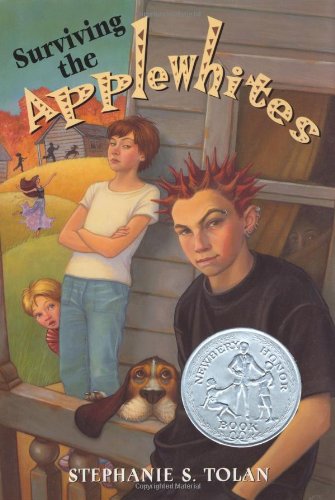
Surviving the Applewhites, by Stephanie S. Tolan, is about a troubled teenager named Jake Semple. Jake has a spiky red haircut and a reputation for getting kicked out of schools. He even burned down the last school he attended. Both of his parents are in jail, so Jake is sent off to live with the Applewhite family. The Applewhites run a homeschooling program, and they are very eccentric and unorthodox in their teaching methods. Most members of the family are immersed in some kind of artistic or creative endeavor. They tend to be very spontaneous and difficult to work with, and they enforce many rules that make it difficult for Jake to adjust to their lifestyle.
However, Jake begins to get along with one member of the family named E.D. Applewhite. E.D. is an intelligent and practical girl who does not have the same artistic preferences of her family members. She prefers structure and organization, so she does not fit in with the unstructured and impulsive nature of her family. As Jake and E.D. realize that they both struggle to get along with the family, the two of them begin to develop a friendship as they help each other to survive in the midst of all the chaos.
I think that the author does a great job of creating a cast of realistic and distinct characters that make this story very interesting and compelling. The internal struggles experienced by Jake and E.D. are very relatable for most people and their personal growth and ability to overcome trials over the course of the story is actually quite inspiring. This book teaches about the importance of discovering individual gifts and talents. It also shows the value of a home that nurtures education, and that sometimes unexpected people can help us to become our best selves. This book is also quite entertaining and humorous, making it very meaningful and enjoyable at the same time. I am homeschooled myself so I enjoyed this portrayal of a homeschooling family. This book definitely deserves its Newbery Honor award and I would highly recommend it to everyone.
Genuinely, WHAT is up with psychics and identity crises in anime? Is it just me? Not complaining, though.
|0%|
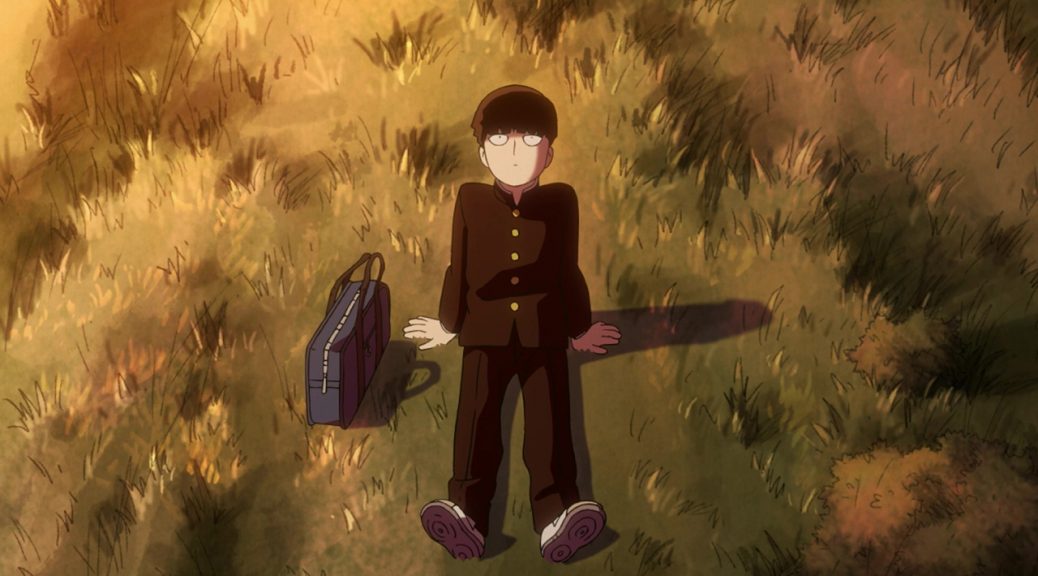
Mob Psycho 100 is, if anything, the strangest and best show I’ve ever had the privilege to watch. The show has an extremely unique animation style and an even more uncommon soundtrack, with both being clearly overshadowed by the non-archetypal, deep-yet-seemingly-unserious, and brilliantly-written characters who constantly subvert expectations and grow in ways that feel both bizarre and deeply human. Like, have you ever seen an anime with green outline art? Green?
While the show is genuinely hilarious at times, please, please, please don’t be fooled by the (if I must admit) goofy-looking art style and the comedy hashtag. Behind every joke is a bigger tear-jerker waiting to be unearthed and an even greater lesson to be learned. I’d be lying if I said this show didn’t teach me some of the biggest lessons I’ve ever learned in life.
|20%|
Shigeo Kageyama | Mob
Shigeo Kageyama, otherwise known as just ‘Mob’, looks no different than an average middle school boy who has absolutely no game (sorry, Mob). However, beneath his unassuming appearance and kind demeanor are intense, powerful psychic powers that he’s had since he was born. To keep from losing total control of his incredible power, Mob has grown into a young man who lives under constant emotional restraints– never angry, passive, and always surpressing his emotional burdens. He doesn’t have many friends and is embarrassingly weak with low stamina (with powers suppressed), and generally has no direction for the upcoming high school years ahead.
In order to learn more about his psychic powers and identity, Mob, since he was in elementary school, has worked as an assistant to Arataka Reigen, a con man and self-proclaimed psychic. Reigen Arataka is a businessman, liar, fake psychic, and most importantly, Mob’s best friend. He’s the owner of Spirits and Such Consultation Office and exorcises spirits with Mob (Mob is the one who does the actual exorcising). Although Mob is clearly more powerful (not to mention the fact that he’s the actual psychic), he sees Reigen as his master—someone who teaches him how to live as a kind, grounded human being, not as someone inherently ‘better’ than others just because of his abilities. In a weird way, even though Reigen constantly lies to everyone in his life, his genuine advice to Mob carries surprising depth and speaks to the audience in a way that feels personal and strangely comforting. I won’t spoil much about his character, but truly, their student-teacher relationship is one of the best I’ve ever seen. Even when viewed separately, I don’t think I’ve ever encountered characters quite like them.
(left to right) Mob, Reigen Arataka
|45%|
Mob Psycho 100 is, in a nutshell, half the best fighting scenes you’ll ever see (they lock in on the animation for all fight scenes, I swear) and half deep identity and character exploration, especially for Mob. The truth is, we’re all capable of change– change that helps us grow and see the world in a new light. This show is the epitome of that truth, even going one step further and teaching us how lucky we are to have people around us who help us grow.
Everyone has something going on in their life, and although how we choose to respond to our own issues is eventually up to ourselves, the most important fact is that there are people to support you along the way. You may not realize it right now, but eventually, there will be moments where you’ll sit there with people and think “man, I’m so happy right now”. I’ve come to learn this lesson after rewatching this show so many years after my first watch.
|60%|
Each and every single character in this show has their own form of struggles while navigating through life. Even though psychic powers seem to be a decently regular occurrence in their world and clearly not in ours, many viewers find at least one character relatable in the sense that they understand their worries and fears. Sometimes, even the characters’ actions might seem to ring a bell. They laugh, worry, make mistakes, make even bigger mistakes, before laughing about it all in the end. Quite literally, a main theme in the anime is the word ‘improvement’. After watching, I found myself wondering a simple yet complicated question: What do I want to do right now?
What do you want to do?
|80%|
Okay, we’re out of the heavy stuff! The show in itself is pure comedic gold. All the jokes are insanely original and require context, which in my opinion, is the best form of a good joke. It’s like the TikTok comments section but anime form.
As for the manga, I’ll start by saying that the art style is, well,
…right.
I’ll leave the description up to you.
It’s certainly unique. But that’s also what makes it so enjoyable to read. The original manga was written and created by One, who admitted themselves that they honestly suck at drawing yet still wanted to create a manga with their story in mind. However, Mob Psycho 100’s manga has a strange appeal through the simplistic art style itself, as seen in its fast rise to popularity over the years, giving it the well-deserved anime adaptation in July of 2016. From there, Mob Psycho has continued to grow in popularity up to this day with numerous stage plays, collaborations, and even a live-action adaptation.
As always, the manga provides more small interactions and details for each character. However, and this is another great thing about Mob Psycho, the anime studio Bones created the anime adaptation with a lot of intent and budget, therefore, they included all of the important and highlighted moments/scenes from the manga in the anime. Which (it shouldn’t be, but) is quite rare. I personally love both, but solely watching the anime is a great option as well.
If you love The Disastrous Life of Saiki K or One-Punch Man, this show is definitely for you. I’d say think 100x deeper than Saiki K but 100x more unserious than One Punch Man.
|90%|
I don’t know what to say. Mob Psycho 100 is, in my opinion, one of the best works I’ve ever seen. Contrary to what people often hear, it actually takes a lot to not judge something by its cover, anime included. So I won’t ask you to not judge this anime by its cover. But hey, I’m hoping that at the very least, this review can help you see Mob Psycho in a new light and that you learned something new about one of my favorite shows.
Now, your final question will probably be, what is up with the percentage sign? Well, throughout the entire anime, there is a percentage that appears flat out on the screen every couple of minutes, starting and going up from 0%. What it represents, however, I’m actually not going to tell you.
Yeah, it’s a cliffhanger. Sorry. I hate those. But how else should I get you to watch it?
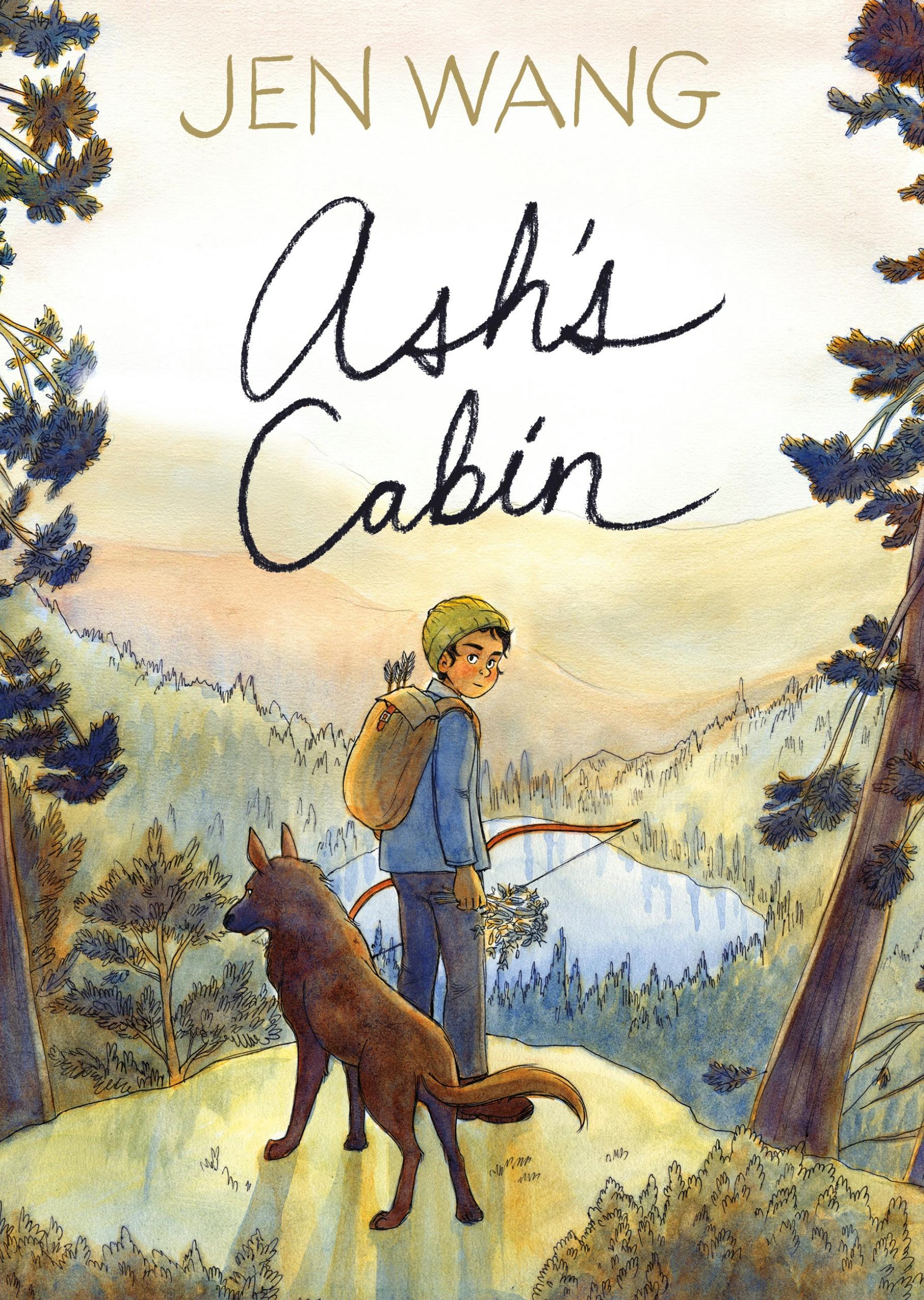
Ash´s Cabin, is a young adult graphic novel by Jen Wang, that follows the life of a teenager who flees to find isolation and independence away from home, after feeling that they feel misinterpreted and ignored by at home and at school. They learn to survive in the wilderness, and understand what it means to be alone.
When I started reading this book I could not remove my grasp from it at all, I finished this book in about just 30 minutes because I was so into it. I would say the illustrations of the book caught my eye the most, they are beautifully drawn with accuracy and detail that really elevate the written portion of the story into a better understanding overall. Reading this book, allows readers to understand the difficulty of growing up especially as a teenager, the transition from childhood to adulthood can be extremely challenging at times. A theme commonly shown and depicted throughout this novel is self-discovery, when Ash is alone at a cabin in the middle of the woods, they grow to become much more mature and independent as a teenager, understanding that it is difficult to live without people around you.
Overall, I would really recommend this book to anyone, especially teenagers as it teaches a lesson of the difficulty of this age in your life. I am looking forward to reading more of Jen Wang´s books, as the illustrations are really magnificent with much detail incorporated into it. Ash´s Cabin is currently available to checkout from the Mission Viejo Library today!
My Father’s Dragon is a short novel by Ruth Stiles Gannett. This book won a Newbery Honor award in 1949. The story is about the narrator’s father, Elmer Elevator, when he was a young boy. Elmer is talking to a stray cat one day when he mentions that he has always wanted to be able to fly wherever he wants. Upon hearing this, the cat tells Elmer about a young dragon who is being held captive at Wild Island. According to the cat, the dragon is forced to carry passengers across a long river. The dragon is cruelly beaten by his captors whenever he complains. Elmer realizes that if he were to rescue the dragon, his dream of flying would come true. He starts packing immediately and sets off on a perilous quest to find and rescue the dragon.
This book is thoroughly enjoyable and satisfying, despite its short length. I found it very easy read and understand, and Ruth Chrisman Gannett’s illustrations are extremely charming and well-done. The story is action-packed and moves at a very fast pace. At times it even felt a bit rushed and overly simplistic, to be honest. However, I can understand how this would be appealing to a young reader, and this book is certainly deserving of the Newbery award. I was entertained by this book and I think it is highly creative and imaginative. Older readers may not find this book appealing, but I would definitely recommend it to young readers and to anyone who enjoys children’s books.
Once referred to as the 9th planet of our solar system, Pluto’s atmosphere might completely disappear by 2030. Located in the Kuiper Belt along with debris of icy objects in the outer part of the solar system, Pluto, also known as 143430 Pluto, was discovered by astronomer Clyde W. Tombaugh in the early 20th century in an attempt to seek out the 9th planet. Tombaugh and another researcher in the Lowell Observatory in Flagstaff, Arizona, were able to rule out Pluto after using astronomical techniques to map out the approximate location of the 9th planet.
Excitement scrambled worldwide, and many people sought out potential names for the distant cold planet. So, they received more than 1,000 suggestions for the planet worldwide. However, none could compare to the suggestion of an 11-year-old girl named Venetia Bernie. She suggested that, similar to the Roman god of the underworld, Pluto, the planet was far from the sun, making it dark and mysterious. Also, the first two letters of Pluto correlated with the initials of Percival Lowell, who encouraged the search for Planet X, which we now know as Pluto.
For the next 76 years after the discovery and naming of Pluto, it was considered to be the 9th planet in our solar system. However, scientists began to speculate if Pluto should have that title. In contrast to the other 8 planets, Pluto was a small planet compared to the other planets. To put it in perspective, Pluto’s size is about two-thirds the size of Earth’s moon. Also, compared to the rest of the planets, Pluto’s orbit seemed unusual since it’s orbit was oval-shaped. Pluto, being so far away from the sun, has an icy composition that is mostly consistency of ice and rock, and it’s atmosphere is thin and made up of methane and carbon monoxide. However, what drove scientists to finally strip Pluto of the title of “planet” was when scientists discovery of a planet by the name of Eris in the Kuiper Belt. Similar to Pluto, Eris was a large body of ice and it was located on the outer part of the solar system. What was different however, was that Eris was much larger than Pluto, which caused speculations between scientists regarding Pluto’s title. After further discussion between astronomers, Pluto was demoted from its title in August 2006 by the International Astronomical Union and was reclassified as a “dwarf planet.”
Despite its demotion, Pluto’s legacy as a former planet has stayed significant and even helped scientists better understand the variety of celestial objects in the Kuiper Belt. Due to Pluto growing farther and farther from the sun each day, its icy atmosphere will eventually freeze completely, and Pluto will just be frozen and ejected to its orbit. However, some scientists theorize that Pluto’s thin atmosphere could completely disappear by 2030 and collapse. Though the dwarf planet isn’t as highly regarded as it was before, Pluto remains a celestial object of fascination that holds a special place with the public and astronomical science.
In today’s world, people are more and more commonly making career switches when they feel unfulfilled in their previous jobs. Although I haven’t entered the workforce and haven’t had to make this difficult decision yet, I imagine that I will seek to pivot my career in some shape or form.
To answer this question, I would have to consider what job would be enjoyable in the short-term, but what I wouldn’t want to have for very long. Dangerous yet high-paying jobs such as being an underwater welder come to mind, although I’m pretty sure that the PTSD I would get from risking my life would outweigh the salary benefits. If I were to hold a job for one day, I would want it to be enjoyable and risk-free, even if it meant that I wouldn’t earn much money. Then it hit me: professional sleeper.
Being a professional sleeper for a day is the obvious choice; I love nothing more than to come home and sleep after a long day of school and extracurricular activities, so why not get paid for it?
After doing some research, I’ve discovered more about this desirable position. Unlike typical 9-5 employees, professional sleepers tend to work as part of studies that can last from several days to several months. Depending on the restrictions of the studies they participate in, professional sleepers may work multiple “jobs” at the same time in order to earn livable wages, which range from $50,000 to $100,000+ per year. For example, NASA paid participants $19,000 to undergo a rest study for 2 months (although this study was less about sleep and more about how the body responds to prolonged weightlessness). Also, the sedentary lifestyle that many professional sleepers live may lead to health complications down the line. Healthcare professionals advise that remaining inactive for many hours a day, especially without intermittent breaks in between, can lead to greater disease risk (Park JH, Moon JH, Kim HJ, Kong MH, Oh YH. Sedentary Lifestyle: Overview of Updated Evidence of Potential Health Risks. Korean J Fam Med. 2020 Nov;41(6):365-373. doi: 10.4082/kjfm.20.0165. Epub 2020 Nov 19. PMID: 33242381; PMCID: PMC7700832.).
Considering the joy of getting paid for something that my body requires, I would become a professional sleeper for one day. However, I would want to seek a more fulfilling lifestyle and be more active, so I wouldn’t consider it for a long-term career. I think the perfect job would have a healthy mixture of relaxation and stress in order to promote positive mental health, but above all else, it would have variety in the tasks I would have to do. So now, I pose the question: what job would you have for one day?














 Mission Viejo Library Teen Voice