Dear Evan Hansen: Musical vs Book

Dear Evan Hansen is a story about an anxious high schooler, Evan Hansen, who spins himself a tale and convinces everyone of a fake personality and story he made for himself. Throughout the plot, he gets deeper and deeper into this false role he created, and he can’t find a way out without exposing himself as a fraud. This story had a musical, book, and movie adaptation. I’ll be comparing the musical and book without major spoilers for either.

The story started out as a musical by Benj Pasek and Justin Paul. It opened on Broadway in 2016 and was nominated for 9 different awards. The most distinguishable feature of this play is the life-like acting that Ben Platt utilizes in his role as Evan. He brings with him both depth and comedy, as well as a natural sort of awkwardness that comes with every high schooler. One of the key features of the musical is, of course, the music. Dear Evan Hansen shows a grand display of emotions and development through their musical numbers. A great example of this is in the song “Words Fail,” where Ben Platt shows the true devastation that Evan feels through his raw tone and intentional voice cracks. 

The book came a few years after in 2018, written by Val Emmich. The main story is the same, following the descent of Evan’s self-sabotage. But while the musical uses songs to convey emotion, the book uses internal monologue and description. Emmich goes more into depth about Evan’s mental state and personal thoughts. We get a glimpse into Evan’s anxiety disorder and how it affects his desicions and actions. Another major difference is how Connor Murphy– a large character in the musical– is more thoroughly fleshed out in the book. We get flashbacks from his perspective, as well as friends he had, his social life, and the mental struggles he faced. Personally, I liked this element of the book and how it elaborated on Connor, whereas in the musical we don’t get much about him as a person. Another main difference between the book and musical is the resolution. While the fundamental concept of the resolution is the same, the book cleans up a few more loose ends. Without revealing too much, Evan basically takes a bit more time to reconciles with people he affected.

No matter whether you watch the musical or read the book, both tell Evan Hansen’s story beautifully. Especially for teens struggling with anxiety or depression, Dear Evan Hansen is a message of honesty, belonging, and individuality. 

Dear Evan Hansen by Val Emmich is available for checkout from the Mission Viejo Library. It can also be downloaded for free from Libby.
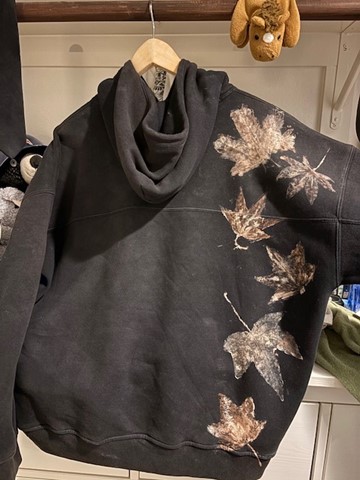
How to Leaf Bleach Clothes

It was New Year’s Eve, but instead of celebrating with drinks and parties, my cousin and I sat in a cold garage that stunk of bleach. To give some context, my cousin had been inspired by hoodies and shirts that had leaf imprints on them. We wanted to try it out using bleach. It took lots of trial and error to find an efficient and effective process. Here’s what we did:

Materials: Cotton clothing, Paintbrush (that you don’t mind ruining), Bleach or any cleaning solution containing bleach, Paper plate, Book or other flat and heavy object, Leaves of varying shape, Steam iron press, gloves, and a mask.

  1. Go outside or in a ventilated area. Cover the floor if you’re worried about stains, and put on your gloves and mask.
  2. Pour the bleach into a paper plate, start heating the iron, and lay out your hoodie. Decide on a layout for the leaves.
  3. Take your paintbrush and brush bleach onto the leaves. The more you use, the more vibrant the print will be.
  4. Press the bleached side of the leaf onto the clothing and use a book to flatten it; Do not smear and hold for about 10 seconds.
  5. Peel the leaf off and immediately press the iron into the bleached area of the clothing. This should bring out the pattern.
  6. Repeat steps 3-5 for the rest of the leaves. You can reuse leaves as long as they are intact. 
  7. Leave the clothing out to dry in the sun, then machine wash.

The result should be an orange-brownish pattern of leaves on the clothing with the leaf’s veins and texture visible. If any of the above steps don’t work, there are a few things you can try. First, make sure your bleach isn’t expired. Second, if liquid bleach doesn’t show on the clothing, try a pasty cleaning solution that contains bleach. We used a Soft Scrub cleanser and painted that onto the leaves. Third, check that your clothing is 100% cotton. This is how ours turned out– Happy bleaching!

Gleanings For the Hungry

Imagine being followed by the scent of peaches everywhere you went. That’s what it was like serving at Gleanings for the Hungry, a Christian volunteer camp in Central California. Their main goal is to feed both the physically and spiritually hungry through shipments of dried peaches and nectarines. These are distributed to poverty countries all over the world, along with excerpts of the Bible.

Our youth group went there in July. It was a 6 hour drive, and we would be spending 6 days there although it was open all summer. When we got there, I was immediately hit with the sulfurous fumes from their plant. The weather was oppressively hot, maintaining an average of 110 degrees all day.

We got settled into our cabins, which were separated by gender. Inside were 10 pairs of bunk beds, and we would be sharing with the other churches and families. Soon after, we went to the dining building to get an overview of how our day would be like. At 5 am, we would do 1 hour of field work before the sun came up. Then, we would work in 4 shifts of 2 hours in the plant, turning peaches for the machines and sorting out the bad ones. In total, 9 hours of work a day.

My week went exactly like that. Every day, we got up early to work our shifts, taking breaks in between to eat lunch or snack. After we were completely finished with the work shifts, we cleaned ourselves up. Everybody was splattered in juice and chunks of nectarine. Crickets hopped around the bathrooms.

After work, we had free time. We happened to be at Gleanings during National Slurpee Day at 7/11, so we drove there to get free slurpees. Other days, I mostly spent time in the game room, bonding with members from the other churches. There was pool, ping pong, and card games. You could go out to the volleyball and basketball courts to challenge your friends, or go swimming in the pool. Or, you could walk around the plot of land, hiking up the surrounding hills to see the view of the far away city. Towards the end of the day, we had dinner and chapel. I got to hear amazing testimonies from some of the Gleanings’ staff.

In total, Gleanings was a blessed experience. It was the subversion of my expectations that made the experience all the more worthwhile. I thought we would be exhausted and irritable after all our work. Not to be mistaken, we were exhausted, but our smiles were as bright as the sun.

If you’re planning on going, I highly recommend it. Especially if you’re on the fence about Christianity or you’re looking for a good service opportunity. Just remember to pack clothes you’re not attached to. After Gleanings, those clothes are not recovering.

McDonald’s at Midnight

It was 11:46 pm on a Friday night, the 26th of January. My family and I were coming home from some event and were far too exhausted to make a meal at home. My dad made the executive decision that we would be having McDonald’s for dinner. I had gotten a cheeseburger Happy Meal with chocolate milk, even though I was above the legal age of ordering one. The employees either didn’t notice or didn’t care. I wouldn’t blame them; they worked for minimum wage in a fast food chain, and night shifts were tiring enough without criticizing a customer.

My family and I took our meals to go, exiting the restaurant we had been to thousands of times in the past. Yet for some reason, I paused. I looked back at the restaurant. The sallow lighting behind the door highlighted the cheery yellows and reds of the interior, starkly contrasting the gloom of the night. Shadows cast by the awnings gave the gray concrete depth. The yellow arch glowed with backlights, a clear and familiar sight. I took a picture and hurried to catch up with my family.

Unbeknownst to me, I would spend the next four months driven by bizarre inspiration. I wanted to capture that eeriness and intrigue I felt that night through my paints. I sketched and smeared, staring at the picture for the minute details. The drainpipe in the wall, the orange permit sticker on the glass, the grids on the ceiling. I pestered my friend (an artist as well) with updates, asking for criticism and advice. Finally, on May 5th, I was content with my product.

My story just goes to show how inspiration can come from the strangest places. The world has cool things everywhere! You just need to look around.

Carpenter’s Performing Arts Center: A Performer’s Experience

In early March, La Paz Intermediate received an invitation to play at Carpenter’s Center in Long Beach, California. Our symphony orchestra would be playing alongside some of the best intermediate schools in California. Although it seemed like an ambitious goal, we were up for the challenge.

After months of practice, hand cramps, and heavily annotated sheet music, we were ready for our performance on May 19th. The performers’ entrance was clearly marked and easy to find, and each school was given a large space to warm up and tune. The hosting group was the South Coast Youth Symphony Orchestra, comprised of the most talented high school and middle school students in our area. They provided us with dinner and let us explore parts of the campus. Additionally, there was a room where we could watch the other schools perform on a TV. Obviously we were a bit judgmental of them, due to the competitive nature of teenage musicians. 

There were two schools performing before us: One of them was a band and the other was an orchestra. La Paz would be the last performing school with a combination of both band and orchestra. I was the principal viola player, so I would be seated near the very front of the stage. When our performing time approached, we were led backstage and given specific instructions of how to enter and exit. We waited in anxious silence for the orchestra before us to finish.

Finally, we went onstage. The auditorium was completely sold out— filled with supportive family members and other schools. Usually, we struggled to fit all our musicians in one space, but the Carpenter’s stage had more than enough room for everyone to spread out. After a few words of introduction from our conductor, Mr. Robbins, we began our pieces. We played four pieces, one of them being exclusively for strings and the rest played all together. The sound shells implemented above the stage drastically helped the quality of our music.

When the last note was played, we received a standing ovation from the audience. Mr. Robbins later said that it was probably the most applause he’s ever gotten for a group, which was impressive considering he’s been teaching for 31 years. Overall, it was an extremely unique experience that I am very thankful I was able to participate in. Even though it was difficult work, it was definitely worth it in the end.

Self Driving Cars: The Future of Transportation?

Cars have always needed drivers at the wheel; otherwise, they could not function. But recently, a new technology has begun to prove otherwise. The rise of self-driving cars has become a popular topic of debate. Ernst Dickmanns built the first model in the late 1980s. Only semi-autonomous cars are on the market today, while fully autonomous ones are still developing. Self-driving cars are a new technology that presents solutions and concerns.

Self-driving cars have many benefits and uses. According to SWARCO, a traffic technology corporation, “99% of all accidents are due to human error” (1). These include exhaustion, inattentiveness, or improper driving etiquette. Self-driving cars have technology that eliminates human error, which can prevent most accidents. Additionally, it helps transportation be available to people who can’t drive. Whether it be disabilities or age, self-driving can improve accessibility by driving for people who can’t. Autonomous vehicles can also help decrease traffic. With advanced communication between the cars, it can “improve traffic flow and increase road capacity” (SWARCO, 2). A benefit of self-driving cars is they utilize advanced and accessible technology.

 Besides the many uses, self-driving cars have problems and concerns. A car that always utilizes data and observation cameras is prone to hackers and other online viruses. This can put your safety and privacy at risk. Furthermore, if an autonomous car commits a traffic violation, “no real person can be prosecuted” (SWARCO, 4). Traffic laws must change to fit the presence of self-driving cars. Finally, the car program must learn to drive with humans safely. They have to be able to adapt to any sort of situation with human-driven manual cars. Autonomous cars still have some concerns that need to be addressed.

Self-driving cars do have their technical challenges, but they also have many benefits. Only time will tell if these cars are truly the future of transportation.

Zoos: Not as Ethical as They Seem

Hard, concrete floors and towering walls. That’s all most zoo animals may learn to see. Some were born free, but that freedom was ripped from their hands as soon as they were taken into a zoo. There are several debates on whether zoos are beneficial to wildlife, but the facts are clear. Misuse of money, poor animal wellbeing, and insufficient education are just a few reason out of several. Zoos are self-indulgent, and should not exist.

Zoos damage the physical and mental wellbeing of animals. Some of them are even driven neurotic due to extreme boredom. Readworks’ “Debate: Are Zoos Bad?” states evidence of “Monkeys and parrots ‘grooming’ themselves until they have no fur or feathers left.” This is unnatural behavior for animals. They are harming themselves because they have lack of nourishment, and it has taken a toll on their mental state of mind. Furthermore, most zoos do not meet the social and physical needs of the animals. Several of them even abuse the animals. National Geographic reports, “An animal welfare group has flagged hundreds of zoos affiliated with the World Association of Zoos and Aquariums (WAZA) for mistreating animals.” The WAZA is a trusted organization, and even within it are several cases of abuse. Keeping animals in such horrid conditions should be illegal. 

It doesn’t take long to find a zoo that cares more about the money than the actual animals. In fact, the Association of Zoos and Aquariums states that around half of the zoos in AZA are for-profit, meaning the money goes to benefit the government, not conservation. This shows that several zoos are just keeping animals as another way to earn money. Additionally, zoos that are not for profit spend more than 1 million dollars on a single exhibit, states article “Should We Have Zoos?” That money could go to preserving the actual habitat, instead of creating an artificial one. 

There are many arguments for zoos, but most of them are untrue. A common argument is that it helps with conservation to save species. But this is arguing for conservation sites, not zoos. An interviewed zoo conservationist on BBC asserts that the ideal zoos should be closed to the public. Instead of spending money on making it look appealing to the eye, they can use those funds for nourishment to the animals without the stress of visitors. Another frequent claim is that zoos help save endangered species. But it is proved that removing animals from the wild can further endanger them, due to the genetics not being as diverse. Financially, BBC states that only “4% of revenue goes back into conservation.” That’s hardly anything. Some pro-zoos say that it helps educate the public, but in reality, there is no significant change in behavior or interest in visitors, Britannica writes. 

Zoos do more damage to the wildlife than they do help. Several zoos care more about the profit than the actual animals, being shown with the poor living conditions, misuse of finances, and insufficient education that zoos provide. As time goes on, zoos continue to pose a threat to the environment, and one day, it will be the downfall to Earth’s delicate ecosystem. But instead of watching as zoos continue to harass animals, you could help make a difference! There are several petitions that you can sign to help take down zoos. Together, we can save wildlife. 

Most Popular Social Medias of 2023

2023, the year of technology. Where daily activities such as shopping, chatting, and reading went online and social media gained users by the masses. According to “Smart Insights,” about 61.4% of the world’s population used social media last year. So with the start of a new year and the end of a great one, it’s time to look back on some of the biggest social platforms used in 2023.

In sixth place, we have TikTok with an average of 1.1 billion monthly users. This addictive app hit 1 million users within a matter of just 200 days. The majority of its audience is 18-20 years old, but older age groups can also find entertainment in it.

At fifth we have WeChat, which is widely known in China as an “app for everything.” It has 1.33 billion monthly users. With its messaging function, video chats, games, mobile payment, location sharing and more, there’s no wonder it’s so popular!

In fourth, Instagram is a steady contestant with 2.4 billion monthly users. Most people have it as a secondary platform, though. Only 0.1% of people have Instagram as their only social media. But despite that, it’s still a great place to stay in touch with your friends!

WhatsApp is third! Because of its widespread use over 180 countries, it has about 2.78 billion monthly users. It is ranked number one as the most used messaging app in the world!

Second place is YouTube, a beloved platform for people all around the world. Users can make jobs from being content creators on YouTube. Not to mention it’s function of YouTube Shorts, which has bite-sized videos to enjoy whenever you’d like.

Finally, in first place we have Facebook. Although it has an older audience, people of all ages can enjoy it. Whether it’s seeing pictures of your grandma’s dog or your best friend’s birthday, Facebook is the go-to place for updates on people’s lives.

2024 is a new year full of new surprises. My predictions for social media will be that TikTok gains more viewers and makes it into the top 5, or maybe even top 3. Social media has come a long way, and I await its further development in the new year.

Spirited Away Movie Review

A little girl named Chihiro travels too far into an alluring village where spirits and creatures come to rest. She encounters a boy named Haku, who is human. He says he forgot his name and warns that if she does, she will never be able to return home. To escape this strange realm, Haku tells her to get a job at a spa house for spirits where humans work. She meets creatures of all kinds, finds love, and helps restore peace with her extraordinary courage. With all these fantastical experiences, does she still want to go home?

Spirited Away is an elegant, wondrous journey into the fantasy world of Studio Ghibli. Directed by the renowned Hayao Miyazaki, it’s no wonder that it’s considered one of the greatest animated films ever made. It has won many prestigious awards, including the Academy Award for Best Animated Feature Film and the Golden Bear.

This film teaches about the dangers of greed. While everyone around Chihiro seems to want money and fame, she just wants to protect the people she loves. In the end, her motivation outlasts the others, and she saves her family and friends. It also warns people against forgetting who they are. In the movie, the spirits call Chihiro different names to try and make her forget her real one. Despite their attempts, she remains confident in who she is and never loses sight of why she is there. I highly recommend this film to anyone who loves movies with intricate meanings and different interpretations. When every scene looks like a painting, it’s hard not to fall in love with Spirited Away.

Spirited Away is available to check out from the Mission Viejo Library.

Ordem Paranormal: Quarentena

Contains minor spoilers for the series

A virus has spread throughout the world. Unknowingly, you have just volunteered your life to stop it. Five teenagers are taken by an industry called Pancea, and it’s your job to stop this outbreak. With nothing much but a mistrustful guide, an unremovable glove, and a… hamster? You have to find the cause for this disaster and fix it.

Ordem Paranormal is a tabletop roleplay game series that features content creators from all over the world. We have Cellbit as the gamemaster, Baghera as Lucie, Quackity as Benito, Pactw as Diego, FoolishGamers as Jeffrey, and Roier as Luis. It is split into two parts: par tone, which took place online, and part two, which took place in Brazil in real life. The series is available on Youtube in English and Portuguese.

The scene starts out at an office in Mexico where Benito, Jeffery, and Luis sign up for the program. They’re not told much except for that it will help advance the future. A few of them are in it for the money, too. A similar scene is happening at the same time in Brazil with Lucie, Diego, a girl named Emi, and her dad. They are taken into a room and asked a few questions. Not even a few minutes later, both surveyor plant a drowsiness bomb and flee the room. All participants black out.

All of them arrive in a sweltering hot boiler room with a mechanical glove attached their left hand, and their right tied up. A stranger by the name of Micael hands them a key before running out of the room with no further explanation. After a few moments of Jeffrey consulting his pocket hamster, Wallace, they’re able to free themselves and flee the room. They’re met with a strange facility, where blood is stained everywhere and dead bodies litter the ground. The only thing going through their minds are “Where am I?” Micael is able to answer that. He tells them that a virus has spread all over the country, and that they’ve been blacked out for quite a while. The glove they have is the only thing protecting them from being infected too. Then, from around the corner, a disfigured creature stalks towards them. It has glowing, neon wires connecting human-like bodies together into an abomination. It moves jerkily, as if fighting for control. Little do they know, this isn’t the only one out there.

That is just the beginning of an entire series of incredible storytelling and jaw-dropping plot twists. If you’ve never watched a roleplay game, this is your chance. Personally, this was my favorite series out of everything watched, even out of professionally made movies. Cellbit’s ability to bring the player’s words to life plus characters you can’t help but root for make for one remarkable story. I fell in love with Ordem Paranormal, and if you watch it I guarantee you will too.