The Watsons Go to Birmingham 1963 Book Review

The Watsons Go to Birmingham 1963 is a historical fictional novel by Christopher Paul Curtis. It is set in the 1960s when segregation was still common in the Southern states, and the Civil Rights Movement was rising. The protagonist of the story, 10-year-old Kenny, finds himself in the middle of a traumatizing experience once he and his family drive from Flint, Michigan, to Birmingham, Alabama to pay Grandma Sands a visit. For those who like realistic fiction books, I think you’ll enjoy this novel, though I do have some likes and dislikes about this book.

Reading the synopsis at the back of the book, I thought that there was going to be more action—action like the riots that arose when peaceful protesters were attacked, or more racist actions against Kenny and his family. Kenny does live in Michigan, though, so there was less racism up there than down in the south. When the synopsis said, “toward one of the darkest moments in history,” I did think it was going to be more dramatic, leading to some slight disappointment that it was over so quick. And with the title being, The Watsons Go to Birmingham 1963 alsokind of surprised me that most of the book was spent in Flint.

Overall, the book had a really good story and plot to it. Christopher Paul Curtis keeps the book realistic and tangible. The reader can relate to and understand Kenny. He’s the underdog in Flint, tailing his older brother, and he does have some more adventures in Alabama. Though I thought the climax was a little dry, the experience did traumatize Kenny, which led to him having to develop strong character traits. All in all, I think this novel was well-written and enjoyable despite some minor disappointments.

Tangerine Book Review

A lie about to be exposed. The classic evil sibling. Justice finally served to a psychopath and his sidekick. Hooked? If yes, you should consider reading the realistic fiction novel Tangerine, written by Edward Bloor.

Moving from Houston, Texas, Paul soon finds his new home, Lake Windsor Downs, Florida, odd. Lightning strikes everyday at the same time, killing a high school football player. Navigating sinkholes, muck fires, and his older brother, Paul finds himself at Tangerine Middle School. He befriends his soccer teammates and overcomes the stereotypes they originally thought of him as he shows his loyalty and willingness to help, such as when he helps the Cruz family fight the freeze. This is when the citrus growers protect their trees from the biting cold, lest all their crops die, and their main source of income deplete.

Paul Fischer, the protagonist of the story, has worn extremely thick glasses ever since he stared at an eclipse for too long and went legally blind. That’s what his older brother Erik and his parents told him, though he can’t remember staring at the sun. Throughout the book, Paul gets flashbacks of past times that bring him closer and closer to the secret his family is keeping from him.

While most of us with siblings probably bicker or fight, or maybe you have rocky relationships with them, hopefully none of us are so scared of our siblings that we avoid them at all costs. Up until the end of the book, Paul is afraid of Erik. He sees Erik’s true nature, despite the star football kicker Tangerine County knows, or the Erik his parents believe in. Finally, after someone Paul knows is murdered, he screws up the courage to confront him. As Erik scoffs and skedaddles, Paul is hit with a last memory: one that reveals exactly how he lost his vision. Now, it’s time to have a chat with Mom and Dad. And the robbed homeowners. And the police. And have a third “first day of school.”

I really enjoyed reading Tangerine. Throughout the novel, there is a sense of there has to be more to it. Paul is an ordinary kid living in his big brother’s shadow, seeing more than anyone in both Lake Windsor and Tangerine. You see his character develop as he learns more about himself and his brother, and it’s great to see the underdog deal a critical blow to certain bullies. By the end, I felt really satisfied because you know how people have been hurt, but the rocky seas are starting to calm, and things are going back to normal. I also liked all the sweet symbolisms that add to the story, along with important lessons, too. Turning the final page, there’s closure felt all around, from Joey to Tino to Paul—who finally comes out into the spotlight, after fearing Erik for seven years.

Tangerine by Edward Bloor is available to check out from the Mission Viejo Library. It is also available to download for free from Libby.

Rivals By Tommy Greenwald

Rivals, by Tommy Greenwald, is a great novel for teens for love sports. Two star basketball middle school boys feel the pressure to perform: a pressure many playing at an elite level feel. It is totally relatable, and as an AAU basketball player, I can really sympathize with what each boy is experiencing.

For Austin Chambers, basketball is starting to feel like a job. He must deal with his father’s legacy and worries that he’s not good enough to live up to it.

Carter Haswell, across town, is brilliantly talented and stressed to stay on his school’s basketball team to help them win and get a scholarship for college to ease his family’s financial situation.

Carter and Austin’s schools are traditionally rivals, and competition between those two middle schools is fierce. Neither school wants to lose, and Carter and Austin each do whatever it takes to win. However, the competitive spirits go way too far, and a few players get seriously injured. Through this, Tommy Greenwald shows how it’s good to compete in sports, but not to let it escalate to the point where people get hurt. Winning shouldn’t be a priority over health.

By the end of the novel, Carter, Austin, and the rest of their teams realize the same thing: at the end of the day, these sports are supposed to be for fun. This is something important to keep in mind because whatever sport you play should be to have fun and be competitive. Austin’s dad also sees that his son just wants to play for enjoyment, and that he shouldn’t force his legacy on him. He lets Austin have fun at the park simply playing ball, and Austin feels like basketball is his friend once again.

This book was totally enjoyable and relatable. The reader can really connect with the characters and learn an important message: sports should be competitive, but never forget that they are supposed to be fun.

Rivals by Tommy Greenwald is available to check out from the Mission Viejo Library.

Christmas in Julian

Over the winter break, my family and I went on a weekend getaway to a small town called Julian, which is near San Diego and has a population of about 1,300 people. It’s a cute little town with really pretty Christmas decorations and delicious pie!

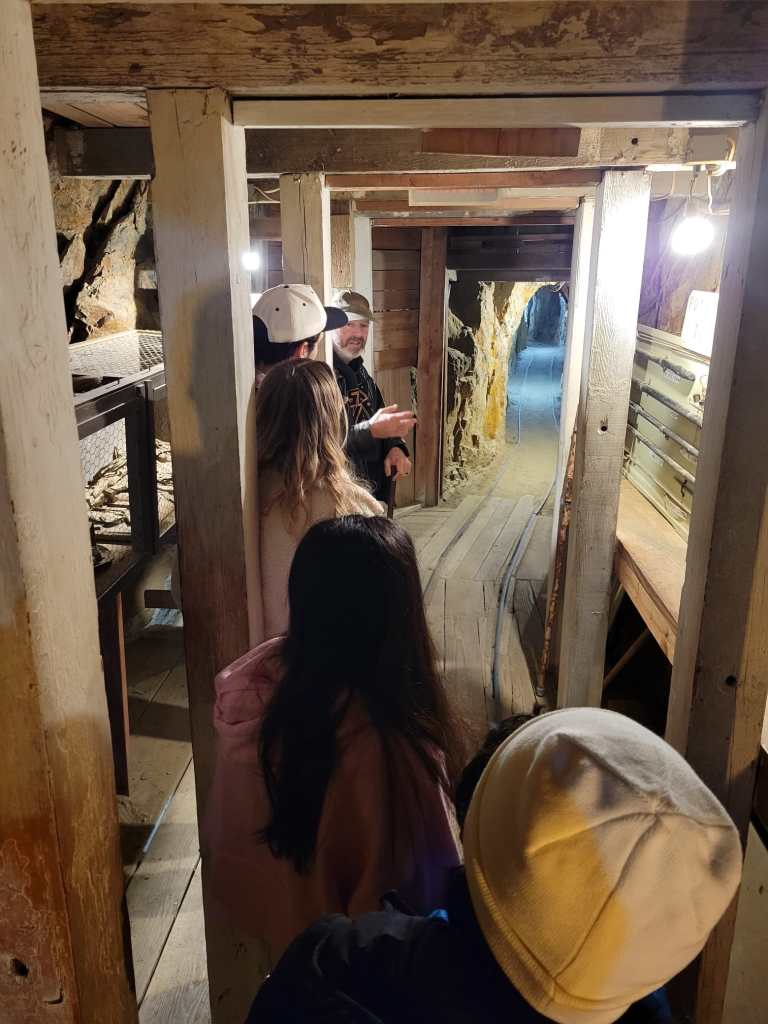
My family and I went on a goldmine tour in Julian, and it was a lot of fun. I learned many new things about the miners and how they dug up gold. The miners’ 1800s version of a head flashlight was a singular candle perched on nook in their mining caps. The gold diggers weren’t allowed to bring matches into the mine, so if his candle extinguished, he had to find his way out of the mine by groping in the darkness. IN PITCH-BLACK DARKNESS. When our guide turned off the lamps, we literally couldn’t see our hands an inch away from our faces.

At the end of the tour, we went to pan for gold. Our guide showed us how to get the gold dust and flakes to the bottom of the pan and get rid of the sand and water. I highly recommend going on the Eagle Gold Mine Tour if you ever go to Julian!

For the pie-lovers out there, the Julian Pie Company has the best pie ever. I myself am not even a pie person, but their pies are magical. My favorite is the mountain berry pie because it’s sweet, but also has that tart flavor. It has apples and mixed berries in it. Their original apple pie is sweeter than the mountain berry one and is absolutely delicious with vanilla ice cream. If you ever see a Julian Pie Company pie at a farmer’s market or grocery store, definitely add it to your shopping cart.

Going to Julian over the winter break was really chill and relaxing. Here are some pictures to really bring you to this charming town!

Nursery Rhymes and Their Darker Meanings

Last week, my social science teacher dropped the bomb for my class—revealing, as my friend said, “that our childhood has been a lie.” Ok, ok, that was a bit dramatic. All he really told us was that the rhyme “Ring Around a Rosie” was about the Black Death, which we are currently learning about. It was still surprising (and funny to see everyone else’s reactions) to find out that a rhyme we’d been singing since we were 3 years old was about people dying. “Ring around a rosie,” talks about the marks of the bubonic plague. “Pockets full of posies,” is about people putting flowers in their houses to clear the horrid smell, and the ashes is from the cremated people who died of the plague; “we all fall down,” is quite clear: people dropped dead with the terrible disease. Here are some other nursery rhymes and their meanings that my friends and I found out about as well.

“Jack and Jill” relates to the execution of the king and queen of France. Walking up the hill symbolizes them walking to the guillotine. “Jack fell down and lost his crown,” is about King Louis getting beheaded, and when Jill comes tumbling after, it’s Marie Antoinette following right in the king’s footsteps.

“The Muffin Man” on Drury Lane was not a kindly baker as shown in little kid YouTube videos. He was based on a 16th-century baker who reportedly lived on Drury Lane, but parents made that song to warn their children away from that street and man. According to urban legend, he was a child serial killer who lured children down dark alleyways to their deaths using muffins tied on strings.

Peter, Peter, pumpkin eater,

Had a horse but couldn’t keep her.

He put her in a pumpkin shell,

And there he kept her very well.

Peter, Peter, pumpkin eater,

Had another but didn’t love her.

Peter learned to read and spell,

And then he loved her very well.

This nursery rhyme is about a poor man named Peter who was married to an unfaithful wife. The story’s meaning goes two ways from here. One possibility was that he forced her to wear a chastity belt. The iron underwear was also called a pumpkin shell; it was locked, and only the husband had the key. The other interpretation of the rhyme was that he murdered her, cremated her, and then hid her ashes in a pumpkin. Neither way is very pleasant.

Though many of our childhood nursery rhymes sound innocent, most have a gruesome meaning behind them. The people who created these rhymes lived in a much darker time period, and this was their way of lightening the mood. Today, some 7th graders believe that “these should be in a sad adult book, not sung to 2 year olds!”