Unknown's avatar

About Oliver H.

I enjoy Earthbound, Chrono Trigger, Pikmin, reading books and playing piano.

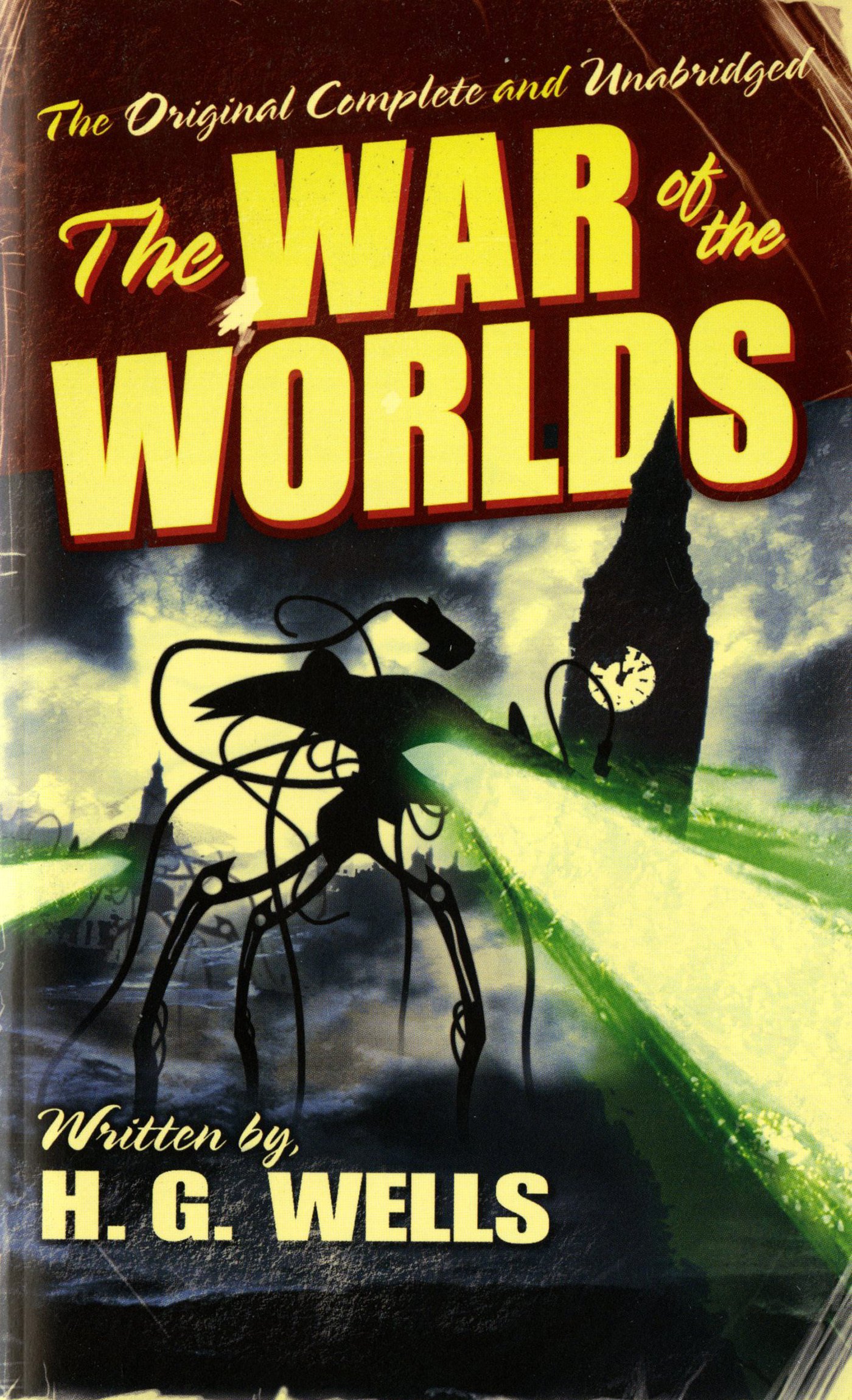
Book Review: The War of the Worlds by H. G. Wells

The War of the Worlds is a highly-influential science fiction novel by H. G. Wells.  The story seems to be set around the late 1800s.  When a supposed meteorite crashes near the narrator’s home, little to no suspicion is aroused.  However, on closer inspection, the object appears to be a huge, artificial cylinder.  Ugly, grotesque aliens emerge from the cylinder, only to retreat back inside.  A group of people attempt to greet the Martian visitors, only to be shot down with a heat-ray.  More and more aliens arrive, and it becomes apparent that Mars has plotted an invasion of Earth.

This book is one of the first science fiction stories of its kind.  It seems almost cliche now for a science fiction story to include an alien invasion, but this was one of the first novels to explore that concept.  The story uses many creative elements that seem ahead of its time, such as tripod-like alien fighter machines that shoot heat-rays.  In a strange way, I enjoyed reading about the humans’ pitiful attempts to defend themselves against the Martians.  The Martians possessed highly-advanced technology, which made it extremely difficult for humans to defeat them with traditional weapons.

I would consider this book a must-read for science fiction fans.  It may be one of the most popular and influential books of its kind.  It is written in a way that makes it seem like an actual historical event, which makes it even more thrilling to read.  Like many of H. G. Wells’ novels, the tone of this book feels dark but engrossing at the same time.  Some people may find the book a bit hair-raising and even frightening, but I enjoyed it thoroughly and would highly recommend it.

-Oliver H.

The War of the Worlds by H.G. Wells is available for checkout at the Mission Viejo Library. It can also be downloaded for free from Overdrive.

Book Review: The Wind in the Willows by Kenneth Grahame

The Wind in the Willows is a classic novel by Kenneth Grahame.  The stories in the book revolve mainly around a mole, a water rat, a toad and a badger.  These main characters, along with the other animals, are anthropomorphic.  They interact with humans and dwell in harmony together.  Mole is a gentle and timid creature.  Rat is quite practical and pragmatic.  Mr. Toad is exceedingly wealthy and boisterous.  Mr. Badger is elusive, but extremely wise.  Their stories weave together throughout the book.

Mr. Toad is particularly amusing.  One day, he brings along Rat and Mole for an exciting trip with his horse and gypsy cart.  Suddenly, a “motor-car” drives by and knocks the gypsy cart to the side of the road.  Mr. Toad is amazed by this new machine.  He becomes obsessed with the idea of acquiring and driving a motor-car.  This new obsession leads to many wild adventures, and many smashed motor-cars.  Things really get out of hand when Mr. Toad goes so far as to steal a motor-car.  He lands in prison for the crime, and finally begins to realize that his careless behavior has led to destructive consequences.  Still, his daring antics are quite entertaining.

Overall, I think The Wind in the Willows is a delightful book.  I loved reading about the little adventures of Rat and Mole, as well as the ongoing story of Mr. Toad.  I especially enjoy the differing personalities of each character and how they interact with each other.  The author incorporates various compelling themes, such as friendship, greed and redemption.  This is definitely a book that I would recommend to readers of all ages.

-Oliver H.

The Wind in the Willows by Kenneth Grahame is available for checkout at the Mission Viejo Library. It can also be downloaded for free from Overdrive.
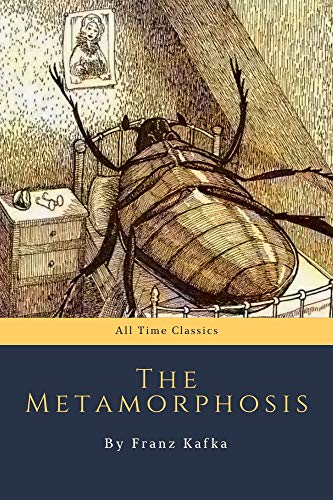
Book Review: The Metamorphosis by Franz Kafka

The Metamorphosis is a short story by Franz Kafka.  A young man named Gregor wakes up one morning and realizes that he has turned into a “monstrous vermin.”  His family is shocked to see him in this state.  Before long, they become angry with Gregor and treat him cruelly.  I was surprised that Gregor would be treated so harshly throughout the story, despite his unfortunate predicament.

This book is a short read, but very memorable.  Kafka offers an interesting perspective on human nature.  We see that people are capable of cruel treatment toward others who are different in some way.  At first it seems humorous to imagine someone turning into a bug.  However, reading the story I began to feel sorry for Gregor.  He seems quite miserable in his new state, and he is terribly mistreated and neglected as a result of his metamorphosis.  This story is a reminder that we ought to treat others with kindness, even though they are different.

-Oliver H.

The Metamorphosis by Franz Kafka is available for checkout from the Mission Viejo Library. It can also be downloaded for free from Overdrive.

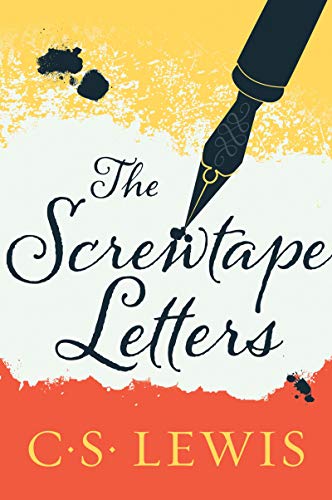
Book Review: The Screwtape Letters by C. S. Lewis

The Screwtape Letters, by C. S. Lewis, is a collection of letters written by a “devil” named Screwtape.  Screwtape is an important official in Satan’s realm, who refers to himself as “His Infernal Excellency, Mr. Screwtape.”  The letters are addressed to Screwtape’s young nephew, Wormwood.  Wormwood is a “junior devil” on earth, who is trying to tempt his “patient” into committing sin.  Each chapter is a letter of advice to Wormwood from his “affectionate uncle,” Screwtape.

I found this book to be very insightful and amusing.  I think it was very clever to imagine what words of advice one devil might give to another, as to how one might properly tempt a human into committing sin.  As it becomes clear that Wormwood’s patient is in danger of choosing good over evil, we see that the devil will stop at nothing to lead his patient astray.  We gain many insights into the devils’ tactics and methods of attack.  At the same time, I was amused by the dignified and affectionate tone of Screwtape’s letters, despite his evil intentions.  I also found it funny that one devil would have seniority over another, as though they aspire to positions of high status within their evil realm.

This book is a short read, but full of profound insights and witty observations.  From the devil’s perspective, we can learn a lot about human nature and frailties.  We can also learn about how to overcome evil tendencies.  This book offers a very unique and imaginative portrayal of the battle between good and evil.  I highly recommend it.

-Oliver H.

The Screwtape Letters by C. S. Lewis is available for checkout from the Mission Viejo Library. It can also be downloaded for free from Overdrive.

The Inimitable Jeeves by P. G. Wodehouse

The Inimitable Jeeves (also published as Jeeves) by P. G. Wodehouse is one of a series of books set around the 1920s, about a good-natured aristocrat named Bertie Wooster and his trusty valet, Jeeves.  Each chapter is a short episode in the life of Wooster, as he manages to get himself into all kinds of challenging predicaments.  Wooster is well-meaning and thinks he can manage problems on his own, but usually his ideas end in disaster.  Jeeves is very civil and highly intelligent, so he always finds a way to solve Wooster’s problems.  The stories are hilarious and I enjoyed this book immensely.

I especially liked a chapter in which Wooster tries to help a friend named Bingo Little.  Bingo is in love with a lady named Honoria Glossop.  Honoria has a little brother named Oswald.  Wooster’s idea is to shove Oswald off a bridge so that Bingo can dive into the lake and rescue the boy, to win the heart of Honoria.  When the time comes to execute the plan, Bingo suddenly decides that he no longer loves Honoria, so Wooster must attempt to save Oswald himself.  As a result, Honoria falls in love with Wooster instead of Bingo.  Jeeves comes to the rescue by triggering a series of events that cause Honoria’s parents to become very angry at Wooster.  The Glossops forbid their marriage and Wooster is saved from an unhappy union.

I also enjoyed reading about Wooster’s aunt, Agatha.  She is described as having a beaked nose and mostly grey hair.  She is very refined and proper, so she disapproves of Wooster’s lazy habits.  Aunt Agatha is always trying to convince Wooster to get married and to do something useful in his life.  She becomes very aggressive toward Wooster, from his perspective.  Wooster sometimes describes her metaphorically as “coming at him with a hatchet” or “polishing her hatchet at this very moment.”  Their interactions are always very amusing.

Overall, I highly enjoyed this book as well as the other Jeeves books that I have read.  Jeeves’ refined use of the English language is delightful to read.  I am always amused at Jeeves’ calm and gentlemanly demeanor even as Wooster gets into ridiculous situations.  No matter what happens, Jeeves politely addresses Wooster as “sir” and finds a clever way to get him out of trouble.  This book is a delight to read and I hope to someday read all of the Wodehouse books.

The Inimitable Jeeves by P. G. Wodehouse is available for checkout from the Mission Viejo Library.

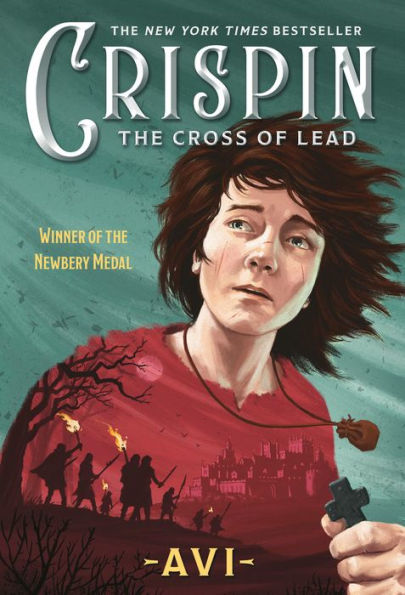
Crispin: The Cross of Lead by Avi

Crispin: The Cross of Lead is a Newberry award-winning novel by Avi. The story is set in medieval England.  The main character is an unnamed peasant boy.  His mother Asta is his only relation, so he is known simply as “Asta’s son.”  Life is difficult for him, especially under the command of John Aycliffe.  Aycliffe is a steward watching over Stromford Village while Lord Furnival is away.  Aycliffe is cruel and ruthless.  He accuses Asta’s son of a theft that he did not commit.  Forced to flee for his life, Asta’s son must escape the village.  Before the boy embarks on his journey, a priest finally reveals to him his name: Crispin.

I enjoyed this book. I found it to be fast-paced and enthralling.  I especially liked a character Crispin meets in his travels, named “Bear.”  Bear is a large, portly juggler who compels Crispin to become his assistant.  I liked how Crispin’s trust and friendship with Bear grew as they were pursued by Crispin’s assailants.  Crispin trying to avoid the people who accused him of theft was very exciting.  As a fugitive, he must keep moving to new places, which gave the book an adventurous and exhilarating feel.

I have also read the sequel to Crispin, and I look forward to reading the third book in the series.  The Newberry award seems well-deserved. The characters are well-developed and the story is quite gripping. Crispin is a fugitive throughout the book and his life is in constant danger.  I was excited to learn about Crispin’s true identity. I would definitely recommend this book.

-Oliver H.

Crispin: The Cross of Lead by Avi is available for checkout from the Mission Viejo Library. It can also be downloaded for free from Overdrive.
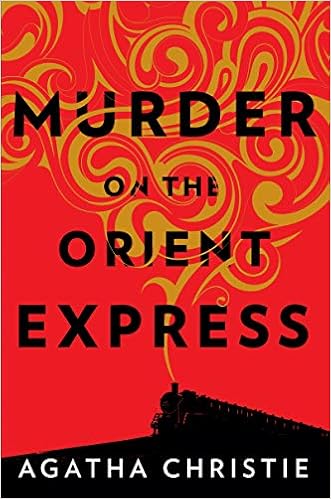
Murder on the Orient Express by Agatha Christie

Murder on the Orient Express is a mystery novel by Agatha Christie.  The hero is the famous detective, Hercule Poirot.  Poirot is described throughout Christie’s novels as a small Belgian man with an egg-shaped head and a distinctive moustache.  The novel is set almost entirely on a train called the Orient Express.  The train was on its way to London, but becomes stuck in the middle of the night due to a snowdrift.  The next morning, a man named Mr. Rachett is found dead in his bed having been stabbed multiple times.  Poirot, intrigued by the mysterious circumstances surrounding this apparent murder, puts the “little grey cells” in his mind to work.  In other words, as he always does, Poirot uses his brain power to solve the case.

One thing I enjoyed about this novel is that we have more suspects than most Poirot stories.  The various personalities made the story quite colorful and entertaining.  Many nationalities are represented, such as American, British, Hungarian, Russian, Swedish and Italian.  One of my favorite suspects is an old woman named Mrs. Hubbard.  She tends to ramble and rattle on about her daughter or anything else that pops into her head.  I found it amusing to read about the passengers’ interactions as they all claimed alibis to absolve themselves of the murder.  The victim seems to have had a very bad reputation, so many suspects might have been motivated to kill him.  This made it very hard to guess which suspect was the actual killer.

This is one of my favorite Agatha Christie books.  There are many characters to keep track of, which makes the story interesting and exciting, but the mystery becomes difficult to figure out.  The ending was quite surprising and different from other Poirot stories that I have read.  Overall, I found this novel to be quite thrilling.  I would also recommend Agatha Christie’s other Poirot books, such as Cards on the Table and The ABC Murders.  Hercule Poirot is one of my favorite characters, and I have enjoyed all of the Poirot mysteries that I have read so far.

-Oliver H.

Murder on the Orient Express by Agatha Christie is available for checkout from the Mission Viejo Library. It can also be downloaded for free from Overdrive.
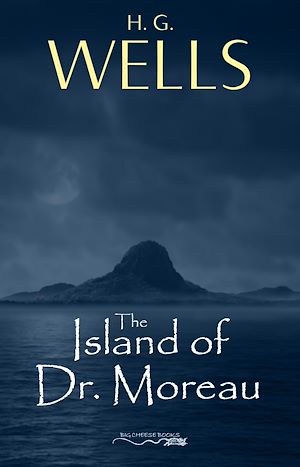
The Island of Dr. Moreau by H. G. Wells

The Island of Dr. Moreau is a short novel by H. G. Wells.  The narrator is a man named Edward Prendick.  As the story begins, we learn that Prendick was a victim of a shipwreck.  He is eventually rescued and brought to a remote island.  On the island he meets Dr. Moreau, a scientist specializing in a practice called vivisection.  Vivisection is a type of surgery conducted for experimental purposes, typically on animals, to view their living internal structure.  Prendick comes to learn that Dr. Moreau’s experiments are not just for scientific research, but that something mysterious is happening on the island.

This book is a quick read, but worthwhile.  This is classic science fiction.  We have a mad scientist who has been ostracized by the scientific community because of his unconventional ideas.  He flees to an island where he can conduct his crazy experiments without interference.  Even though this is a short novel, I think the characters are well-developed.  The author creates an ominous feeling as we discover the extent of Dr. Moreau’s madness.  I enjoyed reading about Dr. Moreau’s wild creations, even though the details are somewhat grotesque and disturbing.  The chilling tone of this novel might be a bit unsettling for some people, but I would definitely recommend this book to anyone interested in reading a thrilling classic.

-Oliver H

The Island of Dr. Moreau by H. G. Wells is available for checkout from the Mission Viejo Library.

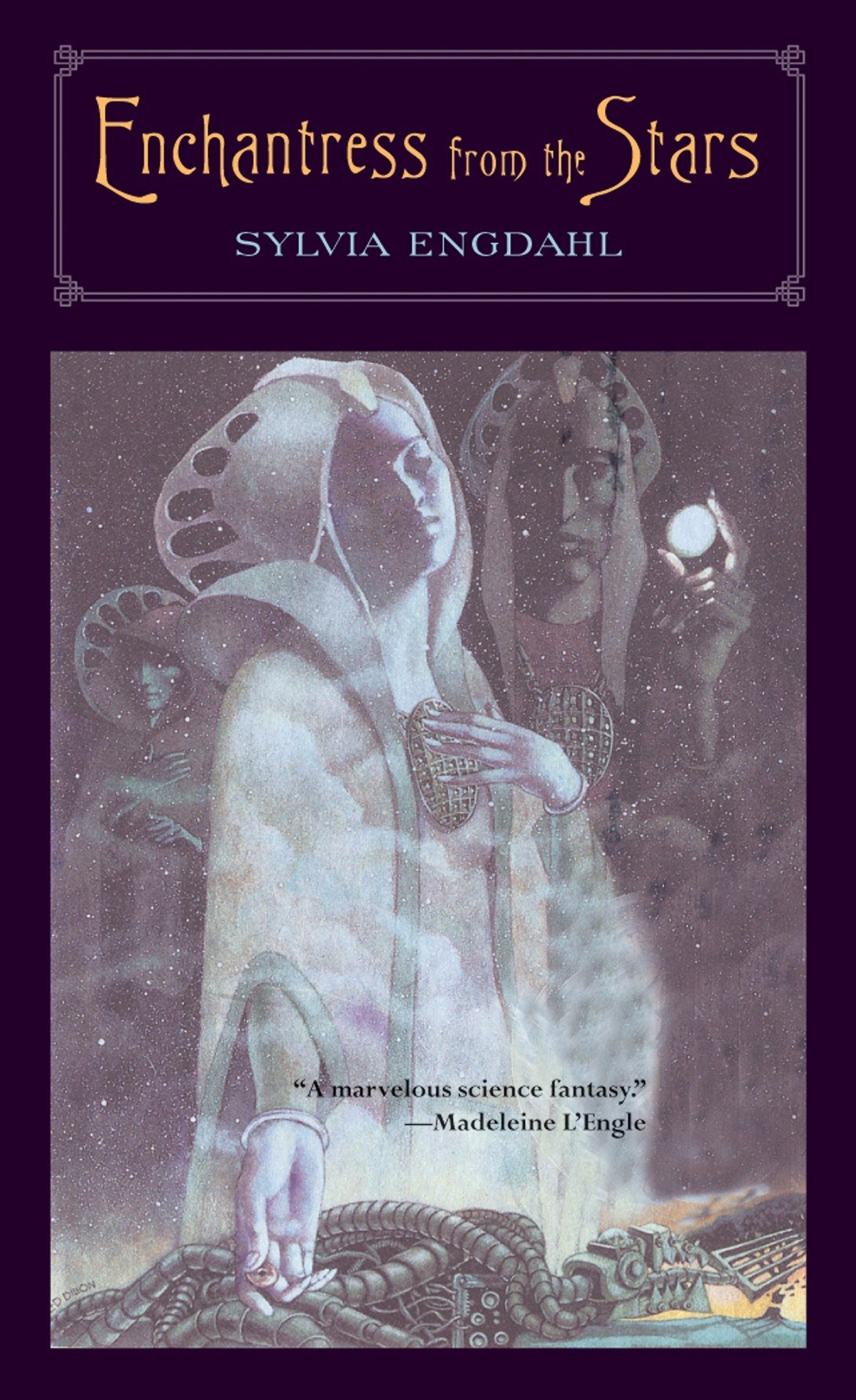
Enchantress from the Stars by Sylvia Engdahl

Enchantress from the Stars by Sylvia Engdahl is a science fiction novel about three groups of people from different parts of the universe.  Most of the events occur on a planet called Andrecia.  Much like Earth, Andrecia is the third planet from a yellow sun.  The native Andrecians live in a relatively primitive society.  A foreign group of colonists has invaded Andrecia, with the intent to conquer it.  These colonists are much more scientifically advanced.  A third group of people, even more advanced than the other two groups, has decided to intervene on behalf of the Andrecians.  These highly advanced people, including young Elana, attempt to empower the Andrecians to drive away the colonists.  Elana must do this without disclosing her true alien identity.  From the Andrecians’ perspective, she becomes the “Enchantress from the Stars.”

I enjoyed reading about how the three groups of people are similar in many ways, despite their differences.  They all seem to experience human emotions and a sense of morality.  However, they view science and technology differently.  To the Andrecians, technology is magic.  To the invading colonists, technology is a tool for conquering others.  To the most highly advanced people, science and technology are used for noble purposes.  This book is written in a way to help us understand these different perspectives.  The point of view alternates between the three groups of people throughout the book, making it seem like we are viewing the story from multiple angles.  For example, the language of the Andrecians seems old-fashioned and medieval, while the language of the colonists seems modern.  The most advanced people are even able to communicate by telepathy.  I found this multi-faceted writing style to be very engaging and insightful.  It was also exciting to see how these three perspectives blended together by the end of the story.

I thoroughly enjoyed this book.  I can understand why it won a Newbery Honor Award, back when it was written in 1971.  I find it interesting to think about what it would be like for people in a medieval period to interact with people from a more scientifically advanced period.  I would certainly recommend this book to anyone who enjoys science fiction.  I would also recommend this book to people who do not think they enjoy science fiction, because this book is about more than science and technology.  I think this book teaches valuable lessons about seeking to understand one another despite our differences.

-Oliver H.