
Whale Sharks: Underwater Terrors or Gentle Giants?

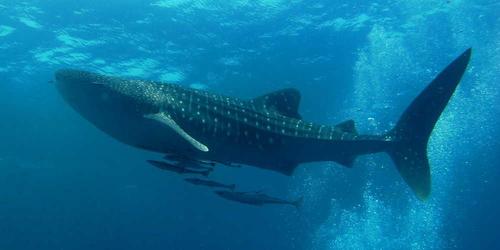
A whale shark swimming underwater with a group of smaller fish in the background.

Imagine you’re swimming far out in the ocean. You’re sitting on the edge of a kayak and something rough brushes your foot, with the texture of sandpaper. You look down and see an enormous shape, larger than a school bus, with white specks and stripes scattered on it. And it’s swimming right below you.  

The word “shark”, for most people, strikes a bit of uncertainty in their mind, maybe even some fear. But not all sharks have to seem like terrifying, man-eating giants. We present to you, the whale shark. 

Whale sharks are some of the largest fish in the world, and more specifically, the largest species of shark. They can grow to be up to 40 feet in size and weigh around 20 tons at full maturity, which is larger than the length of a school bus and over thrice as heavy as one.

To keep up with their extreme size, they have to eat a lot, too. They are carnivorous, but don’t worry, that doesn’t mean they eat people. A whale shark’s diet consists of plankton, krill, and small fish. They are filter feeders, so they swallow their small food and huge amounts of water, straining and filtering the water out.

Whale sharks travel around and populate tropical seas, out in deeper water and farther away from shallow areas. They are generally solitary, and have a very calm demeanor, allowing swimmers to interact with them.

They may seem like huge, underwater terrors, but really, WE might be the terrors for them. Every year, thousands of whale sharks are killed each year, through human disturbance, hunting, pollution, and bycatching. They are hunted for their fins, and are hurt through accidental capture.

To help, you can avoid whale shark products, contribute to reducing ocean pollution, and support and sustainable fishing practices. 

Why Do Birds Flock Together At Sunset?

Birds of a feather flock together. Though this phrase might not always apply to people, this applies very well to birds. When you are outside during the evening, as the sun sets, you might notice a swarm of birds chirping and gathering as they migrate in the sky. Adding to the nostalgic atmosphere as the sun sets and the day comes to an end, this swarm of birds, also known as a murmuration, occurs when a large group of birds, such as starlings, crows, and pigeons etc, gather together when the sun sets. The reason for their gathering together in these flocks, especially during the evening when the sun begins to set, is due to various reasons. One reason for this is due to the birds’ ways of living. In comparison to nocturnal animals such as bats, raccoons, beavers, etc, most birds are diurnal, meaning they are active in the day and sleep during the night. In the morning, most birds leave their nests and migrate in order to do their daily living activities, such as hunting, for example, and when the sun sets, the birds migrate back to their nests. When the sun sets, it’s a signal to the birds that it’s about to turn night and there will be no more daylight. For birds, this means the day is coming to an end, so they gather with other birds and flock back to their nests to rest for the day. They often do this in a large swarm, ranging from small groups of about 30 birds to large groups of about 100+ birds.  They gather together due to mainly due to one reason. Predators. When a bird is by itself flying back to its nest, it makes it easier for predators to target them and attack them; however, when birds are together in a swarm, it creates this black shadowed figure in the sunset sky, which makes them appear to be a large predator, deterring predators. In the winter, however, birds gather in flocks due to the cold. In the winter, the cooler temperatures decrease the temperature in birds. In order to stay warm, the birds typically gather in flocks.  In addition to this, the bird calls, which can be heard during sunset time, are the birds communicating with each other, communicating with each other that it’s time to go home. Thus, next time you see a bunch of birds flocking together during the evening, you’ll know the reason why!