AP Environmental Science Class Review

Let’s talk about AP Environmental Science (APES). The good news for anyone considering this course is that it’s among the most applicable APs in the real world. You’re learning about topics that genuinely affect your life, such as pollution, ecosystems, climate change, and how humans are destroying the planet (but also how we could fix it), rather than just memorizing facts for an exam.

The course itself combines problem-solving, policy, and science. Everything from biodiversity loss and energy use to food production and water resources will be covered. There are many debates concerning what is and is not sustainable, along with a small amount of biology and chemistry. It is definitely the easiest AP science course out there, though. You don’t really need much prior knowledge, and a lot of the course material that you do learn is totally applicable in real life, and most of the vocabulary words you learn you have heard of before in one instance or another.

Also, all the labs that we do are really fun! Think water testing, soil experiments, and possibly even some field trips if your teacher is cool. This class has some awesome labs and projects if you enjoy experiential learning. There’s this one lab that we did for the mining unit in APES. We kind of simulated that, but with cookies. We mined the chocolate chips out of the cookies and had to deal with the “environmental destruction” left behind—aka, the cookie crumbs everywhere. It sounds funny, but it actually did a great job of showing how mining works, from extraction to land reclamation. And yeah, just like real mining, the more you take, the harder it gets to put everything back together. Spoiler: The cookie never looks the same again.

Is it challenging? To be honest, it depends. The science won’t seem too overwhelming if you’ve taken AP Bio or AP Chem, but there is a lot of memorization required (carbon cycles, laws, various forms of energy, etc.). The AP exam’s free-response questions (FRQs) can be challenging because they require you to provide a clear explanation of a concept, but they are completely doable with practice!

But I wouldn’t worry about passing the exam, though. If you really take your time and think through each step and if you care deeply about the subject and want to learn more, I think you’ll be just fine!

Starter AP Classes to Take

When exploring classes to take, you will likely come across AP Classes or advanced placement classes. These classes are college-level courses that you can take in high school for college credit. While each test is different for every subject, most tests consist of multiple choice, free-response, short-answer, and essay questions. Tests are typically taken during May, and scores are released in July. AP tests are graded on a scale of 1 to 5, with 5 being the best. If you receive a score of 4 or 5, you can gain college credit.

One AP class that is easy and manageable is AP Human Geography. I took this class as a freshman (usually it is a freshman class) and thoroughly enjoyed it. I found that the content was straightforward and easy to understand; more significantly, it was interesting as well. In AP HUG, I learned about how humans are arranged and the ways in which they interact with others and the environment. At first, this class was challenging to me; however, later in the year, it became one of my easier classes. For me, the hardest part of AP HUG was the multiple-choice questions (compared to AP World they’re easy), and the note-taking which was long and extensive. However, if you diligently study and work hard in this class, you’ll fly through the exam. The multiple-choice questions can be tricky at first because many of them are stimuli and based on models. I believe I received a score of 72% on the first test from the MC’s. One tip that helped was doing test corrections and reviewing the things I got wrong. Although I did horribly on my first couple of tests, I did well on the exam–so don’t worry if you get a bad grade on tests. To conclude, this AP class is great preparation for future classes and an easy way to get college credit.

Helpful Sources

  • Mr. Sinn on Youtube
  • Crash Course Book on AP HUG
  • Princeton AP HUG book

The second AP class that I would recommend taking is AP World. Unlike AP HUG, World focuses on all of the major global events from 1200 AD to the present day. In comparison HUG hones in on the 21st century. Since AP World teaches students about most historical events, it makes the course difficult because there is much to remember. Additionally, the exam is made up of multiple choice questions, short answer questions, free response questions, long essay questions, and a document-based question (essay); this makes the extremely exam lengthy. Because the exam is long, it is difficult to remember all of the content. Another difficulty is that the multiple choice questions are challenging and have trickly answer choices. While you will face these hardships on the AP route, it will strengthen your test-taking skills + knowledge. You should take this class if you enjoy history and practicing writing skills.

Helpful Sources

  • Hiemler’s History on Youtube
  • Crash Course Book on AP World

AP Seminar: Recommended Class For Juniors!

Taking AP Seminar this year has helped me learn and investigate more deeply into a specific topic that I enjoyed. This class is unique from other classes I have taken because it allows you to collaborate with other people to research a topic that interests the whole group.

This class has also helped me develop skills for independent research such as developing the skills to create a research question and being able to narrow down the question into something that is more researchable.

Not only does this apply to real-world applications such as what is happening around the world currently, it also teaches you truly how to research, which oftentimes requires collaboration.

For those of you who get nervous while presenting, this class is for you too! Because this class is a research class, you first do the research, and then you present your topic.

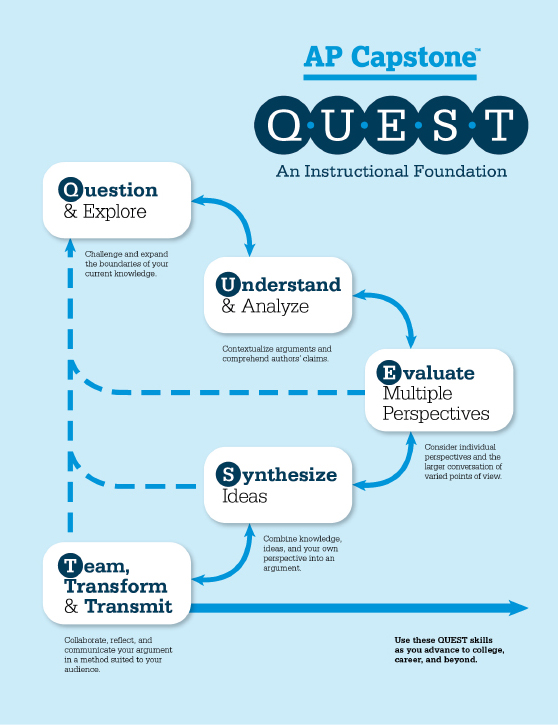
The first 4 months of the class are focused on writing your Individual Research Report (IRR) and a Team Multimedia Presentation (TMP). In these months, your group gets to choose a topic, spend time drafting an arguable research question, and then put that research into a slideshow. The IRR is written simultaneously while you are researching in which you put the different perspectives you researched into conversation with one another.

The second part of the seminar course is where you receive a packet of around 5 stories or articles revolving around a theme. This part is the independent portion and you get to draft your research question based off of the theme. Then, you write a report of your findings and make a 6-8 minute presentation on it by yourself.

This AP course, I believe, is essential for real life as well. In college, we’ll have to be able to research topics we don’t understand, and with this ability we learn in high school, we can better thrive in college.

AP Classes Review: World Literature

AP Literature is a crucial course most need to take for High school if you’re planning for early college credits. AP classes are rigorous classes, and the workload is heavy. In addition to classes, to get credit for college, students must take an AP exam at the end of the course. 

My experience so far isn’t bad, and I’m learning more while doing it. One of the standout aspects of AP World Literature in 10th grade was the diverse selection of literary works we encountered. Our reading list spanned centuries and genres, and this variety allowed us to explore different writing styles, themes, and cultural contexts, providing a well-rounded literary education. Each work presented its unique challenges, but they all contributed to expanding our academic horizons.

The discussions in this class were vital to getting good grades. Our teacher encouraged us to analyze texts from multiple perspectives and encouraged our critical thinking. These discussions helped us grasp the intricacies of the literature and improved our communication skills. The ability to articulate and defend our interpretations was a valuable skill we will need throughout the year. 

The workload is challenging, but it was worth the effort. Writing essays on complex literary topics is essential. Our teacher provided constructive feedback that will continue to help us grow as writers, and the assignments were created to delve deep into the texts.

One of the most valuable aspects of AP Literature was its ability to teach us to appreciate the subtleties of literature. We learned to uncover symbolism, dissect themes, and recognize the artistry in the writing. AP Literature is a fun but overwhelming course, so prepare for a lot of work if you decide to take it. The benefits here are that these classes prepare you for the workload and develop college-level academic skills. AP classes also look good on your transcript since they boost your GPA and save time and money from taking general college requirements. If you decide to take AP classes and love reading and writing, I highly recommend taking AP World Literature. 

Before deciding, you can also check these sites for the benefits and disadvantages of AP classes. 

examstudyexpert.com/easiest-ap-classes

princetonreview.com/college-advice/ap-classes

https://blog.collegeboard.org/3-reasons-take-ap-exams

Bella H.

AP Human Geography Tips

I know the first semester just finished for high schoolers and college students so I guess I wanted to give some more AP advice, at least for classes I took last year as a freshman.

If you are a freshman taking AP Human Geography like I was last year, here is what you need to know: Be prepared to read more difficult and complex texts and answer college board questions that require much more thinking than middle school social science classes. Additionally, there are also 3 FRQs (Free Response Questions) that you have to answer in one hour and fifteen minutes, which leaves you around 25 minutes give or take per question. You can find samples on the AP college board by searching “AP human geography college board frqs”.

The practice questions on the college board (the ones the teachers assign you) are very helpful. They are AP-style questions with 5 answer choices (A-E) per question. These questions come with two basic styles. One is set-based, usually with a stimulus such as asking you to analyze a map of Africa or a table for developing vs developed countries. The other style is just individual concepts that they can ask you that you would have to pull from your own knowledge, with no additional information.

This class is an introductory class to college geography, so a lot of the units are on the analysis of maps and applying that knowledge to understand how the migration of humans affects our geography. Also something to note: You need to memorize a lot of the key terms! I recommend buying the AP Human Geography Flashcards from the Barron’s company (the one with 250 terms). I reviewed this the night before my AP exam, and it was really helpful with locking in on key concepts one last time.

Although many freshmen say that the class is difficult (this is true as it is indeed your first AP class), however this experience can also be really fun as well. It teaches something you don’t normally learn, and you get to learn about the different countries of the world. I don’t know about you, but I have always found the evolution and migration of humans a very interesting topic.

Don’t worry, you guys will do great! – Aleena

AP Studying??

AP test month can be one of the most stressful periods in your entire high school career. Unlike regular tests AP exams demand a year’s worth of information from you. The best way to handle the overwhelming stress is to be prepared for what is coming. I have taken many AP courses and have found some of the more efficient ways of studying along with the methods that are not beneficial. 

Perhaps the most important variable to consider when studying is making a clear cut schedule for studying that aligns up with your AP test day. For example, for history or science based tests designating a certain time block to study each unit a day is very helpful. Personally, about a month out from my AP world exam I started studying half a unit every single day. This way revisiting information is not overwhelming when test time comes. 

Now that you have a set time for studying it is very important how you spend that time you have created for yourself. I have personally found that simply rereading a textbook and labeling that time spent as studying is not efficient when trying to remember information from an entire year. If you are someone who enjoys using notes to study rather than just rereading them add an extra layer. First look at the topic for the section and try to recall all the information you can about that topic. Next read the page/pages of notes. Lastly, and most importantly, outloud recall all of the information that you just reread without looking at your notes. Doing so stimulates your brain to try and read the information rather than simply forgetting the info minutes later.

When studying for history and science based tests there is so much information that no one can remember every single detail. So, when reviewing try to focus more on patterns that you recognize or different relationships. It is important to remember the college board does not just test you on verbatim facts that you have learned. The test evaluates you on different thinking processes so you have to be able to understand different relationships between time periods or scientific concepts. 

Now for the English based tests such as AP Lang one of the best tips I got was to focus on the News. At first I did not understand how this would be helpful. But, for some AP tests you must write papers where evidence comes straight from your brain, no documents. On these occasions you have to think of different important events in history to make your argument. Therefore, listening and keeping up with the news a month before testing seasons can provide you with great relevant evidence to incorporate into your essays. 

For some people, the hardest part of preparing for such a demanding test is getting the motivation to actually sit down and review. For these people, I recommend getting a study partner. As cheesy as that sounds it can be beneficial for those lacking motivation. Having someone that is supposed to study with you every day holds both your partner and yourself accountable to actually reviewing. Your partner does not need to be studying for the same AP, but having someone who is also preparing can force you to sit down and just begin. If you have a close friend you can study over facetime or at the library(considering after COVID). Other ways are finding study discords servers or zoom servers that are offered online where you can study with other people with the same goals as yourself. 

-Lily G.

Reviewing Advanced Placement Classes

As the we approach Spring Break, the long awaited and very much dreaded AP season has begun. It’s time to bring out the Princeton and Barron’s review books and cram the last eight months of knowledge into our brains. As a high school junior, those feelings of stress, panic, and anxiety that accompany the months of April and May have become very familiar. I have taken a total of eight Advanced Placement classes, four of which I am currently taking. As the school year comes to a close and incoming students are deciding on their course selections for the following schools year, I would like to review some of the Advanced Placement classes that I have taken in hopes of aiding some of you in your decisions.

Human Geography

This class was by far the most eye-opening and useful AP class that I have ever taken. I took this class my freshman year, as most students do. This course is the foundation for all AP history courses. So, if you’re thinking about taking European, United States, or World history, I would highly recommend taking Human Geography. The books used for European, U.S, and World History assume that the reader has taken Human Geography or has knowledge of the terms and concepts that are central to the course. All in all, this class was super interesting and was fairly easy. The AP exam is one of the easiest that College Board offers since it is mostly taken by freshman. If you are an incoming freshman and want to try out AP classes, I would highly recommend taking Human Geography.

European History

European History has been my favorite history class so far. Not only is the history of Europe itself extremely fascinating, but I had an excellent teacher. Unlike U.S. history, the time periods and units in the European History are easily distinguishable and easy to remember. The course covers a variety of areas, including a study of European art and literature. Because the course has a strong emphasis on European art, I would highly recommend taking Europe History in the same year as Art History. The two go hand in hand and expand on the curriculum taught in each course. Because of he Documents Based Question, Long Essay Question, and Short Answer Questions, European History is definitely a huge step up from Human Geography. I enjoyed the challenge that it presented; however; if you’re not a fan of writing and reading, I would not recommend this class. Due to the pandemic, I did not take the European History exam as normal. Instead, we were given a single DBQ, which was fairly. Overall, I would recommend this class if you like to read, write, and are excited about history.

Art History

Art History was a very interesting class. My teacher formatted the class very differently from most art history teachers; however, his method was much more engaging and fun. To be completely blunt, I am not artistically inclined and have never been. I’m sure others love to appreciate art for its beauty and meaning, but I found the material somewhat boring at times. I felt that this class was somewhat useless for me. On the bright side, I can now identify works of art when I am out in public and can tell you the school of art, artist, and the materials that the artist used. I would recommend this class to anyone looking to boost their GPA or to those that need to fulfill their VAPA requirement but are artistically challenged. It is a fairly easy class that mostly requires memorization.

Chemistry

AP Chemistry is by far the hardest class I have ever taken. Up until this class, there had never been a class that I truly thought was impossible at times. Although it may seem impossible, AP Chemistry is totally doable with great deal of studying and hard work. I would recommend this class to those that are more mathematically and logically gifted. If you performed well in Honors Chemistry and are looking for a challenge, I would definietly recommend this class; however, do be warned that Chapter 17 is horrible.

Spanish Literature and Culture (Spanish 5)

Unlike Spanish 4, this class is primarily reading and writing. Basically, every week, we are assigned a new story, discuss the story, respond to questions, and write and essay on the story, all in Spanish. I would recommend this class to you if you have very strong skills in Spanish, specifically in writing and reading. As the year progresses, the stories become increasingly more challenging and complex in language and meaning. Even as a Spanish speaker, sometimes these stories seem a bit difficult to comprehend. However, if you dedicate time to understand these stories, you can definitely do well in this class.

All in all, I have had a great experience with with Advanced Placement classes and would recommend them to anyone looking to challenge themselves. They are a great way to learn, obtain college credit, boost your GPA, and look great on transcripts for college applications in the future.

-Yvette C.