
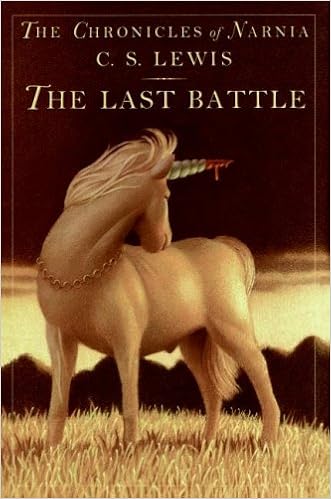
The Last Battle by C.S. Lewis

The Last Battle, by C.S. Lewis, is the final book in The Chronicles of Narnia series.  This is my favorite of the seven books in this fantasy series.  The world of Narnia is in danger because of evil characters roaming the land.  The most important character is Aslan, the lion.  Aslan is the true king of Narnia, but he does not appear for much of the book.  A wicked ape named Shift and his followers plan to use an imposter Aslan to gain power and control over the world.  They use the name of Aslan to convince people in Narnia to serve Shift.  For much of the book, there is a battle between people who believe in the real Aslan and people who are deceived by Shift and his followers.  Later in the story, the real Aslan appears and helps the people in Narnia who believe in him.  Finally, Aslan reveals his true identity and leads his people to his country.

Aslan is my favorite character in the series, and I really like this book because we learn more about his true identity.  I also enjoy this book because of all the action, as good characters battle against evil characters throughout the story.  This book is very exciting and filled with suspense.  There are many villains in this story, which made it very interesting.  I was surprised by the ending, but it was a rewarding conclusion to the series.  I would highly recommend reading the other books in the series before reading this book.  The Chronicles of Narnia is one of my favorite series of books and I would recommend them to everyone.

-Simon H.

The Last Battle by C. S. Lewis is available for checkout from the Mission Viejo Library. It can also be downloaded for free from Overdrive.
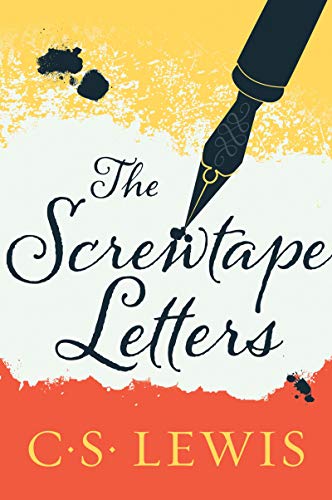
Book Review: The Screwtape Letters by C. S. Lewis

The Screwtape Letters, by C. S. Lewis, is a collection of letters written by a “devil” named Screwtape.  Screwtape is an important official in Satan’s realm, who refers to himself as “His Infernal Excellency, Mr. Screwtape.”  The letters are addressed to Screwtape’s young nephew, Wormwood.  Wormwood is a “junior devil” on earth, who is trying to tempt his “patient” into committing sin.  Each chapter is a letter of advice to Wormwood from his “affectionate uncle,” Screwtape.

I found this book to be very insightful and amusing.  I think it was very clever to imagine what words of advice one devil might give to another, as to how one might properly tempt a human into committing sin.  As it becomes clear that Wormwood’s patient is in danger of choosing good over evil, we see that the devil will stop at nothing to lead his patient astray.  We gain many insights into the devils’ tactics and methods of attack.  At the same time, I was amused by the dignified and affectionate tone of Screwtape’s letters, despite his evil intentions.  I also found it funny that one devil would have seniority over another, as though they aspire to positions of high status within their evil realm.

This book is a short read, but full of profound insights and witty observations.  From the devil’s perspective, we can learn a lot about human nature and frailties.  We can also learn about how to overcome evil tendencies.  This book offers a very unique and imaginative portrayal of the battle between good and evil.  I highly recommend it.

-Oliver H.

The Screwtape Letters by C. S. Lewis is available for checkout from the Mission Viejo Library. It can also be downloaded for free from Overdrive.
Book Review: The Lion, The Witch, and The Wardrobe, by C.S. Lewis

narnia_coverThis story is about four children, Peter, Susan, Edmund, and Lucy, exploring an enchanted world called Narnia through a magical closet.

One day while it was raining, they were playing hide-and-seek, and Lucy found the old room with the wardrobe. Suddenly, she heard Susan coming and she climbed into the closet. She walked deeper into the closet and felt something cold at her feet. Then she discovered Narnia. The magical place was in the season of winter, and she met a fawn, Mr. Tumnus.

When she came out of the closet, she did not notice that no time had passed. A few weeks later Lucy and her brothers and sister entered the wardrobe, and they could not believe that they were looking into the world of Narnia. When Lucy showed the others Mr. Tumnus’ home, it was destroyed by the White Witch. During their exploration in the forest, they met Mr. and Mrs. Beaver. As the beavers and children were talking about the Stone Table and Aslan, a powerful lion, Edmund sneaked out to find the White Witch’s house… and you’ll have to read the book to find out what happens!

I honestly loved this entire book because as I was reading it, I felt like I was actually in the story. This book was very interesting and I think that everyone will like it. Also, if you love adventure and magic, this is the book for you.

-Samantha S., 7th grade

Creative Writing: Destruction Of Charn

Editor’s note: The Chronicles of Narnia, by C.S. Lewis, have inspired many writers over the decades– including one of the Mission Viejo Library Teen Voice bloggers, Sarah J. This short story is inspired by events from Lewis’ sixth Narnia book, The Magician’s Nephew.

old_book_by_rtitoun

Photo by rtitoun

Rosemary and her older twin brother, William, ran up to the attic of their grandma’s house. They had finally gotten permission to explore. They scrambled up the rickety ladder that led to the dark, dry attic. Inside of the attic, there were boxes filled with books, old toys, pieces of dilapidated furniture, and many other odd items here and there. Both William and Rosemary started to rummage through all if the boxes, searching for anything that seemed interesting. One particular box caught Rosemary’s eye. The box was not a plain wooden or cardboard box. The box was sealed tightly shut and covered with strange shapes and designs. It was slightly smaller than a microwave oven.  Intrigued by the sight, Rosemary cautiously crept over to the box and tried to open it. First she tried tugging at the top; then, she found a metal latch that kept it shut. Rosemary carefully undid the latch and warily opened the box. She decided to call her brother over before further investigating the box.

“Will, come over here,” she called, “I want to show you something.”

Will hastily scrambled over.

“What is it?” he asked.

“Look at what I found.”

Both of them peered into the box. The contents of the box were rather odd. Inside, there was a beautiful white, silk dress. On top of the dress lay a heavy golden crown that had crimson jewels set into it. William picked up the crown and placed it next to the box while, Rosemary was taking out the dress and folding it next to the box. There was nothing else in the box except for a few pieces of jewelry and a package that was wrapped in some sort of beige colored cloth. William picked up the package and started to unwrap it.  Inside of the package was a worn leather-bound book. On the cover, the title was written in bold lettering. The title was “The Destruction of Charn.”

Continue reading

Book Review: The Lion, The Witch, and the Wardrobe, by C.S. Lewis

narnia_coverThe Lion, the Witch and the Wardrobe is a compelling story that is filled with fantasy, adventure, and plenty of space for imagination.

It was written by the extolled author C.S. Lewis, published in 1950, and dedicated to Lewis’s goddaughter, Lucy Barfied. The Lion, the Witch and the Wardrobe was a part of a book series that would be come to be known as the Chronicles of Narnia. This story at the beginning is set in England during World War II. Then it takes the main characters, Peter, Susan, Edmund, and Lucy, to another world called Narnia.

In the book, there are many incredible creatures, animals, and people such as the jaunty fauns, elated dryads, serene naiads, talking beavers, and amiable Father Christmas. Because they are there, an element of magic is added to the story. It shows the readers that not only humans have to be in control.  C.S. Lewis also shows some of the Christian beliefs and the story of Jesus Christ because Aslan represents Jesus Christ. When Aslan dies to save Edmund, it is like how  Jesus died to save the people on Earth. Also, The Lion, the Witch and the Wardrobe tells the about having compassion and forgiving others.  This is shown when the Pevensies Children forgive Edmund for betraying them to the White Witch. Incredibly, Aslan goes to die in Edmund’s place, which shows how Aslan had compassion for Edmund, even though he is perfectly innocent.

The Lion, the Witch and the Wardrobe has much fantasy and adventure that allows to reader to explore their imagination while they read an amazing story.

-Sarah J., 8th grade