Gone by Michael Grant

gone_michaelgrantThe book Gone, by Michael Grant incorporates drama, suspense and overall excitement. I recommend Gone to younger teens of both genders.

In an instant, all people age fifteen and above disappear from Perdido Beach. This leaves infants, toddlers, tweens and teens to fend for themselves. At first the kids are excited. No adults means no school, no bedtimes and anything they want to eat and drink. That excitement ends after a few hours when they realize that there are no authority figures around and begin to miss their parents. Then, when things seem unable to get worse, the kids discover that all electronic devices including television and phones do not work anymore. Certain kids also start to develop unthinkable powers that put others in danger if used for evil intent.

It is up to fourteen year olds Sam, Quinn, Astrid and Edilio to figure out what caused this strange “poof” that erased everyone over fifteen years old from existence. They must hurry, however, because Sam’s fifteenth birthday is approaching and if they do not figure out how to stop him from poofing away, they may never see him again.

However, complications arise when students from Coates Academy, the school where Sam’s mom was a nurse, come to Perdido Beach and demand to be leaders. These kids include Caine and Diane, both of whom have powers. They appear to be nice, but as the book progresses, their evilness begins to show as they try to kill Sam, Astrid, and all the other kids who have powers and they are threatened by.

Overall, this book was well written but it was not what I would call a page turner. However, I would still recommend this book to anyone looking for an interesting read because it has a unique plot.

-Matthew R.

Gone by Michael Grant is available for checkout from the Mission Viejo Library. It is also available to download from Overdrive.

Why Fiction Is As Beneficial As Nonfiction

The debate over fiction and nonfiction is a battle between escapism and reality. Fictional stories immerse readers in vast worlds with intriguing characters, while nonfiction books expand readers’ horizons in the real world.

There is an ongoing debate over which is more useful for readers to consume.

In our world of literature, nonfiction is often considered more educational and useful than fiction. While nonfiction deals with the more pressing matters of the real world, fiction distracts readers with entertainment. Just the word escapism carries a negative connotation. If it weren’t for some extra vocabulary, reading a story might be the same as watching a movie.

Right? Wrong.

Fiction is a reader’s lens to view the world through a different perspective. Experiencing a fictional character’s life produces empathy in a way that cold facts fail to achieve. A Canadian research group led by Keith Oatley found that reading literary fiction greatly increased readers’ abilities to assess emotions and social situations. In a world where EQ (emotional quotient) often trumps IQ, empathy is extremely important. It increases a reader’s sense of morality, often through the repeated use of poetic justice. By ending most stories with the villains defeated, fiction reinforces that justice should triumph. On the other hand, only reading about the real world can create a feeling that life is cruel, and nothing can change that fact. Fiction readers have a less rigid line of thinking, and are more adaptable and comfortable with uncertainty.

Especially in children, fiction stimulates imagination and creativity, which in my opinion are just as important as knowledge. Imagination inspires dreams, creates goals, and makes the world seem more beautiful. It transports readers away from the mundanity of life. Happiness and relaxation are good things.

Many people dismiss fiction because they think it provides no tangible benefit to the mind. They believe knowledge and facts are extracted from truth, not stories. But can’t we learn from stories too? Who would argue that 1984 didn’t teach us about the dangers of authoritarian governments? Or that To Kill A Mockingbird didn’t highlight racial tensions? My point is, fiction can educate the public as well as nonfiction, and sometimes in a more convincing manner.

To sum it all up, fiction should stay with readers throughout their entire lives. Don’t cast away the creativity of childhood as you transition into adulthood. Of course, nonfiction is equally important, and we all want a balance of dreams and reality. So read a little of both, however much longer one might take compared to the other. Collect information and insight, while cultivating creativity. Reap the best of both genres!

Lady Midnight by Cassandra Clare

“But our love it was stronger by far than the love
Of those who were older than we-
Of many far wiser than we-
And neither the angels in heaven above,
Nor the demons down under the sea,
Can ever dissever my soul from the soul
Of the beautiful Annabel Lee.”

Strangely enough, Cassandra Clare’s novel is based on the famous Edgar Allen Poe poem “Annabel Lee.” Two of the characters are Annabel Lee and her lover, and the chapter titles are lines from the poem. But that’s not all: after waiting for almost two years, readers are finally awarded with an eight hundred page book on the newest Shadowhunter world: The Dark Artifices.

Five years after the City of Heavenly Fire incidents, Emma Carstairs is living with the Blackthorns in Los Angeles, where every day for her is fighting demons and trying to be the next Jace. Now, Emma is in love, but she can’t tell him because its her parabatai, Julian aka “Jules”.  Supposedly there’s a rule about parabatai falling in love, and Shadowhunter universe lovers know how strict the Shadowhunters are with rules (for those of you who are new, it ends up with someone dying, or in Edmond Herondale’s case, being brutally tortured by having your tattoos torn off).

And now, both faeries and humans alike are being killed, and in return for solving the mystery, the faeries have decided to return a man named Mark Blackthorn for a bit, who hasn’t aged and doesn’t recognize anybody.

Anyway, this was a great book, although there were some things I was disappointed with. To start off with the bad news first, I felt that this book rushed things a little too much. In the Infernal Devices, we didn’t find out about Tessa’s warlock secret until near the end of the second book in the trilogy. On the other hand, Lady Midnight kept teasing us about the secret of the parabatai, and from the way it was going, it sounded like it won’t be revealed until the second book, but then it’s quickly revealed at the end, which makes it slightly disappointing. It also makes the rest of the series be hard to see the rest of the series. Additionally, I have mentioned earlier that the book is eight hundred pages long, making there be a lot of detail that is sometimes hard to keep track of.

However, there are many details that can’t be ignored, as they are great highlights and put this book as one of the best of the year. Clare does not fail with her psychological plot line, between her not-expected-easily villain, the parallelism of the Jules/Emma parabatai love relationship to Clace “incense” relationship, and the plot twists that will keep you on the edge of your seat, along with a tremendous cliffhanger, no matter how disappointing to me.

I have mentioned earlier that Poe fans will like the book, but those who are missing the Mortal Instruments series will love the book too. Magnus pops up at least twice throughout the book, and Clary, Alec, and Jace make cameo appearances. Also, at least in my copy from the Mission Viejo Library, Clare inserts a side story that takes place at the end of Lady Midnight, in which TMI fans can rejoice over Sizzy, Clace, and of course, Malec! 🙂

Overall, with some slight disappointments, the overall plot was good and the references to Annabel Lee made the book extremely worthwhile to check out, even if one hasn’t read the TMI series.

-Megan V.

Lady Midnight is available for checkout at the Mission Viejo Library

Creative Writing: Original Beginnings

For this month I decided to write the beginning of my own two short stories instead of writing a traditional book or movie review. I hope you enjoy!

Rain. It hadn’t stopped. Continuously, it poured from the sky, drenching the lawns and flooding the streets. I haven’t been outside for weeks because of it. No one could get anywhere. It just kept coming as if the crying sky wanted everyone else to be just as miserable.

I mean, it got its wish. I was officially miserable. With dimmed lights and a dreary view, I only had one thing to keep me happy during my days in isolation.

Sammy. My little brother didn’t understand the meaning of the oncoming rain. He almost liked it. I didn’t understand why. The constant pattering on the roof was enough to drive me crazy within the first few days. But the innocent child loved it, hoping to see a rainbow when it finally cleared. That’s innocence for you, waiting for the bright colors on a gray day. I didn’t have that luxury. I knew it would be a long while until we saw any light, if we did at all. It’d be a miracle to get outside of this dark house.

—————–

I had always been told not to walk alone at night, but I had never been told why. My imagination was left to run free with what would happen to me. What were the chances that a monster would take me? How did I even know something bad would happen? I had no idea why it was such a terrible thing; I just know it was. My mind was filled with the memories of my parents locking my door every night, trapping me in isolation once the sun went down. Now that I thought about it, I didn’t really remember what I did at night. I didn’t remember falling asleep or fighting to get out. I couldn’t even remember anything right after I was shoved into the room and all the light went away. It was as if my mind had shut down and wouldn’t let me access my thoughts or feelings. And when I woke up, the first thing I had always seen was my door. The whole situation wouldn’t have confused me so much if the wood hadn’t been cut through on the inside with claw marks.

-Sabrina C., 10th Grade

The Catcher in the Rye by J. D. Salinger

catcherintherye_salingerThe Catcher in the Rye, by J.D. Salinger, is a novel that expresses the loss of innocence adolescents are required to experience in their transition into adulthood. The book begins with the main character, Holden Caulfield, talking to what is later revealed to be a therapist about his life experiences since he got kicked out of yet another school because of his bad grades. At the very beginning of the book, Holden clarifies that he doesn’t want to say all that “David Copperfield crap”, alluding to Dickens books about Copperfield that went into extreme detail about every aspect of his life.

As the story progresses, we learn that Holden’s younger brother, Allie, died from leukemia. Ever since then, Holden has been almost obsessed with the idea that innocence must be preserved in children, even going to the extent of saying his dream job would be being the catcher in the rye. He explains the job description to be hundreds of kids running around on a field of rye and whenever one of the children nears the cliff, Holden reaches down and catches them. Another way he shows his need to contain innocence in children is through his little sister Phoebe. His constant control and protection over Phoebe shows Holden’s need to preserve innocence. However, at the very end of the book, Holden accepts the fact that innocence cannot be preserved and that you must let children grow from their mistakes.

All in all, the underlying themes and ideas in this book allow for a piece of great literature that I greatly recommend. However, it should be targeted for more mature audiences because of certain scenes in the book. Although it is a generally censored book, that should not stop you from reading it because the questionable scenes all contain underlying messages that only add the book and it helps us get a better understanding of the book. In the end, The Catcher in the Rye should be a book on everybody’s reading list.

-Melika R.

The Best of Me by Nicholas Sparks

bestofme_nicholassparksI recently watched the movie The Best of Me, which is based on the novel of the same name by Nicholas Sparks. After watching the movie, I just had to read the book and found it to be surprisingly similar to how the plot was represented in the film. The setting of the story starts off in the spring of 1984 at the small town of Oriental, North Carolina. Amanda Collier and Dawson Cole are two teenagers that fall deeply in love until unspeakable events cause them to drift apart and move in different directions.

Dawson Cole comes from a bad background; he was always abused by his father and treated even worse by his father’s friends. One day, Dawson was accepted by an elderly man named Tuck Hostetler who lost his wife years ago. Tuck provided Dawson with everything he needed, and was extremely kind towards him for being a teenager that showed up at his doorstep with some bruises and cuts. During the day of the senior prom, Dawson and his best friend leave for the dance, while back at home Tuck is attacked by Dawson’s horrible father and friends. Dawson forgets something and turns the car around, only to find Tuck sprawled on the floor, hurt on his head. Dawson grabs his shotgun and drives recklessly to his father’s place to enact revenge. Unfortunately, tragedy strikes at home resulting in Dawson being sent to jail.

Amanda visits Dawson at the jail every day for a year and weekly for many years, but Dawson refuses to see her since he believes that she is better off without him. Eventually, Amanda gets married, and Dawson and her reunite due to the unfortunate circumstances of Tuck’s funeral twenty-five years later. They spend time together, and realize how good it felt for them to be with each other again, even though Amanda does have two kids with her current husband. When Amanda is back home from the weekend spent for Tuck, her son gets into an accident and is in need of a heart transplant. Dawson is still at Tuck’s place, since he does not have any family or anybody to go back to. Amanda and Dawson’s lives are once again changed as a result of an unfortunate turn of events.

I fell in love with this story as soon as I finished reading because of its key message: even when your soulmate drifts away, their love always remains with you.

-Nirmeet B.

The Best of Me is available to check out from the Mission Viejo Public Library. It can also be downloaded onto tablets and mobile devices from Overdrive.

The Boys Who Challenged Hitler by Phillip Hoose

boyswhochallengedhitler_philliphooseThe year is 1940, the dawn of World War II, and Demark is under German attack. Very few are fighting back, taking a stand or doing anything other than watching from the sidelines as disaster unfolds. Knud Pedersen, 15 years old, will not fall without a fight. Knud wants the German soldiers to go home. This reminded me of the song “Get Back” by the Beatles, especially the line “Get back to where you once belonged.” He believed, much like many, that the Germans did not have permission to take control over the Danish.

So, he and his brother, Jens, along with a handful of schoolmates took action against the Nazis unlike their “role model” parents. Knud first put together a group called the RAF club, named after British pilots. Anyone who was willing to prove that they would do anything to rebel and stand tall for Denmark’s freedom was gladly accepted. This was the beginning of their rebellious acts. But, after busting German signs and vandalizing brick walls with their insignia, the Pederson family moved. But, did this stop them? Persevering for what they believed in, in their new town, they organized another group, still without their parents’ knowledge. Naming their secret club after the fiery British leader, the young patriots in the Churchill Club committed countless acts of sabotage, infuriating the Germans, who eventually had the boys tracked down and arrested. But their efforts were not in vain: the boys’ abuse and eventual imprisonment helped ignite a full-blown Danish resistance. Combining his own narrative with the recollections of Knud himself, Phillip Hoose tells this inspiring story of these young war heroes.

At the end of this motivational story, I was reminded of the song, “I Will Be Heard” by Hatebreed. This song just brought back the memories of this book, and how the whole time, the message the Churchill Club was sending was that they wanted to be heard. A short story, but still an empowering one, I would give The Boys Who Challenged Hitler a 10/10 for its gruesome adventure and determination.

-Maya S.

The Boys Who Challenged Hitler is available for check out from the Mission Viejo Public Library.

Teen Read Week: Surviving Antarctica, Reality TV 2083

survivingantartica_andreawhiteSurviving Antarctica: Reality TV 2083 by Andrea White is an adventure novel about a group of five fourteen-year-olds with different backgrounds selected for surviving together in Antarctica. In the year of 2083, society has changed. The government still exists, but the way the country is being run is different. Television is a major part of everyday life. The government has added a Department of Entertainment because most things, including education, are learnt through television. Schooling beyond high school is only possible by a process called The Toss. Otherwise, you are on your own for schooling.

The Department of Entertainment makes a series of programs called Historical Survival. This series takes important historical events and does reenactments with people (contestants). This time, the Department plans on an Antarctica Historical Survivor, but instead of adults being contestants, kids will be. Without the possibility of an education beyond the eighth grade, Andrew, Robert, Billy, Polly, and Grace are selected as the contestants for the Antarctica Historical Survivor. Surviving the bitter cold, these fourteen-year-olds must muster up courage to survive.

Picking up this book, I was intrigued by the plot line. The premise of the book was appealing to me. I am a fan of the genre of survival/adventure and this book is right up my alley. Generally, the book was okay. I liked the beginning and how each of the characters was introduced in their unique ways. As the story continued, I started losing interest. For me, at least, the book was written in very basic language, making it slightly boring to get through. As I continued, the book picked up when the kids reached Antarctica. I admired how they were brave and how they bore the cold. Overall, Surviving Antarctica: Reality TV 2083 is a good book for anyone looking for an adventure novel.

-Anmol K.

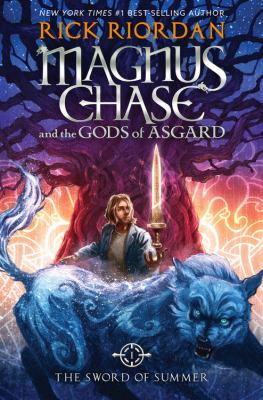
Teen Read Week: The Sword of Summer by Rick Riordan

swordofsummer_rickriordanWhen I first heard about this book, my brain zeroed in on the last name Chase. Related to Annabeth Chase, perhaps? Rick Riordan doesn’t fail to disappoint. Magnus Chase is her cousin (first cousins on their human side) and she is spotted immediately in the first chapter. I got so hyped about a new series from Riordan that ignored a minor oversight: I had little to no knowledge about Norse Mythology.

Fortunately, Uncle Rick understands. There are some clues leading up to the reveal of which god Magnus is the son of. (Here’s a hint: it isn’t Thor) I just didn’t see it because I don’t speak runes. Most of the mythology stuff is explained to go with the plot and never seems like a history lesson. I’m not sure how accurate it is by saying dwarves listen to Taylor Swift, but I’m sure other ideas like the nine worlds is there.

Expect some of the great humor that you know and love. The renaming of a sword to Jack. Ancient gods or goddesses referencing pop culture. First person internal dialogue with just a bit of sass. And the chapter titles. If I wanted to explain what the book was about, I would just display the table of contents because even though they seem random and bizarre, the chapter titles accurately describe an aspect in what happens next.

I really don’t want to spoil any of it, but don’t expect another Percy. No one will ever live up to him anyway. This is a new kid, with a new personality, and a new story to tell. Is it better than Percy Jackson? No. But is it still worth the read? Absolutely.

-Nicole G., 12th Grade

Magnus Chase and the Sword of Summer is available to check out from the Mission Viejo Public Library

The Martian by Andy Weir

themartian_aweirThe Martian, by Andy Weir, is about to become a major motion picture. So, it’s time to look at the brilliant book behind it. This science-fiction novel is the tale of Mark Watney, a resourceful and humorous astronaut on a manned mission to Mars. When a dust storm whips up ferocious winds, a broken antennae flies through the air and impales him, separating Watney from the rest of his crew. When the storm clears, all that remains is Watney and the barren planet. The rest of his crew managed to evacuate the planet, but the entire world presumes Watney to be dead. By some sheer miracle, Watney survives. The rest of the book follows Watney as he ensures his survival until NASA can send a rescue mission. His story is told through his own logs, kept in case some space traveler in the future finds it.

The most appealing aspect of The Martian as a science-fiction novel is its realism. Instead of bringing in aliens or complete bogus technology to fill in the holes, Weir writes using real science and engineering. As a botanist and mechanical engineer, our protagonist relies on his wits to keep himself alive. Through careful planning, Watney uses the available materials to create food and water. He calculates how long each of his resources will last, and how he can replenish them. As a result, much of the book is filled with complicated science-related jargon, but all of it is scientifically accurate. He overcomes real challenges with real solutions.

Mark Watney’s distinct character also contributes to the book. He is both confident and careful, and analyzes problems with careful logic. He is also extremely humorous and vulgar, cracking jokes whenever he can. This lightens the mood of a harrowing survival tale. Watney lets us sympathize with his plight without sounding corny or scripted. All of his reactions to events are extremely realistic. Readers should take notice that Watney does swear a lot throughout the story. The F-word appears in the very first sentence.
The Martian is an excellent science-fiction novel that meshes excitement with realism. Readers with a love of technology will especially enjoy this book. The movie comes out in October, so you can read the novel before seeing the film.

-Philip X.

The Martian is available for check out from the Mission Viejo Public Library and Overdrive