
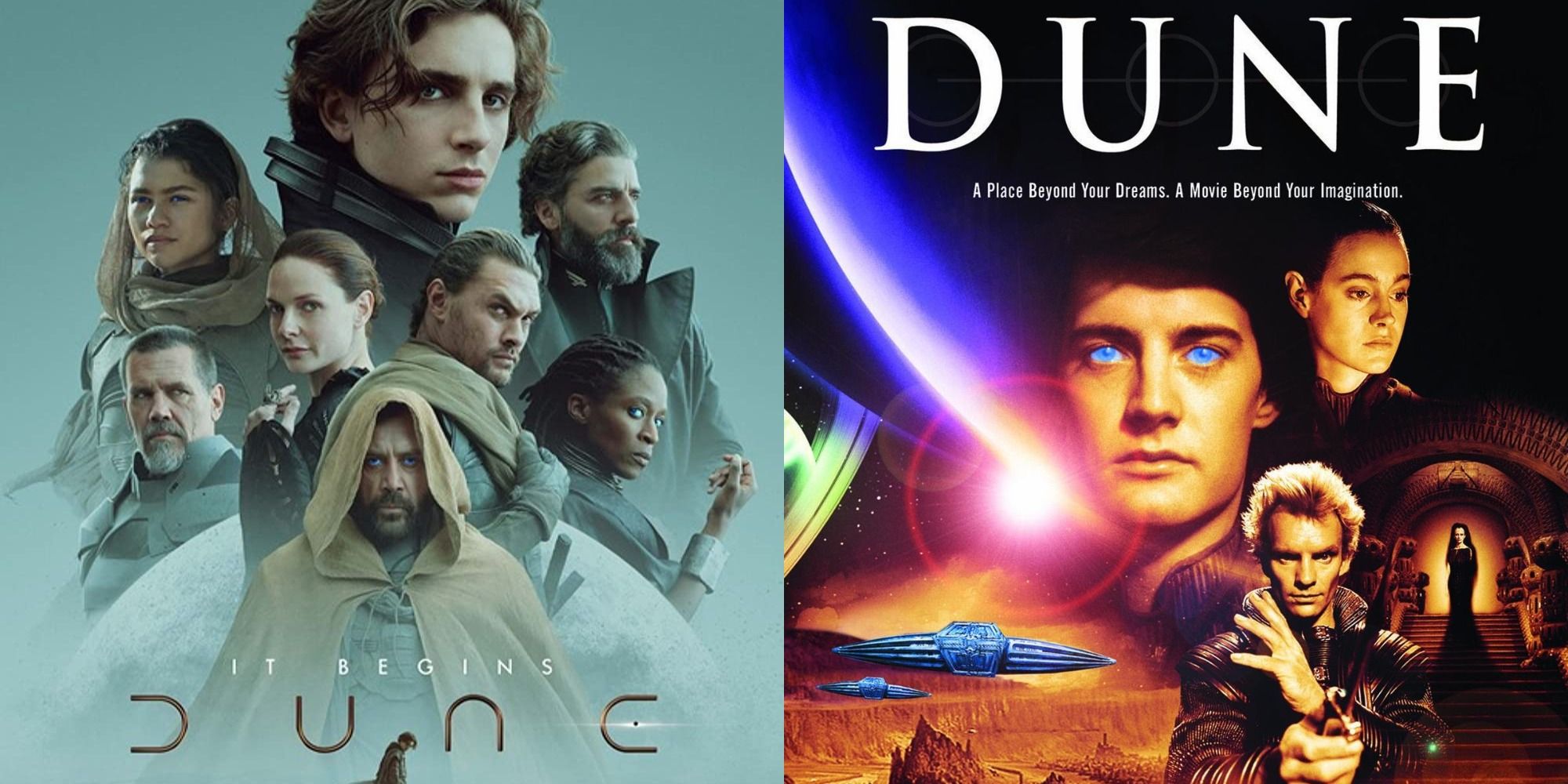
I love Dune or at least two versions of it. My love of it has led me to constantly talk about it, which has caused my friends to ask me what it’s about. It’s a bit hard to answer, I could say “Published in 1965, Dune is a space epic by Frank Herbet that went on to change the face of science fiction.” Or I could say “It’s like Game of Thrones, Lord of The Rings, and Star Wars had a baby, but with a lot more sand.” But if this fails, I use my last resort “The movie has Zendaya and Timothee Chalamet in it” which usually works.
This is a good thing because I think the 2021 movie is by far the best way to introduce someone to Dune. The movie tackles the first half of the book and introduces you to the world, you learn about the Bene Gesserit witches, the secretive Fremen, the all-powerful Emperor, the powers of Paul Atreides, and most importantly you get to see the planet of Arrakis or Dune. It does all of this while showing you amazing visuals. Through both practical and CGI effects the planet of Arrakis is stunning, a wasteland beaming with possibilities, with hostile giant sandworms that attack anything that moves. The director, Denis Villeneuve does a masterful job staying true to the book whilst using incredible cinematography.
The book itself is a masterpiece of science fiction and world-building. It’s a massive book that’s absolutely jam-packed with details and interesting concepts. At some points, you feel like you’re reading a science textbook when learning about how “spice” is created, or how the Fremen stillsuits retain your body’s moisture. However, it keeps itself interesting by guiding you through the planet through the eyes of various characters. Whether it’s the main character Paul, his mother Jessica, or even the evil Baron Harkonnen, you are constantly interested in how the story is unfolding and what motives are shaping each character’s actions.
Despite all this praise I have to discuss the awful monstrosity that is Dune (1984). Directed by David Lynch, Dune (1984) was the first attempt at transferring the behemoth book onto the big screen. It fails miserably, the intriguing characters become flat, the massive world seems small, and the science turns silly. All while the directing remains boring with the same transitions being used over and over. Granted it has some awful CGI that keeps it somewhat entertaining. Some scenes from the book remain but most of the movie seems to ignore the book entirely. To Lynch’s credit, the movie was plagued with issues and was supposed to be 2 parts instead of the 1 movie. But in my opinion, this still doesn’t make up for the absolutely awful translation of the book.
If you want to learn more about Dune I’d recommend starting with the 2021 movie. If you love it like I did you’ll love the book. Be warned that both the book and the movie are long, they have to be in order to explain the world. Chances are the time will fly by while you read/watch it. But whatever you do, stay away from the 1984 version.
-Parker K

 Mission Viejo Library Teen Voice