
Why Should We Read Shakespeare?

Recently in my english class, we started to read Hamlet which left me skeptical at first. I’ve always known Shakespeare to be one of the greatest and most influential writers of all time, but I wasn’t entirely sure what the point in reading seemingly outdated literature was when it came to solving the issues that face us today.

Almost immediately, I realized that this preconceived notion I had about old plays (and literature in general) was extremely wrong. 

It is definitely true that some sentiments in old writing will not seem as relevant to us today, but a lot of the concepts certainly are still relevant. One of the things Shakespeare did best was his ability to analyze the time in which he lived and what issues prevailed around him, and wrote about them in such a way that they could maintain relevance centuries in the future.

A few themes I have noticed in Shakespeare’s work that are still issues faced today are gender, race, and class discrepancies in society. While these issues certainly looked different in the late 16th to early 17th century time period in which they were written about, they still manifest in daily life and are at the center of many political debates.

If there’s one thing I have learned from previously my wrong assumptions about Shakespeare, it’s that I want to encourage people to read historically significant works to help them understand what paved the society we see today like I have recently done as it has greatly changed my outlook on life for the better.

– Taylor O.

Many works by William Shakespeare are available to check out from the Mission Viejo Library. They are also available to download for free from Libby.

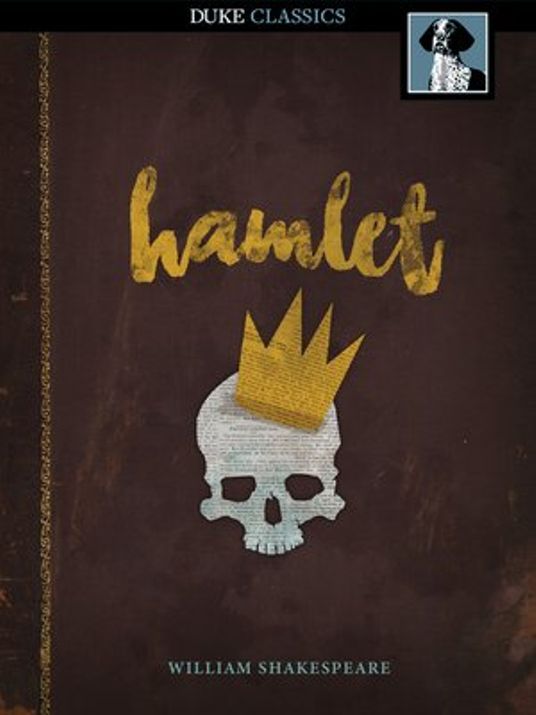
Hamlet by William Shakespeare

To read, or not to read? That is the question. Whether ‘tis nobler in the mind to suffer the slings and arrows of Shakespeare’s outrageous language, or to take arms against a sea of metaphors, and by SparkNotes-ing understand them.

This is, of course, a reference to perhaps one of the most famous scenes in literary history: Hamlet’s soliloquy in the Shakespearean play of the same name. This is the story of Hamlet, prince of Denmark, who, in his quest to prove his uncle murdered his father in order to ascend to the throne, faces obstacles both external and personal that cause his (and the majority of the characters’) downfall.

However, looking beyond the scenario as it is presented, Shakespeare’s characterization captures ideas that permeated throughout society then and still exist in society today. The character flaw that is acute indecision plagues all people in a multitude of ways. Though it may not end in complete misfortune like it does in Hamlet, there are still times when we are paralyzed while making a big decision, and this hesitancy ends up costing us. 

Additionally, for those coming from Romeo and Juliet, be forewarned: Hamlet is not a book of romance. While Hamlet and Ophelia are shown to be in love, Hamlet ends up using Ophelia in his quest to avenge his father, driving her to madness in one of the most tragic events of the play. Hamlet is, first and foremost, a play about appearances versus reality, loyalties and betrayals, and the overarching fear of death and the afterlife.

Hamlet balances these heavy elements with intermittent light-hearted scenes that keep the audience’s attention (after all, this was originally meant to be an Elizabethan-era play), and this creates a book well-worth reading. By doing so, the reader will not only be exposed to one of Shakespeare’s finest works, but also to his most famous lines, many of which originated from Hamlet.

– Mahak M.

Hamlet by William Shakespeare is available to check out from the Mission Viejo Library. It is also available to download for free from Libby.

Hamlet by William Shakespeare

We all know about Romeo and Juliet. The famous star-crossed teenage lovers and “O Romeo, Romeo, wherefore art that Romeo?” sort of stuff. Personally, I didn’t like the play. Romeo and Juliet, as actual characters, were plain and the best character is Mercutio, who not only dies halfway through, but is the reason why the play became a tragedy.

On the other hand, I really liked Shakespeare’s style of writing. He writes all about death, blood and of the era when stories of knights and magic were popular. So I thought, “gee, is there a story that is dark, has fantasy and a lot of blood and death, but also has a decent romance and lively characters? And I didn’t have to look any farther than Shakespeare’s “Hamlet.”

For those who like dark themes, like myself, there is a lot in this play from duels and poison to talking to skulls. Hamlet, the main character of this play, is told by the ghost of his father that he was murdered by Hamlet’s uncle, who is not only the new king of Denmark, but is married to Hamlet’s mother (a sinful act in its time). Hamlet spends the rest of the play not only facing the burden of a promise that he is not sure to keep, but additionally has to deal with the depression and suicidal thoughts leading up to the start of the play, something that a lot of teenagers could possibly relate to. And of course, it’s one of Shakespeare’s tragedies, so almost all of the named characters die by the end. There’s a lot of troubled minds to question and analyze, so fans of psychology would love this play. On top of that, despite the frequency of death, “Hamlet” is actually a better love story than “Romeo and Juliet.” Hamlet and Ophelia are the only link to each other’s sanity.

Finally, the characters are amazing. I loved their development throughout the play and how they appeal to the audience in their decisions. Ophelia, although a dutiful daughter in the end, sasses her father and brother when they tell her to stay away from Hamlet. Polonius, being the nosy parent, spies on everyone and knows their private business. Hamlet, who not only has the role of the emo teenager, but also is clever enough to make fun of every single character in the play. And poor Horatio, who wonders how he got caught up in this mess.

All in all I really enjoyed this play and hope that you get the chance to read it.

Hamlet, and all of its printed and film incarnations, is available for checkout from the Mission Viejo Library.