
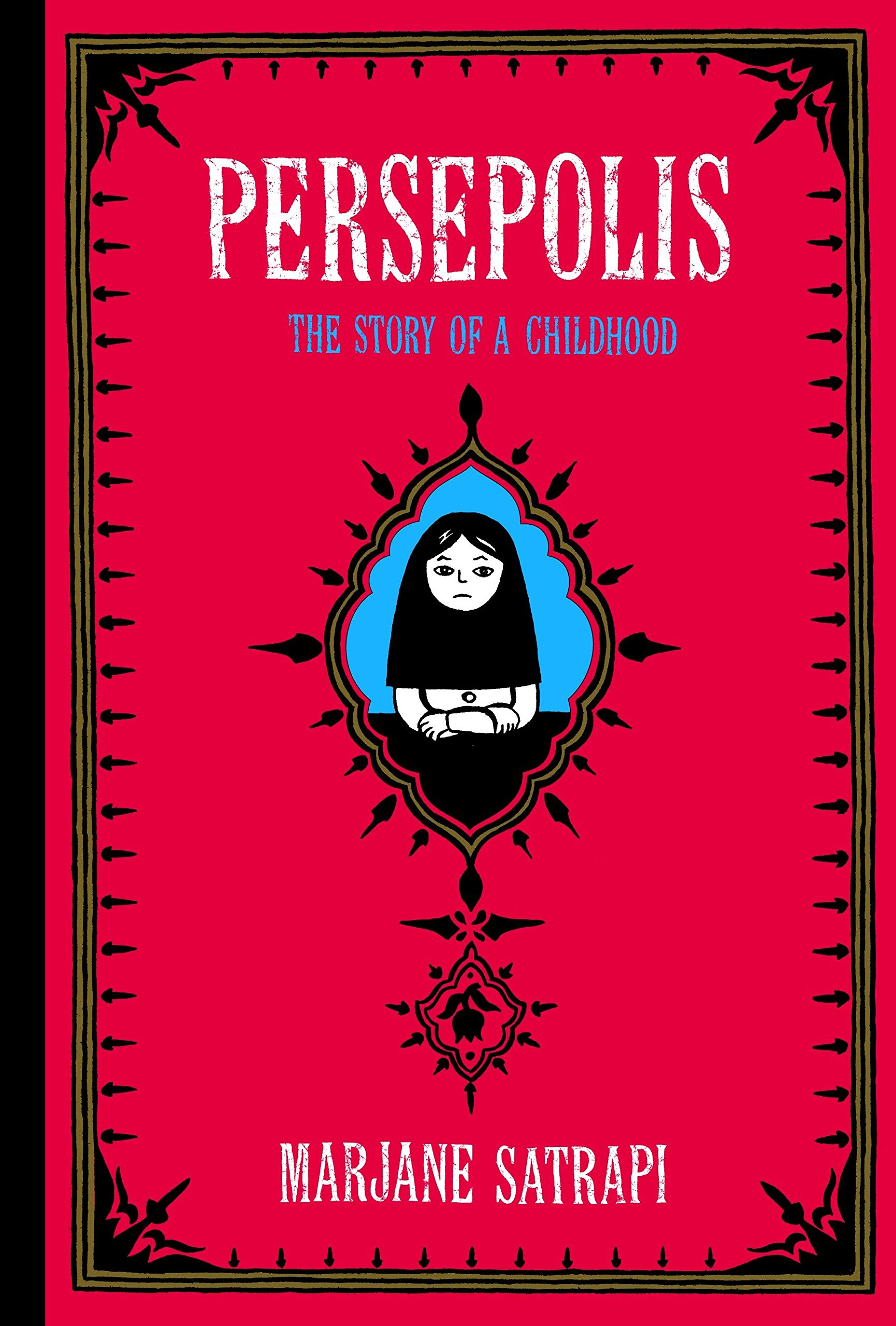
Disclaimer: There are two versions of Persepolis: the graphic memoir version and the literary memoir. The graphic memoir version is divided into two parts. I have only read the first graphic memoir book of Persepolis, not the actual memoir. Therefore, there’s still some of Satrapi’s writing that I haven’t been exposed to (yet). I will definitely try to find the second graphic memoir or the actual memoir soon, but for now, this review is based solely on the first graphic memoir.
Persepolis is both a graphic memoir and autobiography published in 2000. With the memoir originally written in French, Satrapi has received numerous awards for her work including the Cannes Jury Prize and the César Award for Best Writing.
The narration is written through the eyes of the main character—Marjane “Marji” Satrapi, the author herself—during her childhood at the time of the Iranian Revolution. A series of small stories are written in the memoir based on her own experiences, portraying political upheaval and how her own family was affected by the Iranian Revolution, Iraq’s oppressive regime, and the Iran-Iraq War. Marji’s accounts mainly focus on her and her family who live in Tehran, as well as how they attempt to rebel against the regime and take part in Iranian history.
As a daughter of immigrant parents but of non-Middle Eastern descent, I felt like I could connect with aspects of this memoir all while still learning more about Iran’s history. The memoir is a beautiful representation of Islamic and Iranian culture from the first-hand perspective of an Iranian citizen. The illustrations themselves are unique and drawn to perfectly fit the memoir, making Satrapi’s experiences seem more significant.
Although it’s a graphic memoir, I highly recommend Persepolis to high schoolers more than elementary or even middle schoolers. Some topics and drawings can be graphic, making the memoir a difficult read, and there are often parts that simply cannot be taken lightly. However, the book itself is unique at being able to broaden readers’ perspectives on other cultures as a memoir, historical account, and comic book all at once.
– Natisha P.
Persepolis by Marjane Satrapi is available for checkout from the Mission Viejo Library.
 What was most memorable, of course, was the fact that this is based off of a true story. Marji goes from an outspoken child to someone who suffers the loss of multiple relatives and friends, and sees her country constantly at war. Despite this, she does her best to stay herself.
 Before watching this movie, I knew little about Iran and Iranian people. But seeing the world from another perspective really has taught me a lot. I’ll remember Persepolis for the wonderful jokes, animation, and story (Does contain some adult content). You should definitely watch if you have time over the summer.
 Mission Viejo Library Teen Voice