Book Review: Paper Towns, by John Green

paper_townsIn continuing my mission to read every John Green novel known to man, I invested my time in Paper Towns.  This book follows the life of high school senior Quentin Jacobsen and his mission to find his first love, Margo, after she mysteriously disappears.  Margo is adventurous and exciting, and acts as a nice foil to Quentin’s shy and reserved personality.
As cheesy as this plotline sounds, Paper Towns was actually an interesting story filled with mystery, comedy, and a break-in to Sea World.  While the ending is somewhat disappointing and frustrating, everything leading up to it is exciting and enlightening.  This story is humorous, yet has dark undertones as it reveals faults in humanity and society.

What I learned through reading this book is that Green is an expert at creating relatable teenaged characters.  In Paper Towns, the main characters are worried about their future, but also concerned with living in the moment.  As we all know, these two tasks can be very difficult to balance.  In Paper Towns, Quentin teaches the readers how to balance the two, and how this combination of enjoying adventure and preparing for the future helps us to discover ourselves and what we want out of life.

-Amanda D., 11th grade

Book Review: Paper Towns, by John Green

paper_townsHave you ever met someone, maybe a person who is a huge influence on life, who you immediately had a first impression from them and you were also swept away when you found out that your first thoughts weren’t true? If so, then you’re on league with Quentin Jacobsen, a senior in high school who is in love with Margo Roth Spiegelman.

Quentin (nicknamed Q) is Margo’s neighbor, and has been her friend since they were young. Margo is like an enigma to him. She is the one who is adventurous, has run away four times, and once dressed up as a ninja in order to take Q on a wild adventure. Now, she has run away for a fifth time, and left clues to find her again. Only this time, Q finds out how different she is.

While this book is filled with comedy that anybody over the age of 13 would find funny, there are some scenes that some people might find inappropriate for people under the same age. For example, one time Q went out alone with Margo, who just happens to be the prettiest girl in high school, and when his friends found out about that, they made him write a term paper (30 pages min.), draw a realistic picture, make a sculpture, and write a poem describing the female anatomy. (pg 88) Additionally, some male anatomy parts are mentioned.

However, this book actually teaches an important lesson in the life of first impressions. Q has to learn that the adventurous girl that he thought he knew “was not a miracle…not an adventure…not a fine and precious thing. She was a girl.” (pg 199)
-Megan V., 8th grade

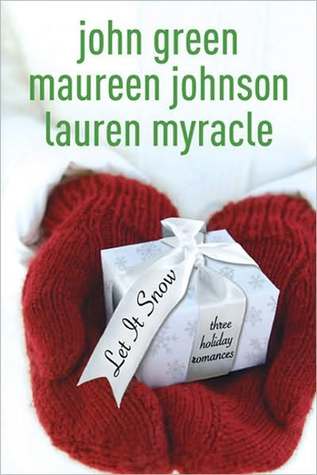
Book Review: Let It Snow by John Green, Maureen Johnson, and Lauren Myracle

let_it_snow_coverAs the holidays come to an end, I search for every way I can possibly find to prolong the season. I decided to read this book due to its dependable authors and captivating book jacket. Let It Snow is a three-story compendium of interconnected Christmas narratives written by John Green, Maureen Johnson, and Lauren Myracle.

The first story is “The Jubilee Express” which is my personal favorite, and follows a girl named Jubilee as she is spontaneously ordered onto a train on Christmas Eve, which unfortunately crashes into a snow drift. Her decision to get off the train and take refuge in the Waffle House nearby kicks off the elaborate series of unexpected events that prevail throughout the rest of the book. Jubilee is relatably awkward and unadulteratedly hilarious. She narrates the story in a unique, strange, and universally enjoyable style.

The second narrative is called “A Cheertastic Christmas Miracle” and is written by the modern king of young adult fiction, John Green. It tells story of Tobin and his friends as they journey through a blizzard to the proverbial Waffle House in pursuit of cheerleaders and hash browns.

The third story, “The Patron Saint of Pigs,” is the tale of an aforementioned girl named Addie, who aims to become less self-absorbed and sets off on a quest to a local pet store to pick up a previously paid for, teacup piglet for her friend, just as she promised she would. In this last part of Let It Snow, Lauren Myracle presents readers with a flawless, wrap-up conclusion to the novel in which all characters are united in one satisfying and intriguing resolution.

There are not very many authors that could possibly amalgamate a Waffle House, a Starbucks, a Tinfoil Guy, a notorious cheerleading cult containing an abundance of Madisons and Ambers, James Bond, a female Duke, tangential Swedishness, Twister, ceramic Santa villages, a girl infamous for her hash brown addiction, a celebratory Smorgasbord, and a dedicated Target employee to form one seemingly sane, unified whole, but that is exactly what these three authors came together and succeeded in doing.

Let It Snow consists of humor, relatable teenage drama, reflection of life, captivating stories of love and of friendship, and the substantial difficulties and benefits of human relationships. One reoccurring issue that is addressed throughout this book is the contemporary corruption of the social paradigm. The entire wholesome social hierarchy is solely based off the disregard of common equality (e.g. the drama geeks are cooler than the band nerds but buried under the social appreciation for jocks and cheerleaders). I found this both true and amazingly appropriate for the designated audience.

If you liked The Fault in Our Stars, Paper Towns, or any of Maureen Johnson’s books or Lauren Myracle’s novels, you’ll love Let It Snow.

“…a taste so profound and complex that it can’t even be compared to other tastes, only to emotions. Cheesy waffles, I was thinking, tastes like love without the fear of love’s dissolution…”
― John Green, Let It Snow

“Christmas is never over, unless you want it to be… Christmas is a state of mind.”
― Lauren Myracle, Let It Snow

“We study there a lot because… what other choice does society give us, right? It’s Starbucks or death, sometimes.”
― Maureen Johnson, Let It Snow

-Danielle K., 8th grade

Book Review: An Abundance of Katherines, by John Green

abundance_of_katherinesAn Abundance of Katherines is a young adult fiction novel written by one of my favorite authors of all time… John Green.  It follows the life of Colin Singleton, a child prodigy who has been dumped 19 times… all by girls named Katherine.  After graduating from high school, Colin and his best friend Hassan decide to take a spontaneous road trip to help Colin get over his recent breakup.

Now, if you have read Green’s more popular works like Looking For Alaska or The Fault in our Stars, you may be worried that this book will also be slightly depressing.  That’s what I thought anyway.  Therefore, I was pleasantly surprised when I discovered that this book was simply a funny coming of age novel and not a depressing romance.

Don’t get me wrong, I love The Fault in our Stars and Looking for Alaska, but An Abundance of Katherines was a nice break from Green’s more dramatic novels.  Colin’s sarcasm and lack of social skills add to the book’s lighthearted nature, while at the same time help to deliver a clear and fascinating message.  (I won’t spoil that message for you because it’s pretty much the whole point of the book.)

Overall, I thoroughly enjoyed this book and I recommend it to anyone interested in coming of age novels, or anyone who wants a book that is able to cheer them up in one page.

-Amanda D., 11th grade

Book Review: The Fault in Our Stars, by John Green

fault_in_our_stars_coverAs the second of John Green’s books that I have had a chance to read, The Fault in Our Stars did not disappoint. Written from the perspective of the 16 year old Hazel Lancaster who is diagnosed with a type of terminal thyroid cancer, it recounts her experiences in falling in love with the 17 year old Augustus Waters, an amputee who is recovering from osteosarcoma, after their chance meeting at a Cancer Kid Support Group.

Although this book is about cancer and the two main character’s experiences with it, it is not a “cancer book.” It is not a book of just tragedy, or a book of just recovery or regret. Instead, The Fault in Our Stars holds valuable insight to the perspectives one would not usually attribute with those who are fighting cancer or another terminal disease. In stark realism to other stories of its type, Green portrays Hazel and Augustus struggling together with observations about the fragility of life, the importance of humor, and the wisdom of death (or the looming threat of it); finally in the end, each reaching their own conclusions about what these subjects signify within their lives.

Green has lived up to every expectation, and has even surpassed some of those I held while beginning to read this book. Even with just two paragraphs into the book, it delivers an incredibly insightful observation cloaked within Green’s down-to-earth writing style:

“Whenever you read a cancer booklet or website or whatever, they always list depression among the side effects of cancer. But, in fact, depression is not a side effect of cancer. Depression is a side effect of dying. (Cancer is also a side effect of dying. Almost everything is, really.)”

Green writes with an incredible tenacity creating characters that are intensely fleshed out, vividly real, complex, and beautifully illustrated, transporting the reader into the shoes of both Hazel and Augustus, allowing for empathizing and connection with them on all levels. His ability of description also lends itself to create beautiful illustrations of the locations that play important roles within the story line making it easy for the reader to imagine themselves in the both the far reaches of where their favorite writer resides in Amsterdam, and in the closer homes or even bedrooms of the characters.

Despite the somewhat distant subject matter of these two teens fighting against cancer, Green manages to pull in the readers with the incredible points of realism and relatedness that they can hold with the characters. He also provides the perfect balance of humor and tragedy, the intense humor within the first half of the novel only serving to make the luminous final pages even more beautiful and heartbreaking. Ranging from the parts of incredible insight, to the intense humor and comic relief, to the final parts of tears and heartbreak, Green continues his winning streak, making this book one of my new favorites. Through the experiences of the characters you will learn a lot about yourself, and also be able to face topics that may have never shown up on your radar before, and in the end leave with a humbling story of love, friendship, and loss.

-Sophia U., 11th grade

Book Review: Looking for Alaska, by John Green

looking_for_alaskaLooking for Alaska is a realistic fiction novel by the recently famous author John Green about an awkward teenage boy who finds love for the first time. Although the plot may sound cliché, Green adds relatable elements to the book that most authors don’t.

The book begins with a 16 year old named Miles Halter spending his last day at his home in Florida before he leaves for a prestigious boarding school located in Alabama. Upon arriving to Culver Creek Boarding School, Miles is introduced to plenty of his soon-to-be friends. But on that day Miles falls in love with the outgoing and crazy Alaska Young. Throughout the school year, Alaska and Miles share countless adventures when suddenly one day changes his life forever.

I thought the story had everything it needed to be overall an amazing book. It lets the reader connect with the characters and allows us to feel and experience the troubles the characters are going through. This book proves to be funny, emotional, and captivating as the reader takes a journey to Miles’ version of a “Great Perhaps.”

I would recommend this book to any teen looking for an engrossing yet simple read and hope to see it someday made into a movie.

-Sara S., 10th grade

Book Review: Will Grayson, Will Grayson, by John Green & David Levithan

will_grayson_coverThis book review is part of series of reviews written by students at St. Margaret’s Episcopal School for their 7th grade English classes.

On a cold night in Chicago, two strangers cross paths. The two teens, living in different cities, suddenly find their lives going in new and surprising directions that culminate in a brave change of heart and an epic high school musical sure to steal the hearts of its audience. This amazing story, Will Grayson, Will Grayson, was written by award winning authors John Green and David Levithan. Green has won numerous awards for writing young people’s literature and has a blog, Brotherhood 2.0, in which he encourages his readers “to fight to increase the awesome and to decrease the suck!”

An enticing novel about a boy, Will Grayson, meeting another boy who is coincidentally named will grayson, this story is about friendship and love, and it is written in alternating points of view.  Will Grayson narrates the story on the odd numbered chapters, while will grayson, whose name is never capitalized, narrates the story on the even numbered chapters. While these two have the same name, their lives are nothing alike.

The theme of this book is that friendship happens because of fate or destiny. Will Grayson says, “But with friendship, there’s nothing like that. Being in a relationship, that’s something you choose. Being friends, that’s just something you are” (260). This quote demonstrates that forming friendships is not a choice, but an inevitable existence. It is fated so you cannot escape from the people who are put into your life to be your friends.

Although the Will Graysons have the same name and age, their personalities are completely different. Will Grayson cares about his family and friends, but his friends easily manipulate him. will grayson, however, has quite an attitude even though he is small. He doesn’t care much about life and he treats people with very little respect. Tiny, who is also one of the main characters, is Will Grayson’s best friend. Will describes Tiny as “the world’s largest person who is really, really gay and the world’s gayest person who is really, really large” (3). Tiny momentarily fosters a romantic relationship with will grayson, who is also gay. Their short fling further affirms the theme that romantic relationships may not last, but friendships last an eternity.

I thought this novel was very well written. It does contain some words that are inappropriate for younger readers, but I strongly recommend this book to anyone who is looking for a realistic drama. I especially like this book because of the way it was written. The alternating points of view of both of the Will Graysons add to the meaning of the story because these characters have different perspectives on the same events. I love the way that the two different authors of the book collaborated to write such a magnificent piece.

Full of drama, friendship, and love, Will Grayson, Will Grayson brings up many of life’s tough truths. In one of the scenes, Will Grayson says, “Caring doesn’t sometimes lead to misery. It always does” (19). This is very sad, but also very true. Will Grayson, Will Grayson will leave you introspective and pondering your own relationships.

-Sarah K., 7th grade

Looking Forward to The Fault In our Stars Movie

fault_in_our_stars_coverWe’ve all read and fallen in love with the book, but will the movie live up to our expectations? John Green’s bestselling novel The Fault In Our Stars is finally being made into a movie, set to hit theaters on June 6, 2014.

Award-winning actress Shailene Woodley has been cast to play the main character, Hazel Grace, and Augustus Waters is being portrayed by the actor Ansel Elgort, and although he isn’t as famous or well known as Shailene, he seems to fit the role just as well. And of course, many of us remember him from the Nickelodeon TV show “The Naked Brothers Band,” Nat Wolff is going to be playing Augustus’ best friend, Isaac. With this cast performing as the main characters, it’s sure to be a hit.

Not to mention author John Green has been tweeting his anticipation for the movie since it began filming. Updating us with pictures, videos, and tweets on set, it’s clear he is as excited as the rest of us.

john_green_tweet

I think The Fault in Our Stars will be quite similar to the Perks of Being a Wallflower movie. Although the two books are completely different, they both reached a wide audience and perfected the cast and movie and gave the fans of the book something to be happy with (which is usually very rare). All in all, the movie will no doubt be a success, and I am very much looking forward to seeing it.

-Sara S., 10th grade

Top 5 Coming-of-Age Novels

walk_path_zappowbang

photo by flickr user Justin Henry

Coming-of-age novels are written primarily for children ranging from middle school to college and they tell of those times. Coming-of-age novels have influenced and shaped my life more than any other novels and they are essential reading because they can do that! There is a quote by F. Scott Fitzgerald which exemplifies the essence of coming of age novels:

“That is part of the beauty of all literature. You discover that your longings are universal longings, that you’re not lonely and isolated from anyone. You belong.”

I believe that this quote exemplifies themes present in coming of age novels because coming-of-age novels reassure the reader that they are not alone and that there are others who have been through what they have been through and they also open the reader’s eyes to new experiences and ultimately help prepare them for life.

Here are 5 of my favorite coming of age novels!

perks_cover1. The Perks of Being a Wallflower by Stephen Chbosky
“Perks” was the novel that got me interested in other coming-of-age novels. The book was inspired by both The Catcher in The Rye and A Separate Peace. The story is told through letters between the main character Charlie and an anonymous correspondent. It tells of Charlie’s freshmen year of high school. Charlie is extremely anxious about high school because he has no friends, but he soon befriends Sam and Patrick who help him to have the full high school experience. Throughout the year, Charlie learns a lot about himself and reveals his darkest secret.

separate_peace_cover2. A Separate Peace by John Knowles
A Separate Peace takes place during WWII in a boarding school and is about two friends Phineas (“Finny”) and Gene. Phineas and Gene are polar opposites but they become friends nonetheless. After an accident that takes place between them, Gene learns a lot about Finny and abut life but ends up losing himself.

catcher_in_the_rye_cover3. The Catcher in The Rye by, J.D. Salinger
The Catcher in The Rye revolves around the life of Holden Caulfield. Holden deals with feelings of alienation and angst throughout the entire novel. He thinks that everyone is a phony and cannot find anything worthwhile in the world. He denounces adulthood and longs to revert back to childhood where everything is pure.

kind_of_a_funny_story_cover4. It’s Kind of a Funny Story by Ned Vizzini
It’s Kind of a Funny Story is centered around the life of Craig. Craig is overwhelmed with life and cannot bear it any longer so he checks himself into the hospital afraid that he might hurt himself. While in the hospital, Craig meets people who change him and after being discharged from the hospital he learned that he does want to live and that he wants to live life to its fullest.

fault_in_our_stars_cover5. The Fault in Our Stars by John Green
TFiOs is about Hazel and Augustus: two teens struggling with cancer who fall in love. The story progresses as their health declines. It depicts the trials and tribulations of their complicated relationship.

-Sarah B., 12th grade

Book Review: The Fault in Our Stars, by John Green

fault_in_our_stars_coverThis book review is part of series of reviews written by students at St. Margaret’s Episcopal School for their 7th grade English classes.

Two sick teenagers, destined to fall in love. Even if love is a powerful force, so is cancer, and in the small amount of time left for the two teens, Hazel and Augustus, love is what is keeping them alive. In The Fault In Our Stars, bestselling novelist John Green illustrates cancer in deeply moving, yet at times light-hearted, words. He mixes young love and the possibility of death into an emotional and memorable novel.

The story of their love is told by Hazel, a sixteen year-old girl with lung cancer, and surviving by luck with Phalanxifor, a drug that is designed to stop the growth of cancer cells, but it doesn’t work with seventy percent of the people who use it.  In Hazel’s life, she sees her job description as “Having Cancer,” but Augustus Waters helps her realize that she can still love without causing pain.

Cancer Kid Support Group is where the sparks fly in this book, and where Augustus and Hazel first meet. Augustus Waters, known to his friends as “Gus,” is a seventeen year-old boy who has cancer in his leg and had to get it amputated years before. Gus walks with a prosthetic leg, but every time someone asks him how he’s doing, he replies “grand,” even when he is stuck inside hospital walls.  Gus is what made this novel the most memorable because of his charm, sense of humor, and absolute compassion towards Hazel.

The Fault In Our Stars is also filled with other characters such as Hazel’s mother and Isaac, who not only help to make the story more real, but also show different types of personalities.  Hazel’s mom is just another one of those protective, caring, and emotional mothers’ who will do anything for her child.  Isaac has eye cancer and struggles with the fact that even people he loves end up betraying him when he is sick or in pain. Isaac is a interesting character and friend to Gus throughout the book.

Hazel admires and even idolizes an author named Peter Van Houten, who wrote a book called An Imperial Affliction. This book that he wrote was about an eight year-old girl with cancer, and has a huge meaning to Hazel’s life.  More importantly, the true significance to the book is that it brings Hazel and Augustus together. Hazel has been wanting to meet him all her life, and when Augustus comes in, her wishes become reality. Only Hazel and Augustus understand the meaning of An Imperial Affliction.  Their discussions of the book add an interesting element, and also develop their passion for each other.

Overall, Augustus Waters is truly the most important part of this novel. Without him, this book would just be another average story about how a teen girl had cancer, but add in Augustus, and not only do you get brilliant thoughts from him, but also a classic love story that will bring you to tears. Even when Hazel is at her worst, Augustus stays in the hospital waiting room for hours because he loves her. Augustus said once to Hazel, “Don’t tell me you’re one of those people who becomes their disease. I know so many people like that. It’s disheartening” (32). Without Augustus, Hazel would have drowned in her own thoughts of living with cancer, and never truly experienced life while she was on Earth.

Despite Hazel having negative emotions towards her disease and her life, she did have her moments, and I found that she was incredibly intelligent and thought-provoking. One day, when Hazel was contemplating her life and the old sad, swing set sitting in her backyard she said, “I tried to tell myself that it could be worse, that the world is not a wish-granting factory, that I was living with cancer not dying of it, that I mustn’t let it kill me before it kills me…” (121). This is a larger theme in the story: you mustn’t let your pain or sickness take your life away before it actually takes your life away; instead, focus on loving other people.

The Fault In Our Stars deserves one of the greatest recommendations I could give about a novel, and I would read this book all over again. The word choice and different, yet intriguing, emotions and interactions with other characters puts you right in the story.  It leaves you with a new outlook on love and your relationships with others.  John Green creates a new form of “forbidden” love in this novel, and Augustus Waters, who feared oblivion said, “That’s what bothers me the most, is being another unremembered casualty in the ancient and inglorious war against disease. I want to leave my mark.”  I strongly recommend that if you want to know what happens in the end with Hazel and Augustus, read this book.  It will leave its mark on you.

-Madeline H., 7th grade