
Authors We Love: Kate Chopin

Influential and inspirational, author Kate Chopin is a notable individual for her necessary contribution to American literature.

Acting as one of the earliest feminists in her time, Kate Chopin wrote frequently in hope of defying the societal norms for a woman in the mid to late 19th century. Chopin embodies this  same mindset as reflected in her novels, such as The Awakening in which she uses a strong female character to show what it means to develop a sense of individuality.

Around the world, Chopin is recognized as one of the world’s most essential author’s, and the lessons within her novels have transcended the era in which they were written. 

Like many other important authors to us today, Chopin was criticized during her time–even having her books banned–as her work was controversial in nature. For this reason, it is necessary to evaluate and commend the impact her work has had on female writers worldwide as she was often disregarded during her own time.

Chopin’s work helps us to understand many themes such as existentialism, transcendentalism, and realism, in order to see how these themes were perceived throughout history. Her work itself was often influenced by her personal life and her beliefs as a woman who fought the incarcerating gender roles experienced in the 19th century.

If you happen to stumble upon a writer whose work was once banned due to it sparking controversy, consider their position and learn more about them. Oftentimes, the books that were the most poorly received during their conception are the most impactful to our lives today.

– Taylor O.

Works by Kate Chopin are available to check out from the Mission Viejo Library. It is also available to download for free from Libby.
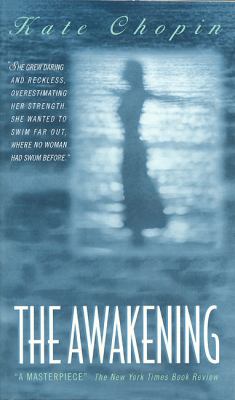
Book Review: The Awakening, by Kate Chopin

awakening_coverAt the turn of the 20th century, the western world, emerging from a long period of industrialization and cultural change, finally began to recognize its mothers, its wives, and its daughters. In the early years of this new century, the fledgling feminist movement reached its pinnacle, achieving suffrage for womankind in the United Kingdom in 1918 and the United States in 1920.

Nonetheless, this insatiable drive to achieve equality did not merely appear from nothingness; rather, the feminist movement had been growing for years beforehand. Perhaps a precursor to the cause was Kate Chopin and her greatest novel, The Awakening. Relating the tale of a young woman, Edna Pontellier, and her development from a subordinate wife and mother to an independent member of society, Chopin’s tale strikes the feminist tone as Edna’s dissatisfaction with her social and familial current status, which reflects the status of all woman at that time.

As the novel begins, Edna and her family are on vacation in the removed vacationland of Grande Isle. Here Edna begins to realize her boredom with the maternal society that is embodied in the protagonist’s peer, Adéle Ratignolle. Increasingly severing her ties with this cult of mothers, Edna finds satisfaction in her relationship with the young man, the son of the proprietor of Grande Isle, Robert Lebrun. Unlike her dominating husband, Leonce, Robert is engaging and treats her as an equal, or so she thinks at the time.

Soon the dreamy stay at Grande Isle comes to an end, and the Pontellier family returns to its bourgeois home in New Orleans. Now set in her recalcitrant ideology, Edna begins to distance herself from her previous life. She finds a new friend in the brilliant pianist, Madamoiselle Reisz, and elderly widow whom she first met on her summer holiday. Edna tries her hand at art, in an effort to support her own living, and begins to find new companions, a number of them men with whom she seemingly has affection. At her dinner party, Edna seems to become a queen, a powerful and respectable sovereign. But that old ennui, the feeling of boredom and discontent lingers. And amongst all this, Edna longs for Robert, who is away in Mexico. But even when he returns, Edna recognizes that he is the same, paternalistic man as her husband, the very threat from which she was trying to escape. The novel’s end is gripping, tragically so, but you must pick up the novel yourself, for I shall not discuss it here.

Overall, The Awakening is not for every reader. Some of its content is rather adult, as are its themes. But I found in Chopin’s magnum opus an inspiring spirit of contrariness. I found inspiration in Edna’s unwillingness to accept the norms of a repressive society. I think The Awakening is worth the read not only for the burgeoning feminist, but for anyone who has aspirations, anyone who has that determination to rise against injustice and enslavement of any sort.

-Sebastian R., 11th grade