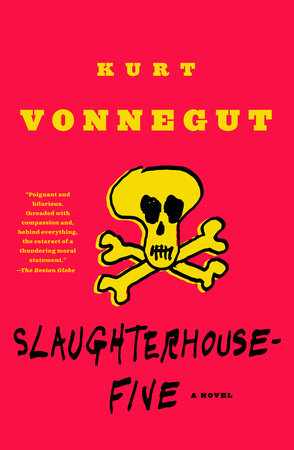
Book Review: Slaughterhouse-Five by Kurt Vonnegut

Recently, I created a bucket list of books that were previously or currently banned in some capacity that I wanted to read, and one book that particularly stood out to me was Slaughterhouse-Five by Kurt Vonnegut. Known for his absurdist writing style, Vonnegut’s work never fails to be humorous and meaningful at the same time.

This book has no specific sense of time, a break from the typical writing style seen in most novels. The book begins with Vonnegut describing his personal connection to the book and his thought process in writing it. Having witnessed the Second World War and its brutality firsthand, there definitely is an anti-war aspect to the book. The story frequently jumps between time periods, as the book’s main character, Billy Pilgrim, becomes “unstuck in time” and “time travels” through what can be implied to be flashbacks and flash-forwards.

The book attempts to explain Billy’s warped sense of time, but also his understanding of life and death, as a result of his contact with an alien race known as the Traufamadorians. Billy “time travels” constantly between WWII and the post-war period, where he is supposedly at, with Vonnegut making it uncertain what time frame the book truly is set in. At the same time, Vonnegut introduces several narratives concerning the brutal and dehumanizing nature of war, including its random nature by killing off characters who were least expected to perish. In fact, part of the reason why the book was banned originally was because of its anti-war nature, with some citing it as “unpatriotic”. By creating these narratives, Vonnegut ultimately expresses a cynical sentiment concerning the cruelty of human nature.

SH5 is one example of Vonnegut’s incredible talent for world-building; while every event seems random or out of place in the context of where it is placed, everything fits together, albeit haphazardly. This book is full of surprises, and I really enjoyed this wild roller-coaster ride of a book that simultaneously managed to be full of significance and meaning, despite the author’s intention for many things to be meaningless. Ultimately, this intention is a paradox in itself. I’d recommend this book for anybody looking for a unique read, or just anybody who wants to read an important piece of literary history in general.

Slaughterhouse-Five by Kurt Vonnegut is available for checkout from the Mission Viejo Library. It can also be downloaded from Libby

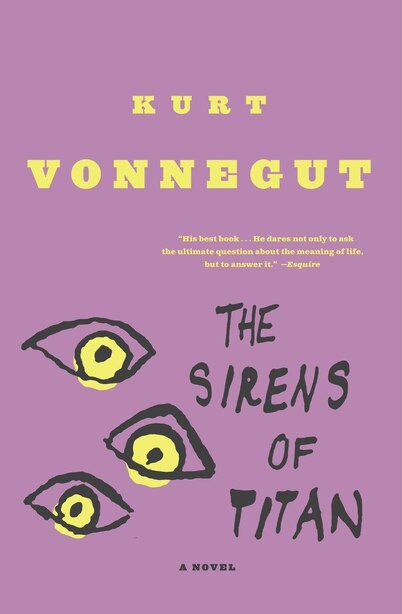
Book Review: Sirens of Titan by Kurt Vonnegut

From the moment you first begin reading Sirens of Titan, Kurt Vonnegut makes his distinctive voice and writing style very apparent.  When I first picked up the book in the science fiction section, I expected to find a run of the mill sci-fi epic, but instead I found a book that I think is one of the most unique I have ever read.

It begins in Newport, Rhode Island at the renowned Rumfoord estate, where a crowd has gathered, as usual, to watch the materialization of a man and his dog. The crowd is denied access as always, but they continue to show up, as they hope for even the smallest of chances to witness this miracle. This miracle is the appearance of a man by the name of Winston Niles Rumfoord and his dog Kazak, which has happened once every 59 days, due to a mysterious concept Vonnegut has concisely named “Chrono-Synclastic Infundibulum”. This phenomenon stretches Winston and his dog Kazak out across all of space past present and future, making him extremely sought after as a sort of fortune teller who has almost absolute knowledge about the human race and their future as a civilization.

By giving Winston the ability to basically know everything at all times I think Vonnegut makes him a very interesting character, as his actions are the driving force in the story but the purpose behind them isn’t revealed at all until the very end. I would definitely say this makes him the most intriguing character in the book, because from different perspectives he can be seen as the protagonist, antagonist, or even an omnipotent third person at times.

The story begins when a man named Malachi Constant gets a rare invite to this materialization, and ends up on a grand tour of the solar system that Vonnegut uses to question the concepts of free will, friendship, and loneliness. Winston tells Malachi that him and Winston’s current wife Beatrice will fall in love, and end up living out their final days on Titan, Saturn’s largest moon. Malachi and Beatrice’s absolute refusal of their fate and the futility of their actions in the end makes a powerful point about free will, and the progression of these two characters also give the reader insights into Vonnegut’s opinion on loneliness and friendship.

Personally, I really liked this book, because the plot is very unconventional, and Vonnegut’s vision of space and the story he writes are both extremely imaginative. The book also frequently employs the use of satirical and dark humor, which I thought was pretty fitting with the tone of the book as a whole. However, because of the unconventional plot structure of the book the writing can come across as a bit hard to follow, as the story is not made entirely clear until the very end and at many times the setting and focus of the book completely shifts out of nowhere.

Overall, I think this book is worth reading for anyone who is interested in sci-fi used as a medium for a greater message, such as the movie 2001: A Space Odyssey or the Dune Series by Frank Herbert, but also for anyone who wants to try something new or wants a unique and interesting read.

Book Review: Galapagos, by Kurt Vonnegut

galapagos_coverThere is an archipelago, six hundred miles from the western coast of South America, isolated from the rest of the world. For some, this remote location is a destination sought in the pursuit of relaxation, others engaged in the hunt of research. Yet most uniquely, this island chain is the focus for a novel written by one of the 20TH century’s greatest authors.

Kurt Vonnegut’s Galápagos, his eleventh elongated tale, remains a true example of his characteristic cynicism and caustic humor which have long attracted a devoted audience, including myself. At a rather superficial level, Galápagos is extremely humorous for those with an attraction to keen wit. Yet upon delving further into the text, one comes to grips with the more profound revelations Vonnegut has to offer. At its deepest level, Vonnegut prophesizes, criticizing the society celebrity-worshipping cult of “big-brained” buffoons that he observes. This is where Darwin comes into play; Vonnegut incorporates evolutionary ideas to suggest that our noggins have outgrown their necessity, and have driven us into despair. And so, as our author predicts, we shall regress to the animalistic state of furry ocean-dwellers.

Vonnegut’s scattered scenes mimic the geography of the story’s setting, and while occasionally disorienting, they lead to a comprehensive narrative regarding the tale of the crew of the fictional Bahía de Darwin who take on a sort of Noah’s Ark as the survivors of the human race. Stranded on the island of Santa Rosalia, the outcasts ultimately are the ancestors of a new species that inhabit earth, which Vonnegut continuously visits a few thousand years in the future. In this way, the only true antagonist of the story, the brain, is victorious.

While not a challenging read, Galápagos is advanced in its writing and revelations, but should be intriguing to any curious teen. There is no doubt that Vonnegut sparks some compelling questions: What is our relationship to the rest of creation? Are the fittest really the ones who survive? Have our brains become the enemy? Surely the author has his own opinions and predictions, but we are not necessarily compelled to agree. Rather, Vonnegut seeks to entertain us, his rhetoric present only under jocularly sardonic remarks and plot.

-Sebastian R., 10th grade

Authors We Love: Kurt Vonnegut

Kurt Vonnegut was one of the most important black humor authors in American history. There was a time that every college student passes by the classrooms with a Kurt Vonnegut book, and I would like to say that it was a Vonnegut’s age that, however, already passed. How many young people know that Kurt Vonnegut was a great author just like Mark Twain? Do they ever meet his works before they appear on their schools book lists? It is a pleasure for me to know this author, and I want to share what I got from him with you.

monkey_house_coverThe book that introduced me to Vonnegut is Welcome to the Monkey House, a collection of Vonnegut’s short stories. I believe that many of us teenagers will be reading this in high school, and I suggest reading it carefully with some knowledge about the author. It will not only help you with your school essay but also inspire you deeper meanings of the stories.

As a German-American, Vonnegut’s life was not easy during the time of World War I and II. He loved peace but later decided to fight for the U.S. in World War II. Almost died on the front, his experience in war led to one of his best works, Slaughterhouse-Five (1969). However, he was still been treated unequally even when he fought for equality. “Yes, and even today there is a sort of San Andreas fault line running between German-Americans and Anglos, but fainter all the time.” He stated in his last work, A Man without a Country.

man_without_country_coverWhy did Vonnegut consider himself as a man without a country? His works are well known by his humor, but Vonnegut decided to change his style in his last book, stating, “You get just too tired, and the news is too awful, and humor doesn’t work anymore. It may be that I am no longer able to joke– that it is no longer a satisfactory defense mechanism.” (A Man Without a Country, 2005)

For me, every Vonnegut story I read connected to Vonnegut’s life. For example, Vonnegut’s short story, “Harrison Bergeron,” explains Vonnegut’s understanding of equality, and you can see the connection. Vonnegut wanted equality and fought for it, but at last he did not achieve what he hoped for. When the main character Harrison frees himself from all the trashes that lock him, could we say that Vonnegut had the hope to free himself from the bias of people around him? Did he ever imagine crushing the labels that people put on him before knowing him as a human being?

As a great author, Vonnegut influenced a generation. However he was not a happy man- almost struggled for his whole life, Vonnegut did not meet his end happily. He fought for what he believed with humor, and he died.

So it goes.

-Wenqing Z., 10th grade