
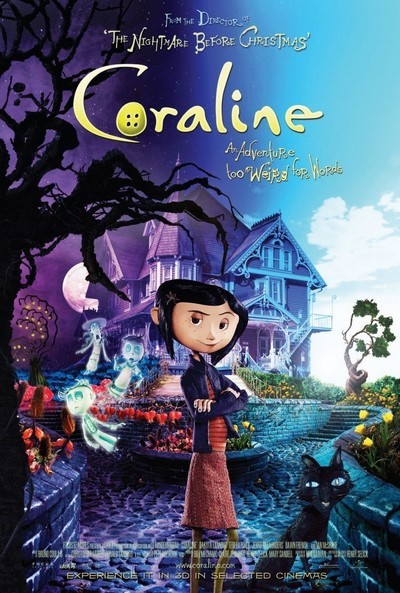
Movie Review: Coraline

The movie Coraline was written by Henry Selick, who also directed the film. The story is based on the novel by Neil Gaiman in honor of his five year old who enjoyed scary stories. This is one of my favorite movies, as it’s a stop-motion animated film, which gives it a unique and detailed visual style. The animation is super detailed and visually stunning, while the plot keeps you hooked with its eerie and imaginative twists. Its definitely a movie both kids and adults can enjoy for its strong characters and captivating storyline.

The movie follows a young girl named Coraline who discovers a parallel world that appears to be a better version of her own life, but it hides dark secrets. Coraline must use her courage to navigate through this journey and save herself and her loved ones. Additionally, the strong, and brave Coraline serves as an inspiring role model as she has the courage to fight for her loved ones, persevered through the tough battles and overcame all the challenges that came her way.

Coraline also has many conspiracy theories that add an extra layer of mystery. It invites the viewers to think more deeply about the plot and look for more hidden clues, enriching the movie-watching experience. So when you watch the movie, watch out for some of these hidden clues to apply back to the conspiracy theories.

  • The well
  • The first few seconds of movie
  • The Taffy
  • Lightning Hand
  • Framed silhouettes of the other children
  • The cat at the end

Overall, Coraline is a remarkable film that blends horror and fantasy and creates an imaginative and enjoyable movie for all ages. It always kept me on the edge of my seat and was very exciting to watch. I loved all the hidden clues; it made it even more enjoyable and allowed me to almost be involved in the movie. I would highly recommend this movie to everyone, even though it is very difficult to get ahold of.
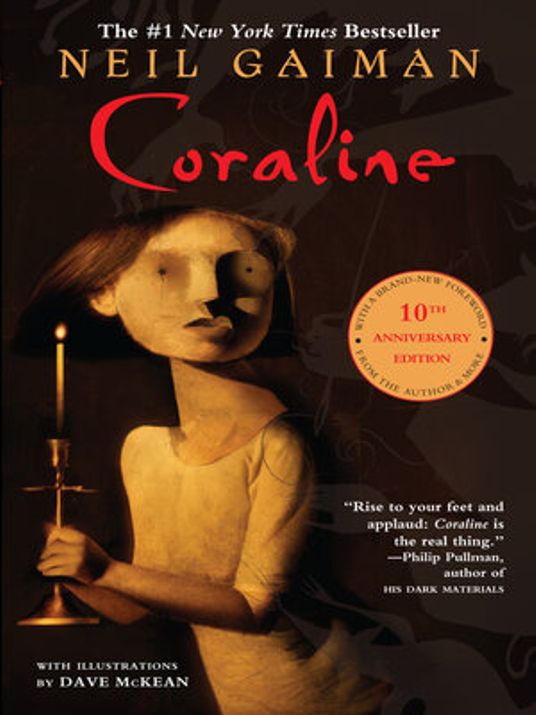
TOPIC – Coraline

Coraline is a children’s novel written by Neil Gaiman, published in 2002 by Bloomsbury and HarperCollins.

It follows a young girl named Coraline as she finds a mysterious door that leads to nowhere in her family’s new flat. However, she quickly discovers that it connects to a tunnel to an alternate world. A world like her own, but different. There are alternate versions of everyone who lives in the house she does, including her Other Mother and Other Father. Everyone has button eyes, and the land doesn’t seem to exist past the house.

Although most people have watched the movie, I think that you should still read the book. It’s different enough that you won’t feel like you’re reading the same story again. For example, Coraline never falls for the Other Mother’s tricks. By the end, Coraline ends up playing a game against the Other Mother. If Coraline wins, she will get to go home, free her parents, and the other children that the Other Mother has trapped before her. If the Other Mother wins, she keeps Coraline. But in the events leading up to that, Coraline was never under the Other Mother’s spell.

The character Wybie also never existed in the book, nor any character that could be compared to him. The character’s appearances are also quite different, as the Other Mother is described as her hair floating around her, as if she was underwater. Coraline does not have blue hair, and the Other Father devolves into a doughy monster, instead of a pumpkin man. There is also a whole scene of Coraline trapped in a basement room with the doughy Other Father, where she has to escape by ripping out one of his button eyes, sneaking up the stairs, and slamming the trap door shut behind her.

I quite enjoyed the book, and read it all in one night.

Coraline by Neil Gaiman is available to check out from the Mission Viejo Library. It is also available to download for free from Libby.

Coraline: Book VS Movie

Aside

Coraline, by Neil Gaiman, is a fictional thriller, originally written as a novel, but later turned into a movie. The basic plot of the story is that a little girl named Coraline and her family move into a new house. Coraline finds a door in their new house that leads to a magical world where everything is perfect. Inside her perfect world, Coraline has ‘Other-Parents’ with sewn on button eyes. They try to convince Coraline to stay with them forever, on the condition that Coraline sews buttons into her eyes. This terrifies Coraline, who then tries to escape.

While I love both versions of the story, there are some major differences between the book and the movie.

Firstly, book Coraline’s parents are much nicer than they are in the movie. In the book, Coraline’s parents are stressed and tired. While they could have been nicer to their daughter, they were very busy and Coraline was being negative and bothersome. In the book, there is a very touching scene where Coraline tells The Cat about when her dad took her ‘adventuring’ and accidentally stepped on a wasp’s nest. Her dad took 39 stings to protect Coraline. So, in the book, Coraline’s parents are much nicer, and Coraline was mostly at fault. Throughout the book, she learns to appreciate her parents. In the movie, Coraline’s parents ignore Coraline and are unnecessarily snappish with her. In my opinion, the movie’s portrayal of Coraline’s parents makes more sense, because her parents’ unkindness is what drives Coraline to prefer the other world.

Secondly, in the book, Coraline visits the other world once and decides she doesn’t want to stay. In the movie, Coraline visits the other world three times before she decides to escape. Coraline in the book is very wary of other world and doesn’t trust her ‘Other Mother’. Movie Coraline was quick to accept the new world and wanted to stay there forever, until she learned that she would have to sew buttons on her eyes.

Thirdly, there is a character in the movie that was not present in the book. His name is Wybie, short for Wyborne. His grandmother’s sister was also taken by the Other Mother. Wybie finds a doll that looks exactly like Coraline, so he gives it to her. The doll was secretly a spy for the Other Mother, trying to find out what Coraline’s insecurities were to lure her to the other world. In the book, both the character Wybie and the doll he found did not exist.

There are many other small differences between the book and the movie (like Mr. Bobo AKA Bobinski, the singing rats, and Coraline’s blue hair), both the book and the movie were excellent. Would recommend!

Coraline by Neil Gaiman is available to checkout from the Mission Viejo Library. It is also available to download for free from Libby.

Norse Mythology by Neil Gaiman

Inspired by Marvel’s Thor franchise as well as the upcoming, Thor: Ragnarok, Gaiman’s book really took hold of my interest, as I could not help but pick it up.  In Norse Mythology, Neil Gaiman re-paints the pictures of ancient Norse mythos to the modern eye, while still keeping true to its roots.  It begins with the legend of creation of the nine worlds, or realms, as also described in the Marvel Cinematic Universe (MCU). There are dwarves and giants, gods and goddesses, and a small section about the mortals living on Earth.  Two topics most compared were, however, the god of thunder and the god of trickery.

Thor and Loki are considered brothers, despite their first introductions: Thor was the son of Odin, and Loki was the son of giants.  There were no definitions of the type of these giants, so the MCU may have created their own story to describe Loki’s past.  Moving past their beginnings, Gaiman takes the reader through an abbreviated retelling of the gods of Asgard and their troubles, especially with Loki.  However, the author kept true to the end, rather called Ragnarok, as the myth goes.

Norse Mythology was quite telling and insightful, as I was able to experience epiphanies, as holes in the myths were filled.  Also an author of comics, intelligent children’s books, and intricate novels of the history of divinity, Neil Gaiman definitely made these myths into a worthwhile story.  Fans of newly-popularized Game of Thrones, as well as the age-old Lord of the Rings, will definitely enjoy this light read for its crossover themes.  Five stars for Gaiman’s Norse Mythology!

Maya S.

Norse Mythology by Neil Gaiman is available for checkout from the Mission Viejo Library. It can also be downloaded for free from Overdrive

Book Review: Good Omens, by Neil Gaiman & Terry Pratchett

good_omens_coverGood Omens is a funny, original book written by British authors Neil Gaiman (Stardust, American Gods) and Terry Pratchett (the Discworld series). It is time for Heaven and Hell to destroy the world in the Biblical apocalypse, and for Adam Young, a normal preteen in a quiet English town, to realize his destiny as the Antichrist. But Crowley and Aziraphale, a demon and angel who have been working on Earth and become friends over six hundred years, decide to defy their respective superiors and save humanity. Meanwhile, the Four Horsepeople of the Apocalypse form a team to trigger the End of Days.

The major strength of this book is its humor, with running gags, half-page-long footnotes, and sarcastic tangents about random aspects of humanity. Aziraphale and Crowley repeatedly attempt to listen to music cassette tapes, only to have them morph into “Best of Queen” albums if left in the car for over two weeks. War, Death, Famine, and Pollution are followed around by four human bikers trying to represent concepts such as No Alcohol Lager, Things Not Working Properly, and All Foreigners Especially The French. Witch-hunter Newt Pulsifer is pulled over by aliens (for no reason) who criticize humans for being a dominant species while under the influence of consumerism. Pratchett’s witty writing style and Gaiman’s inventive fantasy are both evident here.

My favorite part of the book is near the end, where Crowley drives to help Aziraphale in a burning car held together by his own willpower, and proceeds to pick up a tire iron to fight Satan (in contrast to Aziraphale’s flaming angel sword). I also like the depictions of the Horsepeople: War as a beautiful red-haired woman who writes newspaper stories on international conflict, Famine as a thin businessman dressed in black who sells diet foods that make people starve to death, and Pollution as an inconspicuous white-haired young man who helped invent environmentally disastrous products.

If you enjoy satirical books such as Discworld or The Hitchhiker’s Guide to the Galaxy, you should definitely read Good Omens.

-Miranda C., 11th grade