
I’m not entirely sure on how to start this post, so we’ll start from the beginning… (And please excuse my tangent from the standard book review, welcome to an adventure in Japanese pop culture and society!)
 So, this summer I was granted the wonderful opportunity to study abroad in Japan through the program American Field Service (AFS for short, more info at the end of this blog post*). I was placed in Nagoya, the third largest city in Japan, and lived with my wonderful host family for six weeks. During the span of living there I also attended a Japanese language school, to learn more and improve on my Japanese. I am so grateful I was able to experience Japan through this way, because of this I came back home a more outgoing and open minded worldly person, not to mention my Japanese dramatically improved.
I can honestly say I made many new best friends there and through truly immersing and experiencing the culture first hand my view of the world has changed for the better. It may sound a bit cliche and cheesy, but it’s true! Living abroad, let me repeat living, not being a tourist, changes everything about how you view the world, literally with “different eyes.” Ask any exchange student who has come back and genuinely grown from their experiences, I know I have.
As a little about myself, I am of Japanese background so I am and was deeply aware of many Japanese traditions and societal values, but being a Japanese American is entirely different than being a true Japanese person. It is incredible the amount of differences between our two cultures, so although I believe myself to be Japanese, I now know that I am proudly Japanese American. Although the two cultures are dramatically different, there are so many aspects that have been carried to my own life through my ancestry that I only became apparent of with this experience.
So why am I posting this as a blog post you ask? While I was in Japan, I decided to document my experiences in writing on a blog, which before my trip I showed to the lovely Allison Tran (Mission Viejo’s teen services librarian). After my return, she read a majority of my blog posts, she asked that I would write this blog post on different aspects of Japanese pop culture and society. So let’s get started!
Four things about Japanese culture and society that I bet you didn’t know.
(As a quick note: a majority of these things are based off of my own experiences living in Japan, so they may be specific to Nagoya, my host family, or my own experiences. Everyone’s experiences are different, and because of this you may not encounter or experience all the same things that I have.)
1. Japan IS NOT (most of the time) the country it is portrayed as in the “Meanwhile in Japan” memes. Although there are many crazy aspects of Japanese culture that are truly like what you sometimes find while roaming across the internet, there are also huge differences in everyday life as well. I can assure you that any culture has their share of things that would be viewed as “strange” by other cultures or ethnicities. Japan is very much so a culture of opposites, old and new-look at the ancient capital of Kyoto versus modern day Tokyo, people hold values on both ends of the spectrum, and that stuff that you saw in the “Meanwhile in Japan” probably only applies to a fraction of the actual population living there.

Of course Japan has McDonald’s (photo by flickr user Nicky Pallas)
2. Japan and Japanese culture has a lot of adopted things from different cultures. Although they take many things and use them within their own culture, they change it and improve on it, putting a distinctly Japanese twist on it. Food, kanji (adopted Chinese characters), inventions, certain words and vocabulary, social norms of the younger generations, and fashion in Japan, are all things which a fraction of could be traced to another culture of origin. And although Japan does have a large amount of “borrowed” things, they will take it and modify it to be distinctly Japanese and entirely unlike the original imported item of choice. I often experienced culture shock finding so many familiar things there that weren’t all that familiar.
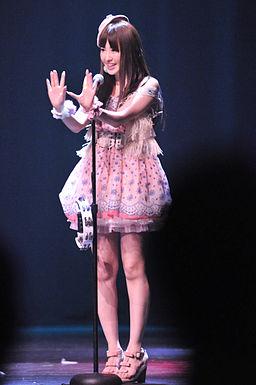
A member of the pop group AKB48 (photo by Dennis Amith)
3. Dramas (basically television shows), manga (Japanese comics), J-pop (Japanese pop music), and anime (animation) isn’t as prominent as you would expect it to be. Of course there is a section in the bookstore of library dedicated to manga, but it’s not as if everyone is an “otaku” (the closest equivalent to this in English is a “geek” or a “nerd” who is obsessed with a certain thing like a certain manga, or anime shows). And yes, of course all of these are much more prominent in the country of their own origin, but I was definitely expecting a lot more. Everyone though does have their own favorites and many anime or manga in Japan could be connected to a certain generation as what they grew up to, similar to us saying we grew up reading dystopian novels that are popular with American teenagers nowadays.
I know I should be mentioning more about these aspects of pop culture so here are some sub-points to this topic:
- Japanese dramas: The standard format of Japanese dramas are around ten to eleven episodes long depending on how well it is received and if liked even more, maybe a second season will be installed. I personally prefer dramas over anime because of the amount of dramas that can truly reveal aspects of daily life and culture in Japan, versus the selection in anime (but this may also be because I haven’t taken the time to actually watch many animes yet). Dramas are basically Japanese television shows, created for a Japanese audience. Since they are produced specifically for a Japanese audience the Japanese humor runs rampant and hilarious. Many Japanese dramas are also adaptations of other mangas, and sometimes animes, and due to the popularity many Korean and Taiwanese versions of the same drama crop up.
- Manga: There are many different styles of manga and genres, very much similar to how one would organize a book collection by genre. Many very successful manga go on to have anime and drama versions. Manga can also be seen as forms of art within the storylines told and art forms themselves. Huge fan bases have been created for various manga, and often times these books are considered real forms of literature with overarching themes that can connect readers to the situations the protagonist is going through. I often read the more girly form of manga named “shoujo,” which isn’t necessarily girly, but known for its emphasis on emotions, relationships between people (not all romantic), and is usually directed towards a target audience of teenage to young adult women (although anyone can read it!)
- J-pop (and other assorted music): Believe it or not, a majority of music is marketed towards the younger generation through television, (if you search through my posts you’ll be able to find mine about the amount of television watched in Japan…if you’re wondering it’s a lot.) There are many channels that are very similar to what MTV was originally, before all the reality TV set in, music artists are invited onto television show to perform and promote themselves. They sometimes have funny challenges for band members to participate in and interview questions so the watcher can learn more about their favorite artist. In this way people in Japan are much more connected to their favorite idol or artist through their television, and these performers probably reveal more things about their own personality and who they are through these shows versus how teens in the United States obtain information about their favorite music artist. It is also interesting to note that there are huge idol groups such as AKB48- which actually has 48 members- formed on the basis of fans being able to connect with at least one of these many girls who have a range of hobbies, likes, and interests. Many J-pop idols are also well into their 30s and 40s for age, yet are still extremely popular. SMAP is Japan’s number one idol group and is composed of members all in their 40s, who aren’t just listened to by women their age, but also by teenagers.
- Anime: Personally I don’t watch a huge amount of anime, but in many cases it could be considered an art form. Much like in the United States there are huge fan bases for popular shows, and many “otaku.” Anime could be comparatively what some people watch in Japan today, versus what we Americans watch as television shows. Many go on for years, a famous example “One Piece” started as a manga in 1997 and is still running having around 400 something episodes. Studio Ghibli, the creators of many classics such as “Spirited Away” and “Totoro” are in particular regarded as one of the highest quality art form of anime produced in Japan.

Students working together to clean their school (photo by Allison Tran)
4. Many people don’t expect this- I certainly didn’t- but everyone works together so well in a group mentality in Japan, versus the mentality of Americans, which emphasizes independence. People act for the betterment of society, for the betterment of their family, or for the betterment of their group, not for individualistic means. I knew my host family’s neighbors extremely well, maybe even better than my neighbors here at home. It’s not as if everyone is extremely self-righteous and friendly towards everyone, but everyone acts more cooperatively and openly with other people. Certainly the culture is shifting a little at the borders and the younger generation may experience it in different ways, but everyone is there to support the others, often placing others before themselves. My own theory for why this came to be is the small size of Japan as a whole, because of this more people have to work harder to understand each other and be a team in times of crisis within the islands. It’s based on the shared experiences of living together, a shared awareness shaped by their own society. Perhaps many other cultures have this as well, but it was highlighted in sharp contrast for me coming from a very American mindset and cultural background.
Oh wow! The memories! You may not believe it, but after living somewhere and truly being a part of the community you may return home and experience homesickness for the country and people you were with before. I can now testify that although I only stayed for around six weeks, I am homesick for Nagoya and I miss my host family and my friends dearly, they have all become like a second family to me. If you would like to check out all of my previous posts and experiences from my time in Japan, check out my blog: http://letters-from-land-of-the-rising-sun.blogspot.com/
I have a bit of a backlog of posts that I started in Japan, but neglected to post, so if you keep reading, I’ll be sure to keep posting!
* As a bit of background related to AFS: A group of young American ambulance workers named the “American Field Service” were sent to France during both world wars to help with aiding the war effort by tending to the wounded French soldiers on the front lines. Many of the young American ambulance workers and French soldiers formed extremely close bonds with one another, becoming almost inseparable friends. The Americans soon realized that one-on-one relationships between people of different countries was major piece of the puzzle in creating world peace, dispelling ethnic stereotypes, and as they said, “breaking down barriers and forming bridges” between different cultures. As soon as World War II ended they decided to do something to recreate the great friendships they encountered with the French soldiers for other people as well. In 1947 the first student exchanges were started. Since then AFS has been promoting positive diplomatic relationships between countries through high school age student exchange. I honestly belief that AFS is an amazing organization that is achieving what was originally intended to occur- the promotion of better country relations and the dispelling of racial stereotypes through one-on-one relations between people of different cultures.
Ok, thanks for reading through such a long post! I hope you learned a little more about Japan, and rid yourself of some stereotypes!
-Sophia U., 11th grade





 Mission Viejo Library Teen Voice