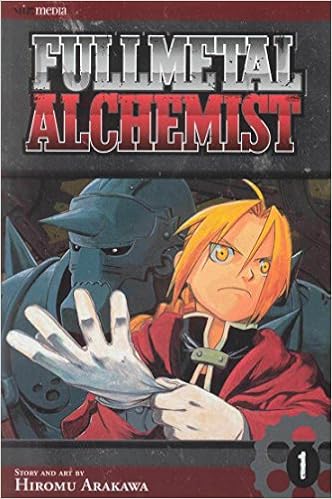
Fullmetal Alchemist by Hiromu Arakawa

What is your wish? Gold? Immortality? Fame? Whatever it might be, you can have it!

So long as you’re willing to pay the price for it. How about sacrificing your first born son to get gold? Dying every time you got hurt in exchange for almost immortal like powers? Or even killing a whole town to gain fame!

You see, with alchemy, you can gain anything you want, but the rule of alchemy is that for everything made there is an equal amount that must be given back. Water is needed to instantly make ice, trees in order to make paper. And brothers Edward and Alphonse Elric have just learned the hard way that in order to bring their dead mother back to life, Edward must sacrifice a leg and Alphonse his whole body. And then, Edward sacrificed his arm to put his brother’s soul upon a suit of armor.

Now, Edward and Alphonse have vowed to get their bodies back, or at least Al’s trying to get his back, as Ed wants to keep his leg as a reminder. They travel the world as “dogs of the military”, Ed with a fullmetal arm and leg, and Al in his armor body. Of course, they have heard of the Philosopher’s stone, the stone that defies the rules of alchemy, but they vowed never to use it. And it was good that they did so, as some evil is distributing fake Philosopher’s stones.

This manga is legendary, and deserves the credit it has. It has been rated by many manga sites as one of the top three mangas ever, and, although it is not the best art, the story is amazing. Not only does the manga have some high depth philosophical elements, but it also has some very good tragic and comedy moments, including the most well known death scene in anime and a ferocious mini panda that considers weak humans worse than food.

Additionally, I love that while it goes over how far one is willing to pay for their wishes, it also gets into immortality. For example, the story gets into how two different people crossed a huge desert just to get immortality. Furthermore, there is even one guy who has immortality, though never really wanted and is now faced with the burden of people calling him a monster, seeing people he loves die before him, and the great sin of what he did to gain immortality.

Not only is this manga well known, it was made by a woman. It is extremely rare for action manga to be created by a women, and I can only think of seven other women who can say that they have written a famous action manga, with only two of those rivaling this amazing woman. So, feminists, rejoice by reading a manga that is not only made by a woman, but features a female role model who is in the military and the other women in the manga are not content with just “waiting”.

Finally, the spacing and ending for this manga is incredible! This manga ended a while ago, but I can think of no better way to end the story. I did read Beezelbub, which ran shorter than Fullmetal Alchemist and had a pretty good ending, but I finished reading it feeling that there could have been more the author could have touched on. I have also read Bleach and Naruto, both longer than Fullmetal Alchemist, but Naruto had an okay ending and Bleach had an ending that is to not be spoken of. However, Fullmetal Alchemist was perfect in this regard. Not only did it tie in stuff from the first chapters, such as us meeting the same characters from chapter one near the end, but Ed and Al get their bodies in a way that best suited the characters. The villains died in such a way that the reader feels satisfied, and everyone gets an ending that not only shows what they’re doing in the future, but also shows so much hope for them in the future. This way was really perfect, and I can see no flaws (other than the fact that I felt that one of the very good villains died way earlier than the rest of the very good villains, but that was it).

Once I again, even for non manga lovers, if there is any manga you should read before you die, it is this one.

Megan V,

The Storyteller by Jodi Picoult

At the suggestion from a comment on this blog, I decided to read The Storyteller, by Jodi Picoult. I had high expectations for the novel, as I read and thoroughly enjoyed My Sister’s Keeper. The novel did not disappoint.

The story follows Sage Singer, a baker who has shut herself away from the rest of the world. She goes to a grief group, but outside of that, she hides her face from the rest of the world. Even Adam, with whom she has a complicated relationship, may just be pitying her. And then she meets Josef Weber, a nonagenarian with a lingering German accent who has a mysterious request: For Sage to help Josef kill himself.

Why her? you may ask. They just met… Well, Sage’s family, except for Sage herself, is Jewish. And Josef… he swears he was an SS Officer.

What makes this novel touching is how the characters relate to one another. They each deal with their own internal struggle and it is incredible to watch them grow to trust one another, or to betray the other. I loved that the story was interrupted by an extensive account of a young girl’s experience in concentration camps, because it made the novel feel not only like a moral decision in the present day but relevant to how history proves to repeat itself.

This was one of the greatest stories I have read in a while. I strongly recommend this novel. It deserves a 10 out of 10.

– Leila S., 11th grade

Authors We Love: Rick Riordan

Rick Riordan was definitely one of my favorite authors.  He is the writer of the Percy Jackson series, the Heroes of Olympus series, the Kane Chronicles, and the Magnus Chase series. Riordan’s books take ancient mythology and weave it into modern-day stories of adventures.

The Percy Jackson series, which was his first series, revolves around a boy named Percy Jackson who learns that he is a demigod — a son of Poseidon. You follow Percy and his friends, Annabeth and Grover, as well as others, in adventures while learning about Greek Mythology. Placed in a world where Greek Mythology is fact, Riordan does a fabulous job writing this series. When you start reading, you aren’t going to want to put the book down. I think that this is one of the best series of books he has written.

The Heroes Of Olympus series is, in a way, a continuation of the Percy Jackson series. However, it adds new characters and involves both Greek and Roman mythology. This series was just as great as the Percy Jackson series and had me intrigued till the end.

The Kane Chronicles revolves around Egyptian Mythology and a brother and sister, Carter and Sadie. Though, out of all the series’ Rick Riordan has written, this is my least favorite, but it is still good. To me, it was just not quite as captivating as some of his other pieces of writing. I would still recommend reading it, though, because it still a really good story.

The Magnus Chase series is about a boy named Magnus Chase and Norse Mythology. It is a really cool series, especially because you get to learn a little bit about Norse Mythology — something that you really won’t know much about other than the fact that Thor and Loki are Norse Gods.

All of Riordan’s writings are a great way to not only get lost in a book, but to learn about ancient mythology in a new and exciting way. All of his books are pretty easy to read, but they can entertain you for hours. Overall, he is just a fabulous writer and I would recommend any of his books.

-Ava G.

The Book of Cthulhu edited by Ross E. Lockhart

H.P. Lovecraft brought horror fiction into existence with his tales of eldritch monsters and otherworldly beings. Now, editor Ross E. Lockhart has compiled The Book of Cthulhu, a collection of short stories, as a tribute to the Cthulhu Mythos story cycle first created by Lovecraft himself. The book is an anthology of short horror stories with a variety of topics yet all containing the familiar dread of Lovecraft.

The unique genre is Lovecraftian horror, which features the supernatural and the extraterrestrial. Within his stories of the occult, Lovecraft was famous for using dread instead of shock and gore. Instead of trying to scare the reader through cheesy ghost stories or bloody axe killers, Lovecraftian literature creates feelings of insignificance, helplessness, and awe. A common theme is the insignificance of humanity. Humans are merely specks of dust in the vast universe, completely at the mercy of ancient or even ageless beings. Aliens and elder gods from different worlds and dimensions exist that could annihilate humankind on a whim. Lovecraft’s universe holds creatures so monstrous and beyond comprehension that even knowledge of them drives men to insanity.

The authors from The Book of Cthulhu continue Lovecraft’s tradition. The first short story, Andromeda Among the Stones, highlights the best aspects of Lovecraft. A family by the edge of the sea must sacrifice everything to guard a portal against the eldritch beings on the other side. Out of all of the stories in the anthology, this short story perhaps best embodies Lovecraft’s sense of awe and dread of the unknown.

My personal favorite story is A Colder War, set in the Cold War era. The world’s superpowers attempt to understand and harness the alien beings as weapons. These elder gods trivialize humanity’s nuclear arms and ultimately threaten to consume this world and other worlds.

The Book of Cthulhu is a worthwhile and thought-provoking read that will put earthly matters into perspective. Although the stories are sometimes hit or miss, each author offers their own style infused with Lovecraft, making it a varied and interesting anthology. The stories often require the reader to grasp the context very quickly, and it often feels as if the short stories are lacking exposition. On the other hand, this adds to the mysterious atmosphere that Lovecraft was so famous for. The anthology is a proper modern tribute to Lovecraft that will leave readers feeling a little tinier than before.

-Phillip X.

The Secret History by Donna Tartt

With a plan to hide, paranoia to battle, and friendships to question, a group of five college students deal with the psychological punishment of murdering their sixth member: Bunny Corcoran.

The Secret History, by Pulitzer Prize winner Donna Tartt, is deep, fascinating, and full of aesthetic-driven description. Richard Papen, a poor college student from California, transfers to Hampden College in Vermont in order to escape his old life. There, he can’t help but be entranced by a group of mysterious young adults that saunter around the campus disconnected from the rest of the student body. Belonging to the highly exclusive Classics major taught by Julian Morrow, those five students have a divine air about them that Richard can’t resist. Securing his spot in their class, Richard is dragged into much more than a new group of friends: relationships full of hidden truths, a wild secret to keep that he never saw coming, and brewing plot of even more horrible proportion. Join Richard as he learns what friendship with Henry Winter, Francis Abernathy, Bunny Corcoran, and the Macaulay twins really means.

From the overlying theme to direct references, Donna Tartt draws heavily from Fyodor Dostoyesky’s Crime and Punishment. Both stories deal with how a seemingly justified murder affects the murderer’s mental state, driving them to extreme paranoia and desperation for relief. Both books open with a murder, Crime and Punishment’s happening about 20% of the way in while The Secret History‘s is described in the prologue. While Crime and Punishment reads chronologically, The Secret History tells the reader about the murder first, then flashes back months before, carrying through the murder and on to what happens after. Having just read Crime and Punishment, the parallels stand out. Reading about a variety of characters’ reactions in The Secret History is far more interesting than that of the sole guilty soul in Crime and Punishment.

Donna Tartt’s writing style is beautiful, oftentimes bringing me to pause and reflect. I grew to care so much about her tragic characters, and her writing brought me to be truly shocked or pitiful or furious right when she wanted me to be. I couldn’t predict any of the twists this book offered, which is a sign of a well-written story. This new adult/murder mystery novel was thrilling to read, and it’s a story that will last with me for a long time. Thought-provoking, genius, and beautiful, The Secret History is well worth the read.

-Abby F., 12th Grade

The Secret History by Donna Tartt is available for checkout from the Mission Viejo Library. It can also be downloaded for free from Overdrive and Hoopla.

Every Falling Star: the True Story of How I Escaped North Korea by Sungju Lee and Susan McClelland

In utopian societies, life is perfect.  To young Sungju Lee, this was North Korea.  His father, an army general, was his greatest hero.  Someday, Sungju would fight in the North Korean army to beat the nasty Americans and cruel South Koreans.  In fact, when he was little, he and his father used to play a game with his father teaching young Sungju the ways of war.  North Korea would always win, for in Sungju’s mind, it was the best country in the world!  One of the strategies he used was a series of stones.  If a hideout was overtaken or deemed unsafe for the soldiers to return to, stones would be placed in front.  Little did Sungju know, this strategy would save his life.

One day, Sungju came home from school to find his parents packing up their things.  Sungju wondered if they were going to vacation to the ocean like he wanted.  But, instead they were going to the country.  Sungju then asked about where his dog would go while the Lees were on vacation.  His mother shamed him for asking, and Sungju felt bad.  He needed to be a good son so he could be in the regime and in the ranks of North Korea’s Eternal Leader, Kim II-sung.  As time passed and despite his complaints, Sungju would never return to Pyongyang.

Throughout the author’s heartbreaking story, I kept trying to push him forward.  I thought of the song “When You Believe” sung by Whitney Houston and Mariah Carey.  The lyrics speak of hope, and it was this hope which I was trying to infuse in Lee.  He endured many hardships at the tender age of 11 and suffered for five years before finally escaping the torment of his country.  Compared to other books highlighting political struggles and the impact on its citizens, this was one of the most compelling stories.  Unlike Chinese Cinderella, a deeply saddening story of a disowned little girl, everybody around Sungju loved him.  They were trying their hardest to make ends meet, but to say more would take away from Sungju’s story.

On a scale of 1 to10, Every Falling Star definitely deserves a 9 for its well-written passages and amazingly illustrated emotion.  Because Lee was not a native English speaker, when he came to the United States, he received help from Susan McClelland to lay out his story.  After finishing the book, I read an excerpt from him, saying that many of the characters’ (family members and brothers) names were changed because they were still living in North Korea.  This was done to protect them.  Please check out this book and be drawn into an intriguing story of overcoming life’s worst obstacles.

-Maya S.

Every Falling Star by Sungju Lee is available for checkout from the Mission Viejo Library

Code Talker: A Novel About the Navajo Marines of World War Two by Joseph Bruchac

Code Talker: A Novel About the Navajo Marines of World War Two, by Joseph Bruchac, is based on the Navajo code talkers during World War II who created a secret code based on their language to be able to send and receive messages that wouldn’t be deciphered. It is told from the point of view of a former Navajo Marine who is talking to his grandchildren, so the book is relatively fast-paced since it goes through a span of a few years pretty quickly and doesn’t go extremely in-depth. It starts off with the main character going to an American boarding school, and continues through until a bit after the end of the war with the Japanese.

The book highlighted a part of World War II that I never knew about, and emphasized the importance of the code talkers during the War of the Pacific with Japan. It also focused on the personal reactions of the main character to the things around him and the way he uses his culture and the “Navajo way” to help him deal with his surroundings. The book also goes over some of the prejudice that the Native Americans went through and the way they overcame it by showing that they were capable of handling their jobs. Overall, the book summarizes a lot, but it was cool to learn about historical facts that I’d never heard of before, the different islands that were battled over, and the Japanese and American defense and attack strategies.

Personally, reading this book came at a good time for me, since I started reading it right before we learned about WWII at school. I really liked it, although I felt that it could have gone more into depth about some of the things that happened and the people around the protagonist. I do think the way it was written was appropriate, though, because it was written like a person would probably tell a story about serving in war to young kids, while having to remember the things that happened.

-Aliya A.