Code Talker: A Novel About the Navajo Marines of World War Two by Joseph Bruchac

Code Talker: A Novel About the Navajo Marines of World War Two, by Joseph Bruchac, is based on the Navajo code talkers during World War II who created a secret code based on their language to be able to send and receive messages that wouldn’t be deciphered. It is told from the point of view of a former Navajo Marine who is talking to his grandchildren, so the book is relatively fast-paced since it goes through a span of a few years pretty quickly and doesn’t go extremely in-depth. It starts off with the main character going to an American boarding school, and continues through until a bit after the end of the war with the Japanese.

The book highlighted a part of World War II that I never knew about, and emphasized the importance of the code talkers during the War of the Pacific with Japan. It also focused on the personal reactions of the main character to the things around him and the way he uses his culture and the “Navajo way” to help him deal with his surroundings. The book also goes over some of the prejudice that the Native Americans went through and the way they overcame it by showing that they were capable of handling their jobs. Overall, the book summarizes a lot, but it was cool to learn about historical facts that I’d never heard of before, the different islands that were battled over, and the Japanese and American defense and attack strategies.

Personally, reading this book came at a good time for me, since I started reading it right before we learned about WWII at school. I really liked it, although I felt that it could have gone more into depth about some of the things that happened and the people around the protagonist. I do think the way it was written was appropriate, though, because it was written like a person would probably tell a story about serving in war to young kids, while having to remember the things that happened.

-Aliya A.

Code Talker: A Novel About the Navajo Marines of World War Two by Joseph Bruchac

Code Talker: A Novel About the Navajo Marines of World War Two, by Joseph Bruchac, is based on the Navajo code talkers during World War II who created a secret code based on their language to be able to send and receive messages that wouldn’t be deciphered. It is told from the point of view of a former Navajo Marine who is talking to his grandchildren, so the book is relatively fast-paced since it goes through a span of a few years pretty quickly and doesn’t go extremely in-depth. It starts off with the main character going to an American boarding school, and continues through until the end of the war with the Japanese.

The book highlighted a part of World War II in the Pacific that I never knew about, and emphasized the importance of the code talkers during the war with the Japanese. It also focused on the personal reactions of the main character to the things around him and the way he uses his culture and the “Navajo way” to help him deal with his surroundings. The book also goes over some of the prejudice that the Native Americans went through and the way they overcame it by showing that they were capable of handling their jobs. Overall, the book summarizes a lot, but it was cool to learn about historical facts that I’d never heard of before, the different islands that were battled over, and the the Japanese and American defense and attack strategies.

Personally, reading this book came at a good time for me, since I started reading it right before we learned about WWII at school and the war with the Japanese. I really liked it, although I felt that it could have gone more into depth about some of the things that happened and the people around the protagonist, but it was written like a person would probably tell a story about serving in war to young kids while at the same time remembering the things that happened, so I think that the way it was written was appropriate.  I would definitely recommend it to anyone interested in history and WWII.

-Aliya A.

Code Talker: A Novel About the Navajo Marines of World War Two by Joseph Bruchac is available for checkout from the Mission Viejo Library

The Three Musketeers by Alexandre Dumas

threemusketeers_alexandredumasThe Three Musketeers, by Alexandre Dumas, was written in 1844. Set in France in 1625, it takes place during the reign of Louis XIII, with Cardinal Richelieu as his advisor. D’Artagnan leaves his home in Gascony and goes to Paris to join the Musketeers. At an inn on the way, he gets into some trouble and has the “letter of recommendation” his father had written for him stolen. When he gets to Paris, D’Artagnan visits the captain of the Musketeers, but is not admitted due to the fact that he does not have the letter. As the story progresses, D’Artagnan meets the three musketeers that he is to be good friends with, and gets caught up in political intrigues, of which some he involves his friends.

I liked this book because I remembered learning about this part of history at school, so it was a bit more enjoyable because I knew the historical background of the political characters (like the King, Richelieu, Queen, etc.). I also enjoyed reading it because the characters had distinct personalities and were not flat, and they each had their own flaws. Although I did not remember the description of each main character and their lackeys that was near the beginning of the book, I realized their personalities as I read so it was nice to not have to continually refer to earlier parts of the book to remember which character was which.

-Aliya A.

The Three Musketeers by Alexandre Dumas is available for checkout from the Mission Viejo Library. It can also be downloaded for free from Hoopla

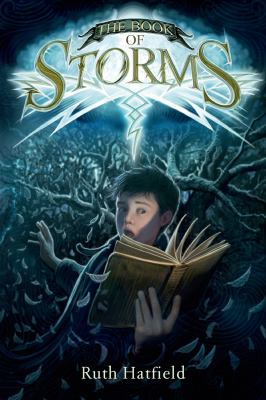
The Book of Storms by Ruth Hatfield

bookofstorms_ruthhatfieldThe Book of Storms, by Ruth Hatfield, is a book that I found to be aimed towards middle school readers. The writing is not difficult, and though there are some clichés in the plot, it was a good read. The book starts off with the main character, Danny, who wakes up alone in the morning and finds that his parents are gone. Now, the reader learns that it is not unusual for his parents to be gone for the night, as they are often chasing storms, but also that they always come back the next morning. Danny attempts to do everything normally, just as he would if his parents had been there, even going to school. He hopes that they will be home when he comes back, but they are not.

After looking around his house again in search of his parents, Danny finds a notebook containing information that is to help him in the search for his parents. Outside his home, he finds a twig with which he finds that he can speak to plants and animals, including the neighbor’s cat .  Along the way, as he is trying to find his parents, he will face a powerful foe (who is kind of like the Devil, but the book mentions that it isn’t actually), whose intentions are not fully revealed until later on in the novel. This person is trying to get Danny’s “Taro” (his twig), for his ulterior motives.

I found the book to be interesting, mainly because I haven’t read another book with a plot or idea like it, although it could have been somewhat improved.

-Aliya A.

The Book of Storms by Ruth Hatfield is available for checkout from the Mission Viejo Library

TV Review: Netflix’s A Series of Unfortunate Events

maxresdefaultA Series of Unfortunate Events, released on Netflix, is taken from the book series A Series of Unfortunate Events by Lemony Snicket. I watched the show, and, personally, I really liked it. I had read the books a few years ago, so I don’t remember exactly how similar the series and the books are, but the way that the Netflix series is set up was intriguing. The narrator (Lemony Snicket), is played by Patrick Warburton, and repeatedly breaks the fourth wall as he explains what is going on with the Baudelaire orphans. The children lose their parents, as they did in the books, and have an incompetent adult looking after them, something viewers will quickly realize after watching the children’s first meeting with them. Also similar to the books, Count Olaf is constantly trying to get the children’s’ fortune. The end of the show (if I remember correctly, it’s only eight episodes) ends on a cliffhanger, since it doesn’t finish the whole book series, but ends somewhere in the middle of the series.

Throughout the series, there were moments where I was face-palming myself or getting mad at the characters (mostly the adults), but overall I really liked the acting and the plot. Again, I don’t exactly remember how things went in the original series, but I thought that a lot of the acting personified the book characters. I would definitely recommend this show to anyone interested, especially if they’ve already read the books.

-Aliya A.

The Runaway Jury by John Grisham

johngrisham_runawayjuryThe Runaway Jury, by John Grisham, is a legal thriller. The book centers on a big tobacco trial, decided by a jury. The verdict the jury passes could have disastrous consequences on tobacco companies or potentially protect them from lawsuits in the future. There is one potential juror that both sides – the plaintiff and the defendant  – are concerned about, because they have no record of him whatsoever. He is, to them, an enigma. This juror, as it turns out, is extremely important in the jury’s decision although I realized it would be hard to see what was going on if I had put myself in one of the other juror’s shoes. As the main driving point of the book, this quote sufficiently encapsulates it: “Every jury has a leader, and that’s where you find your verdict.” With both the plaintiff and the defendant realizing the high stakes, both sides try to influence the jury, although this is illegal and can cause there to be a mistrial. In the end, most efforts do not affect the end decision, although there are some humorous events regarding the eventual effect of some of the attempts at trying to sway a juror.

I thought this book was well-written, and although I had not initially planned to read it, I’m glad I did. Grisham kept me guessing the whole time which way the jury was going to vote, and what the motives of the main juror, Nicholas Easter, were. I would recommend this book to anyone who likes reading thrillers, although there is less of a scary side to it than other thrillers I’ve read.

The Runaway Jury is available for checkout from the Mission Viejo Library

Narrative of the Life of Frederick Douglass by Frederick Douglass

narrativeonthelifeoffrederikdouglassFrederick Douglass was an author and speaker in the 1800s, a human rights leader in the anti-slavery movement who had been a former slave.

In his slave narrative, the Narrative of the Life of Frederick Douglass, Frederick Douglass recounts his life in slavery, and how he went from a plantation to living in a city, and vice versa. The examples he makes to illustrate points are effective, in that they show the reader different aspects of the slave system. Douglass details the evils of slavery, pointing out many ways that slave owners subjugate their slaves, both physically (though this was alluded to concerning Douglass himself, there are other graphic examples that highlight the slaveholders’ brutality), and mentally. However, Douglass does make distinctions between different slave-owners, and shows the reader (at the time the audience were people in the North) that, since all slave-owners were not the same person, that they had different personalities and dealt with their slaves in different ways. Though opportunities in Birmingham allowed him to first see the road to freedom, Douglass did not, as he grew older, keep the knowledge to himself, and throughout the narrative establishes that he wants all slaves to lead a free life.

I liked reading this narrative by a historically large figure for a few reasons. For one , it didn’t only bring to light the evils of slavery – evils that most people know the general gist of, like whipping, physical and mental abuse, etc., but also gave specific examples of things that an actual slave experienced and was not simply derived from historical documents written by white plantation owners or visiting people. On top of that, I thought that this narrative was well-written despite its shortness.

-Aliya A.

Narrative of the Life of Frederick Douglass is available for checkout from the Mission Viejo Library

The Google Art Project

The Google Art Project is a vast collection of art and from different museums from all over the world that can be visited without leaving the house. There are many benefits to visiting this online museum, and while these benefits are very helpful, some could be improved.

As I was exploring the different features, I found many perks in visiting the Google Art Project. For example, I found a panel that grouped pieces of art by the artist, medium, art movement, historical events or figures, and places. This was nice because it allowed me to find many art pieces in a certain category. One of my favorite things while visiting this online museum was the zoom feature, which lets me see finer details, such as printed text and small, intricate designs left by the artist, I would not have otherwise been able to see had I gone to a regular museum. The drawback to this, however, was that although I could see the artwork in more detail, it took a long time to load when I wanted to zoom in very closely, so it wastes some time, too. Another helpful thing the museum has is virtual tours of some museums.

The Google Art Project, in making art and museums more accessible to the general public, allows people to appreciate art and history to a greater degree, and I believe that this is important in a society. While the Art Project could be improved and expanded, I think that it’s a good start in allowing more people who may not have the time or don’t live close to a museum to access artworks.

-Aliya A.

The Adventures of Tom Sawyer

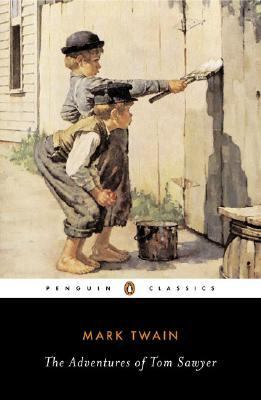
adventuresoftomsawyer_marktwainThe Adventures of Tom Sawyer, by Mark Twain, chronicles a few of the adventures of 12-year-old Tom Sawyer. Living on the Mississippi River, Tom lives with his Aunt Polly and his half-brother Sid. Tom gets into many misadventures and he just as deftly gets out of them. At times, when Tom is punished, one can see how he gets out of trouble and chores by manipulating his friends (though not necessarily in devious ways).

Tom and his friend, Huckleberry Finn (the subject of another book by Mark Twain, The Adventures of Huckleberry Finn), get into all kinds of trouble, from seeing things they were not meant to see, to running away with friend Joe Harper to an island, to going treasure hunting and discovering a dangerous secret. Tom also indulges in more normal pastimes, like playing pretend and going on picnics (though he does get lost in a cave with Becky Thatcher, a girl he is trying to impress). Overall, I thought that this book was a good read, as it was relaxing in some places and funny in others. Plus, in addition to being a nice book about the adventures of a child in the past, it also had some moments where I was figuratively gripping the edge of my seat to see what happened next.

-Aliya A.

The Adventures of Tom Sawyer is available to checkout from the Mission Viejo Library

Essay: A Tale of Two Cities and the Conditions Before the French Revolution

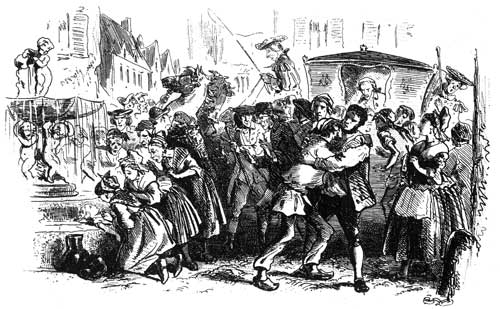
In A Tale of Two Cities, Charles Dickens uses diction to adopt a tone of pity toward the social conditions of France during the period before the French Revolution. At the beginning of the novel a barrel of wine spills, and the people are depicted as having “devoted themselves to the sodden and lee-dyed pieces of the cask, licking, and even champing, the moister wine-rotted fragments with eager relish.” The use of the word “devoted” implies that the poor do not have the freedom to eat when they want, as once the wine cask breaks, everyone quickly drops what they are doing so that they can get a few drops of spilled wine off of the street, and they are so desperate for food that they are not letting go of the fragments of wood. Using the words “champing” and “eager relish,” Dickens demonstrates how, although it was just wood, people still excitedly bit and chewed it with enjoyment and delight, attesting to the fact that the peasants of France are so poor and starved that they have to resort to chewing on rotten wood to get a few drops of wine for nourishment, something that someone who might be even marginally better off would not have even thought of doing.

Later on, Dickens describes how “Hunger was the inscription on the baker’s shelves, written in every small loaf of his scanty stock of bad bread”. The word “scanty” to describe the baker’s stock of “bad” bread emphasizes how there is not enough food for the peasants (which eventually led to the peasant women marching to the palace and taking Louis XVI back to Paris), because although it is the baker’s job to supply the people with food, even he does not have a full larder. The fact that the baker has bad bread demonstrates that bread, which was the staple food of the French diet, is running out or is not being consumed, because the baker does not have enough supplies or resources to make fresh bread as a result of no one being able to buy the bread in the first place. These examples serve to highlight the tone of pity Dickens adopts toward the condition of the peasants in France, as they are reduced to scavenging for food and are not able to sustain themselves, and implies that they had a good reason to rebel. The author’s words serve to highlight the reality of the peasants before the French Revolution, which helped me understand to a greater degree how bad the situation had been, as opposed to just reading the facts in a textbook or article.

-Aliya A.