The Boys Who Challenged Hitler by Phillip Hoose

boyswhochallengedhitler_philliphooseThe year is 1940, the dawn of World War II, and Demark is under German attack. Very few are fighting back, taking a stand or doing anything other than watching from the sidelines as disaster unfolds. Knud Pedersen, 15 years old, will not fall without a fight. Knud wants the German soldiers to go home. This reminded me of the song “Get Back” by the Beatles, especially the line “Get back to where you once belonged.” He believed, much like many, that the Germans did not have permission to take control over the Danish.

So, he and his brother, Jens, along with a handful of schoolmates took action against the Nazis unlike their “role model” parents. Knud first put together a group called the RAF club, named after British pilots. Anyone who was willing to prove that they would do anything to rebel and stand tall for Denmark’s freedom was gladly accepted. This was the beginning of their rebellious acts. But, after busting German signs and vandalizing brick walls with their insignia, the Pederson family moved. But, did this stop them? Persevering for what they believed in, in their new town, they organized another group, still without their parents’ knowledge. Naming their secret club after the fiery British leader, the young patriots in the Churchill Club committed countless acts of sabotage, infuriating the Germans, who eventually had the boys tracked down and arrested. But their efforts were not in vain: the boys’ abuse and eventual imprisonment helped ignite a full-blown Danish resistance. Combining his own narrative with the recollections of Knud himself, Phillip Hoose tells this inspiring story of these young war heroes.

At the end of this motivational story, I was reminded of the song, “I Will Be Heard” by Hatebreed. This song just brought back the memories of this book, and how the whole time, the message the Churchill Club was sending was that they wanted to be heard. A short story, but still an empowering one, I would give The Boys Who Challenged Hitler a 10/10 for its gruesome adventure and determination.

-Maya S.

The Boys Who Challenged Hitler is available for check out from the Mission Viejo Public Library.

Taking Flight by Michaela and Elaina DePrince

takingflight_michaeladeprince“There’s not a mother in this world who would watch her child,
Cry in the street stand and watch her weep
There’s not a mother in this world who wouldn’t give
Up her own life for the life of her child”

-Abdulla Rolle, an established international nasheed writer and artist

The story of Michaela DePrince is one that I will never forget. Between its heartfelt message, its bittersweet moments, and its heart wrenching beginning, the hope of this little war orphan could keep an entire country motivated in such crisis.

A little girl by the name of Mabinty lived a pretty joyous life in a small, poor town in South Africa. Her father worked in the diamond mines while her mother stayed home to help educate Mabinty, for it was unlikely that this tiny girl would get married because of her appearance of white spots covering her neck, arms, and legs. She was considered a devil’s child because of this condition, for only the devil would give birth to such a wretched creature. Under her parents’ tutelage, by the age of 3 Mabinty could read Arabic and speak 5 languages. However, one day news came from the diamond mines that the rebels attacked and Mabinty’s father had been shot. To make matters worse, her uncle, who lived next door, deceivingly took over the girls along with all of Mabinty’s college savings. Then, afflicted by sickness and mistreatment, Mabinty’s mother died. Mabinty was promptly taken to an orphanage because her uncle, believing her to be the devil’s child, knew he wouldn’t get a good deal in marrying her off.

At the refugee orphanage, there were nannies, but not the Mary Poppins type. This type worked only to earn money for their household. They played favorites out of the 27 little war orphans. The beloved number one child would receive the best meals and first choice clothing. However, number 27 would get the smallest portion to eat and the last picked clothing. Mabinty was number 27. Her time at the orphanage was awful, but she still tried to bring her own light to it. She made a friend though with Number 26, whose name was also Mabinty. Number 26 cared for her much like a mother would. She would read to Mabinty when Mabinty couldn’t sleep. Number 26 would sing to her when it was raining or if Mabinty was sad. One day a wind pushed a magazine against the orphanage gates. On the front cover was the picture of a woman in a beautiful costume standing on her tippy toes. But what intrigued Mabinty was the fact that the woman looked overjoyed to be in this position. She ripped off the cover and stuck it inside the only thing that was hers, her underpants. Mabinty later learned from Teacher Sara(h) that the woman was a ballerina. So Mabinty would stretch and flex every day, mimicking the positions of the ballerina, hoping that someday she would become a ballerina.

Time passed and the children of the orphanage learned they would be adopted by American families. Twenty-six of the children had assigned families, but nobody wanted a spotted child. Incredibly, Mabinty and her best friend, number 26, were adopted together. Upon meeting her new mama, 4-year old Mabinty searched the hotel room for pointed shoes or a pink dress or tiara but found nothing. Since she spoke very little English at that point, she pulled out of her underwear the picture of the ballerina and showed it to her new mama. Her mom smiled and said she would dance. Mabinty and Number 26 wanted new American names. Mabinty became Michaela DePrince and number 26, Mia DePrince. Michaela and Mia, once settled in their new homes, both started ballet and dance classes. And, by age ten Michaela was in an upper class, dancing five times a week. Michaela DePrince is an inspiration, and this book follows her fight against all odds. The song at the beginning of this post really describes the whole book, and to me, the meaning of life. This was an amazing book, and I really encourage others to explore more about Michaela DePrince through this book, her movie, TED talks, and inspirational videos.

“Oh people of the world
Can we spare a little justice can we spare a little peace
For the children of war
Oh people of the world
Can we spare a little love can we spare a little prayer
For the children of war”

-Abdullah Rolle


-Maya S., 8th grade

Taking Flight is available for check out from the Mission Viejo Public Library.

Greenglass House by Kate Milford

greenglasshouse_katemilfordWinter vacation. An inn for criminals. Two maps.  One massive adventure. Milo and Meddy, together.  This story begins with a young boy named Milo, returning from his last day of school before Christmas break.  It has started to snow, and he has finished his homework so he can have some fun, but some strange things start to happen.  He and his family, the Pines, live and work at an inn called the Greenglass House.  For a long, long time, it has been the temporary home of several harmless thieves, smugglers, and other suspicious criminals.  Winter is a slow time for the hotel, and customers are rare near the holidays.  However, this year it’s different.  Just as Milo shuts his math book, he hears the distant ring of the bell.  He and his mother, Mrs. Pine, rush outside to see a man trudging up the snow covered front steps.  The man introduces himself, and throughout the course of the afternoon, so do ten other guests, as he is the first of many to stop by this night.  Eleven in total arrive at the Greenglass House, while Milo is thinking this could quite possibly be the worst Christmas vacation ever.  Milo was miserable until a certain girl named Meddy comes to stay as well.

After just one day, Meddy and Milo seem to become the best of friends. Milo shows Meddy a map he found suspiciously left in a rail car.  It is quite a unique map. The two aren’t sure what it is showing, but they believe it is some kind of waterway.  This creates a curiosity in young Meddy.  In her attempt to cheer Milo up, she has an idea for a fun game they could play together.  The basic objective is to find out what the map is and whether treasure exists.  And you have to play while adopting fake characters.  They decide Milo will be a blackjack, the leader, clever and athletic, while Meddy will be incognito.  Milo’s new name is Negret and Meddy’s, Sirin.

They begin their quest in the attic where they find materials such as clothes for Sirin and necessities for Negret.  The game gets pretty fun until one morning, some of the inn’s inhabitants wake up to find they have been robbed.  The two friends put aside the game to search for the missing items.  At this point in the book, I thought of the song, Smooth Criminal, by Michael Jackson.  The tune and lyrics struck me as the smooth criminal in the story left no leading clues from his theft.  As the storyline develops, things start to get intense, violent, and secrets are out in the open.  At this point, I’m questioning whether the situations will be resolved and whether I would be able to hum Happy by Pharell Williams by the last page.

This story twists and twists into a whole new plot.  It changed so much that I vaguely remembered the beginning!  Kudos to Kate Milford on Greenglass House.  This well-written and heartwarming novel deserves 10/10 stars.

-Maya S.

Greenglass House is available for check out from the Mission Viejo Public Library

Spy Camp by Stuart Gibbs

spycamp_stuartgibbsStuart Gibbs wrote Spy Camp as a sequel to his first espionage novel, Spy School.  Ben Ripley, a.k.a. Agent Smokescreen, is no “regular” kid for his age. He is a spy in training for the CIA and spent the last year learning and preparing to be a spy while his friends back home think he is at a dumb science school.  That’s how secretive the CIA is.  Even his parents think that he has a scholarship to this school. However, the school year is over now.  Ben is getting ready to come home for the summer when the principal notifies him that he and all of his other classmates are going to a spy camp.  Ben has never been to camp before.  He is a little nervous, but then he receives a contract from the enemy group, SPYDER, with a death threat.  This reminded me of the song, Camp Granada, by Allan Sherman.  In the song, the young camper details all the horrible circumstances he has to endure.

Ben is put under “extra extra protection” from SPYDER.  Despite these precautions, when his special training starts in the woods, his group is ambushed.  Ben only has his friend Erica, an amazing spy, to help him.  It is very unlikely he will come out of this situation alive.  For he is wanted DEAD OR ALIVE! It was at this point when I remembered the song “Double Agent” by Rush because both Ben and the song lyrics desire to be “anywhere but here”. Ben is scared and feels as though he is useless to solving the problem at hand. To make matters worse, nobody from his family and none of his friends know how dire the state he is in.

I would recommend this book to any young spies out there or anyone who read the first book. A big thumbs up to Stuart Gibbs for Spy Camp.

-Maya S.

Spy Camp is available for check out from the Mission Viejo Public Library

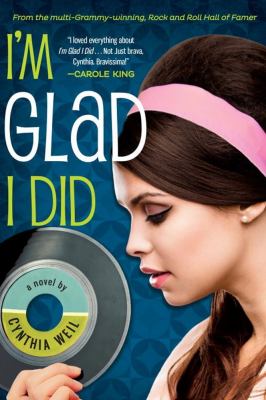
I’m Glad I Did by Cynthia Weil

imgladididit_cynthiaweilThe Big Apple.  Summer.  1963.  JJ Green. The Music Business.  Room for adventure.

JJ Green, a 16 year old girl, is one to speak her mind.  It has always been her dream to write songs, but there is a slight problem. There are three unbreakable rules in the Green family:

1. The Greens always eat breakfast together.
2. The Greens always negotiate instead of arguing.
3. The Greens always become lawyers.

As I read these first few pages, a song automatically popped into my head: “We are Family” by Sister Sledge.  The Greens were happy family, and especially in the 1960s, families stuck together. This song portrayed the scene of family life perfectly. But JJ shies away from these rules, for her wish is to become a songwriter.  Behind her parents’ back she applies for a job at the music business where her ‘disowned’ uncle works.  He calls it the place where songs are born.  Her parents call it the place where dreams are lost. On the contrary, Bobby, the producer, loves JJ’s talent and hires her as an intern for the summer.  When JJ finally shares her exciting news to her unenthusiastic parents, they are furious. Reluctantly, after tireless debates, they sign the paperwork, but they still are not approving of JJ’s decision. Her parents, then, make a deal: If JJ doesn’t get a song recorded by the time school starts in the fall, she will work as a lawyer. JJ doesn’t feel threatened by this arrangement at all.  At this point I thought of the song, “One Way or Another” by Blondie.  Somehow, somewhere, sometime she will get a record.

However, when the time comes to actually write the song, JJ’s fingers stop.  Her creative juices halt.  Her mind goes blank.  This may be a lot tougher than she set out for it to be.  Until she meets Dulcie Brown, her life flashes before her eyes, of thoughts of the deal with her parents. She cannot live the rest of her life as a lawyer; it just won’t do.  Dulcie, a negro jazz singer with an amazing voice, now a custodian at for the producer, can help her through this rough spot in her career. But things take a wild turn. Although a beautiful song is written, JJ’s heart is broken.

I would rate this book 5/5 stars for its originality and incredible authencity because it was written by an actual songwriter, Cynthia Weil.  I loved the historical fiction aspect as well as her unique style of creative writing.

-Maya S., 7th Grade

I’m Glad I Did is available for check out from the Mission Viejo Public Library.

Grammar Girl by Mignon Fogarty

grammargirl_mignonfogartyAre you a grammar fanatic? Are you annoyed when people, including adults, mix up their grammar? Well, Grammar Girl by Mignon Fogarty, a book exploring the surfaces and depths of grammar and writing, is much more than a grammar book.  And more than likely, it is right for you.  It offers easy-to-understand rules of conduct to live by as a writer, or in your case, a blogger.  Throughout this book, easy lessons are explained through quick and dirty tips.  I learned everything from gerunds to objective versus subjective pronouns to complicated conjugations.

The basic definition of a gerund is a noun made from an action verb plus an ‘ing’ at the end.  Every gerund, without exception, ends in ‘ing’.  Gerunds are not, however, that easy to locate.  For example, a name of a profession counts.  Like, ‘Acting isn’t as easy as it looks.’  In this case acting is the gerund and is functioning like a noun, yet it sounds like a verb.  Here’s another one: ‘Her singing almost deafened me.’  Singing is the gerund because it is referring to the act of her singing as an object or an idea.  But, we’re not done yet. In most cases, gerunds need a possessive or objective pronoun much like some words need linking verbs. It can be pretty easy to make the mistake of saying ‘We didn’t know that was his singing.’ This sentence could mean we couldn’t tell if what he was doing was singing or if he was making some other noise.  That was a possessive pronoun, but to clarify the true meaning of these types of sentences, sometimes you need to use a possessive pronoun.  This is the correct sentence: ‘We didn’t know this was him singing.’

In sixth grade, your English teacher probably taught you about basic conjugation.  In addition to these, there are progressive and perfect progressive. Learning these are essential to speaking correctly and formally.  Progressive means that the action is ongoing, progressing, or will be progressing.  (You can see chart below for the progressive and the perfect progressive.)  Then, perfect progressive is when the action has progressed for a while before it ended or it will end.  Perfect progressive uses the words like ‘has been’ or ‘had been’.

I would definitely rate this book a 10/10 for its complete guide on grammar and tips to keep your writing in shape.  In addition to Grammar Girl, I also would recommend checking out some of Mignon Fogarty’s online resources as well.  She has a podcast, a website (http://www.quickanddirtytips.com/grammar-girl), and several books for you to explore and love just as I did with this one.

– Maya S., 7th grade

Grammar Girl is available for check out from the Mission Viejo Public Library

PROGRESSIVE(also called incomplete and continuous) EXAMPLE MEANING OF SENTENCE
Past progressive Jack was walking. At some point in the past, Jack was in the middle of a walk, but we don’t know when he stopped or if he did.
Present progressive Jack is walking. Jack is in the middle of a walk.
Future progressive Jack will be walking. Jack will walk in the future– and walk and walk.  Who knows when it will end?
PERFECT PROGRESSIVE (also called perfect continuous) EXAMPLE MEANING OF SENTENCE
Past perfect progressive Jack had been walking. At some point in the past, Jack started walking and did so for a while, but now it’s over.
Present perfect progressive Jack has been walking. Jack started walking sometime in the past, and he is still walking.
Future perfect progressive Jack will have been walking. Jack will walk until a specific point in the future, and then he will stop.

Mr. Lincoln’s Drummer by G. Clifton Wisler

lincolndrummer_cliftonwislerThe American Civil War took place from 1861 to 1865 and pit the Northern and Southern States against each other, as shown in this novel by G. Clifton Wisler.  Boys from the age of 13 were enlisted to make money for their families.  There were a lot of economic problems at the time for the United States (who, due to the war, weren’t that amalgamated).  People were struggling to survive, and many barely even had enough food.   Since the war was to abolish slavery and the story is told from the side of Mr. Lincoln, there is little racism.  Willie, a young boy of the age of 11, had been working in his family’s business his entire life: mending clothes (mostly army uniforms).  But, he was always interested in war.  Willie didn’t realize any of the devastation and blood many encounter.

Much to Willie’s delight, an army general comes to town offering a modest sum of money for men to enlist in his regiment.  The general vaguely recognizes Willie and calls him over.  The man taught Willie a few of the drum patterns for the army calls some time ago and was impressed with Willie’s talent. The general gives Willie a couple coins.  As Willie walks home, he thinks what it would be like to be in the army, being a drummer.  When he arrives home and shows his mother the coins and asks, “Can I enlist to be a drummer?”  There is silence.

“Danger Zone” by Kenny Loggins, I thought, accurately summarizes the reaction by Willie’s mother to his “whimsical” question.  They both disagree. They need a third opinion. Waiting, painstakingly, for his father to come home, Willie dreams of the Army and of the drumbeat of his own, courageous instrument. Then, after hours of discussion between his mother, father, and himself, the family settle on a plan whereby father and son would enlist together under the condition they must stick together.

However, when the father and son exit the train from their town, they are separated.  Willie has to live his life as a drummer mostly by himself.  Throughout the story, Willie sees death of his own friends, converses with a Reb, and takes a fall himself.  At the end of the story however, awarded with pride, I thought of the song “Raise Me Up” by Josh Groban because that is how Willie feels. He doesn’t believe himself to be a hero.  He thinks that his parents, the general, and his friends pushed him too hard, and he failed.  I would rate this book a 6/10 for its lack of power.  The story itself was good, but I wasn’t drawn in.

Maya S., 7th Grade

Book Review and Music Pairing: Space Case by Stuart Gibbs

space_case“This is one small step for man, one giant leap for mankind.”  ~Neil Armstrong

Tick-tock.  Fast forward to the future.  Man is now living on the moon.  The human race has made a huge advance in technology.  At Moon Base Alpha, or MBA, as referred to by the lunarnauts, life is very different from home on Earth.  This may sound like a pretty cool place to live but not until you get the scoop from Dash Gibson.  While being one of the most famous kids on Earth for living on the moon, he is bored out of his mind.

He tells his readers that all of those Sci-Fi movies are wrong.  Have you ever seen anybody go to the bathroom in space?  Nope, they never thought about how hard it is to make a toilet that functions in low gravity.  And the food is never fresh and tastes nasty.  But of course, the moonies, or the lunarnauts, as they are called, are not allowed to talk about the horrible conditions they are enduring, for NASA invested a lot of money on this expedition.  For the children living on the moon, it is worse because they don’t have work to do like their scientist parents.  Kids aren’t allowed on the actual surface of the moon, for safety reasons.  So, there isn’t much to do besides attending school and playing video games.  Basically, Dash feels like a sardine trapped in an empty can.

After reading all of this, I thought of the song Time Keeps on Slipping into the Future  (Fly Like an Eagle) by the Steve Miller Band.  Not only because of the futuristic aspect of the song, but also due to the other lyrics, I thought it fit quite well.  When the ‘fly like an eagle’ refrain is sung, I thought of how the advancements in technology soared in the decade(s) that had passed to the time period of this book.  (It was not specified throughout the course of the novel.)

One night, Dash was out of his sleeping pod and in the bathroom–which was very inconveniently placed at the other side of the base with the work offices rather than the dwellings–when he overheard a very exciting conversation. One of the scientists, Dr. Holtz, seemed to be discussing a new discovery over the phone.  Once Dash was finally back in his bed, he could not sleep, in anticipation of information to be released on Dr. Holtz’s discovery scheduled for later that morning.  But, that did not occur.  Apparently, Dr. Holtz stepped out of the air lock, solo, and died.

This sci-fi story is about Dash’s mission to solve the case of Dr. Holtz’s sudden death.  The circumstances seemed suspicious to him.  In addition, he was eager to uncover Dr. Holtz’s discovery.  His death-defying investigations got him in trouble.  As the adults and kids were fighting, however, I was reminded of the song, Bohemian Rhapsody, by Queen.  Of the many parts and styles of this song, the “Galileo, Galileo, Galileo, let me go” snippet struck me, and I made many connections between the song lyrics and the falling action in the book.

I would rate Space Case a 10/10 for its captivating storyline and science fiction aspects.  I consumed this book in a single day!

-Maya S., 7th grade

Book Review: The Extraordinary Education of Nicholas Benedict by Trenton Lee Stewart

nicholas_benedictThe Extraordinary Education of Nicholas Benedict, a clever and witty book by bestselling author, Trenton Lee Stewart, is a novel that I have read and loved many, many times.  As a prequel to The Mysterious Benedict Society series, also by Trenton Lee Stewart, this book is rated highly.

Little orphaned Nicholas Benedict is nine years old and has never seen or known what love is.  Both of his parents were scientists and died in a lab experiment when he was very young.  He was sent off to live with his aunt, but she also suffered the same fate as his parents.  Ever since that time, he has lived in orphanages.  At the beginning of this story, Nicholas’ loneliness made me think of the song Imagine by John Lennon in a sense that we should imagine what it would be like to live in a place where everyone cared about each other and how nice that would be.

In a small city called Pebbleton, the story begins.  Nicholas is transferred from Littleview to the Manor, or Roschilds’ End.  He has a rare disease called narcolepsy which is where sudden or strong emotions cause him to fall asleep at inconvenient times.  This condition causes him to avoid certain activities because of the risk of falling asleep at the most unfortunate moments.  Because of this, the director requires Nicholas to sleep in his own locked room instead of the boys’ dormitory.  To avoid this, Nicholas engages in creative ruses to distract Mr. Collum, the director.   In one such event, he grabs a bowl of hot, soft wax from the candles that light the hallway.  Hurriedly, he pushes Mr. Collum’s key into the bowl, leaving a perfect imprint behind after pulling the key back up.  He then stays up all night molding the key to be metalized.  Little to his knowledge, this clever boy unwittingly made a skeleton key of the whole estate, including the expansive library in which Nicholas spends all of his free time.  Nicholas makes a friend with a trustworthy boy of the age of twelve named John.  The two then seek out an adventure to find the Roschilds’ missing inheritance.

This ending was both happy and touching.  Trenton Lee Stewart makes the reader feel happy and safe in this story.  At the ending, if this novel was converted into a movie, the song What a Wonderful World by Louis Armstrong would be perfect.  It fits the ending theme of the book of how, even though not everything may go your way, some things do.  And some of those things are what we come to love in life.

-Maya S., 7th grade

Book Review with Music Pairings: The Left Behinds and The iPhone that Saved George Washington by David Potter

left_behindsThe Left Behinds are three kids whose parents are too busy to spend time with them.  So, they spend their Christmas with their Social Studies teacher at their New Jersey school.  But things take a sharp turn when Brandon starts messing with a MacBook.  While Mel and Bev are trying to stop him, their iPhones start acting up.  A whirl and a pop later, they find themselves next to a weird guy that looks oddly like George Washington.  And that’s not all.  General Washington has a gunshot wound to the chest.  They look at their surroundings and become aware of a barn with hay but no horses and a raging snowstorm outside.  What just happened???

The Left Behinds:  Brandon, Mel, and Bev go on a wild journey in time travel in 1771.  No.  Let me rephrase that.  Mel goes on a wild journey to save history, while Bev and Brandon are held hostage by the Hessians.  Right when this twist began, I thought of the Disney song, “Small World,” because it indicates that we do, in fact, have a small world after all.  In this setting, I believe we have a small past, present, and future world.  While these worlds cannot combine, the morals and lessons transcend the time periods.

As the story continues, Mel takes advice from Dr. Benjamin Franklin and rides across the river from Pennsylvania to New Jersey with the Continental Army through harsh winter storms.  I was reminded of another song.  “Carry On My Wayward Son” by Kansas because of the struggle to find peace.  The song portrays General Washington’s effort to not rest until the colonies are safe from the Hessians.  The army gains victory; however, Mel, Brandon, and Bev find themselves tangled in yet another incident.  What will the Left Behinds do next?

I would rate this book a 9/10 for its historically credible story line, but I would have preferred the language to be less sarcastic.  This review is from an advance reader copy, so be sure to check it out January 15, 2015!

Maya S., 7th grade