Of Mice and Men by John Steinbeck

Despite its length, this novel is certainly one of the masterpieces still in the history of American literature. What I really admire and value the most in this book is the friendship between Lennie and George. I’m sure there is a bond between them which could have lasted forever if it wasn’t for Lennie’s mistake in the end and also it is a relationship which perhaps transcends those these two main characters have developed with their parents even.

From what I know, Lennie is a very physically robust but mentally weak character. He does not recognize his strength and only wields it when George tells him to; he even seems to be afraid of his surprising strength a little. George on the other hand, although always blames and reproaches Lennie for what he does, at important times he is the one who saves Lennie. He seems to be a bit of nonchalant, but when Lennie offers to leave him, I can sense a trail of yearning and guilt in George when he pleaded Lennie not to do so and that he is sorry.

Lastly, I think the last scene where George and Lennie retrospect about their dream of tending rabbits on a farm and how George shot Lennie was very memorable and unforgettable. In some way, I think Lennie knows that George is not here to merely just talk with him, he knew that he has to die in order to save himself and George. Therefore, he pretends to not know and lets him do that. So in other words, Lennie is not simply imbecile, he just lacks the ability to judge things properly and talks more clearly. His reliance upon George ties them together but also, at last, kills him.

-Coreen C. 

Of Mice and Men by John Steinbeck is available for checkout from the Mission Viejo Library. It can also be downloaded from Overdrive.

A Dog’s Purpose by W. Bruce Cameron

From this book, the biggest thing which I learned is that dogs are men’s best friends. It is hard to imagine how much our dogs love us because they cannot talk like we do, through our mouths. They talk from their eyes and hearts and actions to show us just how loyal they are to us. Like the main character in the book, Bailey, he reincarnated so many times just to be back with Ethan again. They’ve gone through so much and it’s really the hardest for either of them to forget this relationship. One scene that imprints itself in me was the part where after Ethan hurts his leg he decided to go to college in another state and Bailey chases the car to a very far distance. I’ll bet he knows what’s best for Ethan to do in this case, but it’s just that he wasn’t willing to let his best friend just leave him at that.

Actually, a lot of the movies these days are about the relationship between dogs and humans. We devote attention, love, patience, and money to dogs but they return it with their whole life. Ethan and Bailey are not just inseparable when they are happy, they take on hardships together and it’s either both of them get blamed or punished or they escape together. There was never a time when one abandons the other to danger. And I really think through these types of books and movies humans can adjust the attitude they take on to other people as well. If animals can treat people they love and love them with loyalty and dedication, why can’t we?

-Coreen C. 

A Dog’s Purpose by W. Bruce Cameron is available for checkout from the Mission Viejo Library. It can also be downloaded for free from Overdrive

11/22/63 by Stephen King

This novel tells of Jake Epping, a recently divorced teacher at his local high school, teaching some GED classes for extra money. One of his GED students, the high school’s janitor, Harry Dunning, writes a tear-jerking essay for his final, about how his family was killed by his alcoholic father and how he was crippled for life. 

A few years later, when Jake visits his friend, Al, at Al’s Diner, Al shows Jake a time portal in the pantry of his diner; Al, seems to have aged years within a day, explains that he had used the portal to travel back in time, and had lived years in the past before he developed cancer and had to return. 

The few rules to the portal are as follows:

  • Each trip to the past is a complete reset to September 9, 1958. Whenever you enter the portal, you’re undoing whatever you did the last trip.
  • Each time coming back from the past through the portal, no matter how long you stay, you come back two minutes after you left.
  • The past can be changed, impacting the future, but the past is also obdurate; it tries it’s very hardest to stop from being changed.

After Al shows Jake the ropes, he sends Jake on the mission that he had been unable to complete last time. From what Al has observed, everything bad in the world can be traced back to John F. Kennedy’s assassination; if Jake could stop the assassination, the world would likely be a better place. And if it wasn’t, he could always go back and reset it. 

Jake agrees to the plan, but adds a few elements of his own; he would drop by the Dunning household, and stop Frank Dunning from murdering Harry’s family. Then, he would wait until 1963, watching and monitoring the world around him, and stop Kennedy’s assassination.

The title of this novel definitely was the eye-catcher on the library bookshelf for me, in addition to its impressive size. The reality of life that’s starkly shown in this novel, contrasting the preposterous situation Jake enters into, is why I enjoyed it so much. He constantly feels the danger of discovery, injecting an underlying urgency into the story, but I also felt a wrenching desire for him to settle down when he finds a wonderful woman in a content little town where he could live a happy life in the past. 

There’s a sense of heroism to the story as well; armed with the knowledge of the future, Jake strives to do his best for the greater good of the world. However, the past is “obdurate;” he runs into so many obstacles when he tries to change things, ultimately causing more harm than good. It’s an excellent example of how good intentions do not necessarily bring good results.

-Adelle W.

11/22/63 by Stephen King is available for checkout from the Mission Viejo Library. It can also be downloaded for free from Overdrive

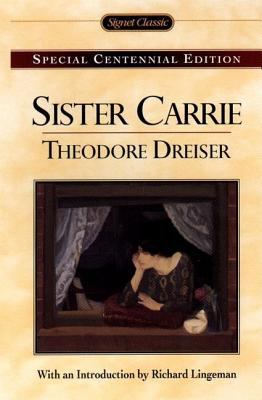
Sister Carrie by Theodore Dreiser

Carrie Meeber is from a small city who seeks to go to her sister in Chicago to have a better life. However, when she gets there she realizes the fact that her sister and her brother in law are in a very wretched condition together with their daughter. Unable to endure their apathy when she fails to secure herself a job, Carrie decided to leave. Before she even arrived in Chicago, she met Druet, a wealthy young man on the train who really likes her due to her beauty. So right after quitting her job at the factory, Carrie accidentally met Drouet around the street corners. He treats her a meal and often buys her beautiful clothing and jewelry which made her think in his favor. And thus, soon they were living together in a comfortable flat.

But it wasn’t soon when Drouet introduced Carrie to his manager friend Hurstwood. Lured by his gentleness and suave manner, Carrie fell in love with him and he with her. However, since Hurstwood was not in a relationship with his wife and his children, he lied to Carrie and said that he was unmarried. One day, Hurstwood under the influence of alcohol accidentally took ten thousand dollars from the cashier’s unlocked box and decided to flee to New York. He wheedled Carrie into escaping with him as well and so the two left for New York. However, life was not as easy there because everything was more expensive. After several unsuccessful attempts at finding a satisfactory job, Hurstwood depended on Carrie to earn and they again fell into the state of poverty.

Just then, due to her looks, passion, and aptitude for singing and acting, Carrie made a career in the theatre. She was well-liked by a lot of rich people and thus deserted Hurstwood. Although she regularly supported him somewhat, she severed the relationship at last when Hurstwood, due to his pride, stopped asking money from Carrie and suicided at last.

-Coreen C.

Sister Carrie by Theodore Dreiser is available for checkout from the Mission Viejo Library


The Boy in the Striped Pajamas by John Boyne

The Boy in the Striped Pajamas is one of my favorite books ever written. It was published in 2006, by John Boyne, and is set during World War II, at the Auschwitz Concentration Camp in Poland. It is narrated by Bruno, the 9-year-old son of a Nazi Commandant. Bruno’s innocent perspective makes the novel absolutely gut-wrenching, as he has no idea what exactly is happening beyond the fence surrounding Auschwitz.

Bruno’s father has a high station in the Nazi hierarchy, and he is on very close terms with Fuhrer Hitler. In fact, Hitler has Bruno’s father move out of Berlin and to Poland so he can oversee tings at Auschwitz, much to Bruno’s dismay. The new house at Auschwitz is old and gloomy, not at all like his previous home in Berlin. With nothing to do except explore, Bruno makes a number of startling discoveries that, in turn, lead to a massive turn of events.

Overall, this book is a roller-coaster of emotions. Readers will laugh at Bruno’s adorable perceptions of things that we understand with ease, cry at the mistakes he makes because he doesn’t know any better. John Boyne expertly wraps the reader up in the plot, writing complex, dynamic characters that the reader can sympathize with. This book is just an amazing read, and if you’re looking for a novel that will enrich and educate as well as entertain you, your search has met its end.

The Boy in the Striped Pajamas by John Boyne is available for checkout from the Mission Viejo Library. It can also be downloaded from Libby

How to Read Literature Like a Professor: For Kids by Thomas C. Foster

How to Read Literature Like a Professor: For Kids is exactly its title.  I, however, found that I had a difficult time enjoying the book.  Because I am what you may call a “Do it Yourselfer” I like to develop my own practices and ways of going about things by experiencing the world for myself. I would rather teach myself how to paint rather than take lessons from a professional in order to develop my own unique style.

In the same sense, when reading, I analyze it my way. Foster may think that he is merely helping young readers learn to see the signs in literature that lead us to understand it for themselves (though had that been his true intention the title of his book might have been something like How to Read Literature For Yourself) but in reality, he is molding young minds to see literature as he does. The way that I see it, the more people who read this book, the closer we are to a dystopian thought process.

Literature is an art form, much like painting, music or drama, and should be treated as such.  Foster subtly suggests that it is, in fact, an equation that can only be solved one way, his way, such as a computer program. Of course, like anybody would, Foster denies this, claiming that he is only showing you that the signs exist. If this were true, he could have written a persuasive essay instead of a book about what these sights mean. Somebody reading this book is obviously struggling in the field of English. Does he really expect them to have the ambition to interpret the sigh an on their own? No, they will simply take his word for it. If Foster says pasta is a protein, they will blindly believe it.  Being an outspoken advocate for individuality, this book struck quite a chord with me.  I think that everyone’s own ideas are beautiful and that symbols don’t always mean one thing, that we should have conversations about what a work of literature means to us, not settle on one theme.  The quarrel over a scene’s outcome, not just accept the way it turned out to be morally correct if you feel that it is not.  We must stay true to ourselves and our view of the world based off of our morals, not let our minds be re-arranged to match others.  On a more positive note, I must amend Foster on the wide range of books, short stories, etc. in which he uses as examples to express his thoughts.  After reading this book, I found numerous new titles to explore.

If you are familiar with the works of Rick Riordan or John Green, you will find that Foster’s writing style and tone reflects there’s.  Perhaps this is for the audience he presumably is addressing, which the book recommends for 8 to 12-year-olds.  Some may be exasperated by my comparing of these authors to one who wrote a book aimed at that age group, so allow me to elaborate:  Foster writes in a laid back, childlike manner in order to appeal to the age group as Riordan and Green write in a laid back manner, because, well, the characters that tell their stories are still (to some extent) children.  I am not trying to poo-poo that style of writing, I am merely making a comparison.  If you are attracted to that style, you may find this book a refreshing alternative to the likes of Call of the Wild or Oliver Twist (not to cast shadows on those either).  

Calling all Hermiones:  You’ll have a field day correcting some of Foster’s mistakes about Greek Mythology.  I would not go as far to say that I know everything about everything when it comes to Greek Mythology, after all, there is probably still more crumbling under the weight of the ruins that lay atop them like a crown.  However, I know enough to know that Foster either got a few points wrong, or one of us took a wrong turn in our time machines back to Ancient Greece.  If you are a free thinker: never read this book, ever.  It is a waste of your time and your beautiful mind.  If you could use a little help in the good old subject of English, you may find this book informative.  Either way, like any book, take it with a grain of salt.  

-Ainsley H. 

How to Read Literature Like a Professor: For Kids by Thomas C. Foster is available for checkout from the Mission Viejo Library

Doctor Sleep by Stephen King

The sequel to The Shining, Doctor Sleep tells the story of adult Danny Torrance. Traumatized by the horrific events at the Overlook Hotel, he’s developed alcoholic tendencies like his father; however, when he settles in the town of Frazier, New Hampshire, Dan stops drinking and begins working at a hospice, helping dying patients pass on peacefully with his strong psychic abilities, or “shine,” earning the nickname “Doctor Sleep.”

While he settles down, a girl named Abra Stone is born, and her shine is even more powerful than Dan’s. They sense and understand each other from when she is very young, all the way through most of her adolescence. 

They don’t see a need to actually meet until The True Knot, a group of people who feed off of shine, usually children’s, to keep themselves immortal, becomes aware of Abra’s immense power and comes for her. Dan and Abra together, along with a few friends in on the secret of the shine, work together to end The True Knot forever.

Dan’s character development was one of the first things that struck me deeply. No matter how much he swore to himself that he would never become like his father, he drinks and drinks, traumatized by the Overlook Hotel and afraid of his abilities. However, unlike his father, he realizes what he’s doing, and mends himself, using his abilities for good. 

Dan’s relationship with Abra was also an incredibly interesting element of this story. Despite never meeting before, the two psychics speak to each other like old friends when they actually meet, and Dan quickly takes on a fatherly role, helping Abra control her abilities. From the beginning, Abra is fundamentally good; though she makes mistakes and badly estimates some decisions, her actions are always for the betterment of others’ lives. 

After reading both this novel and The Shining, I would say that the sequel is more advanced and interesting than the original, although The Shining was crucial to setting the stage for Dan’s development and life. Doctor Sleep tells of the impact of psychological trauma, recovery from that, the use of power for good, and the development of family independent of blood relation. Some elements of the story are still chilling to the bone, as is Stephen King’s norm, but the novel overall develops the experience of life in addition to just the horror.

-Adelle W. 

Doctor Sleep by Stephen King is available for checkout from the Mission Viejo Library. It can also be downloaded for free from Overdrive
The Outsiders by S.E. Hinton

I read this book in eighth grade as a reading requirement and at first, I thought it was relatively childish and boring. Nevertheless, the more I read about it the more that I thought this is an amazing book. Through reading this book, I think the biggest thing that I learned is friendship, family and the gap between rich and poor.

Greasers and Socials are two rival groups, the former representing the poor and the latter rich. Although Greasers are poor, their friendship seems to be unwavering. Their relationship is not built upon any foundation of money, social status, or family background. But merely that we all share a similar interest and intend to achieve it. For one thing, if one Greaser is in danger, all the others would risk their lives to help. But for Socials, they would just run away afraid if their parents should find out they would stop supporting them.

The Socials seem like they are enjoying their lives and they despise the Greasers, but in my opinion, they in some uncanny way also want to be like them. They were born and raised in well-off families, the education they received requires them to be aloof towards anybody who isn’t on the same social level as them. However, I believe in some way they also want to make friends who really care about them and wouldn’t just desert them if their parents’ company went bankrupt or something like that. So deep down, I think there is a piercing desperation and loneliness both from the fake worldliness they have to confront every day and the neglection from their always busy and snobbish parents.

-Coreen C. 

The Outsiders by S. E. Hinton is available for checkout from the Mission Viejo Library. It is also free to download from Overdrive

Father Goriot by Honoré·de Balzac

Père Goriot by Honoré de Balzac

“Father Goriot” focuses on exposing and criticizing the naked money relationship between people in the capitalist world. The novel is set in Paris between the end of 1819 and the beginning of 1820. It mainly tells two parallel and overlapping stories. Retired flour-maker Goriot was neglected by his two daughters and died miserably in the attic of an apartment. The young Rastignac changed constantly under the corrosion of Paris society, but he still maintained justice and morality.

It’s also interspersed with stories about Madame de Beauséant and Madame Vauquer. Through the alternating main stages of shabby apartments and luxurious aristocratic salons, the writer paints a picture of the materialistic and extremely ugly society of Paris. It reveals the moral decay of the bourgeoisie under the control of the power of money and the ruthlessness between people, and reveals the inevitable destruction of the aristocracy under the attack of the bourgeoisie, which truly reflects the characteristics of the Bourbon Restoration period.

In “Father Goriot”, Balzac successfully depicts the complex relationship between class and class consciousness through the fate of Eugène de Rastignac and Goriot. This complex relationship has a historical basis. As two different classes, the aristocracy and the bourgeoisie have different economic bases, lifestyles and values, and occupy a dominant position in different historical periods. In France, in this sense, both the rise of Eugène de Rastignac and the fall of Goriot are the inevitable products of certain historical situations. The context set in the novel is 1819.

Although it was the restoration period of Bourbon, the regression was only partial, and the overall trend of historical development could not be reversed. The capitalist mode of production became increasingly stable, and the bourgeois consciousness inevitably became increasingly dominant. The gradual dominance of bourgeois consciousness not only means that the aristocracy is defeated on the whole, but also means that some individual aristocrats are incorporated by the bourgeoisie, such as Eugène de Rastignac.

This shows that the rule of the aristocracy was not only defeated from the outside, but ultimately collapsed from the inside as well. At the same time, the process eliminated members of the bourgeoisie who were not pure, such as Goriot. The bourgeoisie was consolidated from within. This shows the complexity of the historical process in which the bourgeoisie replaced the aristocracy. The struggle between the two took place not only externally, but also internally, not only in the form of revolution, but also in the form of ideological struggle.

Madame de Beauséant and Vautrin are the smartest people in the world. They had insight into a society that was respectable on the outside but dirty underneath. They were Eugène de Rastignac’s worthy mentors, and without them the young peasant would not have awakened so quickly. However, in addition to the words of these two teachers, it was also due to the example of Goriot that finally enlightened Eugène de Rastignac. We do not say this to regard Goriot as a bad man, or to say that he had done something unseemly.

Goriot died alone after his two daughters had bled him clean of his poor savings, and Eugène de Rastignac was a witness to the whole course of this tragic event. It was from here that Eugène de Rastignac saw through the world’s sordid society and was no longer under any illusion about the so-called justice, affection, friendship and so on between people. Therefore, he was determined to enter the upper class arena as a challenger. Sure enough, after some struggles, when the reader sees the young man again in one of Balzac’s other works, he has already mixed up a personal image.

Far from the Madding Crowd by Thomas Hardy

Far from the Madding Crowd eBook by Thomas Hardy - 9780553905557 | Rakuten  Kobo United States

The tone of this novel is light-hearted, humorous, lively and full of love for ordinary farmers, which is different from the heavy tragic color in Hardy’s later works. Although the reunion finale also contains themes familiar to readers in later works, such as pain and betrayal, the novel still shows a clear romantic color. In the novel, Hardy rendered the primitiveness and roughness of the natural scenery in Wessex with heavy color and ink, suggesting the potential deterrent force of such natural environment. However, man is extremely small and weak in front of the vast nature. A rainstorm or fire can destroy all the fruits of people’s hard work. An uncertain fate pervades “Far from the Madding Crowd”.

Poor Boldwood was tormented by fate. He poured all his feelings, thoughts, energy, and possessions into Bathsheba. Troy’s presence twice shattered his hopes just as he was within reach, so it was futile to demand what was fated to be unattainable. The beginning of the novel sets the tone that Bathsheba cannot live without Oak. In spite of Oak’s mediocre talent and appearance, in spite of the fact that his sheep had gone bankrupt and he had been reduced from a rich farmer to a wandering hand, Bathsheba had become the mistress of the farm because she had inherited her uncle’s fortune.

The conflicts between human beings and society in Hardy’s later novels reveal more about the social root of the characters’ tragedies, weaken the concept of fate, and replace the contingency with the inevitability of tragedy, which is the mature deepening of the author’s tragedy consciousness. However, such maturity and deepening are based on the conflicts originally embodied in “Far from the Madding Crowd”. In the plot structure, Hardy often sets up two parallel love clues and uses a lot of means such as chance, coincidence and mutation, making the love triangle between two women and a man or two men and a woman closely linked and fascinating. Techniques such as creating a heavy, tragic atmosphere through bleak depictions of the environment were pioneered in “Far from the Madding Crowd”.