Five Weeks in a Balloon by Jules Verne

Five Weeks in a Balloon eBook by Jules Verne - 9781775452614 | Rakuten Kobo  United States

The friendship and care between people are reflected in the book. Three travelers once risked their lives to save a French missionary. When the balloon was about to fall into Lake Chad, in order to make it rise again, Joe jumped into the lake and saved the lives of his two companions. As Joe fled the Sahara for his life, a shot from Kennedy saved Joe from the barbarians. This spirit of mutual love and mutual assistance in the era of personality publicity is very worthy of readers to cherish and carry forward. In order to show the wonderful scenery in Africa, this novel introduces the rich geographical knowledge. Through the image of the hero Fergusson in the novel, the author fully shows a scientist’s loyalty to the cause of human progress, praises his courage and strength, and shows the great power of modern science and technology.

However, when the novel describes the African native people, the racial prejudice reveals inevitably the era and history of the limitations. Five Weeks in a Balloon, by Jules Verne, describes the journey of Dr. Fergusson and his companions across the African continent, in which the admiration for European civilization, as well as the disgust and disdain for backward civilization, is evident. From the perspective of orientalism, Five Weeks on a Balloon shows a strong national character and the resulting Eurocentrism, which is mainly reflected in its description of the African environment. More than that, Jules Verne wants to show the excellence of his own nation in this process. To highlight this, the typical environment in his works is the desert, which means to raise thirst, desolation, loneliness and death, which must be overcome when crossing the desert.

The success of Mr. Fergusson’s entourage is the author’s affirmation of westerners and western civilization. But the whole work, from the point of view of orientalism, this affirmation is also based on a kind of dislocation between Europe and Africa. They thought of themselves as the most civilized people, looking down on others, and orientalism retained a more or less European-centered consciousness even in their later reflections. It is difficult to avoid this phenomenon, which requires that people should treat the East objectively and not overnight. However, in the analysis and criticism of people, they should at least be conscious of preventing them from being brought into the theory of Eurocentrism. When they look at problems, they should always make clear their position as an Oriental.

The African landscape is described in vivid detail, with mountains and seas, swamps and depressions, desert rivers and volcanoes all covered in the novel. The baobabs, fig trees, acacia trees, tamarind trees and other tropical plants are very strange. Elephants, hippos, crocodiles, vultures, leopards, hyenas and other tropical animals, as well as the thrilling battle of wits with savages and monkeys, all inspire the imagination to travel to Africa in an adventure. The hydrogen balloon was their vehicle, a relatively unknown object even to today’s readers, and the hero of the book had thought of it as a tool for exploration in the first half of the 19th century. What is more interesting is that the author even introduces the complex structure of the balloon to the readers in detail through the protagonist, which shows the author’s extensive knowledge and extremely rich imagination.
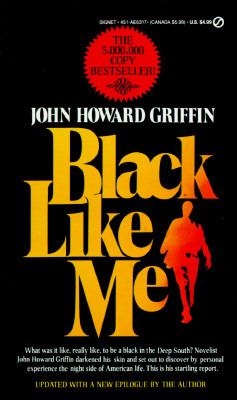
Black Like Me by John Howard Griffin

Black Like Me, a memoir written by John Howard Griffin, tells the true story of Griffin’s time spent in the segregated south in the 1950s as a black man. Griffin, however, was not biologically black. In fact, he was a white journalist with a focus on racial equality- a white man who wanted to experience the truth of black life in a land supposedly “separate but equal”, a sugar-coated line which people knew even then to be a lie. In order to truly understand the plight of African Americans in the southern states, Griffin chemically dyed his skin black using pills normally reserved for treating vitiligo. With black skin and a deep-rooted curiosity, Griffin ventured into the south. What he found horrified him, and became the subject of his memoir.

In Black Like Me, Griffin addresses the dehumanizing conditions which were caused by segregation in the American south. Most people are aware of the immediate impacts of segregation. Black people and white people were physically separated from each other, barred from drinking from the same water fountains, using the same bathrooms, eating at the same restaurants, or even using the same seats on the bus. It served as a barrier, keeping black men and women from attaining education, or those with education from obtaining jobs which could provide livable wages. These are things taught in school, considered to be common knowledge. What fewer people are aware of, however, is what Griffin portrays to be the true result of segregation and racism: the very denial of the right to humanity. When no person affords you even the slightest common courtesy when people deem it unnecessary to look at you on the street, when you need to work hard each and every day to prove to the white man that you mean him no harm- what does that do to a human’s spirit? According to Griffin, the true horror of segregation is the degradation of humanity which naturally ensues from it. The result is a book that is hard to read without taking on the pain of the oppressed- a reaction which is not only desired by Griffin but which makes this book a truly unforgettable, essential read.

There is no specific demographic which I would recommend this book to. The truth is, everyone should read it. It is one of those once in a lifetime books which makes you think just as much as it immerses you in its story. Further, if you enjoy this book and would like to read another like it, I would highly recommend Kaffir Boy by Mark Mathabane (I wrote a review about this book, too).

-Mirabella S.

Black Like Me by John Howard Griffin is available for checkout from the Mission Viejo Library. It can also be downloaded for free from Overdrive

Animal Farm by George Orwell

Animal Farm takes place on a mismanaged farm in England. The animals, upset with their treatment, prepare a rebellion to take over the farm. Once the farm is taken over, the animals attempt to validate their rights by painting seven commandments on the wall; these commandments are known as “animalism,” and they set the basic laws for the farm animals. These laws are: whatever goes upon two legs is an enemy. no animal shall wear clothes, no animal shall sleep in a bed, no animal shall drink alcohol, no animal shall kill any other animal, all animals are equal, and whatever goes upon four legs, or has wings, is a friend. In addition, the farm, known as the Manor Farm, is renamed into Animal Farm.

Soon after the animals seize control of the farm, the pigs, the leaders of the farm, run into management issues. The two leaders of the farm, Snowball and Napoleon, can not decide how they want to run the farm; Snowball wants a windmill to be constructed in order to reduce work hours, while Napoleon believes a hard-working, simple farm is the happiest lifestyle the animals can work.

Day after day, the pigs become more human than animal, and they begin to slowly change the seven commandments, in order to manipulate and dominate over the other animals. For instance, the law “no animal shall drink alcohol” is changed into “no animal shall drink alcohol to excess,” and as time goes on, the pigs even begin to purge the farm of opposition to their reign.

Animal Farm reflects history since it shows even a government with the noblest intentions can be corrupted. Snowball represents the idea of capitalism, while Napoleon represents communism. Napoleon controls the farm through the belief that the animals are their own rulers, and that they are better off ruling themselves than they were under the reign of humans. The reality is that Napoleon is simply deceiving the animals with words and numbers, as the pigs slowly force the other animals into submission until the animals cannot differentiate pig from human.

-Josh N. 

Animal Farm is available for checkout from the Mission Viejo Library. It can also be downloaded for free from Overdrive

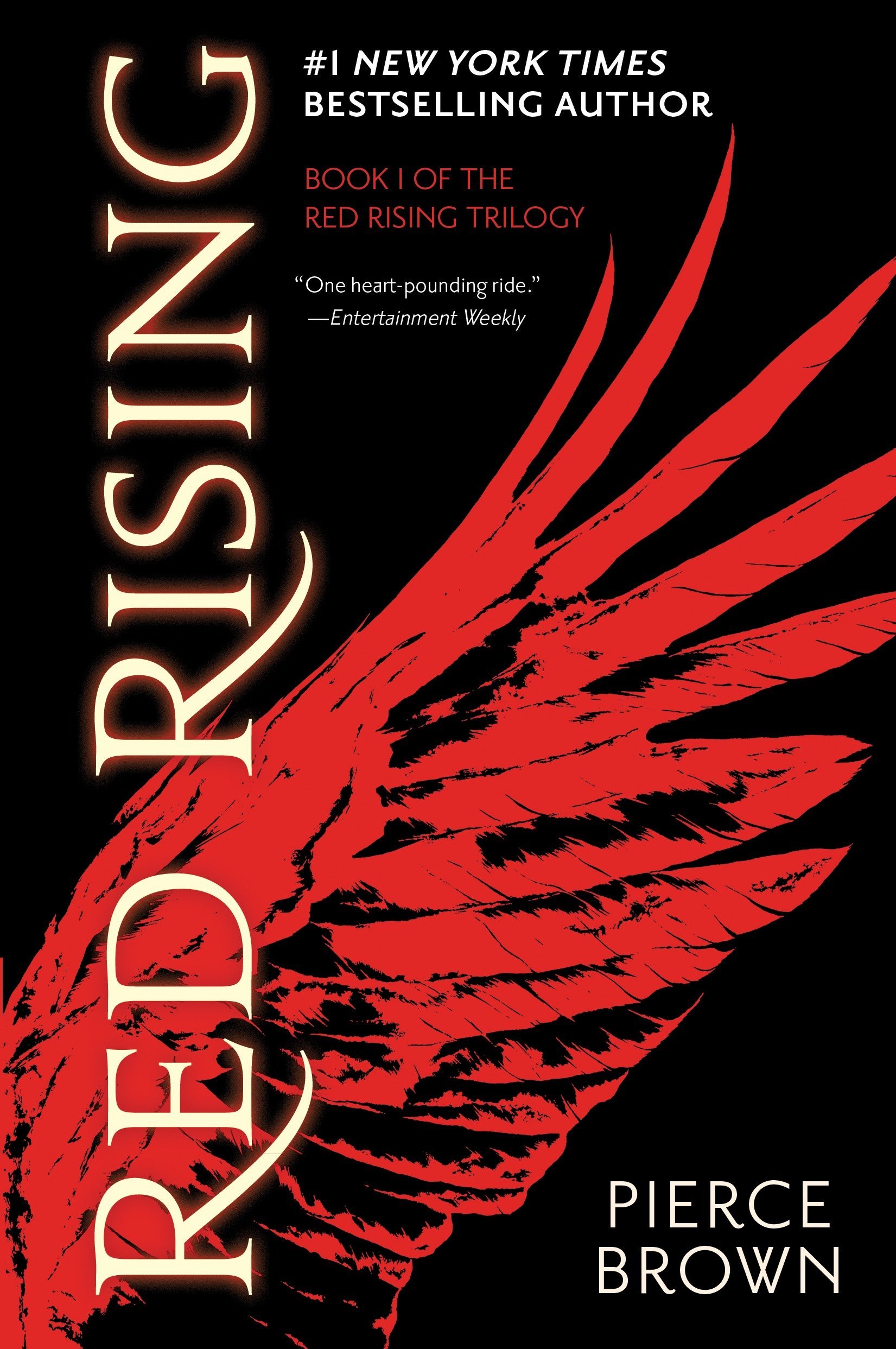
Red Rising by Pierce Brown

Image result for red rising book cover

The year is 736 PCE – over seven hundred years after the former colonies of Earth across the solar system rebelled against their mother planet and won. Now, the world has been divided into rigid social classes that depend on the color of one’s skin, from the ruling Golds to the slaving Reds. 

Darrow, a Red Helldiver who risks his life daily to procure helium-3 from the bowels of Mars to make its surface habitable for human life, does not suspect what truly lies above the surface of the planet. But when circumstances force him to fake his own death and join the rebel group on Mars, Darrow quickly realizes that his entire life is a lie – there is already a city of Golds on Mars, and the Reds are merely slaving away beneath the surface to provide a life of luxury and comfort for the higher colors.

Furious at this deception, Darrow agrees to infiltrate the Mars Institute for Golds as a student by changing his skin color in an arduous and painful process called the Carving. However, once the now-Gold Darrow arrives at the Institute, he quickly understands that to become the best of the best requires courses of action .that he would not have dreamed of taking while he was a Red. As Darrow progresses on his journey to become the Primus of House Mars, he unearths the deep corruptions within Gold society, as well as the horrifying truth behind the power of the Golden people.

Pierce Brown’s Red Rising holds a slight resemblance to The Hunger Games, but it is only a slight one – this novel takes the idea of colonization to an entirely new level, and questions the idea of a “perfect” society of social classes. This book is definitely recommended to fans of science fiction and adventure novels.

-Mahak M.

Red Rising by Pierce Brown is available for checkout from the Mission Viejo Library. It can also be downloaded for free from Overdrive

Eragon by Christopher Paolini

Image result for eragon christopher paolini

A dark shadow looms over the seemingly-picturesque world of Alagaësia, where humans roam alongside elves, dwarves, and werecats – the wicked and powerful emperor Galbatorix, who rules with an iron fist. For nearly a century, the innocent inhabitants of this mythical land have suffered under the evil king, but all of that is about to change with the birth of a boy named Eragon.

Born as a simple, illiterate farm boy in a small village, Eragon was raised by his uncle alongside his cousin, unaware of anything beyond his home in Palancar Valley and, occasionally, the deep forest known as the Spine. It is in the Spine, however, that his life is changed forever when he comes across a peculiar sapphire-like jewel. After he sneaks it home, though, he quickly realizes that the “stone” that he found was actually a dragon egg, and that he was now a Dragon Rider, who were fabled peacekeepers, scholars, and healers during the Golden Age – the era before Galbatorix. 

Unfortunately for Eragon, being bonded with a dragon is one of the most dangerous occupations in Alagaësia, so he and his newly-hatched dragon, Saphira, are forced to flee from Palancar Valley with the help of Brom, the village storyteller who knows more than he tells, to find the mysterious rebel force which is known only as the Varden.

All in all, Eragon, written by Christopher Paolini, is an intriguing book containing new ideas imbibed with the same adventurous atmosphere featured in other popular series such as The Hunger Games and Percy Jackson. However, it can be said that the writing is rather childish, and so takes away from the overall excitement of the book. Nevertheless, while Eragon may not aspire to the same heights as Harry Potter, it is certainly a classic in its own right. 

-Mahak M.

Eragon by Christopher Paolini is available for checkout from the Mission Viejo Library. It can also be downloaded for free from Overdrive

Finale by Stephanie Garber

Caution: this review may contain spoilers from books one and two, Caraval and Legendary

The Fates have been released from the Deck of Destiny. Legend has claimed himself Elantine’s heir, and his coronation as emperor of Valenda is soon to occur. Scarlett and Tella’s mother has not opened her eyes since her imprisonment in a card. Legendary, the sequel to Stephanie Garber’s Caraval, has dressed the place behind the curtains for a final act: the finale.

While the first two books in the trilogy are told by single narrators (Caraval told by Scarlett and Legendary told by Tella), the two sisters take turns narrating in Finale. I thought the combination of Scarlett and Tella’s narration provided a wonderful balance to the story, for each sister has a unique personality and an individual mindset. The idea of the two points of view working together to build this final story also compliments the theme of sisterly love, which is present throughout the trilogy.

Finale focuses largely on the power of love when directed at someone and when used against beings who live off of fear. This story exemplifies how love–whether given gently like Scarlett or ferociously like Tella–may be the strongest force against enmity.

In Finale, Stephanie Garber expands upon certain objects and curiosities that previously appeared in the other two books. I was interested to learn more about Scarlett and Tella’s mother’s past, why Scarlett sees feelings in color, and how Scarlett’s magical dress originated.

I was a bit disappointed that Caraval is not played in this final book, but by no means did the story lack the magic and elaborate colors found in Legend’s game. Understandably, with the Fates running free in Valenda, the characters can no longer simply play a game (not that Caraval was really just a game).

Though Finale is filled with visited dreams, different kinds of magic, and unusual places, I still think my favorite book in the series is Caraval (though I usually tend to favor the first book). It could just be the initial magic of Caraval and Legend that makes the first book so compelling or the mystery of who is an actor and who is not. However, I’m glad I read Finale, as it expanded upon many elements of the magic and characters while also leaving some untied strings to the story.

– Mia T.

Finale by Stephanie Garber is available for checkout from the Mission Viejo Library

Picture Us in the Light by Kelly Loy Gilbert

The recent representation of Asian-Americans in film and literature has been thundering the media. From the more obvious success of Crazy Rich Asians and Fresh Off the Boat to the smaller-rooted Netflix film “To All the Boys I’ve Loved Before” (and it’s soon-to-be sequel), the portrayal of Asian families has skyrocketed, building new stepping stones in which the small society of its own is rendered in society as a whole.

Kelly Loy Gilbert’s second novel, Picture Us in the Light, is a beautifully crafted story revolving around the Asian-American cultural hub in San Francisco. Picture Us in the Light follows eighteen-year-old Danny Cheng, as he struggles with his pursuit of artistic inspiration (post-college acceptance to an art and design school) and finding footholds in his graying, mysterious family life. Accompanied by long-time friends Harry and Regina, Danny unearths his family’s deep past piece by piece and discovering small realizations about himself and the relationships he has with those he loves most in his life.

As Danny jockeys with the slow, difficult reveal of his parents’ secrets and tries to find some balance over what he does and doesn’t know about his own identity, the audience is presented with the intense and haunting realities of global immigration. Every turn of the page brought a new feeling of suspense — each time we were given new information, the plot became more and more complex, heading a dozen different ways at once.

Being Asian-American myself, I found the story delightfully relatable in a small-scale way that it was powdered with concise “Asian insider” instances that I could relate to — the abundance of food, the hefty trips to Costco and Ranch 99, the intensive preparation for big exams.

The featured family in the novel, the Chengs, center the majority of their conflicts and victories over meals, which is extremely relatable to me in the way that family bonds over food. Just this seemingly insignificant instance opens up huge discussion for literary meaning (communion occurs over cuisine, perhaps?), but also exhibits how striking and intimately real the characters and situations Gilbert creates are.

Picture Us in the Light, published just over a year ago, is one of YA’s most down-to-earth and honest storylines thus far. Gilbert brings together shattering occurrences with the small moments of merriment, joining together two of our center emotions into a heart wrenching and, slowly, heartwarming book.

     So, as we are, picture us enchanted by Gilbert’s authentic and profound capability for storytelling.

—Keira D.

Picture Us in the Light by Kelly Loy Gilbert is available for checkout from the Mission Viejo Library

The Bell Jar By Sylvia Plath

There are a number of reasons for which this book is famous, but my favorite is that The Bell Jar is the only novel ever written by Sylvia Plath, who has only published two other works (both are books of poetry). In fact, Plath took her own life about a month after The Bell Jar was published, famously putting her head into the oven and turning it on. Her novel is semi-autobiographical, as it follows her life story, changing only the names of her acquaintances and the mental health treatments that the main character, Esther, endures.

While the plot of the novel is intriguing, the most important aspect for me was psychological. The main character, Esther Greenwood, compares life to a bell jar, suffocating her when it covers her completely, and letting her breath when lifted. The bell jar’s meaning has been debated, but I believe that it symbolizes the box that society and Esther’s own perfectionist ideology create. Esther actually spirals into a depressive state, and this peaks when she attempts suicide via overdose in her other’s basement, almost exactly like Plath did with her mother’s sleeping pills under her house in 1953.

After her suicide attempt, Esther spends some time at a mental institution, where she is prescribed electroshock therapy, which was a form of therapy for depression used in the 1950s, in which electric shocks were administered until the patient had a seizure. Guess who else was prescribed electroshock therapy for years? Sylvia Plath- the sheer number of details that match between the novel and its author are the reasons for the novel being called semi-autobiographical.

Overall, this novel is absolutely fantastic, and I would certainly recommend it or anyone looking for a mental and psychological eye-opener. Plath’s detailed insight into mental illnesses that women suffered through during the early to mid-1900s as well as the treatments for these illnesses is truly awakening to the mind. A true work of art, The Bell Jar is a perfect novel for someone looking for psychological semi-fiction.

-Arushi S. 

The Bell Jar by Sylvia Plath is available for checkout from the Mission Viejo Library

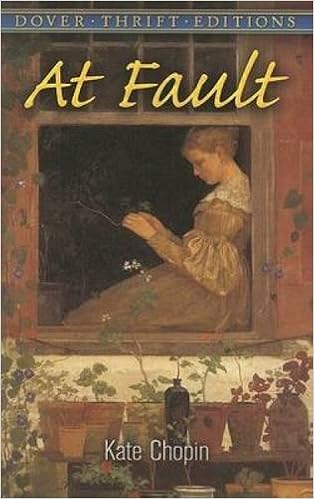
At Fault by Kate Chopin

Image result for at fault kate chopin

This is definitely a novel which I couldn’t stop reading from the moment I picked it up. Its intriguing characters and twisting plot but eventually a happy ending reserves this art piece for one of the top-rated ones.

I personally really liked Gregor, who is Therese, the owner of the farm’s nephew. Although he was often controlled by rash actions and speaks savagely to black servants, still he was a man of authenticity. Despite the fact that he killed Jocint, who set the mill on fire. But when Melicint, his lover accused him of this murder and left him one can tell how faithful and loyal his can be to his true love.

My other favorite character is David Hosmer. Only because Therese told him that to remarry his impudent wife Fanny would be an excellent choice and one that would conform with her moral principles, his didn’t even hesitate to do that. This shows how much he cares about her opinions, even if it meant to torture himself. Moreover, when the cabin that Fanny was staying in was washed away by the rain, he didn’t falter a bit but to risk his life saving a person who never cares genuinely about him. It was that she died at last from the flood, or else Fanny could have been possibly a hindrance to the splice of David Hosmer and Therese Lafirme.

-Coreen C. 

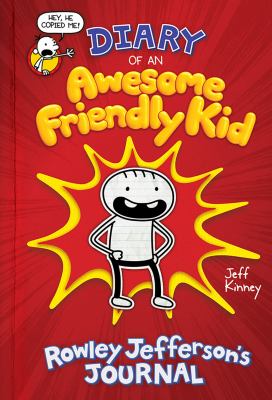
Diary of an Awesome Friendly Kid by Jeff Kinney

To be completely honest, I didn’t know what to expect with this book. I have two other book review on Jeff Kinney books, but those were Diary of a Wimpy Kid. This book is about Rowley Jeffen, Greg’s best “friend”. But after reading Diary of an Awesome Friendly Kid in one day, it had realized this was a great addition to the Diary of a Wimpy Kid franchise.

Many would think that this book is just the stories from Diary of a Wimpy Kid in Rowley’s perspective, but you are wrong! In Diary of an Awesome Friendly Kid, Rowley tells you different things that happened between him and Greg, like Rowley and Greg’s first sleepover, and the time they made their own superhero! Some of the stories were so dumb, they were actually funny!

You may think that the drawings in this book will be very good like Diary of a Wimpy Kid‘s, right? No! This book features Rowley Jefferson’s drawing. So everyone has an oval face and no nose! Which makes this book even funnier.

Overall, this book exceeded my expectations. I enjoyed a lot! It will forever stand as one of my favorite Jeff Kinney books.

-Brandon D.

Diary of an Awesome Friendly Kid by Jeff Kinney is available for checkout from the Mission Viejo Library