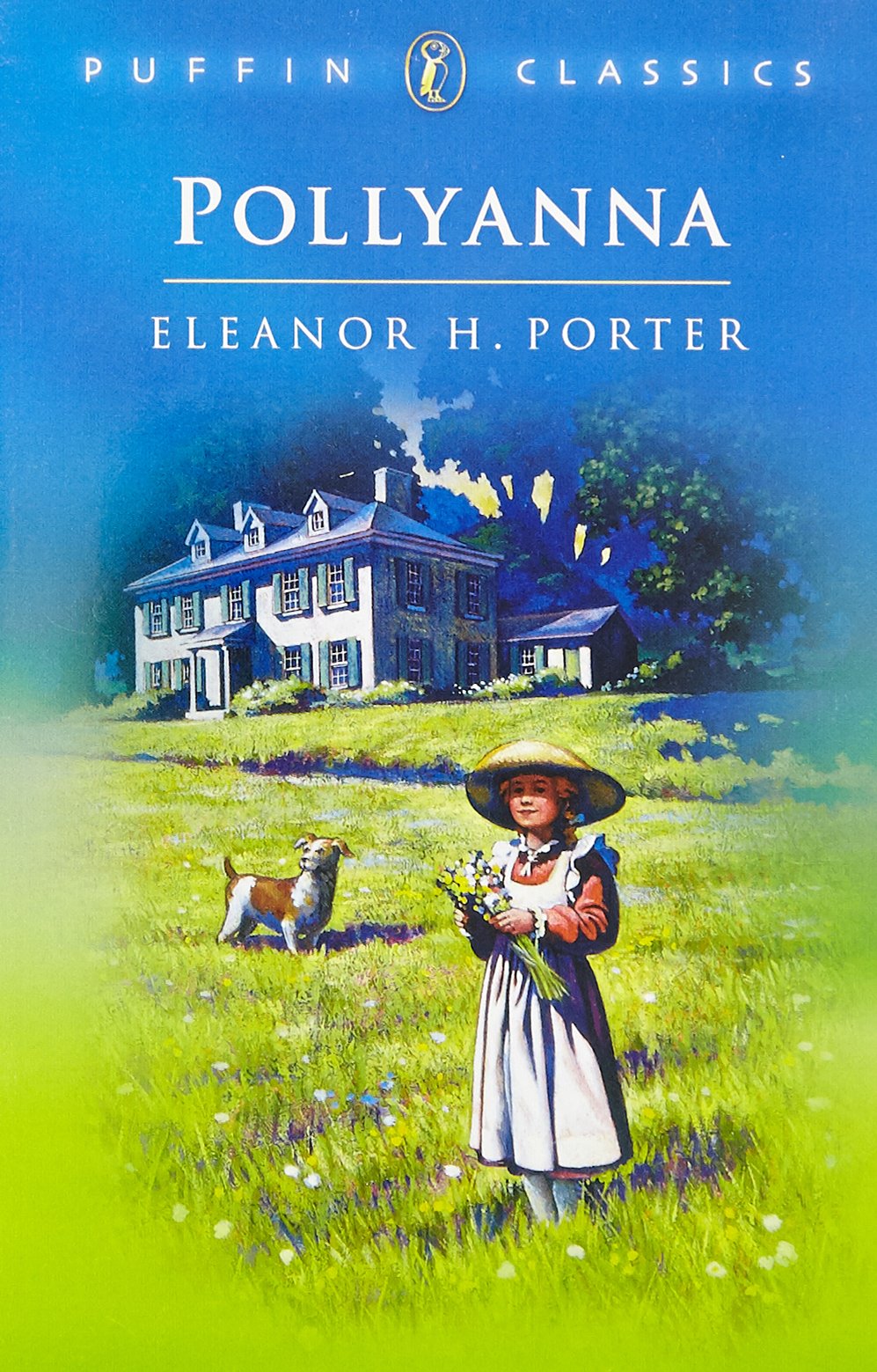
Pollyanna by Eleanor H. Porter

Pollyanna is an orphan. Her mother died of sickness when she was very young, and her father also died shortly before the story begins. After these traumatic events, Pollyanna is sent to live with her Aunt Polly, her only remaining family member (her mother had two sisters, Polly and Anna). Aunt Polly is very mean, and does not seem to care much about Pollyanna. This is easy to see why, as Aunt Polly’s sister (Pollyanna’s mother) moved to the West Coast of the US to be with Pollyanna’s father from the East Coast of the US against the will of her family. Polly never wrote to her sister after that, not even when the surviving child was named after Pollyanna’s mother’s sisters, Polly and Anna became Pollyanna.

Aunt Polly continues to be upset through this great novel. However, will Pollyanna be able to reverse her aunt’s negative ways?

Pollyanna gets to know most of the people living in her village within a short period of time. Her friendly, cheery ways affect many others as well. Everyone adores her company, even Mr. Pentleton, who has rarely spoken for the past decade.  

I enjoyed reading this book because of Pollyanna’s positive way of dealing with problems and how she can quickly find a way out of every situation she is faced with. Pollyanna’s positive mental attitude made this novel even more enjoyable to read. Another reason I liked this book was because of the wide variety of characters. I appreciated that the author included so many characters because meeting a lot of different characters throughout the book made the story more interesting, as all of them have a different personality and the author is able to develop that so well.

You should read this book because it is a very fun book to read and the events are thoroughly captivating. I really liked this book, and I think you will too. 

-Peri A.

Pollyanna by Eleanor H. Porter is available for checkout from the Mission Viejo Library.

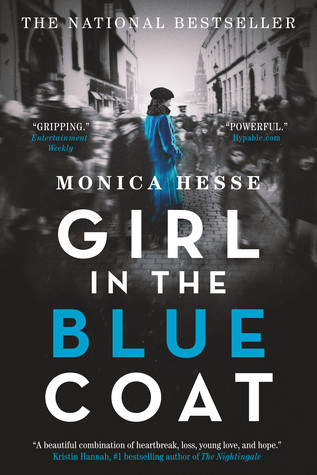
Girl in The Blue Coat by Monica Hesse

I can truly say that there are only some books in this world that simply makes the reader sit in shock once they’ve finished the novel. I can also truly say that Girl in The Blue Coat is one of those books. Written by Monica Hesse, who won the Edgar Award for the best young adult mystery novel, Girl in The Blue Coat takes place during the 1940s, where a Dutch girl named Hanneke manages to survive World War II off of delivering black-market goods to customers. Still recovering from the death of her boyfriend, one of her clients, Mrs. Janssen, begs Hanneke to find a missing Jewish girl the client’s been hiding. Hanneke soon gets pulled into a web of mysteries that slowly unfolds as the novel progresses.

This book is well-crafted down to the finest details, creating a novel that shocks readers in the way every mystery novel should. All of the characters felt so realistic; they had flaws of their own, some aspects that make readers question what they value. Yet that’s what makes them human. The novel revolves mostly about how people often make mistakes in their lives which lead to regret, but also about courage and friendship. These real human values are what largely connects readers to the story. Through these characters actions, both good and bad, many understand and share their own emotions. Hesse beautifully portrays how humans often make mistakes, how they regret those mistakes, and how they learn to let go of those regrets.

As for the book’s plot, it’s honestly rare to find a book as addicting and unique to read. Monica Hesse manages to cleverly put twists and turns throughout the story to keep readers entertained. In the ending, rather than a perfect resolution, the author even leaves some issues unresolved for the readers to analyze themselves. The layers of plots that overlap each other were never overwhelming, and actually turned the novel into an emotional rollercoaster of events. The chaos of the war along with the character’s own problems that intertwine together makes the novel even more worthy for a read.

To be honest, I had a sea of emotions once I finished the book. This remarkable story truly speaks to its readers in the most realistic way possible. For any fans of historical fiction or even mystery novels, Girl in The Blue Coat will never disappoint.

– Natisha P.

Girl in The Blue Coat by Monica Hesse is available for checkout from the Mission Viejo Library. It can also be downloaded for free from Overdrive.

Neanderthal Opens the Door to the Universe by Preston Norton

Most of us, hopefully, have never undergone a near-death experience. Or perhaps we have, but we didn’t see God. Wait, what?

Yeah, God. Don’t worry, though, it gets better! Because God, who apparently sounds sort of like Morgan Freeman, has a plan for you. A List–sort of like the grocery kind–that reveals five objectives you should complete to…well, make high school suck less, I guess. Confused yet?

Cliff Hubbard, loser extraordinaire, known by the student body as Neanderthal due to his enormous size (6’6″ and over 250 pounds), is thrown into an unusual alliance with incredibly popular quarterback, Aaron Zimmerman, after Aaron claims to have seen God and received His message while in a coma.

Cliff, whose axis is still spinning off center due to his brother’s suicide, is reluctant to join lame, uber-star Aaron on his quest to bring enlightenment to Happy Valley High School. Against his better judgment, Cliff does, which spirals into a Sermon Showdown against the Jesus Teens, countless trips to the principal’s office, raging teachers and lawn mowers, and an unforgettable school year–all driven by the divine nature of a possibly insane List.

First things first: this book’s humor is on point! To the mild alarm of my mother, I would burst out laughing at particularly well-timed paragraphs. Now, when it’s a forced sort of funny because the author obviously tried too hard, it verges on the edge of annoying. Norton, though, is clearly the master of the funnies; humor rolls off his writing effortlessly, slipped into the seams of dialogue, stitched imperceptibly in Neanderthal’s hilarious narration. What I’m trying to say here, ladies and gentlemen, is that this dude has talent!

Second: I absolutely love the friendship evolution between Aaron and Cliff. Norton builds up their relationship so meticulously, at the perfect pace, so that by the end of the book undeniably there exists an adorable bromance between the two. Aaron and Cliff are so incredibly relatable, each with their struggles and hardships, that they gradually reveal to each other. In subtle ways, they are able to remind us of what friendship truly means.

Even after I closed the book, I was thankful to be reminded by Norton of the gratitude we must hold for our friendships. Amidst all of the confusion and hatred in the world now, sometimes all you need is that one friend that makes you laugh until you cry, and will cry with you; the friend that will never question eating ungodly amounts of bacon with you for breakfast; the friend who you know will never judge you, no matter what you tell them; the friend that makes you feel, even if only for a fraction of a second, infinitesimally times better when you hold their gaze steadfast; the friend that you thank the universe brought you together, because you cannot possibly imagine living without them.

At first, I thought the book was going to be highly religious or somewhat “preachy” about life lessons, if you know what I mean: “Time heals all wounds! Hope is our saving grace!” I was wrong. Universal messages are presented beautifully throughout the plot, and I was impressed by the wide range of present societal issues that are presented throughout the story, such as homophobia, bullying, substance abuse. I loved how the story prompted me to become philosophical with it–did God really come to Aaron? Or was it the workings of his subconscious mind during his coma, stirring up the depths of his morality as he truly grasped the incompetency of his high school?

But what I truly enjoyed about this story is how touching it can be to the reader on a personal level. These characters are quintessential models of our suffering, loss, grief, and hidden struggles that we may not wish to reveal to the world.

To be honest, this YA fiction reminded me strongly of the novel Darius the Great is Not Okay. Both present messages about hope, of putting one foot in front of another, even when sometimes you feel as if you’re trying to tread through wet cement. Sometimes there’s this wide, yawning chasm of despair inside of us that cannot be filled, until we are drawn into the golden light of friendship and purpose–though probably not all of our callings are to save the future of our high schools.

But hey, do we have to sit around patiently and wait for our callings? God or no, is there any reason why we shouldn’t be the voices of change? This book reminds us that change starts with us, even if we might only be sleep-deprived teenagers in this big, confusing world. Though we may feel uncomfortable in our own skins, no matter how irreparable or insignificant we seem, we have graced this earth for a purpose…a purpose that may leave an imprint on the world bigger than Neanderthal’s size 14 shoes.

-Katharine L.

Neanderthal Opens the Door to the Universe by Preston Norton is available for checkout from the Mission Viejo Library.

Little Men by Louisa May Alcott

Little Men, the second book after Little Women, once again written by Louisa May Alcott, is truly just as warm and cherishable.

Anyone who loves Alcott’s classic Little Women will undoubtedly love Little Men just the same. Though this book regards less about the characters in Little Women, save for Jo and Mr. Bhaer, it revolves around a new generation of children, including Meg’s children and Jo’s children. As we know from Little Women, Jo went on to establish a children’s school named Plumfield, which is where nearly all of the events in this book take place, as it revolves around the pupils who live there. Plumfield serves as a school and home for young children who have no other place to go; many of which are orphaned, poor, or alone whom the Bhaer’s kindly take in. 

The story begins by following a storyline but then changes course to be a series of random days and happenings at the school, following no particular order. This change in the way of writing is quite pleasant, as Alcott captures little flashes and special moments in the school. 

Warm sunny days and cold, yet cozy winters around the fireside. Berry picking, pie-making, pillow fights and storytelling, naughty instances and sweet moral lessons.

Now, in terms of one of the most arguably beloved characters from Little Women, Jo, readers can now see what Jo is like all grown up; a school teacher, a mother, and a wife. She is older, quite motherly, and much more mature, but never lost her amusement in spending time with boys or her wild side.

 In this book, Alcott truly captures the spirit of both parenthood and childhood and the dynamics between the two. Though this book is about children and more so directed to young readers, it is a heartfelt, beautiful read for any age. Similar to Little Women, it’s characters are easily lovable yet do not lose a sense of realism and are each incredibly well-written. I highly recommend this book!

-Aisha

Little Men by Louisa May Alcott is available for checkout from the Mission Viejo Library. It can also be downloaded for free from Overdrive.
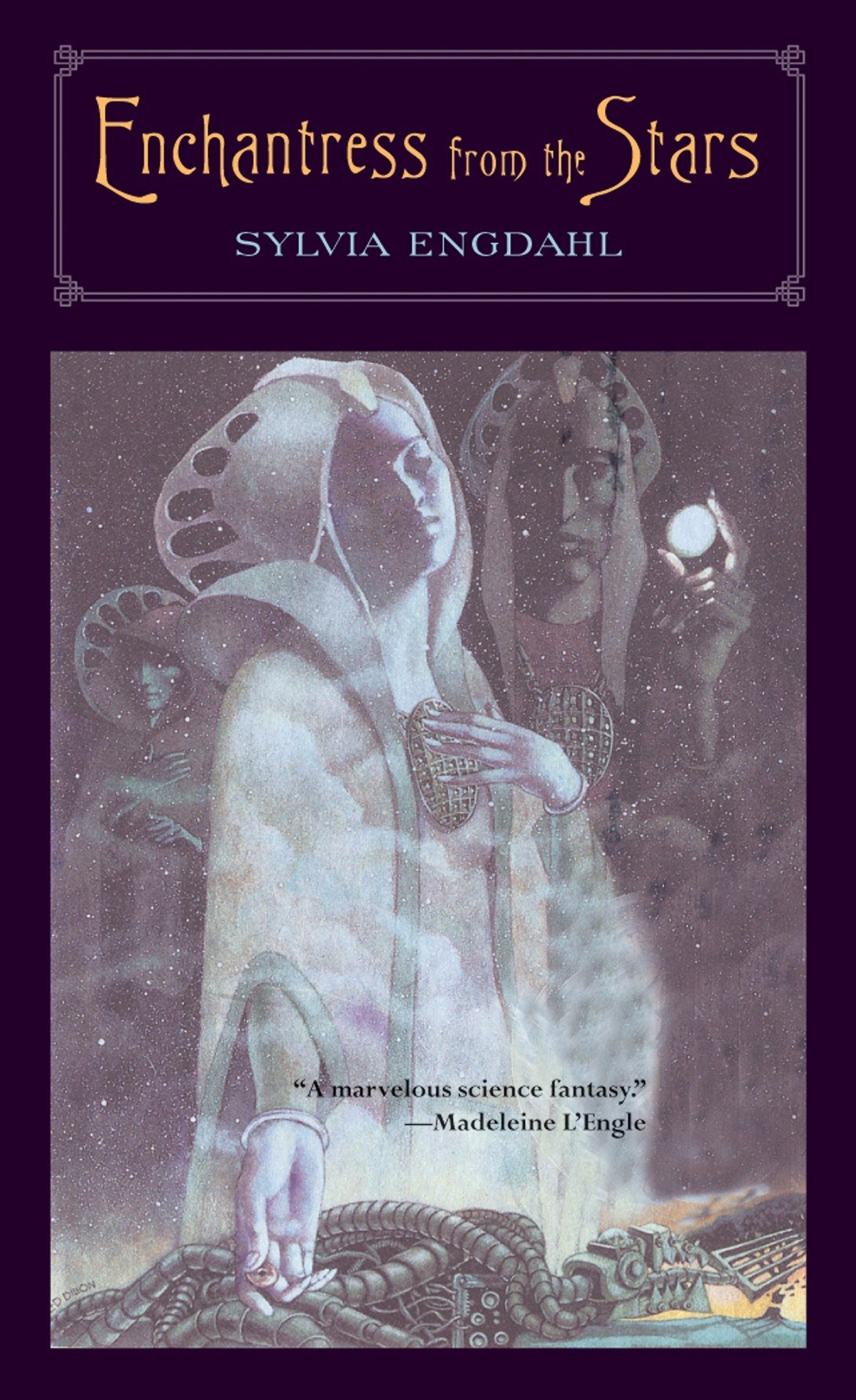
Enchantress from the Stars by Sylvia Engdahl

Enchantress from the Stars by Sylvia Engdahl is a science fiction novel about three groups of people from different parts of the universe.  Most of the events occur on a planet called Andrecia.  Much like Earth, Andrecia is the third planet from a yellow sun.  The native Andrecians live in a relatively primitive society.  A foreign group of colonists has invaded Andrecia, with the intent to conquer it.  These colonists are much more scientifically advanced.  A third group of people, even more advanced than the other two groups, has decided to intervene on behalf of the Andrecians.  These highly advanced people, including young Elana, attempt to empower the Andrecians to drive away the colonists.  Elana must do this without disclosing her true alien identity.  From the Andrecians’ perspective, she becomes the “Enchantress from the Stars.”

I enjoyed reading about how the three groups of people are similar in many ways, despite their differences.  They all seem to experience human emotions and a sense of morality.  However, they view science and technology differently.  To the Andrecians, technology is magic.  To the invading colonists, technology is a tool for conquering others.  To the most highly advanced people, science and technology are used for noble purposes.  This book is written in a way to help us understand these different perspectives.  The point of view alternates between the three groups of people throughout the book, making it seem like we are viewing the story from multiple angles.  For example, the language of the Andrecians seems old-fashioned and medieval, while the language of the colonists seems modern.  The most advanced people are even able to communicate by telepathy.  I found this multi-faceted writing style to be very engaging and insightful.  It was also exciting to see how these three perspectives blended together by the end of the story.

I thoroughly enjoyed this book.  I can understand why it won a Newbery Honor Award, back when it was written in 1971.  I find it interesting to think about what it would be like for people in a medieval period to interact with people from a more scientifically advanced period.  I would certainly recommend this book to anyone who enjoys science fiction.  I would also recommend this book to people who do not think they enjoy science fiction, because this book is about more than science and technology.  I think this book teaches valuable lessons about seeking to understand one another despite our differences.

-Oliver H.

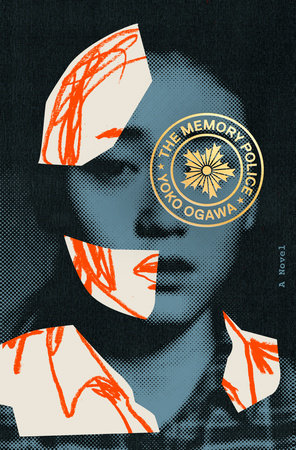
The Memory Police by Yōko Ogawa

The Memory Police by Yoko Ogawa: 9781101911815 | PenguinRandomHouse.com:  Books

Consider an ordinary object lying around your house – for example, a marker. Now, imagine that object being completely erased from your life and the lives of every single person you know. Not only that, all memories of using a marker vanish from your consciousness. You haven’t a clue what a “marker” is, what it’s used for, how to pronounce it – “marker” has been completely eradicated from your vocabulary. Repeat this harrowing process ad infinitum, and you have the premise of The Memory Police by Yōko Ogawa.

On an unnamed island, every inhabitant fears the brutal Memory Police, a secret task force committed to ensuring that objects that have disappeared remain forgotten by the population. However, there are those who are gifted (or cursed) with the ability to recall the disappeared items, and they are in danger of being “disappeared” themselves by the Memory Police.

When a young novelist who lives in this nightmarish world realizes that her editor, only referred to as “R,” is one of the few people who are able to recall vanished items, she makes a plan to hide him in a secret room beneath her floorboards. As time goes on, and more essential items begin to vanish, the inhabitants of the island begin to lose their sense of self, and the novelist and R cling to her writing as one last way to preserve the past. 

A hauntingly surreal portrayal of the importance of memory and the terrors of state surveillance, The Memory Police is a powerful dystopian novel involving the terrifying erasure of the past, the inability to distinguish an individual from the collective, and an overall feeling of horror that slowly descends upon both the island people and the reader. 

For fans of chilling Orwellian novels that make one consider the significance of the past as well as the present and future, The Memory Police is a fantastic novel that checks all of those boxes and more, and I would definitely recommend it to all.

-Mahak M.

The Rent Collector by Camron Wright

Newport Local News Under Cover Book Club: "The Rent ...The Rent Collector by Camron Wright is an incredible book about the power of literacy and hope in desperate situations. The story is centered around Sang Ly and her family, who live in the biggest municipal waste dump in all of Cambodia and pick trash for a living. Her young son is very ill- she has spent years trying every medicine she can find, but nothing has helped. Sang Ly rents her home from Sopeap Sin, an irritable drunk known as “The Cow” to the residents of the dump. 

But Sopeap knows something that the residents don’t. She knows how to read and write. Sang Ly, desperate to change her family’s circumstances, goes to Sopeap and begs her to teach her how to read and write. But soon, Sang Ly doesn’t only want to read and write- she wants to learn about literature. And what she finds in literature changes her life forever.

This book was absolutely amazing, especially considering that it was based on a real story. It was fascinating, gaining an insight into how, even in a dump, a sense of community, and love abounds. The novel itself is an incredible insight into the power of education, especially literature, which is something that many of us take for granted in our day-to-day lives. The novel also explores how some concepts are universal in literature, like love, luck, and happiness- common threads that tie all literature of the world together. The author did an amazing job of showing the kindness and humanity that are present even in the most adverse of circumstances.

I would give this book a 9.5 out of 10. Although it became a bit bland in places, it was absolutely a life-changing book about knowledge and compassion.

-Vaidehi B.

The Rent Collector by Camron Wright is available for checkout from the Mission Viejo Library. It can also be downloaded for free from Overdrive
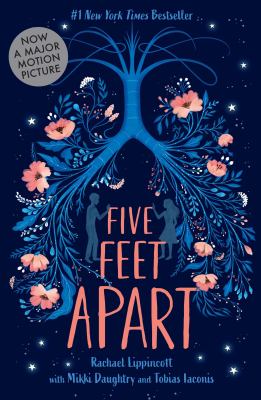
Five Feet Apart by Rachael Lippincott, Tobias Iaconis, and Mikki Daughtry

Stella, a teenager that has Cystic Fibrosis whose entire life has been very routine-like is approached by a boy named Will. The catch is that Will also has Cystic Fibrosis and they must stay six feet apart at all times in order to stay safe. Hospital trips, medications, and nurses have been a huge part of Stella’s life, but to Will, this is all new. Ironically, their personalities clash. Stella could be described as a good kid, but on the other hand, Will likes to act out, giving the book an adventurous side. Fortunately, this doesn’t get in the way of them catching feelings for each other. Five Feet Apart is a book about their influence on each other with appearances made by other vital side characters.  

Even though I read this book a couple of months before the movie came out, I still watched the movie. I figured that some of you may have already heard of, or seen the movie, but I’m here to tell you to give the book a shot as well! It made me bawl my eyes out and allowed for more emotion to be felt. Will really added a fun and exciting element to the book that kept me on the edge of my seat and the impact they both had on each other really touched my heart. It’s a 10/10 for me!

-Kaitlyn Y.

Five Feet Apart is available for checkout from the Mission Viejo Library.

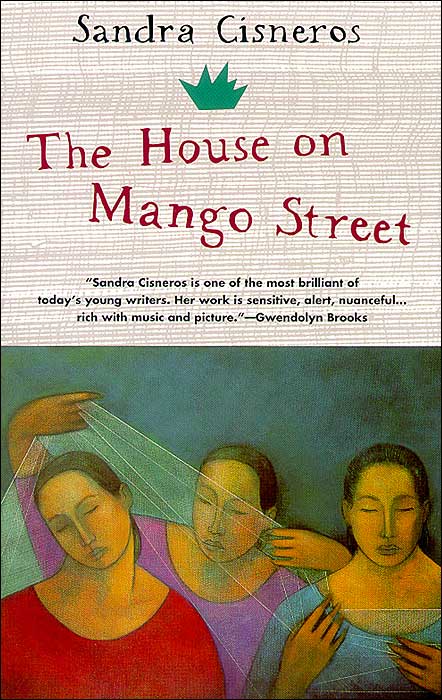
The House on Mango Street by Sandra Cisneros

Six Traits Blog - Word Choice: An Excerpt from The House ...

The House on Mango Street by Sandra Cisneros is a poignant coming-of-age book centered around a young Latina girl, Esperanza, in 1960s Chicago.

In a series of vignettes, or short stories, Cisneros examines themes of maturity, belonging, poverty, and femininity. The vignettes are told from Esperanza’s point of view, laden with rich imagery and symbolism, and hazy- like they are being told in a dream. Each vignette focuses on small events in Esperanza’s day to day life, and provides insight into her thoughts and desires.

Cisneros skillfully presents the dichotomy of Esperanza and her family’s life- many of the vignettes center around happy moments in their lives, like playing outside with friends, getting a first job, or going to a neighbor’s party, but even so, the abject hopelessness and desperation of their situation lurks just below the surface. The entire book is a masterful study of not only Esperanza’s situation, but the human condition- a careful examination of ritualistic maturity, traditions, gender norms, and youth. 

Cisneros writes in a simple, easily understandable vernacular, complete with sentence fragments and a lack of quotation marks that makes each vignette easy to read. Nonetheless, the book contains a depth of emotion and, often, desperation that was immensely heart-wrenching to witness. I grew up in circumstances close to those of Esperanza’s, so reading about her experiences took me back to my own childhood, to times when I felt the same way she did. Personally, I would rate this book a 10/10. 

This book contains some mature themes.

-Vaidehi B.

The House on Mango Street by Sandra Cisneros is available for checkout from the Mission Viejo Library. It can also be downloaded for free from Overdrive.
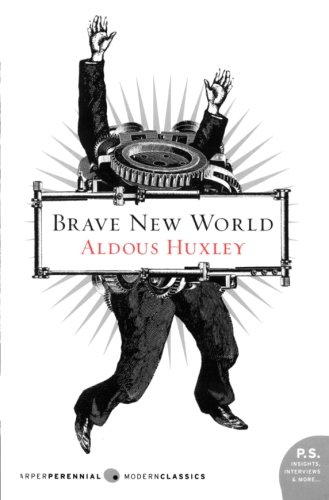
Brave New World by Aldous Huxley

Brave New World: Aldous Huxley: 9780060850524: Amazon.com: Books

One of the most prominent dystopian novels of all time, Aldous Huxley’s Brave New World explores a horrifyingly relevant potential society in which all individuals are in a perpetual state of bliss and “innocence,” and are unaware of pain or unhappiness. However, like all seemingly utopian worlds, there is a dark side.

In the World State, people are no longer born – they are “decanted” and treated according to their predetermined place in the extremely rigid caste system, from the intelligent Alpha Pluses to the Epsilon Semi Morons who have their development stunted.

Rather than contemplate the morality of this, the citizens are brainwashed to not care through sleep hypnosis techniques, which convince each class that they are best suited for said caste, and that they should not challenge it, completely eliminating free will from a young age.

Additionally, to keep the citizens complacent with the control of the World State, they are encouraged to participate in activities that bring pleasure, while at the same time discouraged from getting pregnant or becoming parents (a slur in the World State). The people continue to be submissive through an excessive consumption of soma, a drug that induces feelings of happiness and bliss.

When Alpha Plus Bernard Marx and his date, Beta Plus Lenina Crowne, travel to a Native American reservation and meet John, a “savage” with connections to the World State, their lives are changed forever. John’s inability to reconcile his idealistic notions of love and life, obtained from old copies of Shakespearean works, and the reality of the World State causes conflict between himself and Lenina, who he loves.

All in all, Brave New World is a fascinating read, not only for those who enjoy dystopian fiction, but also as a warning for an overly mechanized future, in which individuals are not treated as such, and are instead manipulated into becoming perfect cogs in a reproductive machine.

-Mahak M.

A Brave New World by Aldous Huxley is available for checkout from the Mission Viejo Library. It can also be downloaded for free from Overdrive.