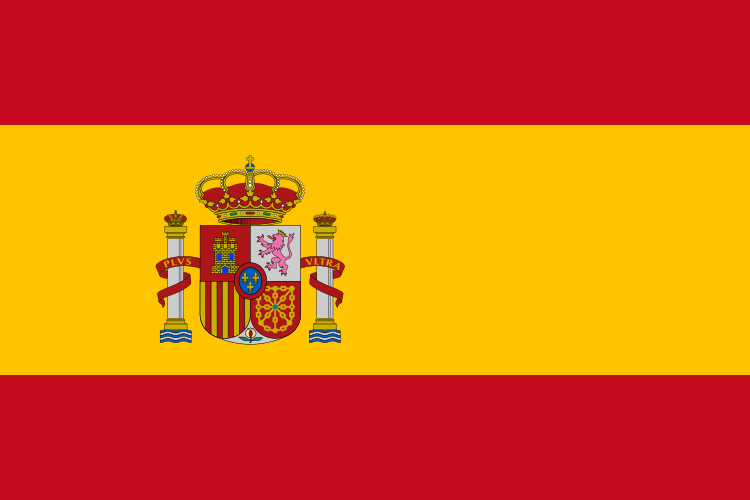
The French versus Spanish Debate

In the majority of schools, there are two languages offered: French and Spanish. In this essay, I will attempt to do an analysis of both languages and finally settle the debate of which language is better, talking about two categories: practicality and culture.

To start, Spanish seems to be the more practical choice in Southern California. However, this essay will not specifically focus on Southern California, and will focus on the United States as a whole. Mathematically speaking, more states border Canada than Mexico. Furthermore, more states border French-speaking Canada than Mexico. This would mean that French is more practical in these states, which there are more of. On top of that, French is more spoken than Spanish in the world, so taking French instead of Spanish would be useful in international working and travel. Because of this, French is more practical than Spanish, although it is debatable.

However, what is not debatable is how much better French culture is than Spanish. Sure, Spanish food is infinitely times better than French food (mmm pizza!), but French culture is more supreme in every other way. The French celebrate many great holidays, such as Poisson d’Avril, which I like because I get to put fish on people’s backs. They also have more interesting architecture and landmarks. Fun fact: Paris is the most visited city in the world, beating any Spanish or Mexican city by a landslide. France also has a very rich history too. France has fought in many wars. Although their win-to-loss ratio….. actually I won’t get into that. But thanks to their wars, they have brought a lot of history! Landmarks such as the Eiffel Tower and the Arc de Triumph have deep stories behind them that are very interesting.

Because of these two reasons, French may be the language to take in high school!!!

The Steam Engine

If I were to ask you what the most important invention in human history was, what would you say? The computer, which kickstarted the digital revolution and launched us into the modern age? The lightbulb, which moved humanity out of the darkness and into the literal light? However, to find the invention that truly revolutionized humanity, one must go a few centuries back in time and consider the steam engine.

In 1698, an engineer named Thomas Savery invented the first steam engine, although it certainly was not used for the purposes we consider today. Instead, it was made to draw water out of flooded mines using steam compression. However, the slow heating-cooling process and wastage of steam made this and successive machines, notably the Newcomen engine, largely ineffective, but that changed with James Watt in 1765. Patenting a new, improved steam engine, James Watt was able to harness the power of steam into machines, which led inexorably into the Industrial Revolution.

Like the name suggests, the Industrial Revolution revolutionized industry. More specifically, it shifted the economy from agrarian to industrial, and people moved from working in the home to working for wages in the factories. These factories housed machines that were powered by the steam engine for every industry, from textiles to iron. Without the steam engine, these industries would have never gotten off of the ground.

However, the steam engine did more than impact industries – it revolutionized transportation. In steamboats, like those engineered by Robert Fulton, the steam engine allowed for the shipment of goods both downstream and upstream with ease, lowering costs and travel times. However, the most important impact of the steam engine to consider is the rise of the railroads. In Europe and America, railroads changed the way people lived, worked, and settled. The transcontinental railroad, for example, made moving to other parts of the country easier, since the transportation would cost less and there would be greater access to goods. Not only that, these railroads tied together the countries they were built in in a way that would have been impossible without the steam engine.

So the next time you use a computer or switch on a lightbulb, spare a thought for the oft-overlooked steam engine – it’s quite possible that none of these inventions would exist without it! 

– Mahak M.

The Origins of Thanksgiving

Thanksgiving is a widely celebrated holiday in the U.S. taking place every year on the fourth Thursday of November. In fact, 62% of Americans celebrate Thanksgiving at home with their loved ones each year. But are we celebrating something that we don’t really know the full meaning behind? Thanksgiving is a time that most Americans can agree is spent being thankful, which is true. But the story of Thanksgiving involves much more than being thankful for all that we are given.

The story of Thanksgiving first begins in 1620, when a group of 102 religious separatists left their home in search of religious freedom. The pilgrims finally settled in Massachusetts Bay after 66 days on a ship named the Mayflower. From there, the pilgrims began to cultivate and establish the town of Plymouth. The first winter in America was brutal, and many pilgrims suffered from diseases such as scurvy. By March however, they were greeted by an English- speaking tribe of Indians known as the Abenakis. A member of one the native tribes, Squanto, taught the pilgrims how to use and respect the land. In November of 1621, the pilgrims had their first successful harvest and called for a celebration that included their native allies.

This celebration- now referred to as “Thanksgiving”- lasted for three days. Much of the menu of the first Thanksgiving is unknown, but historians rationalize that many of the sweet treats we enjoy at the table today- 400 years after the first Thanksgiving- were most likely not present in November of 1621. Most of the sugar necessary in making these sweets would have been in short supply after months on the Mayflower. Much of the meal, however, was made using native spices that local tribes had used for years before.

So the next time you are sitting around the dinner table with your loved ones enjoying turkey and stuffing, remember the first Thanksgiving, one of harvest and harmony.

-Roma L.

Black History Month Reading List!

Greetings!

This is your friendly neighborhood Teen Librarian and I wanted to share that I’ve set up a new page link just above this post. The library’s Teen Advisory Board has put together a list of books, films, and notable figures to celebrate Black History Month! If anything catches your eye, follow the links on the page to put them on hold 😀

Thanks, everyone!