The Tea Dragon Society Series

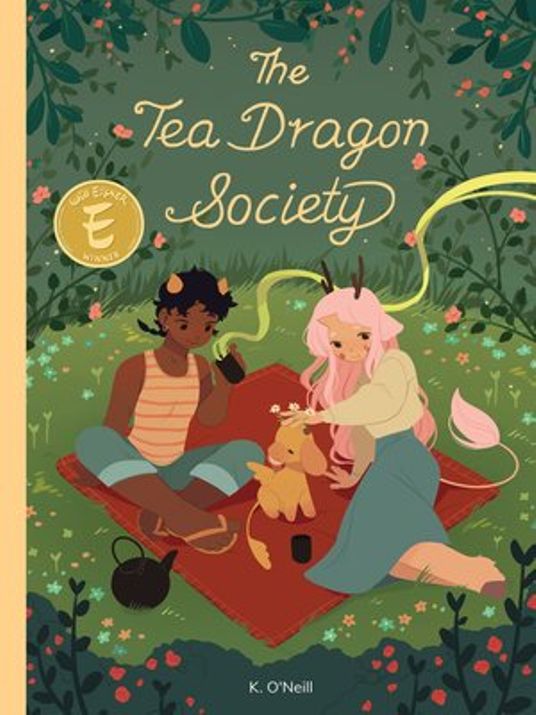
The Tea Dragon Society series is a series of graphic novels written by Kay O’Neill. The three-part story is set in a fantasy world in which dragons grow leaves and flowers on their horns, that are able to be brewed into tea. Whoever may drink the tea is able to see the memories of the dragon’s owner. 

The first book, The Tea Dragon Society, follows young Greta, a blacksmith apprentice, as she discovers the art of caring for a Tea Dragon after finding one lost in the marketplace and returning it to its owner. She meets Hesekiel and Erik, the owners of the tea shop that she returns the dragon to. There, she befriends Minette, a shy girl with no memories of her past. We learn that she used to be a prophetess, and in an attempt to see every future possible, lost all of her memories. The book is short, with beautiful calming art and a nice cozy story.

The second book, titles The Tea Dragon Festival, takes a turn to a new character named Rinn, when they find a real dragon in the forest outside of town. The dragon’s name is Aedhan, and it is revealed that he was assigned to look after the village, but fell asleep in the woods eighty years ago. It follows Rinn as they help Aedhan adjust to a new life, solve the mystery of his long slumber, and accept that he can not get back the time he lost.

The last book of the series is titled The Tea Dragon Tapestry, and once again follows Greta and Minette as they face challenges in their lives. Greta is tasked with creating something beautiful to impress a skilled blacksmith, and become their apprentice. All the while, she is learning how to care for a grieving tea dragon after it fell into her care when it’s previous owner died. Minette receives a mysterious gift from the place she once lived, which throws her whole life into questions and confusion. She learns over the course of the story that one must open themselves to those who care about them, to truly understand oneself. 

The Tea Dragon Society by Kay O’Neill is available to check out from the Mission Viejo Library.
Book Review: Thornlight by Claire Legrand

Thornlight is a book I picked up recently—an adventure-filled fantasy novel that exudes creativity, combined with heartfelt character development.

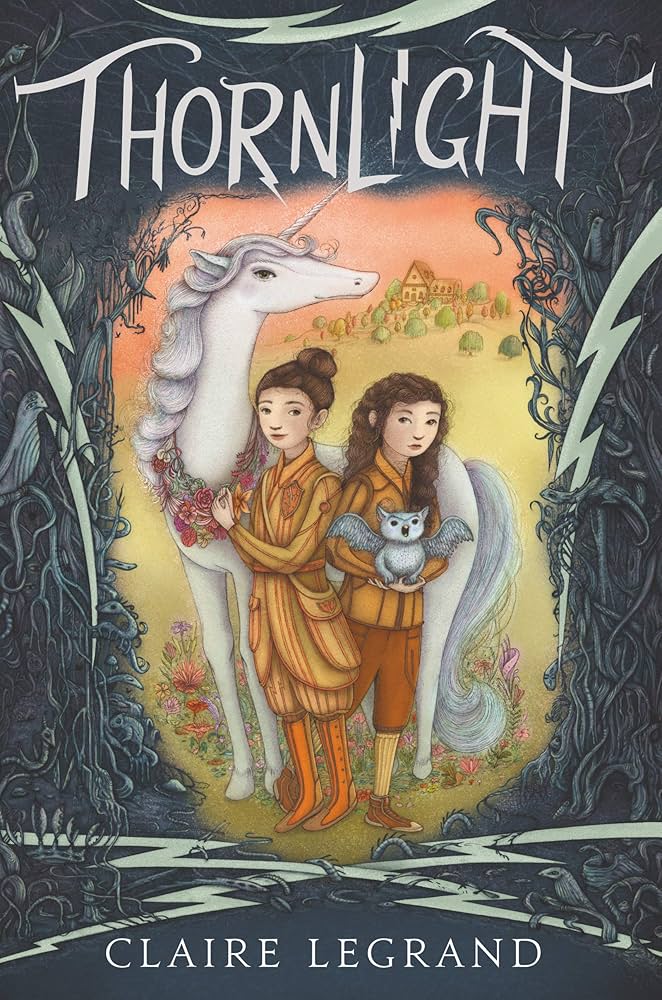
Before anything, though, I want to take a moment to appreciate Jaime Zollars’ beautiful illustrations that help to set the fairy-tale atmosphere straight from the get-go.

Thornlight: Legrand, Claire: 9780062696663: Amazon.com: Books

Okay. The story follows twin sisters Thorn and Brier, who, despite being twins, have utterly distinct characterization with unique struggles, not to mention their equally unique yet lovable animal companions. On a journey to close the chasm, known as the Break, that divides their world, the story’s characters encounter witches, evil creatures, and numerous obstacles that keep you intrigued.

One thing I love about this book is that it’s told from three points of view—the twins and a third character named Celestyna—that alternate consistently. You would think you’d lose track of the story because of this, but it’s quite the opposite while reading. The story flows smoothly and the changing perspectives keep you hooked.

I also love how Legrand conveys the relationships between her characters. No matter how fantasy-driven this novel is, the interpersonal relationships and the struggles that accompany them are portrayed realistically, in a way that touches your heart.

The only criticisms I have about this novel is that the pacing can feel rushed in some moments, particularly with Thorn’s character development. A few side characters also have resolutions that come off as unsatisfying, or don’t align with prior emphasis placed on them. Other than that, Thornlight was nothing short of an entertaining read, and I’d recommend it to anyone who enjoys well-written fantasy.

Climate Change

Cracked and crumbling, the earth once full of life and water lays barren and dry. Dust bunnies blow across the land without a single living thing in sight. Blue skies turn gray and smoky. Trees that once seemed to hold up the sky with their strong arms are now reduced to stumps. That is the future that lays ahead. 

Climate change has always been a big problem. Politicians ignore it as if they weren’t the ones who created it. Advocates protest, and we turn a blind eye. Brushing it off like it’s nothing, a mere annoyance. No one expects the earth to crumble away in their lifetime. We flourish in our big cities focusing only on what’s ahead of us, but not what’s above or below us. We move too fast to acknowledge problems that seem to loom ahead. Problems that are screaming to be solved. Problems that are bolded and put in italics for us to see. Problems that are shoved in our faces but we choose to ignore.

So what if the earth is dying? Why should I care? It won’t happen in my life so there’s no reason for me to do anything. These are all excuses. Excuses not to care nor act. Excuses to not do anything. We waste our lives away waiting for someone else to do it for us. We wait and wait and never yet to consider that everyone else may be waiting too. 

There must be something done soon, or there wouldn’t be an earth to worry about.

Books about climate change are available to check out from the Mission Viejo Library. They are also available to download for free from Libby.
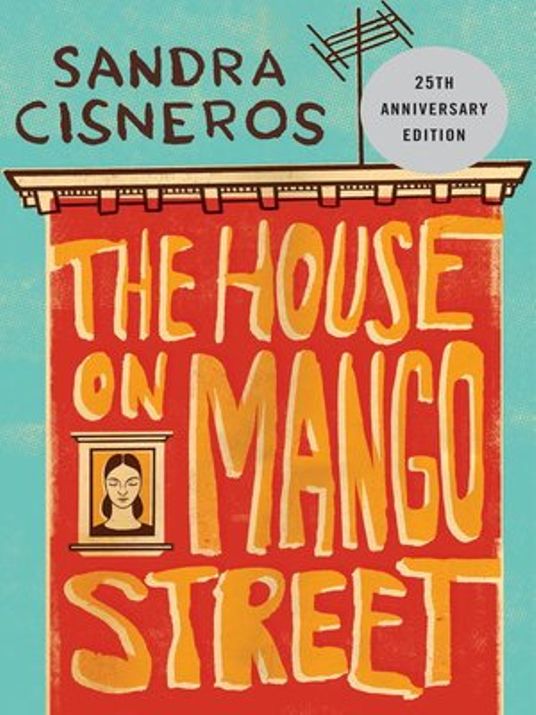
The House on Mango Street by Sandra Cisneros

As usual, school has required readings. The third book required for me this year was The House on Mango Street by Sandra Cisneros. I’m sure many other people know of it. Majority of my friends said they loved the book and remember reading it. 

This coming-of-age novel is split into vignettes–short chapters or episodes–told in the perspective of the main character, Esperanza. She tells stories about things that happen in her life, but in no particular order. It starts with her and her family moving into their new house which is on Mango Street. As she grows up in the new neighborhood, she tells plenty of short stories of different people, what has happened to her, and what has happened to them. 

This is a very short book but it’s still a great read. Most of the book is told in an almost childlike way using simple words and many variations. But even with its simplicity, it holds some very detailed descriptions and symbols. I know that a lot of people would rather not pick out the symbolism and figurative language when they read a book, especially if the book is just for enjoyment. Trust me, if it weren’t for school, then I probably wouldn’t have either. But if you’re willing to look deep into the story and really pick apart a few phrases, then it can make your reading of this book, and others, much more interesting.

This book has so many symbols that really help convey the message more clearly than it already is. It adds so much more to the theme of the book and while you don’t have to pick out symbolism and such, it can enhance this book a lot more.

While it may seem like a fun and happy story, there is a surprisingly darker undertone if you take the time to really look at it. If it didn’t have this other side to it, I don’t think I would have really liked this book. If you’re considering reading this book, just keep in mind that there are some dark messages and scenes that can definitely make you a little uncomfortable. 

Overall, The House on Mango Street was a pretty good read for me. Taking a deeper dive into the symbolism and finer details of the book was fun for me. I think I’d recommend this to anyone looking for a short, good read. But I’d mostly recommend this to people who are a little older, really anyone out of middle school. It’s a great book and a good choice if you’re looking for something to read and really delve deeper into.

-Nicole R.

The House on Mango Street by Sandra Cisneros is available to check out from the Mission Viejo Library. It is also available to download for free from Libby.

The Ballad of Songbirds and Snakes: a Review

Being 517 pages, The Ballad of Songbirds and Snakes is a pretty long book. Despite this, it’s become one of my all-time favorites to pick up off the bookshelf.

Let’s talk about why. (No spoilers!)

SUMMARY –

The Ballad of Songbirds and Snakes is the prequel to the Hunger Games trilogy. If you haven’t already read that, it’s amazing, go do it. It will help make the prequel make far more sense, as well.

The book features Coriolanus Snow as the protagonist, reliving the events of his life after the Dark Days war.

Part One- Positives

The book draws from a lot of the philosophical questions in the original trilogy. Good and bad, black and white.,

The characters are phenomenal, with believable development throughout. It was hard to imagine how Suzanne Collins was going to be able to write such a downright coldhearted individual to be a believable protagonist, but it totally worked.

The book makes it clear that Snow isn’t in the right by any means – but it still makes sense why he does it.

Part Two: Negatives

Admittedly, this book features a bit of repetition, especially in the beginning. Snow goes through the same routine, over and over. Additionally, the plot can get a bit twisty and confusing, and can give you a bit of whiplash.

Part 3: Conclusion

Let’s sum up.

• Fast-paced/Action-packed

•Builds on the original trilogy

• Confusing at times

I’d say that’s a net positive!

This book is beautiful for those who have already read the original trilogy. If you have, definitely check this out!

The Ballad of Songbirds and Snakes by Suzanne Collins is available to checkout from the Mission Viejo Library. It is also available to download for free from Libby.

Book Review: Konosuba: God’s Blessing on this Wonder World: Oh! My Useless Goddess (Yes I am aware the title of this book is overly long)

Okay, so Konosuba I’m not writing out that whole title again is an isekai comedy written by Natsume Akatsuki and is the first novel in a long-running series. (Also for those who don’t know isekai is a Japanese word for other world and will be used frequently in this review). The series follows its protagonist Kazuma Sato as he blunders his way through his journey where the only thing he really has going for him is his above-average luck and genre awareness.

So as mentioned above Konosuba is extensively a comedy. Said comedy is mostly drawn from subverting tropes commonly found in its second genre: Isekai. You see the isekai genre as it currently exists mainly contains teenage male power fantasies; stories where a normal nerd can gain insane amounts of strength, power, and magic with about as much effort as it takes to open a bag of chips. This is not the case for Konosuba’s protagonist however as he is recognized in-universe as one of the weakest adventurers in the guild. Additionally, this is not something that changes later in the book with Kazuma’s biggest achievement by the end of the novel being the fact that he killed a larger-than-normal amount of sentient cabbages during the harvest.

Another bit of comedic subversion in this book is how Kazuma’s team is set up. You see in normal isekai stories the protagonist is typically surrounded by a party whose gender ratio generally leans in the opposite direction to the protagonist, i.e. if the protagonist is male there will be a disproportionate amount of females. However, the subversion with Kazuma’s group is not that they are mostly male but rather the fact that they are completely worthless. With a group that consists of a healer who refuses to do anything unless she’s in crippling debt, a wizard who only knows one spell that can be cast once per day, and a paladin who can’t hit a target that is standing right in front of her Kazuma almost has to play the role of babysitter for the group of idiots that he found himself with.

None of this is to say that Kazuma himself is not also an idiot, he is, just less than the others. For example, the only reason the group’s healer, Aqua, is with the group is because Kazuma dragged her along. You see in this novel Kazuma is brought to his new world after he died a tragic death in our own. Upon dying he met Aqua, who claimed to be a goddess who could send him to a new world with one item or power of his choosing. However since Aqua mocked the way Kazuma died, in an act of pettiness he decided to bring Aqua with him to the new world.

However, I have gushed about this book for long enough and need to finish this review somehow. All in all, I personally believe that if you are a fan of the isekai genre this is a novel worth picking up and if you aren’t this novel still contains its fair share of good jokes.

TV Review: The Defenders (2017)

After I watched the show Daredevil on Netflix, I found this show suggested to me by Netflix, and decided to give it a try. However, it not only featured the famous Daredevil/Matt Murdock (Charlie Cox) but also the heroes Luke Cage (Mike Colter), Jessica Jones (Krysten Ritter), and Danny Rand/Iron Fist (Finn Jones). After I finished each of the following shows and had an idea of who each of these heroes were and the plot leading up, I watched the series. Although it told the story from multiple viewpoints and seemed a little fast at times, I really enjoyed the show and believed that it deserved a second season before its untimely cancellation by its owner at the time, Netflix.

The story takes place in New York, as each of these heroes face a common enemy in The Hand, a villainous organization that fought Daredevil and Iron Fist prior to the series and desired one thing above all — immortality. The stable consisted of the leader Alexandria Reid (Sigourney Weaver), Bakuto (Ramon Rodriguez), Madame Gao (Wai Ching Ho), Murakami, Sowande, and Elektra (Elodie Yung) as they stormed New York, which held the key to their goal. As their plan involved the destruction of New York, these four heroes united to protect the city that they lived in and swore to protect.

Each hero faces their own conflict in the series caused by the Hand. Elektra turned out to be Daredevil’s lover who died fighting the Hand alongside him and became resurrected and manipulated by Alexandria to join and fight for the Hand, which burdened Matt and motivated him to try to bring back the Elektra that he knew. Danny faced a plane crash that killed his parents and nearly killed him before he became rescued and trained by a group of monks to earn the Iron Fist, a weapon earned by killing a dragon – before he learned of the Hand’s role in the crash. Luke Cage witnessed as Sowande forced Harlem boys to partake in illegal activities for the Hand and even killed off any potential threats to the organization. Jessica Jones failed to help one of her clients, who was worried about her husband as he helped the Hand in their business and died at the hands of Elektra, unbeknownst to his wife.

Despite the Hand threatening everyone whom the four heroes loved, the Defenders manage to overcome the Hand and save New York from mass destruction — at the price of a tear-jerking sacrifice and a heartbreaking end sequence. As the final episode came to an end, each of the heroes’ upcoming season storylines became teased and introduced before the end credits rolled.

Although the organization of the seasons to watch was very confusing at first, I still enjoyed watching the show very much and definitely recommend this show to anyone, especially Marvel fans. This show, along with the shows of the four heroes, are streaming on Disney Plus after being transferred by Netflix. It can be watched at any point, however, to get the best experience, the recommended order of the show is to start with Daredevil Season 1, then Jessica Jones Season 1, then Daredevil Season 2, then Luke Cage Season 1, then Iron Fist Season 1, and then finally getting to The Defenders.

Day at the Museum -The Natural History Museum

One of my favorite museums in Los Angeles is the Natural History Museum which is located in Exposition Park.  The museum is a beautiful building that is adorned with grand pillars and a massive domed roof. It houses four floors of exhibits featuring over 80 million items that include prehistoric creatures, dinosaurs and life-size replicas of mammals that date over 65 million years!  It also showcases a butterfly pavilion and a beautiful nature garden exhibit. L.A. County Residents get free admission from 3–5 pm Monday through Friday. If you are 17 and younger but live outside of LA County, the admission is only $12. You can pretty much spend the whole day there, as there is so much to see and do!

One of my favorite exhibits is the Dinosaur Hall, which features an extensive collection of dinosaur skeletons and fossils. The hall showcases a 67-foot Tyrannosaurus Rex and a Stegosaurus but there are also a wide range of others like the Brachiosaurus and the Velociraptor. The models are incredibly realistic and there is a variety of fossils and skeletons from different periods of the dinosaur era. There are also very cool interactive displays that allow you touch real fossils and participate in a virtual reality experience that puts you in an simulated dinosaur habitat!

There many other exhibits like the African Mammals exhibit that highlights various life size mammals found in Africa. The Age of Mammals exhibit, which is another completely different exhibit, shows the evolution of mammals over the past 65 million years. Also life size! There is an Insect Zoo that displays live insects from around the world. The Gem and Mineral Hall houses the famous 563-carat Star of India sapphire, as well as many other remarkable gems and minerals that you’ve probably never even heard of before. The Nature Lab which is an interactive space. lets you explore the natural world and learn through hands on fun. There is a lot! Although all of the exhibits are pretty incredible, I think the most important part of the museum is that it serves as an educational resource for the city. There are a lot of educational programs and workshops for students and teachers that are designed to engage learning and interest in scientific exploration. There is also a focus on environmental conservation and sustainability which reminds us to be mindful of the impact that we have or leave on planet Earth. This is a pretty phenomenal museum that you should visit at least once!

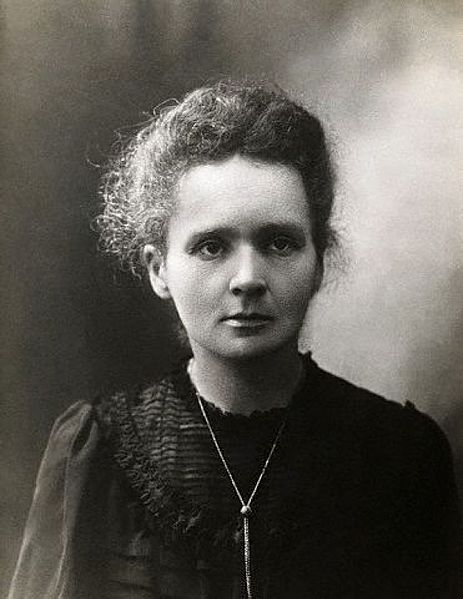
The Life of Marie Curie

Born on November 7th, 1867, in Warsaw, Poland, Maria Sklodowska would go on to become a well-known scientist. Her father, Wladysaw Sklodowski, was also a scientist. Later, in 1891, she would move to Paris. This was when she changed her name to Marie and began working at a research laboratory, where she met her husband Pierre Curie in 1894. 

She would go on to marry her husband, Pierre Curie, in July of 1895. The couple would go on to work together, and eventually discovered the element Polonium. Marie Curie named their newly discovered element after the country she was from: Poland. They would also discover a second element, Radium, months later in 1898. Marie and Pierre Curie had two daughters, Irene (born in 1897) and Eve (born in 1904). In 1903, Marie and her husband won the Nobel Prize in Physics for their research about radiation.

On April 19, 1906, her husband Pierre was killed after a street accident. It is thought to be possible that part of the reason for his death was his and Marie’s repeated exposure to radium, a dangerous substance which weakened them both. Following this, however, Marie continued her work in science, and in 1911 won the Nobel Prize in Chemistry. This time for her work about radioactivity. 

Eventually, Marie Curie would die on July 4, 1934 of aplastic anemia, due to her constant work with radiation. She was 66 years old at this time. Marie Curie was a great scientist, and the first woman to win a Nobel Prize.

– Peri A.

Several books about Marie Curie are available to check out from the Mission Viejo Library. It is also available to download for free from Libby.

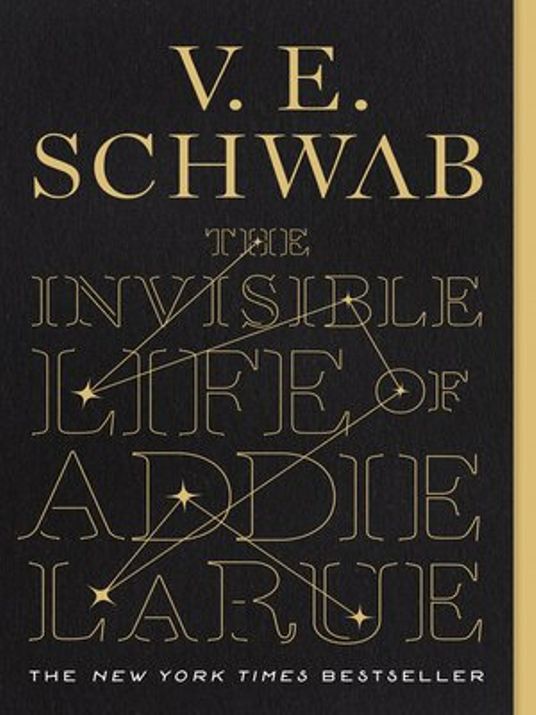
The Invisible Life of Addie LaRue by V.E. Schwab

Recently, I have read The Invisible Life of Addie LaRue which is a Fantasy/Historical Fiction novel about a young French girl who made a bargain with a dark god which made her immortal, but she is cursed to be forgotten by anyone who meets her. Throughout the novel, Schwab describes her life and the different events that Addie has gone through.

I personally enjoyed the characters and how their personalities were described by Schwab as well as their interactions with each other. The scenes written by Schwab were beautifully written and always exciting to read. I also loved how each chapter was only two to six pages long, keeping me motivated to continue reading. I am also currently taking AP European History this year and it was exciting to see Addie go through historical events that I have learned about in my class and apply my knowledge to the scenes!

Unfortunately, I did think that the book got repetitive and could have been a bit shorter. Some characters were also not as enjoyable to read as Addie, and I slowly lost interest mid-way through the book. However, I did find the book quite fun to read either way.

Personally, I did love the formatting and overall writing of the novel and believed it was a fun read. I love fantasy fiction novels and this book is wonderful for anyone who does as well. I thoroughly enjoyed it, start to finish, (even if it took me a bit to get through some parts), and would definitely recommend this to anyone looking for an easy and exciting read!

Kaiya T.

The Invisible Life of Addie LaRue by V. E. Schwab is available to check out from the Mission Viejo Library. It is also available to download for free from Libby.