Book Review: Rana Joon and the One & Only Now

This story, following a music-loving teenager named Rana in 1996 California is one full of love, love for writing, love for music, and love for other people. It narrates the life of Rana, reeling from the death of her best friend and finding her own talent through a haze of loneliness and unsettling family dynamics.

I loved this book so much more than I thought I would. I read it on a whim because I like the cover art, and was left crying by the end of it. Author Shideh Etaat finds the perfect balance between fiction and reality through the storytelling of Rana. As a lover of rap music and Tupac, I felt the story was incredibly compelling and relatable, even to the teens of today.

Rana’s family is a main focus of the book, and the dynamic between herself, her mother, her brother, and her father is one that is almost identical to a myriad of South Asian families in present-day California, the bridge between immigrant parents and first-generation children growing longer and wider as time goes on.

The book explores themes of queerness in immigrant families, a flawed main character learning how to live for the first time, and how the people around us can shape our experiences and our enjoyment of life itself over time.

I would recommend this book to anyone who is looking for a deep, thoughtful, funny read about love, life, loss, and how both writing and music can bring people together through anything. I could read this over and over again and still never get bored of the, frankly, beautiful writing that Etaat portrays as Rana’s as she learns to navigate her own life with herself at the helm.

Tanvi G.

Rana Joon and the One & Only Now by Shideh Etaat is available to check out from the Mission Viejo Library.

The Golden Key by George MacDonald

The Golden Key is a short novel by George MacDonald. The story takes place in a mystical forest called Fairyland. Mossy is a young boy who learns from his great-aunt about a golden key hidden at the end of the rainbow. Mossy does not know what the key would unlock, but he feels a strong desire to obtain it. One evening, while Mossy is looking out of his window, a rainbow suddenly flashes across the sky.  This reminds Mossy of the golden key, so he darts out of the cottage to get closer to the rainbow. To his delight, he reaches the end of the rainbow and finds the golden key.

Meanwhile, not far away, a young girl named Tangle is chased out of her home by fairies. She is led by a strange creature known as an air-fish to the cottage of an old woman named Grandmother. Grandmother then sends out an air-fish to look for someone else. That person turns out to be Mossy. The air-fish returns with Mossy, who has the golden key in his hand.  The two children then embark on a journey to discover what the golden key will unlock.

This book is difficult to describe. It seems like a magical fairytale, but the imagery feels more intense than most children’s stories. The story is extremely mysterious and fantastical, and it seems to have profound spiritual significance. I sense that this book is intended to be an allegory, but I am not sure about its overall meaning. The main themes seem to relate to the journeys of life and death, as well as a hope in life after death. I found this book to be charming and delightful, even though I was baffled at times by its symbolism. I would recommend this book to anyone interested in reading a dreamlike story that is deeply mystical and imaginative.

Circe by Madeline Miller: A Spoiler Free Review

Circe by Madeline Miller is a retelling of the witch Circe from Greek Mythology. She is the daughter of the titan Helios and a nymph. The gods, fearing her witchcraft, banish her to a deserted island. Here, she forges her path – honing her craft, meeting infamous figures of mythology, and being pitted against the wrath of men and gods alike. She’s torn between the mortal and the divine, and forced to grapple with what it means to be immortal. 

I really, really enjoyed this book. It’s one of the most unique stories I’ve read, chock-full of beautiful writing and characters. It’s definitely one I’ll be rereading for a long time to come.

In Circe, I particularly enjoyed the writing. The way Madeline Miller weaves her words into prose is mesmerizing. It’s almost lyrical in its flow, natural yet riveting. I would often read the same paragraph multiple times to soak in the words. This also comes into play as Miller describes the gods. She forgoes many physical details, instead describing things like the sound of their voice and the power in their presence. You begin to fear them the way Circe does. Additionally, the passage of time from the start to the end of the book is beautiful. At the end of the book, you look back and remember all she has gone through – it feels so long ago since she first stepped onto the island. You lived through it with her, in a sense. That feeling of passed time once I finished the book for the first time was overwhelming. 

No one book is enjoyable for everyone. Circe tends to be very character-driven rather than plot-driven and relies on mostly introspective focus. She is isolated on her island, after all. Thus, there are not so many dramatic action moments as dramatic personal moments. Plus, some consider the pacing to be somewhat slow and uneven, especially towards the latter half of the book.

All in all, I enjoyed Circe’s rich, bold 385 pages. It bursts with life and thought, and it holds a proud place displayed on my bookshelf. It is definitely a recommend from me. 

Circe by Madeline Miller is available to check out from the Mission Viejo Library. It is also available to download for free from Libby.

Book Review: The Scythe by Neal Shusterman

Foretelling a possible dystopian future, the Scythe features a world of immorality ruled by a sentient, all-knowing AI called the Thunderhead. However, death is still a necessity for humans as a result of the overpopulation on earth, causing humanity to form the scythes—similar to real-life grim reapers. They are chosen from billions of humans to kill anybody they wish—be it mass murder or a public execution—and are not under the control of the Thunderhead. Featuring Citra Terranova, a newly appointed scythe apprentice, she navigates her conscience through a world a murder as she competes for the scythe position against a fellow scythe apprentice she might have to kill.

The Scythe is a heart wrenching story that leaves people wondering if this could possibly happen in the future given Earth’s direction towards AI. The author beautifully characterizes the motives and backstories all plot characters, leaving no plot hole overturned.

What I loved the most was rather than telling the obvious story of overthrowing the ‘tyrannical rule’ of the scythes, we learn the scythes’ story instead. While many people feared the scythes, not all scythes were willing to become one, similar to Citra’s situation. As a scythe, they needed to leave behind their humanity and family and walk a solitary path alone as a murderer. But even through all that, they’re still human. The author cleverly details the inner struggles of many scythes who committed suicide due to their conscience, others who lavished in the power, and finally some who killed with compassion.

Additionally, many political schemes arise in the scythe world as beliefs over mass execution vs. private murder clash. What lengths would humans go through with the power to kill anyone?

Overall, this is one of my favorite dystopian books and I would definitely recommend to anyone interested in dystopian!

The Scythe by Neal Shusterman is available to check out from the Mission Viejo Library. It is also available to download for free from Libby.

The House on Mango Street

The House on Mango Street by Sandra Cisneros is a classic book that I believe should be read by everyone, of any age. This novel is composed of short vignettes following the life of a young girl named Esperanza living in a small house in Chicago. The descriptive storytelling style is broken up into 44 short stories, each one no more than two pages in length, totaling a little over 100 pages. It is a fairly quick and easy read, and it can be referred back to at any point without having to reread the entire thing. I first heard of this book in middle school, when I had to read about five of the vignettes. Those have stuck with me, and have continued to be some of my favorites, along with the new favorites I discovered through reading the whole book.

I believe this book should be read by anyone of any age, mainly because of the variety of characters that are introduced. Readers get to learn about Esperanza’s neighbors, who are all quirky in their own ways. We learn about Esperanza’s siblings, her friends, the younger kids on the street, the people who move in and out, the teenagers, the adults, and the elderly. Her neighbors are a diverse cast of characters who each have their own struggles in life, but they form a community on Mango Street. One of my favorite things about the novel is how it is told from the eyes of a young girl. I find that I could relate to her at any age, from reading it when I was in middle school, about the age Esperanza is in the book, but also reading it as I get older when I can see her growth and relate to other characters.

Another one of my favorite things about it is the dedication. The novel is dedicated both in English and Spanish to “The Women” or “Las Mujeres.” The House on Mango Street focuses on the female experience, highlighting female characters that Esperanza interacts with but also observes from afar. The stories about Marin and Sally highlight the struggles of being a girl and the story titled “Rafaela Who Drinks Coconut and Papaya Juice on Tuesdays” depicts Esperanza’s fear of becoming, as she describes it, a woman who sits by the window waiting for her husband. Esperanza wants to be independent, she wants a house of her own one day, that she doesn’t have to share with her entire family. I also loved how there were stories about Esperanza’s parents and her family as a whole. Rather than seeing her observe others, readers get to see someone who she really understands.

Ultimately, I loved this book and I can see myself referring back to it as I get older. If this was a required reading for you, I highly recommend taking another look at it, because it truly is an essential book for young readers. My favorite vignettes include, “My Name,” “Marin,” “Hips,” and “Beautiful and Cruel.” If you don’t read the whole book, I recommend reading those at least.

The House on Mango Street by Sandra Cisneros is available to check out from the Mission Viejo Library. It is also available to download for free from Libby.

All The Light We Cannot See By: Anthony Doerr

Anthony Doerr All the Light We Cannot ...

This novel is told from the perspective of two young children during World War II. The first is Marie-Laurie, a blind girl from the center of Paris near the Museum of Natural History, where her father works. The other Werner Pfennig an orphan, from a mining town in Germany who learned how to build and fix technical instruments by tinkering with a broken radio that he found.

When Marie-Laurie was twelve, the Nazi Regime began to occupy Paris, she and her father fleed to Saint-Malo and met her reclusive great-uncle, Etienne. The Museum of Natural History was rumored to own a diamond called the Sea of Flames, under the threat of occupation the museum director created 4 copies of the diamond. He then distributed these to 3 employees and hid one in the museum, but none knew if they had the real diamond. Soon after arriving in Saint-Malo Marie-Laurie’s father is called back to Paris and is arrested by Germans.

As the Nazi Regime, took power over Germany Werner’s talents for technology attracted certain local attention, and at fourteen was recruited to a specialized training program. He sees it as an opportunity to grow and get out of the orphanage that he’s lived in his entire life but his sister worries that he will be corrupted by Nazi propaganda. After 2 years of training at his technical school, he’s documents are falsified to make him seem like eighteen so that he’s able to fight on the front. After 2 years of rising through the ranks, Werner is assigned to Saint-Malo looking for radios, used by the resistance to broadcast their messages.

Marie-Laurie’s uncle begins engaging with in resistance work with the other French townspeople, but he’s agoraphobic so he’s unable to leave the house without intense anxiety. So Marie-Laurie works with her uncle by gathering messages from the resistance for him to transmit from his radio tower in his attic. Werner and Marie-Laurie’s lives begin to further intertwine.

I liked this book, I thought it had a good mix of suspense and historical fiction. I also really liked that one of the main characters has a disability, that is rarely seen in historical fiction. I think if you like historical fiction and has blind representation then this book is for you.

All the Light We Cannot See by Anthony Doerr is available to check out from the Mission Viejo Library. It is also available to download for free from Libby.

Book Review: Immune: A Journey into the Mysterious System That Keeps You Alive by Philipp Dettmer

From the get-go, this book is a must-read for anybody who is interested in the field of biology, or anybody who wants to get to know how the system that keeps them alive works.

This work is divided into several sections, each explaining a specific part or aspect of the immune system. Dettmer first introduces the immune system and how it evolved from around 541 million years ago, when multicellular animal life suddenly exploded, causing bacteria and other microorganisms to become an existential threat, as they could use these ecosystems of organisms as free energy at the detriment of the former. As a result, some organisms such as sponges evolved what would be known as “humoral immunity”, or proteins that would float around and kill microorganisms that were not supposed to be in an animal’s body. This system ended up being so successful that evolution did not phase it out, and rather made it a crucial aspect of an organism’s immune defense.

The book then goes on to explain more aspects of the immune systems, such as different parts of it including the different cells that make it up, including macrophages and neutrophils, which are integral to the functioning of the immune system. After going over these two crucial parts of the immune system, Dettmer then goes on to talk about the process of inflammation and its causes in relation to the immune system.

Although it would be impossible for me to include every single one of this book’s many complex topics in this review, I think that this book was great, and made topics that would otherwise be complicated and tedious to read seem very interesting. The author of this book also has a very well-known science Youtube channel, Kurzgesagt, which I highly recommend checking out.

Immune: A Journey into the Mysterious System That Keeps You Alive by Philipp Dettmer is available to check out from the Mission Viejo Library.

Unwind by Neal Shusterman

Near the end of the school year, my English class read a book called Unwind. Unwind is a well-known dystopian novel among middle schoolers such as myself. Unwind takes place in the United States in the future. In this world, there are many twisted laws. One of these laws includes parents being able to send their kids off to get unwound. This means that the kid will be sent off to get used for their body parts, which basically kills them. This law sets up the entire plot for the book and makes the book a page-turner and an exciting and easy read.

   At the beginning of the book, we get introduced to three kids named Connor, Risa, and Lev who have all been sent to be unwound. These three meet by escaping from Juvey cops while being transported to be unwound. From here they travel to a school where Lev turns in Conner and Risa and simultaneously causes a huge scene where Connor and Risa are able to run away and part ways with Lev. As the book continues we follow the journey of Connor and Risa until they find their way to a sanctuary for unwinds like themselves. We also follow Lev’s complicated journey who also ends up finding himself at the sanctuary with the other two. As the story continues Lev runs away from Connor and Risa, separating the trio again. Soon after, their lives interlink again, which leaves them with some events that help contribute to stopping unwinding.

Unwind is easily one of the best books I’ve ever read. The easy-to-like characters and the suspenseful and breathtaking moments in the book were my favorite parts. Almost every character in the story is very likable and respectable in their own unique way. Some characters are more entertaining than others such as one of the main characters, Connor who is a hothead, which causes many action-packed and engaging events. Some moments that stood out for me include when Conner, Risa, and Lev team up after escaping and when Lev betrays the other two. If you are in middle and even high school and haven’t read this book yet, I highly recommend it to you. If you have read the novel I’m sure reading this again will do nothing but good. This book contains many topics such as betrayal and heroic moments that will intrigue kids in middle and high school.

Overall, Unwind is one of the greatest books I’ve ever read. I loved all of it, but if I had to choose which parts of the book were the best I’d pick the descriptive action moments and the likable and fun characters. As you continue to read you’ll be able to imagine the scenes in the story making the book a page-turner. Once you finish the book you’ll be begging for more. I highly recommend this book to anyone even if you’ve read it before.

-Matthew R.

Unwind by Neal Shusterman is available to check out from the Mission Viejo Library. It is also available to download for free from Libby.

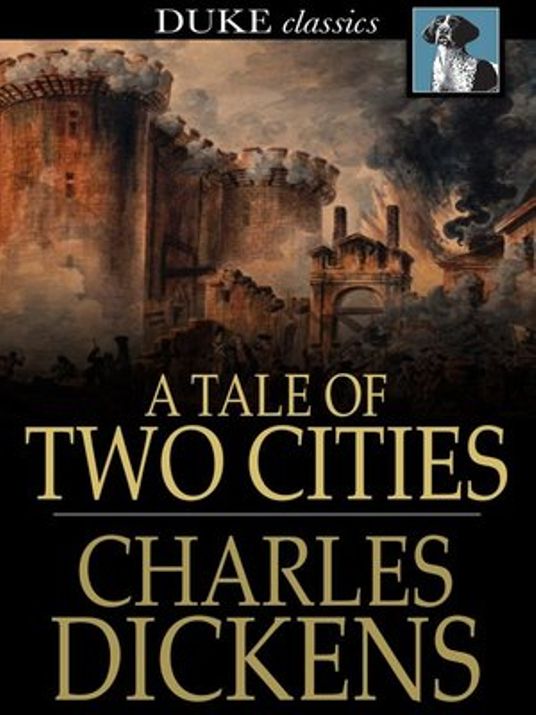
A Tale of Two Cities by Charles Dickens

Let’s go back. This book took me a few months to read for my English class. School is out, yet I haven’t done anything for this novel. A Tale of Two Cities by Charles Dickens was not the easiest book I’ve ever read. I won’t lie, online synopses really helped me out in the understanding portion as I read through it. While it wasn’t an easy book to read, it was by no means bad. 

A Tale of Two Cities is a reflection Charles Dickens writes about on the French Revolution as a warning to those in his period. Almost written in a way to stop history from completely repeating itself. It focuses on the Manette family and their story through trauma and hardships, new found romances and family drama. We meet plenty of characters along the way; those directly involved in the French Revolution and people who are victims to the violence. Dickens sets the stage a few years before the revolution, establishing various relationships and connections that affect all the cast in one way or another. The result of violence and loss, made to make the readers uncomfortable, are beautifully crafted to warn and caution society. 

Dickens writes in a way that elongates the ideas he is trying to express as he sprinkles in colorful vocabulary to make it even more confusing for the everyday reader. However, once you figure out what he is talking about and the main point of what is happening, the story becomes much more enjoyable. The whole plot of the novel is like one big mystery. We all know it leads up to the Revolution, but how could a family and group of friends from London get involved with something happening in France? How are these characters important to the story? I really loved how all my questions were answered by the end of the novel, many of which answered throughout the chapters. And thinking back, I find it even more interesting and intriguing how Dickens had written this novel; releasing one chapter at a time like some TV show with weekly episodes. Dickens released its chapters serially, once a week, to keep readers on the hook, ready and waiting for the next “episode” to find out what happens to their beloved characters. 

All the characters Dickens carefully crafted managed to create an impact on me. Every single one had an important role to play, some more than others, yet they all managed to build from each other and grow into even more impressive people that audiences can feel for and connect to. A fan favorite (for me and for many) was Sydney Carton. He started off as someone your parents would tell you to stay away from, the neighborhood drunk and overall not the best person. What’s worse, is that he knew that. Such an emotionally depressing character was not what I expected and I didn’t know what to expect from him. So many I knew loved this character, including my English teacher. But in the beginning, I had nothing to love about him. But Dickens was fantastic in character development. All characters had their own shining moments, but Sydney just happens to have one of the largest and most dynamic developments in the story. By the end of the book, I discovered a grip he had on my heart as I ended my read with him. His story left me shocked and gaping as I was left to wonder about the rest of the cast. 

Dickens may not be the easiest author to read from. I must say his diction and syntax are not for the weak. However, he writes a very compelling narrative and builds such meaningful characters. I would recommend this novel to others, with a little hesitance. This wasn’t for everybody. I happened to enjoy it, although I struggled a bit; but others may be wanting an easier, less overwhelming read. But if you don’t mind the challenge, I think that this would be a great historical fiction novel to read. 

-Nicole R.

A Tale of Two Cities by Charles Dickens is available for checkout from the Mission Viejo Library. It can also be downloaded for free from Libby

Ramona and Her Father by Beverly Cleary

Ramona and Her Father is a Newbery Honor-award winning book by Beverly Cleary. The story is about a seven-year-old girl named Ramona Quimby. Ramona loves spending time with her father. He buys her gifts and enjoys taking his family out to eat on every payday. However, everything changes when Ramona’s father loses his job. Ramona needs to cope with her family’s financial struggles and her father’s emotional turmoil. Throughout the book, Ramona tries to understand the complexities of adult problems while dealing with her own personal challenges.

This is a short book, but I enjoyed it very much. The characters, and the challenges they go though, are surprisingly realistic. Ramona is particularly likable in this book, as she is in many other Beverly Cleary books. This story is quite enjoyable and I think it could even be considered inspiring. It warns of the dangers of addiction but also teaches how to respond to difficult situations. I appreciate Ramona’s childlike perspective on financial hardship and emotional struggles, and her sincere efforts to make things better for her family.

I enjoyed this book so much that I read it in almost one sitting. I was captivated by the way this book addressed real-life problems from the perspective of an innocent child. Ramona gets into trouble sometimes but she has good intentions. Many things happen in the story that are quite amusing and entertaining, which is typical of Beverly Cleary’s books. This is a charming book and I would definitely recommend it to readers of all ages.

Ramona and Her Father by Beverly Cleary is available to check out from the Mission Viejo Library. It is also available to download for free from Libby.