Afternoon of the Elves by Janet Taylor Lisle

Afternoon of the Elves by Janet Taylor Lisle, is the story of a young girl named Hillary Lenox, who becomes fascinated by her neighbor, Sara-Kate Connolly. Sara-Kate was held back in fifth-grade and seems to live in her own distant world, ostracized from society. Sara-Kate invites Hillary to see a secret village of elves in the woods of her backyard. Sara-Kate explains that the elves live in tiny homes made of sticks, leaves and stones. The two girls soon become friends, even though Hillary’s other friends and even her own parents disapprove of their friendship. Hillary is captivated by Sara-Kate’s theories about the magical elf world. This leads Hillary to see life in a new way.  Hillary also learns that Sara-Kate’s life is much sadder and more difficult than she could have imagined.

I appreciate the way this book portrays the complex connection between childhood imagination and the painful realities of life. This book deals with challenging themes involving friendship and loneliness. It teaches that many people suffer from hardships that are hidden from the rest of society. We can learn to have compassion for people who have lives that are much different than our own and more difficult than we realize. This book shows that we should be kind and friendly to everyone.

This book seems to blur the line between fantasy and reality. The elves add a sense of mystery and suspense to the story. In some ways this book can seem unsettling, because of the severe hardship and trauma that it describes. However, I appreciate this deep exploration into the minds and relationships of children dealing with the harsh and complex realities of life. This book is very intriguing and I would recommend it to both young and old readers alike.

I Who Have Never Known Men by Jacqueline Harpman

Jacqueline Harpman’s novel, I Who Have Never Known Men, surrounds the theme of what it means to be human in a world where you have been stripped of everything that makes you feel human.

The novel follows a young woman, the narrator, with no memory of her past or the outside world, living in an underground cage with 39 other women, guarded by men who never speak. During her time in this cage, the narrator, who remains unnamed throughout the entire novel, lives with a constant urge to gain knowledge of the outside world and what humanity is really like. Relying on the broken memory of the other women, the narrator struggles to put together the notion of the outside world, like a jigsaw puzzle with pieces that don’t fit together. She finds herself holding on to anything that makes her human, while being faced with dehumanizing circumstances everyday, such as defecating without privacy, walking with nowhere to go, and attaining intellectuality without proper books or educational material. This marks an important aspect of what makes humans, humans: The strive for knowledge and persisting curiosity.

One day, an alarm in the bunker where the women are imprisoned goes off, initiating the fleeing of the guards who accidentally leave the cage open when feeding the women. After a moment of wondering whether the guards would return and in disbelief that they were actually free, the women run from the cage, starting up the stairs of the bunker and facing the sky for the first time in years, feeling raindrops fall to their faces like water hadn’t existed, and feeling their heartbeats rise in adrenaline like their heart hadn’t beat before.

However, once free, the women face an unforgiving post-apocalyptic world, unlike the one they had remembered like a distant dream, and slowly begin to die, one by one, not just of illness, but of the burden of grief of missing their past lives. The narrator, having no recollection of this life and having had grown up in an imprisoned world, persists in her efforts to find her humanity while being the last of the women to survive a world unlike the one the women had described.

What I love about this book is that its a story of a human with so much of her humanity stolen from her, yet she still finds herself asking the most fundamentally human questions: Why am I here? What does this all mean? It’s a story about how even when born into a society so different from any that exists now, humans will always find hope, love, and wonder.

I Who Have Never Known Men by Jacqueline Harpman can be downloaded from Libby

The Big Wave by Pearl S. Buck

The Big Wave is a short novel by Pearl S. Buck. Kino is a young Japanese boy who lives on a small farm on the side of a mountain. If he is not at school or working with his father, he is usually with his friend Jiya, who lives in a fishing village just below the mountain. Because he lives so close to the ocean, Jiya often worries that the sea will suddenly become angry and create a phenomenon known as the “big wave,” a huge and destructive wall of water. Kino is aware that the big wave is a real possibility, but he does not consider it likely to actually occur. Unfortunately, the big wave suddenly appears one day and annihilates the entire fishing village, including Jiya’s family. Jiya was with Kino and his family when it happened, so he saw the entire destruction of his village. Kino does not know whether Jiya will be able to endure the emotional shock of this tragedy.

This book is short, but extremely impactful. I have always been fascinated with Japanese culture, and this book provides a great deal of insight into their traditions and way of life. This book is very realistic and meaningful. For example, Kino’s character traits, and specifically his flaws and weaknesses, are described in a very genuine way. Possibly my favorite thing about this book is its overarching message of dealing with grief and hardship. It also teaches about the power of bravery and the human spirit. After the big wave hit the village, I actually felt worried about Jiya and I wondered how he would be able to cope after this traumatizing experience. The way Jiya responds to this event would probably feel very relatable to anyone who has experienced a personal tragedy. I would highly recommend this book to anyone who is looking for a short but poignant read.

The Big Wave by Pearl S. Buck is available for checkout from the Mission Viejo Library. It can also be downloaded from Libby

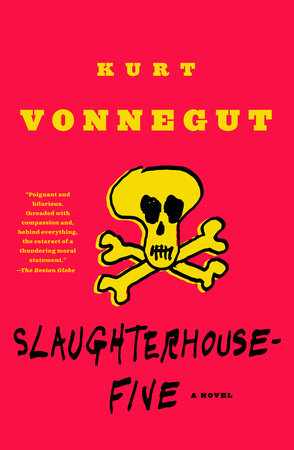
Book Review: Slaughterhouse-Five by Kurt Vonnegut

Recently, I created a bucket list of books that were previously or currently banned in some capacity that I wanted to read, and one book that particularly stood out to me was Slaughterhouse-Five by Kurt Vonnegut. Known for his absurdist writing style, Vonnegut’s work never fails to be humorous and meaningful at the same time.

This book has no specific sense of time, a break from the typical writing style seen in most novels. The book begins with Vonnegut describing his personal connection to the book and his thought process in writing it. Having witnessed the Second World War and its brutality firsthand, there definitely is an anti-war aspect to the book. The story frequently jumps between time periods, as the book’s main character, Billy Pilgrim, becomes “unstuck in time” and “time travels” through what can be implied to be flashbacks and flash-forwards.

The book attempts to explain Billy’s warped sense of time, but also his understanding of life and death, as a result of his contact with an alien race known as the Traufamadorians. Billy “time travels” constantly between WWII and the post-war period, where he is supposedly at, with Vonnegut making it uncertain what time frame the book truly is set in. At the same time, Vonnegut introduces several narratives concerning the brutal and dehumanizing nature of war, including its random nature by killing off characters who were least expected to perish. In fact, part of the reason why the book was banned originally was because of its anti-war nature, with some citing it as “unpatriotic”. By creating these narratives, Vonnegut ultimately expresses a cynical sentiment concerning the cruelty of human nature.

SH5 is one example of Vonnegut’s incredible talent for world-building; while every event seems random or out of place in the context of where it is placed, everything fits together, albeit haphazardly. This book is full of surprises, and I really enjoyed this wild roller-coaster ride of a book that simultaneously managed to be full of significance and meaning, despite the author’s intention for many things to be meaningless. Ultimately, this intention is a paradox in itself. I’d recommend this book for anybody looking for a unique read, or just anybody who wants to read an important piece of literary history in general.

Slaughterhouse-Five by Kurt Vonnegut is available for checkout from the Mission Viejo Library. It can also be downloaded from Libby

Maybe You Should Talk to Someone by Lori Gottlieb (Book Review)

Maybe You Should Talk to Someone by Lori Gottlieb is available for checkout from the Mission Viejo Library. It can also be downloaded from Libby

The Fall of the House of Usher: The Tale of Madness and Decay

Edgar Allan Poe’s The Fall of the House of Usher is a haunting short story that masterfully explores themes of isolation, mental deterioration, and the inescapable grip of family legacy. First published in 1839, the story follows an unnamed narrator who visits his old friend, Roderick Usher, at the Usher family estate. Upon arrival, he is struck by the bleak and decaying atmosphere of the mansion, which seems to mirror the physical and psychological condition of its inhabitants.

Roderick, suffering from a mysterious illness, and his twin sister, Madeline, who is on the brink of death, are the last members of the once-great Usher family. As the story unfolds, the mansion itself begins to embody the psychological torment of its residents. The house seems to crumble under the weight of its own dark history, and its eventual collapse parallels Roderick’s descent into madness.

I personally love the vivid, Gothic imagery Poe uses to enhance the story’s eerie mood. The detailed descriptions of the house’s dark, oppressive environment set the stage for the final, shocking twist, where Madeline, seemingly dead, returns from her tomb to confront her brother. I love the tragic conclusion in which the physical collapse of the House mirrors the emotional breakdown of the entire Usher family. I think Poe created a wonderfully dark story for anyone who loves Gothic, haunting stories.

If you enjoy eerie and chilling stories, Edgar Allen Poe is for you. The suspense leading up to the climax leaves you clinging to your chair and biting your nails which was perfect for Halloween which was when I read this. Ultimately, this timeless exploration of moral decay and inner turmoil is a wonderful read for anyone willing to pick up one of Poe’s horror novels.

Kaiya T.

The Fall of the House of Usher by Edgar Allan Poe is available for checkout from the Mission Viejo Library.

Fast Food Nation Book Review

“Twenty years ago, teenage boys in the United States drank twice as much milk as soda; now they drink twice as much soda as milk.” ~ Eric Schlosser

So, let’s talk about Fast Food Nation by Eric Schlosser. This book rips off the veneer and presents some harsh realities for anyone who has ever wondered what actually goes on behind the neon-lit drive-thrus and golden arches. The system that supports the fast food industry, from factory farms and worker exploitation to the hazardous meatpacking industry and the horrifying realities of food production, is more than just greasy food.

Schlosser delves deeply into how fast food spread around the world, influencing not only what we eat but also how we work, how we farm, and even how we view convenience. Indeed, there are some really unsettling parts of it. He reveals how fast food companies use marketing to target children, the hazardous working conditions in slaughterhouses, and how the industry’s drive for efficiency frequently comes at the expense of public health. Warning: You may want to reconsider your next burger.

What I appreciate about this book is that it’s not just a hit piece on McDonald’s (though they do take some heat). Schlosser connects the dots between corporate greed, government policy, and the way our food system has evolved into something pretty unrecognizable from the farms of the past. It’s like The Jungle but for modern times.

Is it enjoyable to read? Not precisely. However, it’s captivating. Schlosser blends factual information with true stories to give everything a personal touch, writing like a journalist who has done their research. This book is worth reading if you’re interested in environmental and public health issues or simply want to understand what’s actually in your food. But fair warning: It might not be a good idea to pick it up just before lunch.

Would I recommend it? Yeah, but with a warning: once you know this stuff, you can’t un-know it.

Fast Food Nation by Eric Schlosser is available for checkout from the Mission Viejo Library. It can also be downloaded from Libby.

Life’s Golden Ticket

Life’s Golden Ticket by Brendon Burchard is a self-help book that helps readers with personal transformation and motivation. He used a fictional character to narrate actionable advice; Burchard aimed to guide readers toward a more fulfilling and purposeful life through his book using his fictional character. While the book has received praise for its inspirational content, it has also faced criticism.
I like that the author used a fictional character to teach readers how to transform their lives and even gave actionable steps.

Spoiler Alert!

In the book, a man receives a golden ticket and an opportunity to transform his life. One of the book’s best parts is the engaging narrative and how the author uses this type of narration to create a format that shows readers ways to change their lives and makes self-help concepts more engaging.

He also provides practical advice through the protagonists’ journey. In the book, the author demonstrates actionable steps, exercises, and reflections using his fictional character as the narrator. Readers can use them to identify their passions and set goals. I especially like the exercises for overcoming obstacles.

The book excels in its ability to inspire and motivate engaging stories and uplifting messages that encourage readers to take control of their lives and pursue their dreams.

The author emphasizes the importance of self-discovery and personal growth throughout the book. Life’s Golden Ticket emphasizes the importance of personal growth and self-discovery and motivates readers to reexamine their values to set more meaningful goals, continuous improvement, and development toward a more fulfilling life.

What I would have preferred about the book is that it’s predictable. While the storytelling approach is engaging, some readers may find the plot predictable and misleading. Although effective, the narrative follows a standard arc of personal transformation that may need more originality for some.

This book is helpful because of the potential impact on readers who don’t like the typical nonfiction self-help book.

The book motivates, brings self-awareness, and makes you think more profoundly about your choices, goals, and personal experiences that lead to transformation. It also encourages readers to pursue their dreams and aspirations by focusing on personal growth and goal-setting. It reinforces the idea that change is possible and that people have the power to shape their own destinies if they work hard and set actionable goals.

I think Life’s Golden Ticket offers a compelling blend of narrative and self-help advice that can inspire and motivate readers. I especially loved receiving my golden ticket at the end of the book when I finished reading it.

Here’s to your Golden Ticket!

Bella H.

Life’s Golden Ticket by Brendon Burchard is available to check out from the Mission Viejo Library.

Romeo and Juliet Play

A few days ago, our class just finished reading Romeo and Juliet by William Shakespeare, and watched both movies. It was…an experience.

I have to put it out there, this was definitely one of the more boring sections in our English Curriculum Requirements. Almost everyone has heard the story of Romeo and Juliet: two children from feuding families fall in love, and love brings them both to a terrible end.

At first when we went to check out the play from the library, I flipped through a few of the pages, and to me (and most other people in my class), the language made absolutely NO SENSE. I tried to process what the author was trying to imply, but every interpretation of what I THOUGHT it meant, was actually very different from what the actual translation was.

Throughout the daily reading sessions we had, my mind always drifted. It was almost impossible for me to focus when the language was so confusing! More questions kept popping up in my head as we read, but the most prominent one was: “How did the people during this time period understand Shakespeare’s unique language?” As we read Shakespeare’s works, we can truly see HOW our language has changed throughout several hundred years (461 to be exact!). Of course, I was thinking this while we were reading during class, which made the homework we had after a lot harder for me, but it was worth it.

Okay, on to the movies. The original one that was published in 1968 was a decent movie. It captured a majority of the plot, and the dialogue was almost exactly the same. I can most definitely say that the new version of the Romeo and Juliet movie was NOT what I expected.

For those of you who don’t know, the new version is a spin-off of Romeo and Juliet, where they are (hear me out) part of different mafia gangs. Could they have captured this any worse? Additionally, the ending was a complete shocker. This movie was quite hard to watch for me, as I feel the director lost the true meaning of what William Shakespeare was trying to convey.

Out of 5 stars, I would give the old version a solid 4 out of 5. Pretty good, but not too great. The meaning was there, although they skipped a few parts. The new version? 3 out of 5. Lost the meaning halfway through the show, but they did a decent job on the spin off, I suppose. 

Romeo and Juliet by William Shakespeare is available to check out from the Mission Viejo Library. It is also available to download for free from Libby.

The Sun and the Star: A Review

Written by Rick Riordan and Mark Oshiro, the Sun and the Star dives into countless topics and genres– just as the main characters, Nico di Angelo and Will Solace, dive into Tartarus. One of the overarching themes is “fixing what’s broken,” and the process of doing so.

A quick plot summary: In a previous book, Bob the Titan sacrificed himself to let Annabeth and Percy escape from Tartarus. However, they neglected to think about or visit him afterward. In “The Sun and the Star,” Rachel Dare comes bearing a prophecy for Nico and Will, saying they need to save Bob. To do so, they must journey through the underworld and go to the heart, otherwise known as Tartarus. Though Nico, being a son of Hades and a previous Tartarus visitor, is an obvious choice, it’s different for Will, son of Apollo. However, he insists on coming with his boyfriend and facing the danger. Through their adventures, they find an overbearing plot and overturn it (and the primordial goddess leading it…).

One “broken” part they try to mend is Nico’s state of mind as he comes to terms with his PTSD. It’s a part of him, experiences he’s had, but it doesn’t mean he should be bound by his nature or past. In addition, he starts to understand feelings and PTSD are not weaknesses. They may be extremely difficult, but working with them is better than hiding them. Also, Will supports Nico during this time. To talk to your demons is scary, however, it’s better when you do it with someone you care about. In page 367, we see “[Will] wanted to understand Nico, even the parts that seemed difficult or sad. All Nico needed was to be seen and heard by someone he cared for, and Will was making the effort.” This also introduces the concept that relationships are a two-way street. No matter how different or similar the two may be, the most important part is accepting and working to understand one another.

Meanwhile, Bob, who also stars in the book, must work with his newly returning memories of his former self, Iapetus. Since he was dipped in the River Lethe, he became a better person (or Titan,) but he suffers from an identity crisis since remembering his dark past. Near the end of the book, he demonstrates his realization that he can never stop being a Titan, but it’s also completely possible for him to have changed.

Nico and Will are often respectively compared to darkness and light in the book. A key moral of the book, they realize they’re not just one or the other: “”There cannot be light without darkness, nor darkness without light. You must have the contrast for both to exist.”” (Riordan & Oshiro 244) Not everything is broken, even if it looks like it. Fix what’s actually broken, but treasure what isn’t.

The Sun and the Star by Rick Riordan and Mark Oshiro is available to check out from the Mission Viejo Library. It can also be downloaded for free from Libby.