Book Review: Robinson Crusoe, by Daniel Defoe

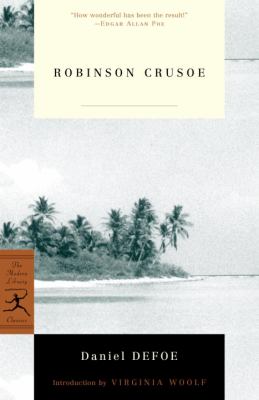
robinson_crusoeRobinson Crusoe is an interesting book written by Daniel Defoe. This book is about a man that was stranded on a tropical island alone and desperate for help. He goes to great lengths to try and survive. He does incredible work trying to survive. However, there are some setbacks such as an earthquake. He describes it as “would have overturned the strongest building that could be supposed to have stood on the Earth.”

Crusoe begins to get used to all of these misfortunes. Many new events start to happen at the same time as well. One of these events include meeting Friday. Crusoe teaches Friday many new things. Friday and Crusoe also become very good friends.

The story goes on and you must read to find out what happens next! I would recommend this book to an older crowd such as ages 13 – 16. This of course depends on what version you read.

In the end, this book is very good and I recommend you to read it. This is a classic that you will love. This book is one of the few books that you will ever forget about!

-Melika R., 8th grade

Book Review: Anthem, by Ayn Rand

anthem_cover

“You need to work with a partner or a group.”

“You have to know how to corroborate.”

“Group spirit is more important.”

“Don’t stand there by yourself, joy others!”

Do you hear these in your daily life, in school during classes, in field during sports, or even in the simplest activities? People say that the future society is for the one who knows how to work with others. However, in the novel Anthem by Ayn Rand, the author expresses her opinion by this future world with no ego.

In this world, the previous human history was abandoned that cities were covered with plants that grew incessantly. And in the society now, people don’t have the word “I,” “she,” or “he” in the dictionary.

“We are alone here under the earth. It is a fearful word, alone. The laws say that none among men may be alone, ever and at any time, for this is the great transgression and the root of all evil.”

Everyone works as a group and studies as a group, and everyone should be the same; when it comes to jobs, the law makers work as a group to decide the jobs randomly, which a genius may ends up being a street cleaner for the rest of his life. Ironically, people are named as a word with numbers, such as Equality 7-2521, but in fact, there is no such thing as real equality in this society.

There is no love. The government sets up reproduction process, sex, randomly. There is no marriage, no family, and laws control even the basic relationships.

However, an individual develops in this world. How will he survive and what can he change about this cold world?

I give this book a 9 out of 10. The topic is very unique that the author focuses on the idea of ego that people are forgetting in our society now. The only thing that I hope the author would add is the formation of this kind of society, which the story does not cover. How did the world change into this society that all men must be alike?

“Over the portals of the Palace of the World Council, there are words cut in the marble, which we repeat to ourselves whenever we are tempted:

‘We are one in all and all in one.

There are no men but only the great WE,

One, indivisible and forever.’”

-Wenqing Z., 11th grade

Book Review: Lord of the Flies, by William Golding

lord_of_the_flies_coverHave you ever wondered what it would be like to be stuck on a stranded island with other people, oh wait, I’m sorry– I mean, other kids? Imagine all that freedom! But could all that freedom lead into something horrible or evil?

Well then, you should read Lord of the Files by William Golding. A fictional story taking place in the “near future,” it is a story about a group of boys who crash land on a stranded island. They all realize later that there are absolutely no adults that survived the terrible crash. This book has some suspenseful moments that keep you reading until you literally fall off your chair.

Mr.Golding also did a wonderful job using figurative language to describe his beloved, and ruthless characters and the strange and creepy island the boys are on. I must say, though, that you have to be at least in 8th grade to read this book. The reason is because there are many scenes that do have some violence that may not be suitable for a 7th grader or below. Also because many times in the book the author tends not to say what is happening or actually what happened. The author really wants you to figure out what is actually happening, he wants you to analyze the story.

If there are any readers out there that really like suspenseful, and adventure type books, this is the book for you!

-Robert N., 10th grade

Book Review: White Fang, by Jack London

white_fang_coverThis month, I am blogging about a book that I have always wanted to read, yet have never had a chance to read, until now. White Fang by Jack London is one of those classics that people are always telling me about, yet, even though I am always reading something, I have never read it. As soon as I picked it up and looked at the back cover, I knew that it would be a book that I would like a lot.

I do not want to give the whole plot away, but White Fang starts out as a tiny puppy struggling for survival, half dog and half wolf. He is found by a cruel man named Gray Beaver, whose brother owned White Fang’s mother. Gray Beaver turns White Fang into a nasty and vicious dog that cannot trust anyone, and White Fang has to quickly learn how to hurt, or be hurt, and soon becomes the most feared and hated dog in Gray Beaver’s tribe. Gray Beaver then sells White Fang to an even nastier man named Beauty Smith, who discovers White Fang’s fighting abilities, and has him fight other dogs for money. Without spoiling anything, I can gladly say that the ending is a happy one, where White Fang finally learns that some people can be kind and caring after all.

White Fang is a story of survival, and trust. It is also a story of love and companionship. White Fang is a great story, and I really like Mr. London’s style of writing. He shows what it is really like to be out in the harsh lonely world with no one to trust, and no one on which to rely. White Fang is not the best book I have ever read, but I really enjoyed it, and would recommend it to anyone above nine years old (a little of a complicated read for younger children), boy or girl, who enjoys reading, especially about animals and nature. All in all, White Fang is definitely a great book and I would most certainly read it again.

-Will R., 9th grade

Book Review: Gone with the Wind, by Margaret Mitchell

gone_with_the_windSet in mid-nineteenth century Georgia, Margaret Mitchell’s Gone with the Wind is one of the most unforgettable stories of all time.

A charming and obstinate sixteen-year-old girl, Scarlett O’Hara is the belle of the County. Like the rest of the South, she is used to a pampered lifestyle, where slaves wait on her twenty-four hours a day. All she does is dream about Ashley Wilkes, the man who she is madly in love with. When the Civil War begins, Scarlett and the rest of the South must give up their spoiled lives. At the same time, however, she must win Ashley’s heart and fight to survive one of the most brutal wars in American history.

Gone with the Wind is not just a story about love; it is also a very informative book that teaches readers many valuable lessons. Scarlett stayed strong and fought bravely throughout the war. Her conduct teaches readers determination, perseverance, and optimism. In order to survive, she gave up her old life and even picked cotton like a slave. Because of this, she learned to appreciate what she had in life, although she eventually became greedy because of fear.

As the book goes on, readers will become attached to the many characters, including the headstrong Scarlett and the sardonic Rhett. In my opinion, Scarlett is a spoiled, greedy brat who doesn’t care about anything except herself and money. I thought Scarlett got what she deserved when Rhett mocked her all those times and when the town treated her like an outcast. However, I still felt a connection to Scarlett, and actually felt sorry for her at the end of the story.

I thoroughly enjoyed Gone with the Wind, and it will always be one of the greatest classics of all time. As the Chicago Tribune says, Gone with the Wind is “fascinating and unforgettable! A remarkable book, a spectacular book, a book that will not be forgotten!”

-Kaylie W., 9th grade

Book Review: The Phantom Tollbooth, by Norton Juster

phantom_tollbooth_coverThe Phantom Tollbooth is a classic novel in which everything is taken seriously, and misinterpretations are common. There is an Island of Conclusions (you get there by jumping) and a car that goes without saying.

There is a young boy named Milo. He is always bored and has extra time. Then, one day a package arrives in Milo’s room, addressed to “Milo, who has plenty of time.” Inside is a genuine turnpike tollbooth. Milo hops in his car and drives through the tollbooth, beginning his journey to the Lands Beyond.

On his travels, he meets the whether man (after all, it’s more important to know whether there will be weather than what kind of weather there will be), Tock, the watchdog (who goes tickticktick), the Humbug, and many, many more. He embarks on a great journey to The Castle in the Air to bring back the princesses Pure Reason and Sweet Rhyme. He faces many challenges, comes face-to-face with monsters like the demon of insincerity and the Terrible Trivium. His friends help him along the way and come forth to help him face the demons, even Canby (who went to show that he was as brave as can be but stayed back to show that he was as cowardly as can be). When Milo returns back home, he begins to enjoy his life, and realizes that there is always something to do right there.

The Phantom Tollbooth is a great book that has been enjoyed by readers of all ages for over 50 years. I recommend reading it, because you will never know what comes next.

-Linna C., 7th grade

Book Review: Flowers for Algernon, by Daniel Keyes

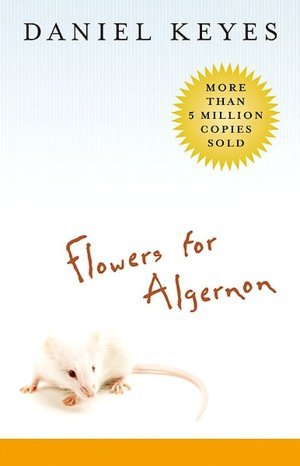
flowers_for_algernon_coverThis book review is part of series of reviews written by students at St. Margaret’s Episcopal School for their 7th grade English classes.

Have you ever wondered what it would be like to live in a world where you don’t know how to read, write, talk correctly, and have people stare at you like you’re stupid? Flowers for Algernon is a great book that immerses you in the life of someone who has all of those disabilities. In Flowers for Algernon, our brilliant author Daniel Keyes takes us on an ambitious walk through a disabled persons shoes, all the while trying to incorporate them into everyday society. He first thought of writing this book when he met a challenged young man and thought how good it would be if there were techniques to help him and others like him. Flowers for Algernon visits the point of view of how a disabled person might feel about this transition, rather than just how we might feel about it.

Charlie Gordon is 32 years old and lives by himself in a small New York apartment. All his life he’s struggled with a severe learning disability keeping him stuck at simple, and simultaneously making him a social outcast. Charlie has always desired to be smart to gain his mother’s approval, but he simply couldn’t retain knowledge. Coincidentally he is part of a research study where he takes basic tests and writes progress reports everyday so they can observe his development. “Dr Strauss says I should rite down what I think and remember and every thing that happins to me from now on. I don’t know why but he says its importint so they will see if they can use me. I hope they use me because Miss Kinnian says maybe they can make me smart. I want to be smart” (3).

In the lab, Charlie befriends two key people: Dr. Straus and Alice. Alice is Charlie’s best friend, motivational coach, helper, and first love. She is also Charlie’s first step into having a social relationship. Dr. Straus is the person who takes Charlie’s progress reports and analyzes them. He observes Charlie in therapy and examines his maturity.

One day the lab has Charlie race a mouse called Algernon in a maze. Much to Charlie’s aggravation Algernon beats him every time. The reason for Algernon’s success was entirely due to an operation performed on his brain, which super charged his intelligence and problem solving skills. Realizing Charlie would be a perfect candidate for this surgery, Dr. Straus hoped to test it on him as the first human specimen. Charlie eagerly jumps on this opportunity and the surgery is performed. Afterwards Charlie can’t see much of a difference, but little by little his intellect progresses; so rapidly in fact that he even surpassed his doctor. Unfortunately, our mighty mouse Algernon starts to display signs of digression. “When he found himself moving along the unfamiliar path, he slowed down, and his actions became erratic: start, pause, double back, turn around and then forward again, until finally he was in the cul-de-sac that informed him with a mild shock that he made a mistake. At this point, instead of turning back to find an alternate route, he began to move in circles squeaking like a phonograph needle scratched across the grooves” (212). Charlie fearfully starts to wonder if the same fate is inevitable for him… “What eludes me is the reason for his regression-is it a special case? An isolated reaction? Or is there some general principle of failure basic to the whole procedure? I’ve got to work out the rule” (213).

Flowers for Algernon is cleverly written from the perspective of the writer as though it is the main character’s journal. I really enjoy the fact that I can physically see Charlie’s intellectual progression in writing throughout the book. It really made his character come alive in a way I hadn’t experienced before. Flowers for Algernon also made a bold clarification between social disabilities and mental disabilities, as people sometimes assume they are one and the same. I highly recommend this phenomenal book, as it will give readers a fresh perspective on the true motives behind helping people adapt to our society. Is it really for our benefit, or for theirs?

-Jake K., 7th grade

Book Review: Fahrenheit 451, by Ray Bradbury

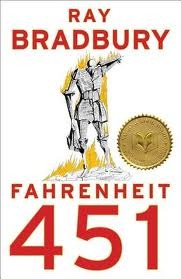
fahrenheit451_coverFahrenheit 451 was a required reading book for me in my English class. At first I was like, ugggh required reading, right? ‘Cause who gets excited when they hear “required reading?” But once I started reading this book, I actually found it really interesting.

Fahrenheit 451 is the temperature at which books burn. The main character, Guy Montag, thinks his life is swell and everybody’s happy and life is perfect. Montag is a fireman, and all he has known his whole life is firemen receive an alarm, go to the house that has been accused, find all of the books, burn them AND the house they were in. He never questioned books or if their job was right to do. Even though he has “everything a guy needs,” he still tells himself every day that he isn’t happy.

This story is basically about Montag finding himself and searching for the missing piece of his life. One day, however, a mishap of timing and an act of courage change Montag’s life. After that, Montag is fascinated by books and longs to understand the words on the page in front of him. I suggest this book to all teens because it really opens your eyes to how lucky we are to be able to freely and openly READ!!

Have you read this book too? Comment and let me know– I’d love to hear your thoughts.

-Kelsey H., 9th grade

Book Review: A Tale of Two Cities, by Charles Dickens

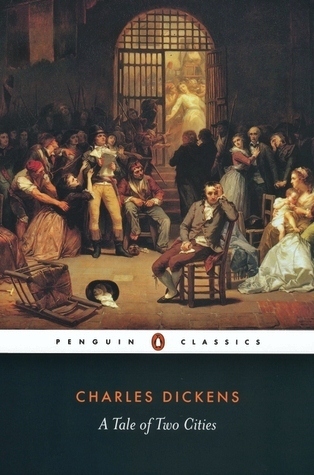
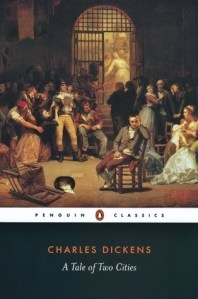
tale_two_cities_coverThis past year, I immersed myself in the study of the history of the world, a mighty feat that required exhaustive hours of reading and memorization. As with most students, I, at times, found this endeavor dry and lifeless, yet, conversely, often I was so captivated by a figure or civilization or event that history ceased to be a chore. To illustrate, an example of such an historical topic is the French Revolution.

Throughout all periods of history, there has been change; for stagnancy is something we humans seem incapable of maintaining. Nonetheless, at the end of the 18th century, change took on a form more radical than ever seen before. Shortly after its American counterpart, the French Revolution consisted of rapid metamorphoses in government and society, spurred by turbulent times and the boiling anger of the French People.

It is easy to find and study these happenings in history books, but the best way to understand the general sentiment of the period, in my opinion, is to read Charles Dickens’ immortal work, A Tale of Two Cities.

Set in both Paris and London (hence the title) at the onset of the French Revolution, Dickens’ tale chronicles the occurrences surrounding a small group of characters, most notably the long-imprisoned Dr. Manette, his near perfect daughter Lucie, and her husband the, as the reader comes to learn, French noble Charles Darnay. In the first book of this three-part novel, Lucie and the Tellson’s Banker, Mr. Jarvis Lorry, travel to Paris to retrieve the former’s father, who was previously thought to be dead but has, instead, been released from a lengthy imprisonment in La Bastille.

This action sets the basis for the rest of the tale and the second book, where, as it commences, the reader is introduced to Charles Darnay, who is being tried for treason against England. Upon his acquittal, Darnay begins a life in England and eventually comes to wed Lucie. Yet simultaneously, in France, the reader observes the wine-shop owners of Saint Antoine, Madame and Monsieur Defarge, who are at the forefront of the revolution as they lead the storming of the Bastille and the resistance against the French nobility. A son of the aristocracy, Charles is summoned to help by the proprietor of the estate of his uncle, whom we know as the Marquis. Yet, as both an immigrant and a noble, Charles is imprisoned in Paris, and so Lucie and her father travel to the aforementioned city in a desperate attempt to save their loved one.

I shall not discuss the climax and conclusion of the novel; that, reader, is for you to discover on your own. But I warn of the turmoil of the events that transpire subsequent to the actions stated above. The revolution is unrelenting in its wrath, and quite frightening, especially as it is manifested in the character of Madame Defarge herself. Ultimately, however, the indomitable spirit of the tale’s protagonists yield them a bittersweet refuge from the terror of the new French Republic.

Dickens is truly innovative; through the lens of a few characters, he is able to summarize and recount a whole period of turbulence, and, in so doing, seems to provide his own critical view of an epoch we now see as influential in the establishment of liberty and democracy in the west. One may read this novel for the entertainment of the gripping plot and richness of the majority of the novel’s characters alone, yet there is much greater historical resonance to A Tale of Two Cities below the textual surface. It is this ingenuity Dickens offers that has allowed his novel to obtain its status as a timeless classic of English literature.

-Sebastian R., 11th grade

Book Review: The Lion, The Witch, and the Wardrobe, by C.S. Lewis

narnia_coverThe Lion, the Witch and the Wardrobe is a compelling story that is filled with fantasy, adventure, and plenty of space for imagination.

It was written by the extolled author C.S. Lewis, published in 1950, and dedicated to Lewis’s goddaughter, Lucy Barfied. The Lion, the Witch and the Wardrobe was a part of a book series that would be come to be known as the Chronicles of Narnia. This story at the beginning is set in England during World War II. Then it takes the main characters, Peter, Susan, Edmund, and Lucy, to another world called Narnia.

In the book, there are many incredible creatures, animals, and people such as the jaunty fauns, elated dryads, serene naiads, talking beavers, and amiable Father Christmas. Because they are there, an element of magic is added to the story. It shows the readers that not only humans have to be in control.  C.S. Lewis also shows some of the Christian beliefs and the story of Jesus Christ because Aslan represents Jesus Christ. When Aslan dies to save Edmund, it is like how  Jesus died to save the people on Earth. Also, The Lion, the Witch and the Wardrobe tells the about having compassion and forgiving others.  This is shown when the Pevensies Children forgive Edmund for betraying them to the White Witch. Incredibly, Aslan goes to die in Edmund’s place, which shows how Aslan had compassion for Edmund, even though he is perfectly innocent.

The Lion, the Witch and the Wardrobe has much fantasy and adventure that allows to reader to explore their imagination while they read an amazing story.

-Sarah J., 8th grade