We Free the Stars by Hafsah Faizal

The newly-released sequel to Hafsah Faizal’s best-selling We Hunt the Flame is here, and it’s every bit as amazing as the first book, filled with the same spellbinding prose and darkness, as well as the characters who are dealing with the aftermath of their stay in Sharr.

We Free the Stars picks up right where We Hunt the Flame left off, with Altair captured by the Lion of the Night and the rest of the group aboard a ship, sailing their way to Sultan’s Keep, where they will be forced to confront Nasir’s father.

Zafira, after accidentally binding herself to the Jawarat in the previous book, is now dealing with the repercussions, as the Jawarat is a voice in her head that never seems to stop whispering, putting her on edge. She also continuously battles feelings of purposelessness now that she is stripped of her identity of the Hunter, with the Arz now gone and her father’s cloak long shunned.

Kifah remains as bold, hopeful, and action-oriented as ever, set on following through with their mission to return the hearts of each Sister of Old to their designated minarets across Arawiya. Nasir, on the other hand, finds that he is finally beginning to slowly melt away his hardened shell as he begins feeling and caring again, no longer the cold, lethal Prince of Death that all once feared. 

Something notable about this book is that, rather than the story being told solely through the eyes of Nasir and Zafira, Altair’s perspective is added to the mix, allowing for more angles to the story and more information about his and Arawiya’s past to be understood. 

This book is also considerably longer and more action-packed and heart-wrenching than the last; filled with much battle and loss, love and hope. 

All in all, though, this book ends this enthralling duology on a good note, but never shies away from the realistic fact that even with victory, heavy loss often still follows.

-Aisha E.

We Free The Stars by Hafsah Faizal is available for checkout from the Mission Viejo Library.

Six of Crows by Leigh Bardugo

To me, this book is a bit like a fantastical version of Ocean’s Eleven. Of course, the plot of Six of Crowns is quite different, but, like Ocean’s Eleven, it involves a witty cast of characters who each possess a unique skill; a seemingly infeasible heist; and incredible twists unveiled with the air of a magician’s flourish.

Among the many inhabitants of the beautiful and expansive world of Six of Crows, there are Grisha, people born with special powers (such as the ability to heal, to control water, or to manipulate materials). These powers can be used for great good. However, towards the beginning of the novel, news of a dangerous drug called jurda parem, which enhances a Grisha’s ability, begins to surface. Not only does the drug enable Grisha to cause terrible destruction with little effort, but it is also highly addictive and dangerous to the Grisha themselves.

Kaz Brekker, nicknamed “Dirtyhands” for his apathetic and ruthlessly practical actions, is offered a mountain of money should he succeed at an unfeasible heist: stealing the scientist who created jurda parem from the nearly impenetrable Ice Court in Fjerda. He promptly assembles a skilled team, each chosen for their expertise in a certain area.

What I loved most about Six of Crows was the characters. The six main characters are each vividly developed and unique in their own wonderful way. In addition, their conversations with each other are entertaining and witty.

The characters take turns narrating the chapters, so we get a glimpse into the minds of each of the characters at different points in the story. Reading from each character’s perspective was really enjoyable, as each character has a different way of thinking. I liked how we were able to learn about each character’s thoughts and vulnerabilities–information that other characters may not perceive. Nevertheless, although she gives readers peeks into each character’s mind, Leigh Bardugo still manages to conceal information from readers–and reveal it in with incredible, unexpected plot twists.

I found the chapters narrated by Kaz Brekker–the leader of the group; a boy whose past is so nebulous and whose emotions are so imperceptible to others that some view him more as a legend than a teenager–particularly interesting; they give readers an understanding of this outwardly hardened and indestructible boy.

What’s interesting about this book is that none of the characters would call themselves heroes. They each have their own motive, and some of them don’t even get along. However, as the story progresses and as we gather little shards of each character’s past, we begin to understand them, and we learn what path led them to a future in which they would attempt one of the most dangerous and inconceivable heists. Though they are not obvious heroes, they do heroic things: they fight for each other, save each other, and care for each other. And despite being hardened by their pasts, they still manage to act like regular, bantering teenagers at times.

I will warn that there are several violent fights, and I could have done with less violence (however, this coming is from someone who used to be frightened by The Lion King). Nevertheless, this book, its world, and its characters are so vivid, intriguing, and compelling that I would, without a doubt, recommend it for YA and fantasy lovers.

– Mia T.

Six of Crows by Leigh Bardugo is available from the Mission Viejo Library. It can also be downloaded for free from Overdrive.

The Mysterious Benedict Society by Trenton Lee Stewart

The Mysterious Benedict Society (The Mysterious Benedict Society, 1):  Stewart, Trenton Lee, Ellis, Carson: 9780316003957: Amazon.com: Books

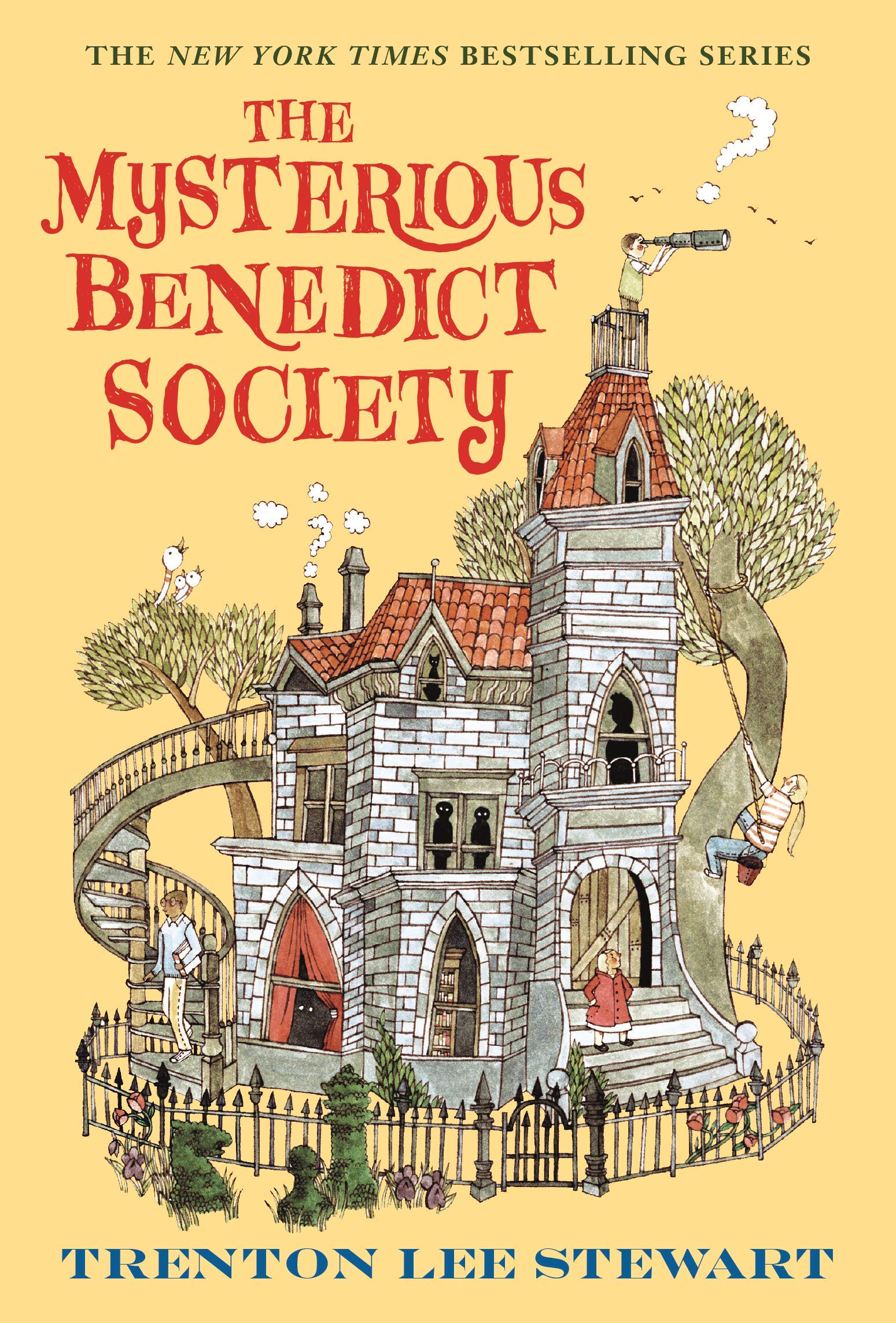
The Mysterious Benedict Society is a classic mystery and adventure book, that I would highly recommend for you to read! The style of this book is similar to Lemony Snicket’s Series of Unfortunate events, and comes in a series for you to read! The book’s main characters are four young kids named Reynie, Constance, Sticky, and Kate. The book features only Reynie’s thoughts and insights, which is one downfall of the book. Personally, I would have enjoyed reading the book from all the character’s points of view.

Reynie is an orphan who has always felt out of place at his orphanage. Reynie decides to take a test from a mysterious sign he saw in his town, where he meets the other three kids who also happen to be orphans that passed the test. Shortly after, they meet Mr. Benedict, a strange old man who invites all four kids to help him with a secret mission. If you want to hear more about this thrilling story, you’ll have to pick up your very own copy of The Mysterious Benedict Society!

-Anusha M.

The Mysterious Benedict Society by Trenton Lee Stewart is available for checkout from the Mission Viejo Library. It can also be downloaded for free from Overdrive.

The Ninth House by Leigh Bardugo

Every place you’ll ever find yourself in is more than meets the eye. This is the central idea of Leigh Bardugo’s new novel The Ninth House, a supernatural fantasy about the life of Yale student Alex Stern. The story follows Alex through her freshman year of college, recruited by a secret society at the university known as Lethe. This society supervises 8 other organizations across campus, each of them specializing in a certain magical concept through rituals and other supernatural events. Lethe has been interested in her for most of her teenage life due to strange occurrences in police reports that reveal her secret; Alex was born with the power to see “Grays”, the ghosts that fail to pass over beyond “the Veil” and wander the living world. As someone who can see them, Alex plays an important role in protecting the societies from supernatural interference with their business. She studies the ways of Lethe and magic under her mentor Darlington, and receives help from grad student Dawes and Dean Sandow. However, life as a college recruit is not an easy path, and Alex must learn to navigate her struggling GPA and avoid suspicion from her roommates, all while keeping the existence of magic and the Nine Houses a secret.

However, life gets turned even more upside down when Darlington disappears and a random girl is found dead on campus. Concerned about the societies’ potential involvement in both cases, she goes out to solve the mysteries in a collection of twists and turns. As the murder investigation unfolds, people are tossed in and out of the scapegoat role, even some of the people she trusts most. At the novel’s conclusion, everything is made clear through shocking revelation that leaves its readers yearning for a second installment in Stern’s universe.

This book took me a little bit of time to get into. Being a “New Adult” book, it was a large jump in detailed writing from the book I had just read. However, once I sat down and committed to reading, I found soon enough that I couldn’t put the book down. The characterization of Alex fascinated me, and became more enthralling as her past is revealed. The interwoven stories between the world of the living and the dead and the world of Lethe and Yale as a whole make for an interesting story. I am looking forward to the next installment, hopefully to come out late 2021 or early 2022.

-Bailey L.

The Ninth House by Leigh Bardugo is available for checkout from the Mission Viejo Library. It can also be downloaded for free from Overdrive.
The Handmaid’s Tale by Margaret Atwood

Extract | The Handmaid's Tale by Margaret Atwood - Penguin Books Australia

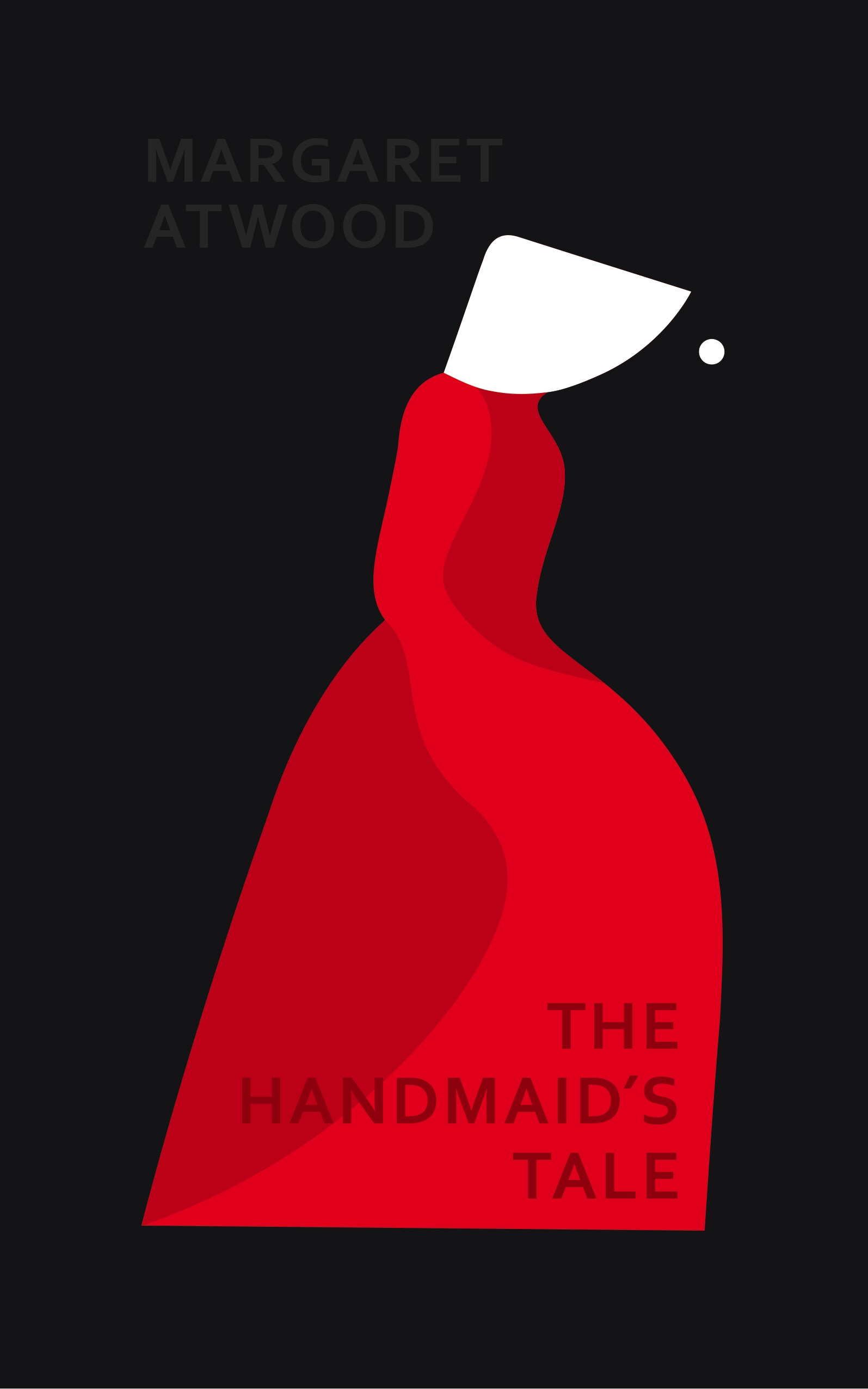
The land that was once the United States of America has been taken over by a totalitarian theocracy known as Gilead. In this new government, society is divided into rigid castes, ranging from the powerful Commanders to the lowly Handmaids, with other classes like the Commanders’ Wives and the working Marthas and Econopeople in between.

With the laws of Gilead being based on select passages from the Bible, women are reduced to almost nothing, and have little to no freedom. For instance, they are not allowed to read or write, they must cover their hair and bodies in order to avoid tempting men to sin, and they cannot even choose who they associate with or marry.

The unfortunate women who are “chosen” to become Handmaids, however, lose even more – their basic right to their own bodies. Because of dangerously low reproduction rates, fertile Handmaids are assigned to bear children for elite couples that have trouble conceiving. Despite their importance, the Handmaids are treated as their Commander’s property, only to be seen and not heard.

The narrator, Offred, is among the class of the Handmaids, and she belongs to the man named Commander Fred, as well as his Wife, Serena Joy. Stripped of her name, her body, and her past life, all Offred has left is her voice, which she uses to describe the horrors of Gilead in a way that drives even the most hard-hearted audience to pity. 

Margaret Atwood’s writing skills are brilliant, and she weaves the world of Gilead in a gripping masterpiece that will occasionally cause the reader to be lost inside the dystopian hellscape that is The Handmaid’s Tale. However, the epilogue (which I will not spoil here) leaves a last bit of hope for the reader that will leave them feeling both bitter and optimistic about the future.

-Mahak M.

The Handmaid’s Tale by Margaret Atwood is available for checkout from the Mission Viejo Library. It is also available for download from Overdrive

Authors We Love: Patrick Ness

Patrick Ness at arrivals for A MONSTER CALLS Premiere at Toronto International Film Festival 2016, Roy Thomson Hall, Toronto, ON September 10, 2016. Photo By: James Atoa

Twice Carnegie Medal Winner Patrick Ness was born in the United States, currently holding dual citizenship status while living in London. He attended the University of Southern California, graduating with a degree in English Literature. While having written books for all age groups and genres, he is most known for his young adult fiction novels, most notably A Monster Calls.

After working as a corporate writer for a cable company, Ness published his first novel in 2003, titled The Crash of Hennington. He also published his pivotal short story collection Topics About Which I Know Nothing the same year. His career took off with the publishing of The Knife of Never Letting Go, the first in a young adult trilogy about a society where everyone can hear each other’s thoughts. He was awarded the Guardian Children’s Fiction Prize for this novel. He continued headstrong with the Chaos Walking trilogy, publishing the next two books and a series of short stories in the same literary universe. He is currently working on a film adaptation of the trilogy alongside screenwriter Charlie Kaufman.

A Monster Calls originates from the mind of Siobhan Dowd, and Ness was hired to write the story after her passing in 2007. With illustrations by Jim Kay, the novel’s tale of a boy struggling to come to terms with his mothers illness earned Ness the Carnegie Medal after its 2011 publication.

Patrick Ness has written numerous novels about defining the teen experience from non-stereotypical perspectives. The Rest of Us Just Live Here presents an ironic spin on the classic YA fantasy novel, instead focusing on the ordinary side characters while the powerful “protagonists” fight monsters in the background. He has also touched on science fiction with his book More Than This, showing a teenage boy’s journey through a strange world in which he somehow wakes up after drowning in the ocean. The novel is one of my favorites from the author, describing themes of life’s meaning, trauma, and the difficulties of growing up in a place where you don’t feel welcomed. Ness wonderfully defines his diverse character set, and is an expert of including representation of POC and LGBTQ characters without making those identities their defining traits. Instead, he writes diverse characters not for the sake of diversity, but for the sake of telling an important story that everyone can relate to. Other books by Ness include his adult novel The Crane Wife, and his new young adult story titled Burn. As one of my favorite authors, Patrick Ness has astounded me in the  diversity of his literary prowess. I have enjoyed reading all of his works, and would recommend them to anyone that has a love for reading. My personal favorite has been More Than This for several years, and I am currently rereading the Chaos Walking trilogy before the movie makes an appearance.

-Bailey L.

The works of Patrick Ness are available for checkout from the Mission Viejo Library.

Authors We Love: Ray Bradbury

Ray Bradbury (August 22, 1920 – June 5, 2012) was, and still is, a well-renowned author known for his science fiction, fantasy and horror short stories and novels.

Born in Waukegan, Illinois, Bradbury’s start as a writer began very early on at the age of 12. He had a fateful encounter with a carnival magician by the name of Mr. Electrico who proclaimed “Live forever!” to which Bradbury decided to never stop writing.

Soon after this encounter at age 14, the Bradbury family moved to Los Angeles. When the Great Depression hit, Bradbury couldn’t afford to attend college so he instead attended the local library three days a week for ten whole years to acquire his education.

Over the course of his career, Bradbury published thousands of literary works including 400 short stories and 50 novels. In addition to this, Bradbury has also earned dozens of awards including the World Fantasy Award for Lifetime Achievement, the Science Fiction and Fantasy Writers of America Grand Master Award, and the Pulitzer Prize Citation.

I was first introduced to Ray Bradbury in the 6th grade with one of his short stories titled All Summer in a Day. The story is about a group of students who live on the never-ending rainy planet of Venus that have never seen the sun with the exception of a young girl named Margot who only moved to Venus five years prior. As our class read through in monotone uninterested voices (as most children do), I remember sitting there in awe at his simple yet elaborate descriptions of simple things such as the sun or the rain, the fantastical world he created on Venus, and the development of the characters in only a couple of pages. I remember that being the first time a short story truly made me feel something, like a deep pit in my chest.

The second short story I ready from Ray Bradbury was A Sound of Thunder, a story about time travelers who have something in drastic in store when they arrive in the past and return to the present. It was in this short story that I was truly enamored by his descriptions of the dinosaurs which were so incredibly elaborate that I felt like I was standing right there in front of them. It was when I read this short story that I set my own goal of creating scenes of such immaculate sensory description.

Ray Bradbury was not only a spectacular author but a person with an incredibly inspiring story and a true passion for something he loved to do. If you’re looking for a good long read or a good quick read, this is an author that will give you something interesting to read for years and years on end.

-Elia T.

The works of Ray Bradbury are available for checkout from the Mission Viejo Library. They may also be downloaded for free from Overdrive.

Mary Poppins Comes Back by P. L. Travers

Mary Poppins Comes Back by P. L. Travers is the sequel to Mary Poppins.  The story picks up just a few months from when the original book left off.  The Banks’ house is in complete disarray.  Mary Poppins had deserted the family without notice.  They had hired other nurses to take Poppins’ place, but none of them lasted long.  One nurse, for instance, had been spat at by young Michael Banks and quit immediately.  Michael fought with his sister Jane, little twins John and Barbara quarreled, the kitchen flue caught fire, the cherry trees were devastated by frost, and so on.  Mrs. Banks does not know what to do.  In despair, she sends the four children to the park so she can have some peace at home.  Jane and Michael decide to fly a kite to entertain John and Barbara.  As they pull the kite back in, to their astonishment, they see Mary Poppins herself holding the string and gliding down with the kite.

Within moments, Mary Poppins is already ordering the children around.  Much like the original book, Poppins assumes a stern and haughty attitude.  However, the children enjoy many new adventures in this sequel.  I enjoyed reading about their magical ability to fly above the park holding just one balloon each.  I also liked reading about the day they met an interesting man named Mr. Turvy.  The day happened to be the second Monday of the month.  Every second Monday, mysterious things happen to Mr. Turvy.  He flips upside-down, he finds himself outside when he wants to be inside, and he even feels sad though he normally feels happy.  This quirky episode is strange but I found it to be quite amusing.

Mary Poppins is as scornful as ever in this book.  She displays a short temper and even intimidates the children.  On one occasion, for example, we read: “Mary Poppins, in her fury, seemed to have grown to twice her usual size.  She hovered over him in her nightgown, huge and angry, waiting for him to reply.”  Poppins also proves to be quite vain.  For example, as she passed by a glass window, “Mary Poppins gave a little conceited nod to her reflection and hurried on.”  She also seems to be dishonest with the children.  After almost every adventure, Poppins denies that she had anything to do with it or that it even happened at all.

I began to wonder if all the tumult in the Banks’ household was caused by Mary Poppins herself, so that the family would appreciate her more when their situation magically improved.  Whether or not my conspiracy theory is correct, everyone still seems to love Mary Poppins by the end of the story.  Despite her periodic rude comments to the children, they seem to enjoy her company as much as ever.  The main reason for this may be that many exciting and delightful adventures seem to follow Mary Poppins wherever she goes.  These adventures make the book charming to read, if you can look past Mary Poppins’ less-than-perfect attitude and behavior toward the children.

-Oliver H.

Mary Poppins Comes Back by P. L. Travers is available for checkout from the Mission Viejo Library. It can also be downloaded for free from Overdrive.

Charlie Bone and the Time Twister by Jenny Nimmo

Charlie Bone and the Time Twister is the second book in the Charlie Bone series by Jenny Nimmo.  The main protagonist is a boy named Charlie Bone who possesses a special power.  Charlie can hear what people are saying inside photographs.  Charlie is not the only person to possess magical ability.  He attends a school for the gifted called Bloor’s Academy, where other students appear to have special powers of their own.  Charlie discovers that the evil Bloor family in charge of the academy has been plotting to harm some of the students, including himself.

I enjoyed reading about the development of Charlie’s powers in this book.  It becomes easier for him to hear what people are saying in the pictures he sees.  However, he does not fully realize the strength of his power yet.  One day at school, Charlie is surprised to meet one of his ancestors, named Henry Yewbeam.  Henry looks the same age as Charlie, but he was born over 90 years ago.  Henry had teleported through time using a mystical marble known as the Time Twister.  Charlie needs to protect Henry from the Bloor family, who would consider Henry an enemy.  This book is very suspenseful, as the Bloors become increasingly suspicious of Charlie.

One of my favorite characters in this book is Ezekiel Bloor.  Ezekiel is a cranky old man living at the academy.  He seems to hate everybody.  He has an old connection to Henry that creates a very intriguing background to this story.  I enjoyed the mystery and suspense of this book.  It was fascinating to read the story as it unfolded through different time periods.  After reading this book, I was anxious to read the next book in the series.  I highly recommend it.

-Oliver H.

Charlie Bone and the Time Twister by Jenny Nimmo is available for checkout from the Mission Viejo Library.

A Wrinkle in Time by Madeleine L’Engle

Is it a kid’s book or all ages one?  Madeleine L’Engle’s classic (but not too classic) story A Wrinkle in Time, winner of the Newbery Medal for the Most Distinguished Contribution to American Literature for Children focuses on Meg and Charles Wallace Murry and their new friend Calvin O’Keefe through time and space on a mission to save Mr.Murry.  While some argue that this work of science fiction is aimed at youth, it is actually a timeless piece that will transcend time and space itself.  

A Wrinkle in Time tackles different scientific theories by putting them into play and describing them with simple words and emotions making them easily comprehensible.  For example, L’Engle talks about tesseracts or anything which is four-dimensional.  As the three heroes move through time and space, or tesser, L’Engle uses simple but effective words coupled by vivid descriptions of the event.  This allows readers to fully grasp the advanced scientific and mathematical concepts.  Some confuse L’Engle’s use of basic vocabulary as a way to aim her story at children.  While I am sure that she is pleased for children to read her story, this does not mean that A Wrinkle in Time is a kid’s book.  The use of base-level vocabulary simply makes these ideas accessible to everyone and not just rocket scientists.  

Moreover, L’Engle’s characters all deal with absent and neglectful parents, a theme which is definitely not aimed solely at children.  The Murray children practically grew up without their father who was kidnapped by the evil It.  Charles Wallace had not ever even properly met his father.  Calvin O’Keefe’s mother struggled to keep the house in proper sanitation and neglected her children.  While these ideas are important for children to understand, it is certainly not limited to them.  For all I know, reading about how these parent’s identities have shaped their children could give some parents a wake up call.  In any event,  the theme of unideal parenting is one that can resonate with any generation.

Further still, A Wrinkle in Time focuses more on timeless themes and morals than anything else meaning that it will withstand the test of time for all generations, not just children.  L’Engle’s’ story, though it is classified as science fiction, is largely about love and how it connects all of us throughout the universe.  From Meg’s sisterly love of Charles Wallace, Charles Wallace’s love of Mrs. Who, Mrs. Whatsit, and Mrs. Which, to Calvin’s love for Meg, love is all over.  Love is something timeless and will never fade away, and neither will A Wrinkle in Time.  

It almost goes without saying that any book which has obtained a Newbery Medal is fantastic, but Madeleine L’Engle’s A Wrinkle in Time is a truly extraordinary work of science fiction. Though many declare that it is a children’s story, it is in actuality a story for all ages or anyone who likes scientific theories explained simply, themes about absent or neglectful parents and enjoys a good old fashioned story about the power of love.

– Ainsley H

A Wrinkle in Time by Madeleine L’Engle is available for checkout from the Mission Viejo Library. It can also be downloaded for free from Overdrive.