
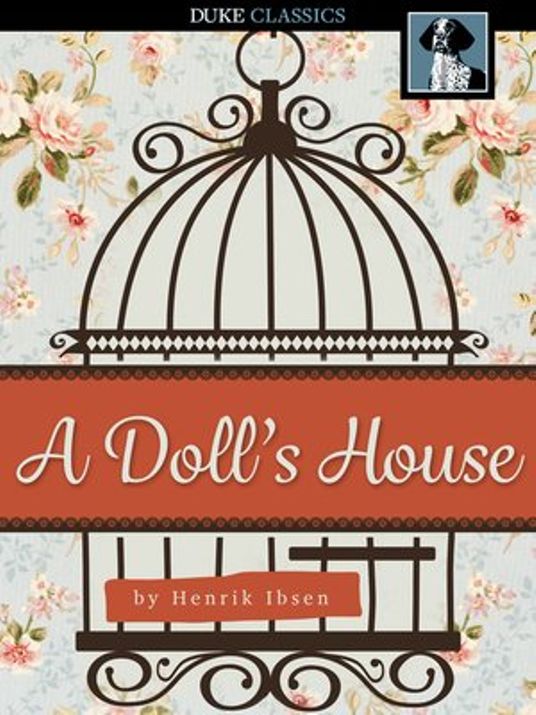
A Doll’s House by Henrik Ibsen

By the latter half of the nineteenth century, Europe had for the most part settled into a status quo. The great upsets of the 1800s had largely ended, and Europe enjoyed a period of relative peace and tranquility for the remainder of the century. However, to judge the impact of this time on the events that preceded and followed it would be to overlook one of the greatest developments in history – the feminist movement.

This change in attitudes towards women was only emphasized by the literature of the time, the most significant and impactful of which can be seen in Henrik Ibsen’s A Doll’s House. Published in December of 1879, the play explores how “a woman cannot be herself” in the male-dominated society of the time.

The play’s protagonist is Nora Helmer, a cheerful and naive middle-class housewife who, over the course of the play, contends with various truths about her existence, the foremost of which is that she has no agency over her own life. That is, her every action is dictated by her overbearing husband, Torvald Helmer. Up until this point, Nora and Torvald have lived in a relationship akin to a doll and its owner – that is, Nora exists only to look pretty and take care of Torvald. All of this changes, though, when one of Nora’s long-held secrets comes back to haunt her, causing her dollhouse to come crashing down.

Nora Helmer’s transformation over the course of the play from a passive and sheltered young woman to one who has the drive to seek out what she wants in life implies Ibsen’s intentions to show how women are indisputably as capable of heroic transformations as men. Despite having been written well over a century ago, the themes of this play continue to resonate with audiences today. When Nora takes her fate into her own hands at the end of the play, she serves as the mouthpiece for millions of women who have done and will do the same.

A Doll’s House by Henrik Ibsen is available to check out from the Mission Viejo Library. It is also available to download for free from Libby.

Two Plays: Blood Wedding by Frederico García Lorca and A Doll’s House by Henrik Ibsen

wells-theatre-210914_640While in contemporary times we do not perceive it as greatly as we once did, the theatre has unquestionably had an vast impact on art and culture. Since the days of Ancient Greece, the common man has flocked to the theatre to fulfill his urge to be entertained and engaged by stories. Today, drama is something of which the average person is latently cognizant, but it seems access to this artistic institution is increasingly hindered. Nonetheless, albeit the stage is the best mode to experience them, we do have access printed copies of these same theatrical works. I would like to briefly share two works which I recently read.

dolls_houseA Doll’s House (Et dukkehjem) is a late-19th century play composed by the prolific playwright Henrik Ibsen. In the spirit of realism, the major artistic movement of the time, the play does not aspire to amaze with a grand, heroic plot but rather observes the daily life of a typical, middle class Norwegian family. Set around Christmastime, the play follows Nora, a housewife, and her interactions with her husband, Tørvald, among others.

The driving factor of the play is that of Nora’s indebtedness to Krogstad, from whom she received a loan that saved her husband’s life. As Krogstad is about to lose his job at the bank, of which Tørvald will soon become the manager, the former man threatens Nora that she must persuade her husband to allow Krogstad to keep his job or he will reveal to Tørvald the loan, a shameful contract in which was not socially acceptable at the time for women to engage. Ultimately, Nora is paralyzed in her dire situation, and hopes for, as she says, “a miracle” that her husband may accept the actions she performed behind his back.

blood_weddingAlmost diametrically opposed to A Doll’s House in its stylistic features, Frederico Garcia Lorca’s early 20th-century play, Blood Wedding (Bodas de Sangre), is a work composed at the hight of modernism, the artistic movement focusing on symbolism and the usurpation of traditional theatrical norms.

Despite its utilization of the aforementioned devices, the central focus of the play is one that is not significantly out of the norm—a wedding. Lacking names for its characters, except for the antagonist, Leonardo, Blood Wedding depicts The Groom, a prosperous young man now in possession of a vineyard, and The Bride, Leonardo’s former lover whom she rejected for his poverty, in the days directly preceding their nuptials. Despite Leonardo’s quiet protestations, everything seems to be progressing smoothly. Soon the two youths are married, and the reception is at hand when the play take a turn for the worst. Leonardo and The Bride have eloped, and tragedy supersedes any prior joy.

Both plays discussed here have their merits in various aspects of their artistry, and though the components of their composition differ, perhaps the most fundamental concept that both is explore is the relation of the individual to society. Nora is suppressed in her domestic role and is largely ignorant of the word outside her door and herself. The Bride and Leonardo are prohibited from the free expression of their love because of the social limitations of economic viability and propriety. Both are tragic in their own right, but in their courage to present the problems of these individuals, they seem to support the individual and denounce society and the destructive forces that lie therein.

-Sebastian R., 11th grade