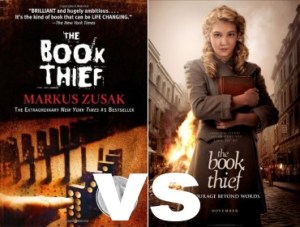
Book vs. Movie: The Book Thief

book_thief_bookmovie***A few questions and their answer***

Who would steal books before she knew how to read? Whose story caught the interest of Death? Who is Liesel Meminger?

Answer: She is The Book Thief

“She was clutching the book. She was holding desperately on to the words who had saved her life.”

Liesel Meminger is in a new life. Her brother died on the train ride. Her mother disappeared. She never knew her father. Things start looking up when she is adopted by a couple who live on a street called Heaven, both to simply be called Mama and Papa. Her papa plays the accordion and teaches her to read her first stolen book; the one from her brother’s funeral. She befriends her next door neighbor Rudy, a boy with hair the color of lemons, who keeps asking Liesel for a kiss.  It could have been a perfectly happy story if they weren’t in Germany during World War II, hiding a Jew named Max in their basement.

The book itself was beautifully written, although it began a little slow for me. It isn’t a book you want to race through. The movie matched this the heart of the story, even when details such as how Liesel’s papa was drafted, the reason her mama was fired, and which books were stolen changed, but on the whole, I was surprised how close the movie followed the book.

There were a few changes I liked better in the movie, such as Max giving Liesel the diary and Rudy discovering she was hiding Max because it established a closer relationship to these characters that felt less due to some scenes like Max’s handwritten books or Rudy and Liesel stealing things other than books together being cut.

The thing that bothered me the most in the film was the lack of the narrator, Death. He had a prominent part in the book, making side comments and revealing what is yet to come. Although it was nice in the movie to not worry about jumping around in the story, Death barely speaking at all in the movie had an unsettling effect any time he spoke, which may have been what the movie intended.

The movie can stand on its own, but it loses some depth from the elegantly written book. There isn’t as much violence as one might expect from World War II, but that’s not to say it isn’t there. The ending was exactly the same as the book, but I won’t reveal any more. Maybe not being a lighthearted movie is the point, because that is how it becomes that much more powerful.

-Nicole G., 10th grade
Saving Mr. Banks: The Making of Mary Poppins

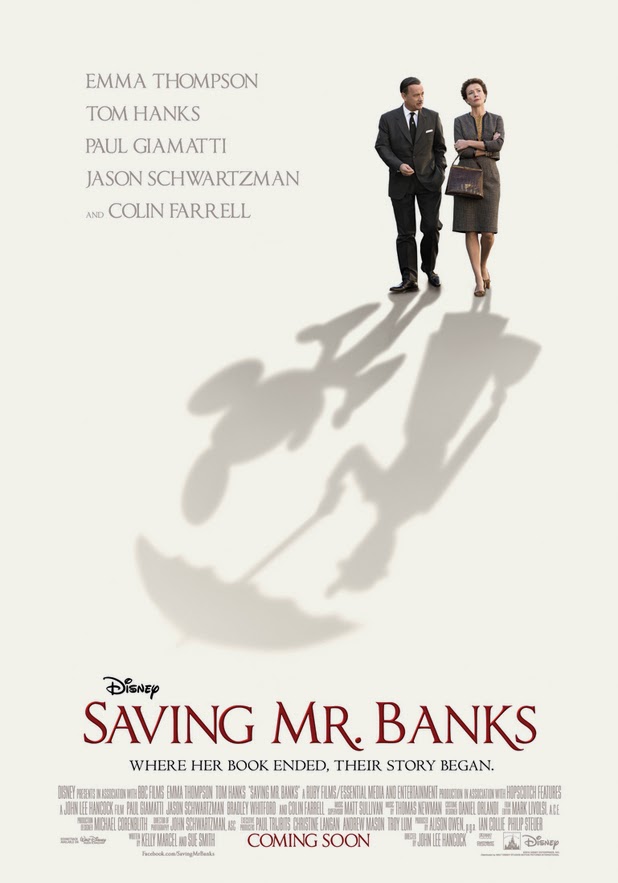
Saving_Mr_Banks_posterI recently saw the Saving Mr. Banks movie and I thought it was fascinating! I feel that what this movie unveils is unprecedented in the multimedia world because it actually takes you into the making of the movie. However, the movie was really more about the author of Mary Poppins, and her struggles in maintaining control over her story in the film making process. I read the original Mary Poppins this past summer, and I was shocked at how different the book is from the Julie Andrew’s nanny figure we all know.

First of all, how does one put music to a book? That is amazing that the Walt Disney musicians could actually make the book into a musical‼ In the movie, P.L. Travers (played in this film by Emma Thompson) explicitly states no singing or dancing in her movie. But by the end of the process, well… let’s just say that she was inspired. You’ll have to watch the movie to see what happens!

The most important part of Mary Poppins is not the Mary Poppins character, however- it’s Mr. Banks, the father of the Banks children whom Mrs. Poppins watches over. The movie really went into the depth of Mrs. Travers’ childhood inspiration. Throughout the movie, Mrs. Travers has flashbacks to her childhood and it is revealed to the viewer the hardships her family underwent. In the current time of the movie- around the 1960s- it was very common for authors to take a pen name, especially ones that did not reveal their gender. P.L. Travers adopted her father’s name as her own because it is obvious that she greatly loved and respected him. During a few flashbacks, her father tells her to never stop dreaming despite her mother’s practicality. Walt Disney (Tom Hanks) tries desperately to understand why this woman is so hard to please in the movie room-all of their suggestions fail in the eyes of Mrs. Travers. Towards the end of the movie, Walt shows up at Mrs. Travers’ apartment in England, where he shows her that Mary Poppins is family to him also. He finally connects Mrs. Travers’ father to Mr. Banks and understands why she was having such trouble with their portrayal of him.

I love how Emma Thompson portrays this abrupt, posh English author. She does such a phenomenal job at showing the transition from this uptight woman into a fun, emotional lady at the end of the movie. I can easily connect P.L. Travers to Mary Poppins, because they are both proper, British, and inwardly kind. I really enjoyed the movie and the “behind the scenes” of one of the most classic stories of all time.

-Kelsey H., 10th grade

Book Review: My Brother Sam Is Dead, by James Lincoln Collier & Christopher Collier

Z917SchBroSam2upMy Brother Sam is Dead is a fascinating historical fiction by James Lincoln Collier & Christopher Collier, and is a story about a family torn apart over the American Revolution.

The story all starts when the oldest brother, Sam Meeker, comes home unexpectedly from college- Yale to be exact. He gives the family news that the patriots have defeated the “lobster backs” or the British. The Meeker family is loyal to the king and do not think that the war would do any good. However, Sam has a different perspective on this.

Tim, Sam’s younger brother, admires Sam greatly. When the brothers are outside together doing chores around their family’s tavern, Sam tells Tim his plan to steal their father’s gun in order to fight. Tim protests, but he can do nothing to stop Sam. That night, Mr. Meeker and Sam have an argument about the war and Sam runs away from home. One day, near winter, Tim’s father says that this year Tim will be going with him to Verplanck’s Point with him to trade the cattle. On the way there cowboys almost rob them, but a rescue team comes just in time. On the way back however, Tim’s father gets kidnapped and Tim almost does too, but he luckily outsmarts the cowboys. When Tim gets home he immediately becomes more responsible and takes charge of the tavern the family owns. When Sam comes home to visit them a couple months later, he advises Tim to butcher the cattle’s meat and hide it before the patriots steal them. One night when Sam is visiting the tavern again, two patriots try to steal the cattle. Sam chases after them, but gets framed for stealing them.

The question everyone is asking is, what will happen to Sam? I would recommend this book to anyone who is interested in the American Revolution. It is an interesting read and it gives you a new perspective on the revolution. It will be one of the best historical fictions you have ever read!

-Melika R., 8th grade

Book Review: My Brother Sam is Dead, by James Lincoln Collier & Christopher Collier

Z917SchBroSam2upSpoiler alert! Spoiler alert! The authors of this book definitely need to make some adjustments to this title. I mean seriously, why give away the ending of this book in the title– the first thing a person reads when looking for a book.

Anyway, if you are looking for a story with lots of true facts and details on the American Revolutionary War blended in with some fictional characters, this is the perfect book for you. Sam, a farm-boy, has just gone off to school when he decides to go and fight the Redcoats with the Continental Army. With a tavern to run and a farm to maintain, Sam’s mother, father, and younger brother, Tim, beg for him to stay. With his heart set on going to war, Sam runs away. With nothing to do but pray for his brother, Tim takes over his brothers job and soon finds himself on a trip with his father delivering cattle to the British troops. On his way home he soon finds that his father is missing. With warnings of thieves Sam doesn’t know whether he should look for his father or go home. Will Tim find his father?

This is a suspenseful and educational read. I would rate it 9 out of 10 on my favorite historical novels list. The story kept my interest and was hard to put it down. I recommend this book if you enjoy reading an intense historical fiction.

-Marilyn J., 8th grade

Book Review: Circle of Cranes, by Annette LeBox

circle_of_cranes_coverAsian legends about cranes and real life in New York during 1999 and 2000 are two subjects I would find very interesting to be in the same story. In this book, Circle of the Cranes by Annette LeBox, the author masterfully combines the two to create an amazing tale that is both rooted in truth and fiction,

The story is about a thirteen-year-old orphan girl by the name of Suyin who is sent away to New York by her Chinese village. Her life is far from easy in New York. She works in a sweetshop earning barely pennies each day. She also finds about her connections with an ancient Crane Sisterhood that is high above the earth in a place called He-Shan. She goes through the trials and trouble both with the Sisterhood and in New York. Suyin perseveres through all of this and eventually the good things start to happening.

It books is personally one of my favorites of a combination of real life and legends. Suyin is just a normal 13-year-old girl but she seems so much older. Some stories I have read have a really hard time with combining Chinese legends with American history due to the fact that they are barely related to each other. This book pulled it off amazingly. All the characters were well created and fleshed out in a way that you get to know them really well and they seem to come to life.

Other than Suyin, my favorite character is a boy named Pang because he is a normal boy who plays a large part in the story. His personality makes him very likeable too. This book deals with the fact of unfair labor laws and there is somethings that only slightly more mature teenagers might be able to understand. Well, for me this is a great book to read but you might think differently– so read it for yourself.

-Sarah J., 8th grade

Book Review: At the Mercy of the Queen, by Anne Clinard Barnhill

at_the_mercy_coverThis summer I was inspired to read a handful of books about English courts and palaces because my family went on a trip to England and Ireland. I toured the famous Hampton Court; the exact setting of this enthralling novel, and the Tower of London; the haunting location of Queen Anne of Boleyn’s execution. It was amazing to be able to visit the places described in this book! I felt like if I turned the corner into the great dining hall, I was going to walk in on a lively feast and celebration complete with dancing and music.

Now, I won’t spill too many details or secrets (as there are many in this mischievous novel), but I will give you a brief summary of the novel. This story follows Lady Margaret Shelton, who suddenly finds herself in the midst of King Henry’s lively court when her cousin Anne Boleyn becomes queen. Queen Anne immediately finds Lady Margaret Shelton (Pretty Madge) to be charming and very becoming, and invites her to become her lady in waiting. The men at court become enraptured by her beauty, but none more than Sir Henry Norris who begs the king to grant her to him for marriage. However, Margaret finds Sir Norris intimidating, forceful, and cruel. And then, there’s Sir Arthur Brandon, whose comedic, mocking manner seems to irritate Margaret. That is, until Sir Brandon rescues her from a very terrible situation. Is Margaret forced to marry her reproachful betrothed? Or will Queen Anne finally convince the king to break their ties? Lady Margaret Shelton helps the queen through her shaky marriage, births, miscarriages, and even her execution. And when Queen Anne begs Margaret to do something completely horrifying and completely against Margaret’s wishes, will Margaret consent? Or will she risk committing treason against the queen? Read my new favorite novel of all time to find out what happens!

My favorite part of the story is when Lady Margaret Shelton realizes that she’s madly in love with Sir Arthur Brandon. The two, while visiting a banquet house, step inside a room where Arthur declares his love for Margaret. When he asks Margaret if she returns his love and she hesitates, Arthur warns her that if she doesn’t say she loves him, he will leave and she will never see him again. Margaret runs to him and claims her love for him and the two share a passionate embrace. I love this scene because it is so romantic and dramatic. Can’t you see this scene in a movie? I definitely can 
I really did not have a least favorite part of the story, or a part I didn’t like. It was all amazing, thoroughly thought through, and connected!

I definitely recommend this book to teenage girls who are hopeless romantics and interested in English court life. This passionate love story is sure to make you want to visit Hampton Court!

-Kelsey H., 10th grade

Book Review: The Wild Girls, by Pat Murphy

wild_girls_coverThis book review is part of series of reviews written by students at St. Margaret’s Episcopal School for their 7th grade English classes.

An insightful and erratic woman once stated, “Pay attention. Notice things and think about what you notice. Sometimes you’re writing about one thing and realize your actually writing about something else” (108). That contemplative and unusual woman is Verla Volante, one of the lesser-talked about, but very distinctive and important, characters, in the novel The Wild Girls, written by Pat Murphy.

The year is 1972. Joan and her average, mediocre four-person family have just traveled over 2000 miles across the United States, from the comfort of her cozy home in Connecticut to a new house in Danville, a small suburb just outside of San Francisco. Joan is almost sure she’ll disapprove of her new and ‘improved’ life, but soon finds makes a discovery that changes her mind.

The Queen of the Foxes, Fox, or just simply Sarah- Joan’s newfound friend is known by many names. When Joan encounters Fox, wearing war paint and ascending a tree in the forest behind her house, a friendship is formed immediately. Joan is fascinated by Fox’s ability to not care what other people think of her, and Fox supports Joan, or Newt, a nickname given to her by Fox, in helping her to find adventure- right in her own backyard. Fox lives near Joan- just her, and her writer father, Gus, who is just as strange as Fox, perhaps a bit stranger. When these two wild girls enter a writing competition at school- life takes them in directions they had no idea they could be taken. From a strange new writing camp to meeting with some old friends, these two wild girls are whisked away on the greatest journey that two friends could take.

The three main characters in this story- Joan, Fox and Verla- all have very interesting stories and opinions about certain things- but not all are dying to share. Fox is very opinionated- she isn’t afraid to speak her mind, as shown when she refused to dissect a frog in biology class. “I’m not sticking a needle into a frog” (60), she stated bluntly. But her opinion is usually only heard by her close friends, and family. Joan, on the other hand, is shy and quiet- at some times- but Fox really changes that as the story progresses. The characters also posses strengths, weaknesses, and fears. Fox isn’t good with people- especially people that want her to become something she is not. Joan is afraid of her father, more specifically her mother and father fighting. Which brings us to the conflict of the story.

A few conflicts are mentioned in this story- and not all are resolved. There are a few that are solved in the story. When Joan and Fox are straining to come up with an idea for the writing competition- BAM- it hits them. They then begin a magical story, starring the wild girls, with an evil prince, a kidnapped queen- you get the picture.  But a few conflicts do remain unresolved. Joan’s mother and father are constantly fighting at home. Her father is always arguing about money, and how everyone else is stupid, and claiming that he is smarter than every person. When Joan’s mother convinces him to try a marriage counselor, he is bitterly angry, saying, “I understand a lot of things. I understand that is cost me an arm and a leg to spend an hour talking with some quack about things we already know. I understand you’re spending money like it was water” (130).  Gus has some opinions on this topic- he believes that some people say they’re fighting about some things, when they’re really fighting about another.

I thought this story was very well written. I loved the way that the author, Mrs. Murphy, depicted the character’s emotions, and they were very real, and raw feelings. I also enjoyed the way that the story was written from Joan’s perspective. It probably would have made for a very different story written from Fox’s perspective, or even the third person’s perspective. I would recommend this book to all aspiring writers out there- even though it is a fairly easy read, is gives you some point of view about writing, and life in general. As Verla Volante once said, in order to broaden your perspective, and improve as a writer, “Drop a pebble in a pond. Watch the ripples spread. That’s what you want your writing to do” (288).

-Daisy S., 7th grade

Book Review: Nory Ryan’s Song, by Patricia Reilly Giff

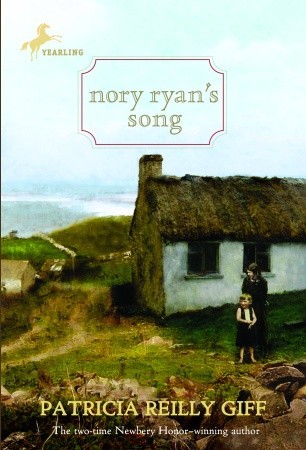
nory_ryans_song_coverNory Ryan, the heart of her family with her songs and carefree spirit, spends her days frolicking on the coasts and country fields in Ireland. With her Dad gone fishing for half a year, and her mom passed away from childbirth, Nory Ryan does everything she can to hold her family together. The one thing her family could live on was their harvested potatoes. Every Irish man could rest assured that his family would be well fed, as long as they had fields of potatoes. That was, at least, until disaster struck.

The English government takes control over their land, and a terrible famine sweeps through the little town where Nory and her family live. Patricia Reilly Giff describes the smell of rotting potatoes as Nory wraps her nose and mouth in her shawl, and her sister bends over gagging as they work to save their crop.

Toward the end of the story, Nory is left all alone on their family’s farm in Ireland after she insists for her family to migrate to New York, America without her. Nory is very brave to be left all alone, and she is selfless to give the tickets to the rest of her family instead of herself.

I chose to read this book in preparation for a family trip to Ireland and England. I wanted to get a deeper appreciation for my grandpa’s Irish ancestors and a greater image in my head of Irish countryside, where so much hardship was endured. I also thought it was interesting that the author added some old Irish words such as madra, meaning dog. This book was very depressing because it was on the Great Potato Famine; however, Giff brought a great power to the Irish spirit in Nory, and I loved to read about her. This book is so important for all of us fortunate OC teens to read because it brings to light the fact that we are so very blessed to have a safe and happy neighborhood to call home.

I recommend this book to teen girls because Nory Ryan is a teen girl, just in a very different world. It was fascinating to see Nory’s story, and to imagine what life was like for her. Patricia Reilly Giff did an amazing job painting the picture, and if you like Nory Ryan’s Song, then you’ll love the sequel, At Maggie’s Door. Please feel free to comment on any one of the topics I touched on!

-Kelsey H., 10th grade

Book Review: Esperanza Rising, by Pam Munoz Ryan

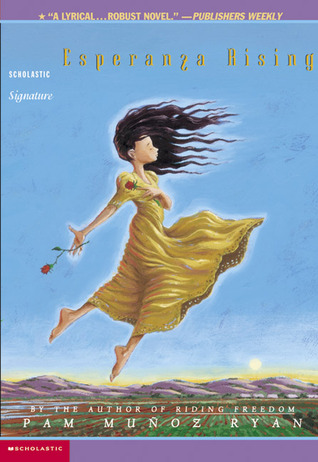
_206890SchEsperanza_0.tifEsperanza Rising is a great novel about a young Mexican girl’s adventure of riches to rags– quite the opposite of most stories.

Esperanza lives on a big ranch called El Rancho de Las Rosas. There she has servants, huge acres of land, her best friends and a mother, father and grandmother who love her dearly. Esperanza lives the life of a princess, she has everything. That all changes on the day that Esperanza pricked her finger on a rose thorn, bad luck was coming. And she was right.

Esperanza’s father promises to meet her in the garden that day, but he never arrives, having been killed by bandits still bent on the Mexican Revolution. From that point on, Esperanza suffers through her uncles taking advantage of her father’s recent death and proposing to Mama, the burning of El Rancho de Las Rosas, the separation from Abuelita (grandmother), the step by step process to becoming poor and the escape from the only home she had ever known. Moving to California to work (although work was never in Esperanza’s vocabulary) is a big step for Esperanza.

A revolution boiling in the background of this new life and Mama’s sudden illness all come as a surprise to Esperanza. Will she be able to save Mama’s life and her own? Is the strength of love and perseverance truly the strongest medicine of all? Esperanza learns to “never be afraid to start over” because our lives are lives of “mountains and valleys.” After all, “he who falls today may rise tomorrow.”

-Danielle T., 7th grade

Book Review: The Wednesday Wars, by Gary D. Schmidt

wednesday_wars_coverNewberry Honor books are usually pretty good, but this one definetly wins top 10 on any of my reading lists. The writing was superb, the voice child-like but engaging, the character development definite, and the plot was riveting.

13 year old Holling Hoodhood knows seventh grade will be a nightmare when Mrs. Baker, his English teacher, hates him with a passion for no reason (most of us know that feeling, right?). But the world outside him is much worse than anything the two pet rats could cook up. The year is 1967 and the Vietnam War is raging. Every night on the news is a few more pictures of men crouching in bunkers, trying to survive.

But Holling has plenty of torture in store. Because he doesn’t go to the Jewish temple or the Catholic Church on Wednesday afternoon, he is stuck with Mrs. Baker who makes him read Shakespeare. But Holling soon notices an uncanny parallel between what is going on in his life and the plays he is reading. Eventually he doesn’t mind the Shakespeare. Even if it does end up with him in yellow tights on stage.

The character development of all the characters, even the minor ones in this book is huge and very rewarding. They all seem so alive and complex, which I think is one of the signs of a great author. The writing and the voice, which may be my favorite part, is very much like a 7th grade boy with a humorous outlook on life that reminds me of The Worst Best School Year Ever, by Barbara Robinson.

This book definitely made me think more about life but not in a boring way. I was always excited about what the next story would be and loved looking at life through Holling’s eyes. Everyone should read this book!

-Becka O., 9th grade