The Secret History – Donna Tartt (SPOILER FREE)

For fans of the aesthetic of upper-class academic settings or those drawn to the darker, more morose themes of literature (or both), Donna Tartt’s The Secret History offers a captivating and chilling experience.

Set at Hampden College in Vermont, the novel follows 20-year-old Richard Papen, who joins an elite, selective Ancient Greek class taught by a brilliant but detached professor. Richard finds himself having to assimilate with the foreign ways of his intellectually and socially superior classmates, who harbor secrets that lead to a series of tragic, life-altering events.

What I found to be most interesting in The Secret History was its exploration of themes like the corrupting impact of economic privilege, the conflict between morality and loyalty, and the weight that guilt carries on one’s consciousness. The novel is full of introspective, philosophical reflections and literary references, which may appeal to readers who enjoy deep character studies, thoughtful commentary on day-to-day life, and stories that stick with you long after the final page.

If you are unsure whether or not you’d enjoy the book, here are a few similar ones that you could compare it to:

Dead Poets Society, N.H. Kleinbaum: Academic settings that are a breeding ground for free intellectual thought that take a turn towards darker themes

The Picture Of Dorian Gray, Oscar Wilde: Captures the psychological and moral downfall of a member of the intellectually and economically privileged class

Brideshead Revisited, Evelyn Waugh: Shows the nostalgia, beauty, and eventual downward spiral of a set of elites through the eyes of an outsider.

Happy reading!

The Secret History by Donna Tartt is available to check out from the Mission Viejo Library. It is also available to download for free from Libby.

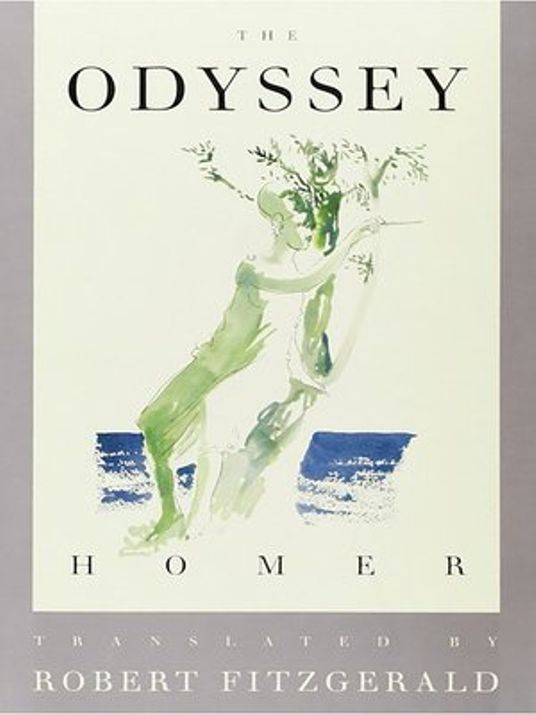
The Odyssey by Homer (Using translation by Robert Fitzgerald)

I’m sure many people know of this book. Whether you have heard of it or have even read it yourself, I’m sure that a good majority of people know of The Odyssey by Homer. It is completely fine if you don’t but do be warned, this can be a very difficult read without proper background knowledge. I had to read this in school and I couldn’t be more thankful that my teacher had given us extra pages to brief us. These papers were from Edith Hamilton’s Guide to Mythology and taken from the chapters about the Trojan War. These two chapters were relatively short but hold a lot of important information regarding the Trojan War and prior events to The Odyssey. If you can find these anywhere, they would be great to read before reading The Odyssey. You can most likely find this as a PDF online and I’m serious when I say this was one of the crucial things when it came to my understanding of this book. 

The Odyssey is one of Homer’s epics, completely centered around Greek mythology. Specifically, the Greek hero, Odysseus and his journey after the Trojan War and how he gets home. He journeys through different lands, meeting many other popular characters in Greek mythology such as Calypso, Circe, and many more. The Odyssey also includes Odysseus’ son, Telemachos, who goes on his own journey in hopes of finding his father to save their island, Ithaka. The short version of the story is that while Odysseus is out fighting in war and disappears for 10 years, his home is overtaken by suitors trying to take his wife Penelope’s hand in marriage. Telemachos cannot let this happen, so with Athena’s help, he journeys out to find news about his father. While this happens, Odysseus, who has been stuck on Calypso’s island for many years, has escaped her grasp and tries to make his way home, explaining how he had ended up on Calypso’s island and what had happened to him after the war. However, he is not done with fighting yet as when he comes back home, he must fight for it back.

I remember I tried to read this book over the summer before school started. I couldn’t understand it at all and I got frustrated and gave up on it. But when my teacher explained it all, I ended up enjoying the book a lot. There are plenty of Greek values and conventions in the book which help the story make a lot more sense if you know about them. 

Despite having given up on it before school had even started, once everything made sense, I actually enjoyed this book. A lot of people I know don’t like it or dislike it. They are in the middle of the two which is fine. I liked the unique way of storytelling. It was funny to read about the absurd things that happened like how over 100 men came to pursue Penelope’s hand in marriage. Other times, the book would have five chapters that would just be Odysseus explaining what had happened. While it may sound boring, it was really interesting to read about the places he went to and what he had done to get him to where he was now. I also enjoyed picking apart the characters and analyzing them. Many of the characters are heroic and different in their own way. 

The Odyssey is not an easy book to read due to its way it words certain phrases, the different types of spelling, and is especially hard to read without any prior knowledge. If you don’t know much about Greek mythology but are interested in reading this, I would highly suggest researching and trying to find Edith Hamilton’s Guide to Mythology which is available online. While it may take a while to get used to reading this book, The Odyssey was still enjoyable to me, even though I had to re-read a few pages every now and then. I would definitely recommend this to a Greek mythology lover and even would recommend it to those who have little to no knowledge in that area – with some hesitation.

-Nicole R.

The Odyssey by Homer, translated by Robert Fitzgerald, is available to check out from the Mission Viejo Library. It is also available to download for free from Libby.

Odysseus: A Character Analysis

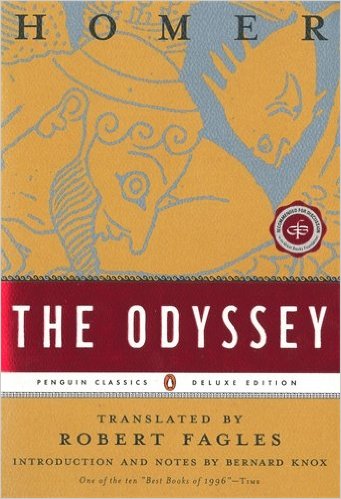
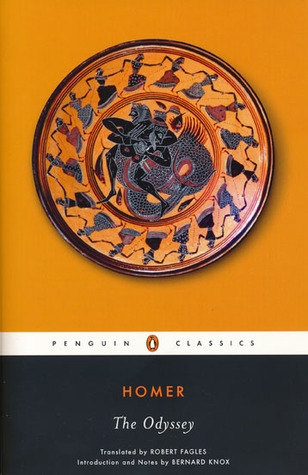
The Odyssey by Homer: 9780140383096 | PenguinRandomHouse.com: Books

Around 750 BCE, at the height of Greek civilization, a blind bard named Homer lived in Ionia, on the western coast of Turkey. Little is known about Homer, but his legacy lives on in his two great works – the Iliad and the Odyssey. While the former is formidable in its own right, it is in its sequel, the Odyssey, that Homer’s incredible craft is showcased. Detailing the adventures of Odysseus, the wily king of Ithaca, and his ten-year-long attempt to return to his country, the Odyssey explores lofty themes of human nature while remaining relatable to readers nearly three thousand years later. 

The poem can generally be split into three parts: immediately post-Trojan War, when Odysseus begins to set sail for home; the true odyssey, in which Odysseus must overcome many obstacles on his way back to his home; and the return to Ithaca, the chronicle of Odysseus regaining his rightful position as king. However, it is not the events of the poem that are worthy of note – instead, it is the behavior of the hero himself. Through the interference of the gods, whether to aid or hinder, Odysseus withstands harrowing experiences, all of which leave him a man and hero changed for the better. 

Odysseus is introduced to the audience as a god among men (in Ithaca, at least). However, this implies that Odysseus has never truly needed to better himself, making him vulnerable to hubris. Odysseus’ pride is justified to an extent, as seen when he and his crew are captured by the Cyclops, but Odysseus manages to trick the Cyclops and engineer their escape. However, just as they are about to sail away, Odysseus arrogantly stokes the rage of the Cyclops, not realising that the Cyclops he insults is the son of Poseidon, who then curses Odysseus. This is the catalyst for the change that Odysseus will undergo for the rest of the poem, because it makes it clear his pride will not serve him well in the future. 

In the ten long years between Odysseus’ departure from Troy and his arrival in Ithaca, Odysseus faces countless struggles that mold him into a character that is capable of overcoming his previously debilitating hubris. He meets characters who are equally as clever and wily as he is, forcing him to recognise people outside of himself. Famous characters who make an appearance during this arc are Circe, the wickedly powerful enchantress of the sea; Scylla and Charybdis, two sea monsters who devastate Odysseus’ crew; and Calypso, who successfully manages to trap Odysseus on her island for seven years. However, these experiences are mitigated by divine interference, notably via Athena and Hermes. 

By the final arc of the story, Odysseus has finally renounced his hubris and bowed to the will of the gods, while also being self-aware enough to understand his own worth. The situation in his country has deteriorated in his absence, and suitors of his wife, Penelope, have overrun the palace. Heeding the lessons of the past decade, Odysseus disguises himself as a poor beggar and wanders to the home of his loyal shepherd, Eumaeus, choosing to keep himself secret until he can determine who in Ithaca is truly loyal to him – a wise move, considering that the very next day, he is accosted by both one of his subjects and a suitor. By this point in his journey, Odysseus has learned how to let go of his pride with the knowledge that he will soon get his revenge. 

It is this that makes Odysseus a revolutionary hero: not that he is strong enough to kill all the suitors, but that he is clever enough to both withstand the abuse directed towards him while betraying nothing, and to trick the suitors into underestimating him until the fatal moment. Because of the way he handles the unfortunate situation he is in, although Odysseus does not fit the usual definition of a Greek hero (that is, all brawn and no brains), throughout his journey, he learns to be a more balanced heroic figure, which undoubtedly cements his status as one of the foremost heroes in literature for all time.

– Mahak M.

Homer’s The Odyssey is available for checkout from the Mission Viejo Library. It can also be downloaded for free from Overdrive.

2001: A Space Odyssey Essay

Throughout the movie, many parts led me to believe that David Bowman, in 2001: A Space Odyssey, is most relatable to Odysseus, in The Odyssey. David Bowman and Odysseus relate in many ways. First, David Bowman is emotionless and “cold-blooded,” just as Odysseus is throughout The Odyssey. Second, David Bowman could be described as intelligent and witty, as could Odysseus could be described as well throughout the story. Lastly, David Bowman is strong-willed and strong-minded, which Odysseus is in many sections of The Odyssey.

2001Title6x4

David Bowman could be characterized as emotionless because in order for him to open the emergency latch door to get himself to safety, he lets go of the body of his fellow scientist, Frank Poole, who he recently just picked up. He does this to ensure that he could live because Hal, the “sixth member” and computer on board, malfunctions and doesn’t let David Bowman in with the body of Frank Poole. The body of Frank Poole was held onto by the claws of the pod that David Bowman was in. Since Hal didn’t let David to enter, he had to enter through the emergency landing pod, which had to be opened by the claws of the pod he was in, so without thinking twice, David Bowman let goes of Frank Poole’s body, into space. This shows how David Bowman is completely emotionless and that relates him to Odysseus because when Odysseus returns to find that his maids have betrayed him, he makes them clean up the blood, and then he decides to kill all of them, which I think is completely unfair because he never took a second thought to consider the circumstances that the maids were in. The maids didn’t really have any choice but to betray him. So, this is a reason why David Bowman and Odysseus relate.

Another reason why David Bowman is like Odysseus is because David is intelligent. Throughout the movie, David Bowman shows his smartness in many ways. First, when Hal restricts David from entering, he thinks of another way, and succeeds. David entered through the emergency landing pod. Since he didn’t have a helmet, he had to improvise. He brilliantly lined the door to the opening of the emergency pod landing, then he jumped out grabbing the latch handle to close it. That plan that he made, in a matter of barely any time, saved his life. This is why I would describe David Bowman as intelligent and smart, which would relate to Odysseus too because in order for Odysseus to defeat the cyclops, he used his skilled mind to blind the cyclops and save his crew, quite simply from dying. Another time in The Odyssey when Odysseus shows how he is smart is when he heeds to Circe’s advice to not eat the cattle on the island of Helios.

odyssey_homerLastly, I would relate David Bowman and Odysseus with the trait of strong-willed. David Bowman, shows how he is strong-minded when he continues to Jupiter even though he lost all of his fellow scientists and cutting out Hal.This, to me, shows that he is persistent and will do anything to succeed in the mission. Whether that’s always good, or not, that’s arguable on the situation at hand, and in the circumstances, I would say that it is a good thing that David Bowman in strong-minded and strong-willed to continue to Jupiter. This attribute relates to Odysseus in many ways. Throughout, The Odyssey there were many times where Odysseus showed his courage and his strong mind. For example, when they passed by the Sirens, he sacrificed himself for the crew, he stayed tied to the mast ended up being the first man to survive the Sirens’ song. Also, he shows he is strong-minded when he is forced to stay for seven years at Kalypso’s island. He does end up staying all seven years and then is set free, so his time in the island, shows the readers how strong-willed and strong-minded he can be.

Throughout 2001: A Space Odyssey, David Bowman shows how he relates to his Greek equivalent, Odysseus. First, how emotionless he is when he lets go of Frank Poole’s body into space and how Odysseus slaughters all of his maids. Second, when David Bowman shows his intelligence, quite like Odysseus blinding the cyclops, when he finds another way to enter through the emergency landing hatch. Lastly, David Bowman’s strong mind related to Odysseus when he continues to go to Jupiter, and when Odysseus stays captive for seven years, but “toughs it out.” Overall, out of all the characters in 2001: A Space Odyssey, I would say David Bowman relates to Odysseus the most.

-Satej B.

2001: A Space Odyssey is available for check out from the Mission Viejo Library. 

Essay: Odysseus’s Dangerous Ego and Pride

odyssey_homerIn “The Odyssey,” a epic poem, translated by Robert Fagles, Odysseus represents an archetype that resonates in our culture today. I believe that Odysseus represents an archetype of a hero. Odysseus was well-known for being the King of Ithaca, his wife Penelope, occupied the suitors for many years while Odysseus went to fight at Troy. I believe that Odysseus is a hero but not an ideal one and that we should not accept his heroic conventions because many of his actions throughout the story make me believe the fact that he is too harsh at many times.

Odysseus’s actions in Book 22 represent show his cruelness to others. For example, when Odysseus trapped and killed the suitors, which is completely understandable, he also forced the maids to clean the blood and then he killed them. The maids were completely innocent, even though they sided with the suitors, they didn’t have a choice and at that moment there was no other choice then to listen to the suitors. I believe that the way Odysseus treated the maids, even after they betrayed him, was cruel and harsh and that this represent the merciless attitude of Odysseus.

Another good example of Odysseus’s non-heroic conventions is in Book 9, is when Odysseus stays to see the Cyclops, Odysseus just wants to brag about having a gift from the Cyclops. If he either stole some food, as his men persuaded him to, or just leave without food, lives would have been saved. Many men were murdered by the Cyclops because of Odysseus’s pride.

Throughout the story, Odysseus is on a journey, and his wife, Penelope, is at home keeping the suitors “occupied.” In many oppurtunities, Odysseus cheats on Penelope, which doesn’t represent and heroic attributes because honesty is one of them. Odysseus cheats on his wife many times with Circe and Calypso. Even though Odysseus was “unhappy” with Calypso, he was forced to sleep with her at night, but I’m sure he didn’t complain too much about being forced into it. To add on to Odysseus’s dishonesty, “Odysseus stayed with Calypso for seven years.” In modern times cheating is much more serious, the act of it, even back then, is nothing to be proud of and does definitely not represent honesty.

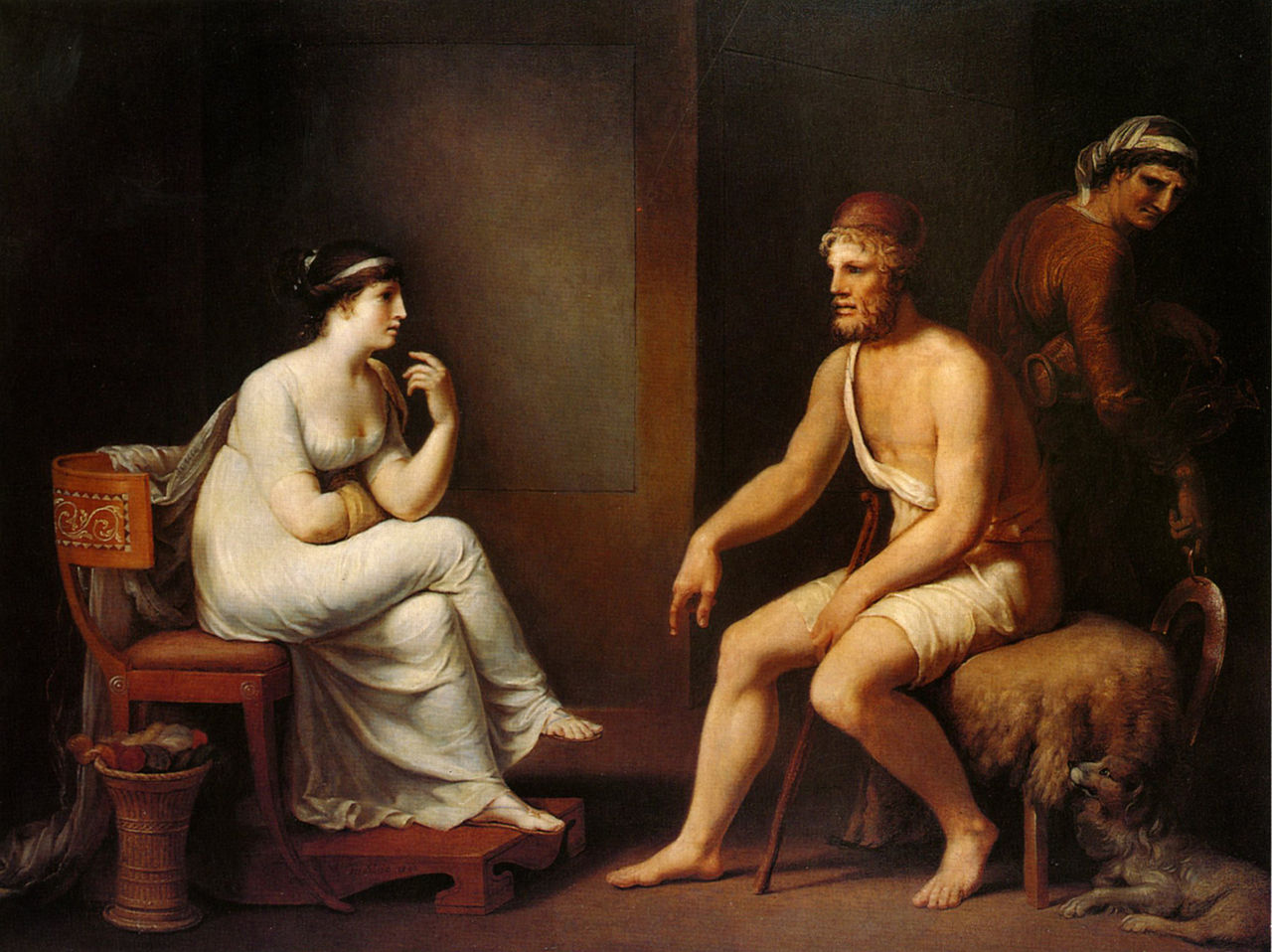
1280px-Odysseus_und_Penelope_(Tischbein)

Odysseus and Penelope by Johann Heinrich Wilhelm Tischbein

Another notable example of Odysseus’s non-heroic actions is when after he stabs Polyphemus, the cyclops, in the eye, he ends up escaping but Odysseus shouts back to the cyclops giving away his position and almost causing the ship to wreck. A hero, puts others in front of him, Odysseus put his ego and pride over his men on the ship, almost causing the death of his men to occur. His cockiness and selfishness is proven throughout the poem to be dangerous to others affiliated with him.

A trait that all heroes should have is humility. Odysseus doesn’t have any of humility. When Odysseus and his men are reflecting upon their escape from the Cyclops, Odysseus shows his true-self. “Did I not keep my nerve, use my wits, to find a way out for us.” (p.776-777) This shows how Odysseus is unappreciative of his men and that he thinks is the sole reason of success. Thinking that you are the best and everyone else is nothing compared to you isn’t the way the hero should act or think in front of his men.

Throughout the story, Odysseus proves that he is a ruthless and lying person. First, when Odysseus makes the maids at his house clean the blood and then kill them, that shows his ruthless trait. Second, when Odysseus wants to brag about a gift from the Cyclops, thats shows his big ego. Next, when Odysseus cheats on his wife, Penelope, with Circe and Calypso that represents his dishonesty and disloyalty, especially when he is “forced” to stay with Calypso, for seven long years, while Penelope is busy occupying the suitors to help Odysseus. Lastly, Odysseus shows that he has no humility when he tells his men that he is the sole reason why they escaped from the Cyclops. These traits do not represent a hero in any way, that is why it make my opinion to be in assurance that Odysseus is not a hero and that we should not accept his “heroic conventions,” because they are quite far from being heroic in many ways.

Works Cited

Homer, The Odyssey, Trans, Robert Fagles, New York: Penguin, 2002, Kindle.

“Odysseus | Greek Mythology.” Encyclopedia Britannica Online. Encyclopedia Britannica, n.d. Web. 30 Nov. 2015.

-Satej B.

Book Review: The Odyssey by Homer, interpereted by Robert Fagels

odysseyYou may have heard about the two great epic poems of Greece, purportedly written by a blind poet, Homer: The Illiad and The Odyssey.

It was required reading for my English course to read The Odyssey. Warning: It is not a quick and easy read. I read the poem version, and that was 485 pages of verse. Though it may seem like an odyssey in itself to read this book, I found it to be surprisingly good, given the time period in which it took place.

An odyssey is a long journey. This epic tells of the odyssey of Odysseus, a great hero who left his hometown of Ithaca, Greece to fight in the Trojan War. The entire poem tells of the trials and hardships that Odysseus encounters in his attempt to return home after the war. The book is full of daring adventures, the whims of the immortal gods (mainly Zeus, Poseidon, Athena), and lots of bloodshed.

Given that the novel is in verse and was written so long ago, the names and places are now abstract to present day audiences, but that did not necessarily take away from the poem. To me, this aspect of the poem made it seem even more like a fairytale, since many of the names and places are so intangible and seem made up.

I would not necessarily recommend going out of your way to read this book, but when you have to study it for an English class, keep in mind that it is not a terrible book as may have been rumored by other students. Be grateful that we now have access to ways of reading books both on paper, audio books, and electronically, because in Homer’s time, this entire poem was passed down through oral traditions. That means this 485-page poem was memorized in its entirety! That was probably the most shocking part of the whole reading experience!

– Leila S., 9th grade