Possible Planets for Life

In our universe, there are many planets which could possibly contain life. However, there are multiple criteria a planet must be able to meet in able to be considered “habitable.” First of all, it should be in its solar system’s habitable zone, also called the Goldilocks zone. This is the area in a solar system where the planet(s) in it are most likely to meet the criteria for containing life as we know it. For example, in our solar system, Venus, Earth, and Mars are in the habitable zone. Another criteria is temperature, partly determined by a planet’s location in a solar system (ex: Venus, being closer to the Sun, is very hot, while Mars, being farther from the Sun, is much colder). Earth has temperatures which are able to sustain life, which is why climate change is such a big problem for life on Earth as we know it. This directly connects to another criteria, which is liquid water. While there is possibly water in the form of ice on Mars, it is too cold to sustain life. While there are definitely more factors in defining life as we know it, these are some of the most major ones.

  1. Mars

Surprisingly for many, Mars may once have had life. It is believed that Mars was habitable ending 3.5 billion years ago. During this time period, Mars would have received rain in the form of liquid water, a vital element for life. Life on Earth developed earlier than this time, so assuming the then-habitable Mars followed similar patterns, there was definitely more than enough time during Mars’ habitable period for life to develop.

  1. Kepler-22b

This exoplanet orbits the star Kepler 22, in the constellation of Cygnus, about 600 light-years away from Earth. Kepler 22 is a star which is actually similar to our own Sun. Both our own Sun and Kepler 22 have similar sizes and temperatures. It is about 2.4 times Earth’s size. Not only is the planet in the habitable zone, but some studies also suggest that it could have temperatures very similar to Earth, at about 72 degrees Fahrenheit, or 22 degrees Celsius.

  1. Proxima Centauri B

Proxima Centauri B is one of the closer potentially habitable planets at just about 4.24 light-years away. It is similar in size to Earth, at about 1.17 Earth masses. However, it orbits its star much more quickly than Earth orbits its Sun. It takes Proxima Centauri B only about 11 days to orbit its star, Proxima Centauri, a part of the triple star Alpha Centauri System. Proxima Centauri B is within the habitable zone, so it is definitely a plausible candidate for extraterrestrial life and habitability.

While there are many candidates for extraterrestrial life on exoplanets, it is important to remember that these are only the one’s considered habitable due to similarity with Earth. Therefore, there may actually be many more exoplanets which possibly contain life. Our lists of “habitable” exoplanets are only based on our knowledge of what life on our planet, Earth, needed to develop.

-Peri A.
Unique and Interesting Exoplanets

There are many exoplanets in our universe, all with varying characteristics. Here are just a few of them that have been discovered.

#1: The Ocean Planet – GJ1214b

This planet is likely to be an ocean planet, meaning it is entirely covered with one large ocean (no land). It is located about 40 light-years away from Earth.

#2: The Fast Planet – PSRJ1719-14b

Exoplanet PSRJ1719-14b quickly orbits its star; it takes about 2.2 hours for the planet to complete a full orbit around its sun. However, this is not the planet’s only unique characteristic. In addition to its fast orbit, this exoplanet also has a chance of being made of diamonds, although this has not been proved. Diamond planets form when the pressure and temperature are high enough to turn the carbon on the planet into diamonds. It is about 3,914 light-years away from Earth. 

#3: The Dying Planet – WASP-12b

Despite being around the size of Jupiter, this exoplanet is constantly nearing its star. Eventually, the gravity of its star will pull this planet into the star. Currently, this planet is 870.8 light-years away from Earth.

#4: A Large Planet – TrES-4

This planet is over 70% of the size of the largest planet in our solar system, Jupiter. What makes this planet unique, however, is that it has only %75 of the mass of Jupiter, giving it a much lower density. It is 1562.3 light-years away from Earth.

#5: An Old Planet – Methuselah

Estimations predict Methuselah is about 13 billion years old. Scientists believe that at that point in time (13 billion years ago), the materials to form planets were not actually able to form planets. This exoplanet is about 12,400 light-years away from Earth.

These are just a few of the many amazing exoplanets in our universe, with many more still waiting to be discovered.

-Peri A.

James Webb Space Telescope: First Images Revealed Event

Launched on December 25, 2021, the James Webb Space Telescope (or Webb) has the potential to revolutionize astronomy, astrophysics, and other space sciences forever. Last month, the first images from Webb were transmitted back to Earth, and what they show is astonishing.

On Saturday, August 20, the Mission Viejo Library held the James Webb Space Telescope: First Images Revealed event, which showcased the preliminary images received from Webb as well as a live presentation by NASA Solar System ambassadors alongside expert comments and conclusions from video panelists. 

Webb works by using infrared light (or heat, imperceptible to the human eye), to view and capture images from deep space. This new technique complements the Hubble telescope, but it also allows Webb to see extremely far away at distances over 13 billion years away – nearly as old as the universe itself!

One of my favorite images from the presentation was the Carina Nebula, shown to the left. The James Webb Telescope has captured the first image of a star actually being born in a stellar nursery, confirming scientific theories while also raising new questions about the details of star birth. 

I also liked the picture of the deep space field, shown to the right. Although the brightest stars are “photobombing” the image, since they’re part of the Milky Way galaxy, some of the smaller and dimmer spots are actually never-before-seen galaxies, part of the ancient world formed just after the creation of the universe. The curves near the center of the image also show concrete proof of gravitational lensing (or the curving of space-time as theorized by Albert Einstein). 

Despite all of these fascinating discoveries, Webb is far from finished. Not only is there so much left to be discovered and explained about the images it has already sent, it is projected to last for a decade or longer, so it will undoubtedly unveil more and more about the universe we live in. Overall, I really enjoyed the Webb event, and look forward to presentations like this in the future.

Images courtesy of NASA (nasa.gov)

– Mahak M.

Exoplanets and the Transit Method

Have you ever wondered about exoplanets? Exoplanets are the planets outside of our solar system.

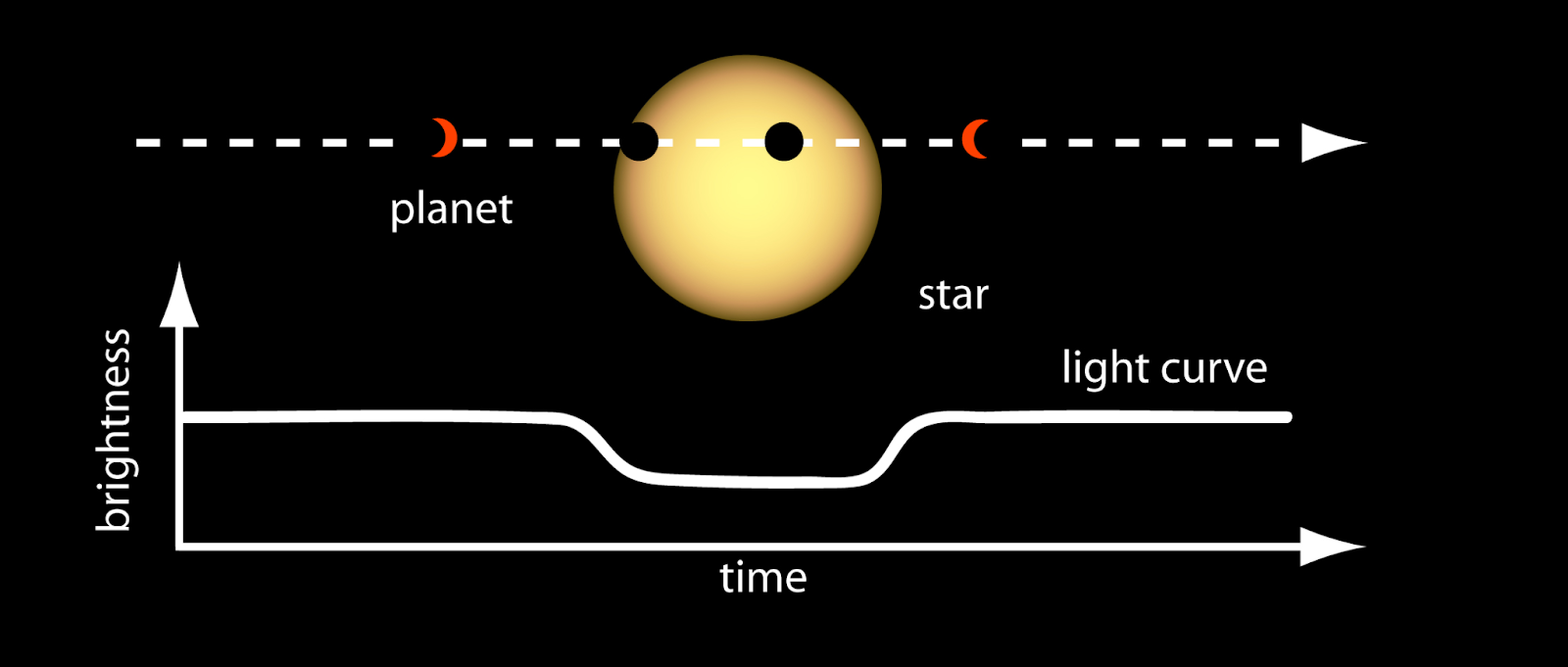
There are multiple methods used by astronomers to discover exoplanets. One of them is called the Transit Method. As planets orbit their stars in a mostly circular way, exoplanets will always pass in front of their own star (at least, to our own perspective). During a planet’s transit around its star, its effects will be somewhat similar to an eclipse. The amount of light given off by the star that is visible from Earth will decrease until the planet completes its transit. Using the data like the drop in the star’s brightness and how long the transit was, astronomers are able to make various calculations. Not only are they informed of the exoplanet’s existence, but they also discover the exoplanet’s distance to its star or how long its orbit takes. More than 3000 exoplanets have been discovered using the Transit Method to this date. 

Still, though, there will always be mistakes in using this method as well as any other methods. There may be unseen details or simply missed periods of light differences by astronomers’ telescopes and graphs. There may always be unobservable celestial objects in our universe that may remain undiscovered. All we can do is try to discover as much of it as we possibly can.

I think it is very important that we discover more about this infinitely large universe we live in before other galactic clusters move out of our observable universe. This will eventually happen, as the universe is constantly expanding at an accelerating rate, moving an increasing amount of celestial objects out of our observable universe every moment.

-Peri A.