
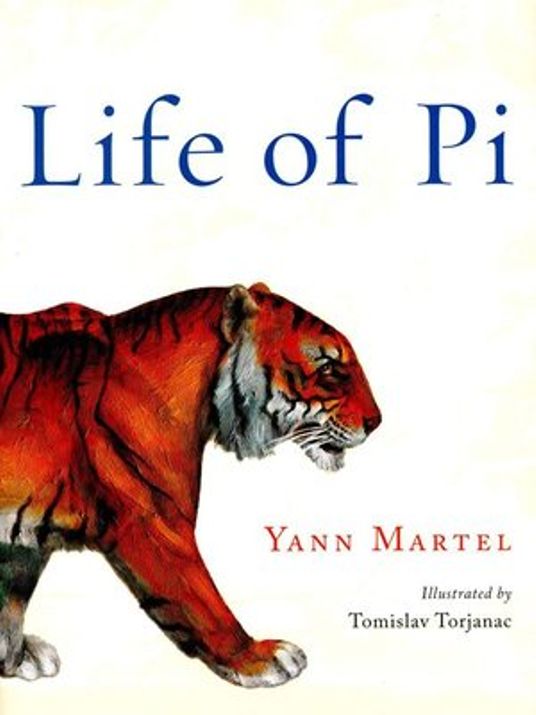
Book Review: Life Of Pi By Yann Martel

I read this book about half a year ago, towards the beginning of the school year. It was summer homework for my school, and I thought it would be very boring and a hassle. This proved not to be true as I kept reading.

This book is about a young boy, Pi Patel, who is stranded out in the middle of the ocean on a lifeboat. He is stuck with a giant tiger and some other animals. The book shows the thought process of a shocked boy who just lost his family and needs to do everything in his power to survive.

Initially, everything was well for the Patel family. They owned the Pondicherry Zoo and lived a happy life. When they decided to move to Canada, Pi’s dad decided to move all of the zoo animals to Canada and then sell them for money. This proved difficult since the ship sank, leading to Pi being stranded on a lifeboat in the middle of the ocean. I don’t want to spoil too much of what happens, but I personally thought the ending was fulfilling and that the book was very interesting.

One part I found particularly interesting was the fact that Pi was named after a swimming pool in Paris. Both of Pi’s parents were never too fond of swimming, but it was their family friend, whose favorite pool was the Piscine Molitor, who inspired them to name him that. I found it sad that the people at Pi’s school teased him by calling him “Pissing” instead of “Piscine,” but he dealt with the teasing really well and I loved how he responded to everyone, even the teacher.

Overall, I feel like this book is a great option for anyone who is looking for some good survival books. It was a lot of fun to read and there is a lot of action in the book. You will never get bored by this book!

– Albert X., 10th grade

Life of Pi by Yann Martel is available to checkout from the Mission Viejo Library. It is also available to download for free from Libby.

Book Review: Life of Pi by Yann Martel

This Summer, I read Life of Pi, an extraordinary story detailing the adventures and survival of Pi Patel, a young Indian boy who fell victim to a shipwreck, and was stranded on a lifeboat with a Bengal tiger. This book was definitely a interesting one from my perspective, as it involves a diverse amount of characters, as well as plenty of symbolism to go with it.

I’ll try my best to avoid spoiling the book, although in describing the story, sometimes I can’t, so be aware, Spoilers Ahead! With that out of the way, the book begins with an author’s note, explaining how he was inspired to write the book because he met a mysterious man who would tell him a story that would make him “believe in god” However, it is later implied this is all part of the story.

At the start of his story, Pi would explain how he was brought up near a zoo owned by his father, as well as how he was always ridiculed for his original French name, the boys at school would often mispronounce “Piscine,” calling him names. to prevent this from happening in the future, he just told everybody to call him Pi. Later, he explains how he adheres to multiple religions, even asking to be baptized and to get a prayer rug at the same time, which is in my opinion one of the most interesting and unique parts of the book

As the years passed the family realized they couldn’t stay in India any longer. it was 1977, and the “emergency” declared by the government had no end, with traces of tyranny being shown through the leaders of Tamil Nadu, the Patels’ home state, being quietly placed into “house arrest”. Because of this, Pi’s family decided to make the decision to sell the animals and move to Canada.

Shortly after the Patels board the cargo ship Tsimtsum, it sinks, leaving Pi the only survivor along with a 300-pound Bengal tiger named Richard Parker, a wounded zebra, a hyena, and a female orangutan. during the first week, the zebra and orangutan fall one by one to the hyena, which is shortly after killed by Richard Parker. Pi learns to coexist with Richard Parker, eventually training him to some degree, making it relatively safe for them to be on the same boat. they pass trial after trial together, braving massive storms at sea, and eventually a man-eating island. after they leave the island, Pi “turns to god” and survives the rest of his long and arduous journey at sea.

I won’t spoil the ending of the book, because the story ends with another author’s note, structured like an interview between Pi and some investigators in an extremely unexpected way. All in all, this was a great book that will make anyone interested in reading the whole thing after a few pages!

Life of Pi by Yann Martel is available to check out from the Mission Viejo Library. It is also available to download for free from Libby.
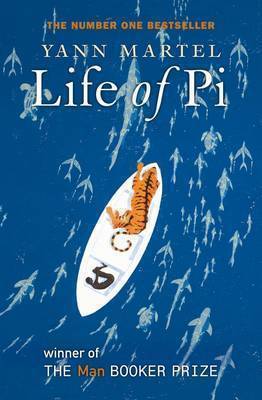
Book Review: Life of Pi, by Yann Martel

life_of_pi_coverThis book review is part of series of reviews written by students at St. Margaret’s Episcopal School for their 7th grade English classes.

Hope. Trust. Faith. Courage. Remarkable. Inspiring. Amazing. The heart-warming book, Life of Pi, by Yann Martel, reveals how close the bond between humans and animals is and how they can be commonly mistaken to be uncontrollable beasts. Yann Martel has won the Man Booker Prize and has sold over seven million copies. His work has been read across the world! Many people state that animals have no emotion and cannot control their feelings. However, Mr. Martel beautifully describes how this is untrue. This novel also shows how strong the connection between man and God can be.  Although our main character, Pi, is unable to see Him, he must still believe and never give up hope. This truly inspiring book is something you will not be able to put down.

An Indian boy named Piscine Patel, also know as Pi, lives with his family in India who own a zoo. Pi is involved in multiple religions and worships the gods whenever he can. He has always been engaged with the animals’ behaviors and feelings, while all his father sees are dangerous, untrustworthy beasts. Pi mentions how, “we commonly say in trade, that the most dangerous animal in a zoo is Man” (29) . He continuously tries to prove that animals are innocent and that it is not their fault if they injure somebody.

Now he and his family has make a decision to travel to Canada, but when their ship, the Tsimtsum, crashes, he is left on a lifeboat by himself with a group of untamed animals. Pi now has to figure out how he will survive with a 450-pound Bengal tiger, an orangutan, a zebra, and a hyena. “There was nothing. Only rain, marauding waves of black ocean and flotsam of tragedy” (107). For countless days, Pi continues to pray to God and keeps telling himself never to lose hope. But can man prevail against a huge Bengal tiger?

I was very pleased while reading this book. It felt as if I were really on the boat next to Pi and all of the animals. Yann Martel uses very emotional and descriptive words, adjectives, and figures of speech. He did a wonderful job illustrating a picture in my mind. This fantastic book taught me how powerful the connection between humans and our Lord can be.

Life of Pi is a great novel that has changed my view on how animals feel and how they can be loving and caring. This book also strengthened my understanding and belief in God. Life of Pi is an excellent example of classic literature and I would definitely recommend it!

-Kaitlin K., 7th grade

Book vs. Movie: Life of Pi

life_of_pi_book_vs_movieI saw this movie on the deck of a cruise ship during spring break in the Caribbean. Not exactly the ideal spot to watch a movie about a boat sinking in the ocean! But I loved the movie so much that when I got back from my break, I immediately began reading the book Life of Pi, by Yann Martel.

Watching the movie immediately drew me in to Pi’s world, and I just had to read the book! Let me just give you a taste of what this phenomenon is all about. Life of Pi tells the story of an Indian boy named Pi, who loves animals and God. His family decides to move to Canada, and on the way, their ship sinks leaving Pi on a lifeboat with a hyena, zebra, orangutan, and a giant Bengal tiger. The second half of the book is about Pi’s struggles to survive in the middle of the ocean. Pi learns to abandon his vegetarian ways, train the tiger, and become a master shipman.

The story is dripping with imagery that is so vivid it will make your mouth water. Life of Pi is so powerful that I had dreams about giant whales, tigers, islands, lifeboats, and sunsets for practically a week! I have such an appreciation for Yann Martel because of Life of Pi. He is the most amazing author ever, and definitely deserves all of the awards he received!

In the movie Life of Pi, however, the ending is such a Hollywood ending that I feel bad for Yann Martel. Yann Martel specifically wrote the ending to show the brutal truth of life to the readers, and if you want to find out his lesson, then you’re just going to have to read it yourself! If I personally was directing the movie, I wouldn’t dream of changing the ending, because that is the whole point of the story. However, Ang Lee did do an amazing job because the scenery was beautifully artistic, casting was perfect, and computer graphics were out of this world, though, so I did still really love the movie, just not as much as the novel.
Anyways, I know that this review doesn’t even begin to express how amazing this story is, and it cannot possibly live up to Yann Martel in any shape or form. Life of Pi is the most amazing book I’ve ever read– literally, I found myself bawling my eyes out at some points! I want more than anything for everyone to read this book! You will never see tigers, humans, the ocean, animals, religions, or life the same ever again. Yann Martel strikes you with so much wonder and awe it is unbelievably breathtaking.

Please feel free to comment below as I know there will be many since this is such a renowned book!

-Kelsey H., 9th grade

Book Review: Life of Pi, by Yann Martel

life_of_pi_coverThis book review is part of series of reviews written by students at St. Margaret’s Episcopal School for their 7th grade English classes.

The book I am reviewing is the book “Life Of Pi” by Yann Martel. You may recognize this book from the popular 2012 movie based after this novel. You also may recognize Yann Martel from other Canadian books that he has authored, such as “Self”. At any rate, Yann outdid himself with this book. Not many people could take the life of a young Indian man and make it into a compelling epic filled with conflict, hope, & promise.

This 537 page novel is divided into three main parts. The first is told from the point of view of Piscine Molitor Patel. His father owns a zoo in Pondicherry, India. He talks about his young life and the lessons he learned. Two really important things happen in this section. Firstly, after receiving the nickname “Pissing Patel,” he makes a new nickname for himself as “Pi Patel.” You get the idea that Pi is just a normal Hindu boy living in India. Secondly, Piscine “Pi” is born Hindu, but at the age of fourteen he starts practicing Christianity and Islam as well. He claims his reasoning as “I just want to love god,” (pgs 129-130). If I were Pi, I would have prayed to God more because Pi was about to have some bad luck.

The second is also told from Pi’s point of view. Surprising to me and unlike most book protagonists, Pi does not search for adventure. Instead it is forced upon him. His parents decide to move from India to Canada. After traveling with the animals on a ship so they can be sold elsewhere, Pi and the Patel family are thrown into danger. Their boat suddenly capsizes. Pi saves himself by climbing into a lifeboat but he is stuck with 3 (later 4) of the animals from his zoo. These animals are: a hyena, a zebra, an orangutan named Orange Juice, and a Bengal tiger named Richard Parker (RP). Eventually, only RP is left. Pi and RP learn to cope with each other in the boat for 227 days, most of which are spent describing the sea, stars, and his situation. Unlike most other stories, this story seems natural as if it was authored by Pi himself. Pi must remind himself continually of his family and realizes that life is only good if enjoyed, a continual reference through the rest of the book. If not for RP, Pi would have given up and died. Will Pi ever make it back? You’ll have to read the book to see what happens.

During the final part of the novel, years later, a much older Pi Patel is being interviewed by two reporters who are looking for info about the ship he was on. When they do not believe the story he tells them with the animals, he tells them another story in which Pi, his mother, the ship’s cook, and one of the sailors are on the lifeboat instead. The reporters have a mixed review to this story as well. Because neither of the stories have anything to do with the ship, they choose one of the stories. Pi’s response is simply “Thank you. And so it goes with God,” (pg. 531). You’ll have to read to find out which story they chose.

Overall, I would give this novel about 3.5/5 stars, because of two reasons. The book uses complicating word choice and if you prefer short books, this book is not for you. Also, the book does drag on in the middle while describing the few things Pi sees in the ocean in great detail. This leads to a slightly stretched out conflict and even some redundancy, but if you can make it past this part of the book, it is well worth it to see the end of Pi’s journey. Condensed into about 250-300 pages, this book would have been flawless, but now it is forced to depend on a simple plot and pure curiosity to keep the reader going. The only reason I did not stop is because I had to know how Pi’s life ended in the end.

-Tejav N., 7th grade