
In A Tale of Two Cities, Charles Dickens uses diction to adopt a tone of pity toward the social conditions of France during the period before the French Revolution. At the beginning of the novel a barrel of wine spills, and the people are depicted as having “devoted themselves to the sodden and lee-dyed pieces of the cask, licking, and even champing, the moister wine-rotted fragments with eager relish.” The use of the word “devoted” implies that the poor do not have the freedom to eat when they want, as once the wine cask breaks, everyone quickly drops what they are doing so that they can get a few drops of spilled wine off of the street, and they are so desperate for food that they are not letting go of the fragments of wood. Using the words “champing” and “eager relish,” Dickens demonstrates how, although it was just wood, people still excitedly bit and chewed it with enjoyment and delight, attesting to the fact that the peasants of France are so poor and starved that they have to resort to chewing on rotten wood to get a few drops of wine for nourishment, something that someone who might be even marginally better off would not have even thought of doing.
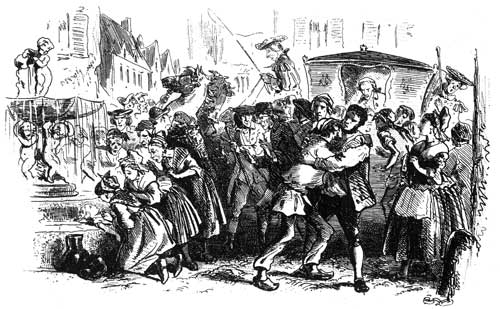
Image source: http://charlesdickenspage.com/illustrations-cities.html
Later on, Dickens describes how “Hunger was the inscription on the baker’s shelves, written in every small loaf of his scanty stock of bad bread”. The word “scanty” to describe the baker’s stock of “bad” bread emphasizes how there is not enough food for the peasants (which eventually led to the peasant women marching to the palace and taking Louis XVI back to Paris), because although it is the baker’s job to supply the people with food, even he does not have a full larder. The fact that the baker has bad bread demonstrates that bread, which was the staple food of the French diet, is running out or is not being consumed, because the baker does not have enough supplies or resources to make fresh bread as a result of no one being able to buy the bread in the first place. These examples serve to highlight the tone of pity Dickens adopts toward the condition of the peasants in France, as they are reduced to scavenging for food and are not able to sustain themselves, and implies that they had a good reason to rebel. The author’s words serve to highlight the reality of the peasants before the French Revolution, which helped me understand to a greater degree how bad the situation had been, as opposed to just reading the facts in a textbook or article.
-Aliya A.
 Haruhi Fujioka, a middle-class student, hopes to finish high school in the prestigious Ouran Academy as quietly as possible, but that is not going to happen in a school full of rich kids. She stumbles upon the Third Music Room where Ouran High School Host Club resides. The first encounter is not what would be called the most fortunate as Haruhi accidentally breaks a vase worth $80,000. To repay back this debt, she agrees to work for the host club, but to add to her misfortune the members of the host club mistake her as a boy. With this misunderstanding, she becomes the club’s errand boy. Her story unfolds with the odd collection of high school hosts: President Tamaki Suoh, Vice-president Kyoya Ootori, Identical twins Hikaru and Kaoru Hitachiin, Mitsukuni “Honey” Haninozuka and his cousin Takashi “Mori” Morinozuka. This is the story of her adventures with these characters and how she survives in the crazy world of the rich and eccentrics. From daily costume parties to romantic adventures on a island, her life is definitely not going to be as quiet as she hoped.
 I saw Lights Out with some of my friends thinking it would be quite scary, and I mentally prepared myself for the worst. But, after the movie, I was quite surprised on how it was a joke to call Lights Out a ‘horror movie.’
  Over the last 20 years, Pixar Studios has cemented itself as one of, if not the best animation studios in the business. This is due to their consistency and devotion to their franchises. One of the most successful of these franchises was Finding Nemo, which was a critical and commercial success for Pixar. After 13 years, the sequel Finding Dory has finally been released.



 Mission Viejo Library Teen Voice