Event Recap: Teen Writing Workshop with Shannon Messenger

shannon_messengerMany of you heard Shannon Messenger speak at the Mission Viejo Summer Lovin’ event last summer.  On Thursday, September 14, 2014, there was another event at the Rancho Santa Margarita Library.  Her teen writing workshop drew over 60 middle schoolers.  Messenger taught us some of the fundamental steps for beginning writers.  She explained characterization and world building as well as plot methods.  Within an hour, I began to feel like a better writer and reader.

One of the first things she recommended was to know your characters and to treat them like real people.  From her personal experience, she advised that you shouldn’t care what people think of you for saying in a conversation, “I want my character to do this, but she won’t let me!”  This cracked everyone up.  As Messenger continued, with a smile, she said we need to know our characters like we know ourselves by asking our character five questions:

  • What does your character want?
  • What does your character need?
  • What is your character afraid of?
  • How does your character feel about himself/herself?
  • What is your character hiding?

The next topic she addressed was building your story’s “world”–big or small, rich or poor, or even fantastic or realistic.  You also need to add in the history, culture, technology, transportation, and government.  The history can be pretty easy.  If it is a fantasy story, you can just make it up, but in a realistic fiction or historical fiction, you may need to research the location.  Culture consists of art, music, fashion, and sports.  The technology means acknowledging the inventions appropriate for your time period.  She advised that transportation can be tricky.  Is your character old enough to drive?  Or do you need to come up with some other means of moving from place to place? Finally, you need to define the type of government, laws, currency, language, and social structure.

The last big topic was “how to.”  Shannon Messenger said that adjectives are one contributing factor to a best-selling author’s success. Use your sensory words to describe different aspects of your town.  Such as, “She saw the blue sky and smelled the fresh scent of pine and evergreen.  As the aroma wafted to her nose, a memory flooded into her mind, and she heard her dad cutting down a Christmas tree for their house before he left for the army.  The scene brought tears to her eyes, and she felt one stray salty tear find its way into her mouth.  She tasted its bitter remembrance.” Using sensory language envelopes the reader in the scene.  In addition, Messenger recommended keeping an “idea journal” to keep track of your great ideas.  Messenger concluded by wishing us good luck and advising us to listen to the stories within us.

This was one of the most helpful writing workshops I have attended.  Shannon Messenger is one of my all-time favorite authors, and you can read my review of her Keeper of the Lost Cities series here.

-Maya S., 7th grade
Book Review and Music Pairing: Breathing Room, by Marsha Hayes

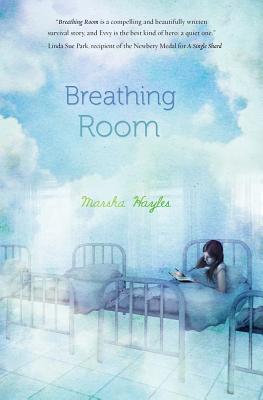
breathing_roomThis story is set during WWII, and a horrible illness is causing many fatalities.  One 13-year-old girl has caught tuberculosis.  She is coughing up blood and is moving into a sanatorium called Loon Lake.  Evvy has to  leave her family and her twin brother, Abe, behind.  Evvy is frightened in this new home, because she is placed in a ward with three other girls who ignore her.  To make matters worse, it seems as though she is not recovering from the tuberculosis.

Not a lot is going right for her, but as I was reading, I was thinking our main character was not dying, but, in a sense, getting stronger.  Therefore, the song “What Doesn’t Kill You” by Kelly Clarkson would fit well at this point in the story if the novel was developed into a film.

Days, weeks, and months go by with little improvement.  My anxiety increased, and my heart was quivering with the start of each new chapter.  It was very sad, but some aspects of Evvy’s life were getting better.  A new girl, named Sarah, was admitted in the ward.  Sarah was the only person who Evvy was able to talk to.  Evvy thought everything was going as good as it could, until one of the girls was discharged.  One of the nicer girls…  Then, the events that followed spelled near disaster for Evvy.  One day as Evvy sat next to one of her dying roommates, I thought of the song “Say Something” by One Big World, in the hopes that the roommate would recover.

This book takes its reader on a quite an emotional journey.  The reader feels such a connection with the main character’s hopes for a better day.  Evvy reaches out to help others but doesn’t always succeed.  Yet, I learned that it is the thought that counts.  I loved this book and would rate it an 11 of out of 10 for its thought-provoking message .

-Maya S., 7th grade

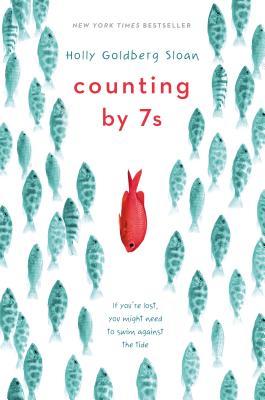
Book Review and Music Pairing: Counting By 7s, by Holly Goldberg Sloan

counting_by_7sCounting by 7s is a heartfelt novel about a genius girl who is an “angel” to many.  Willow Chance, a 12-year-old girl going into middle school has a natural green thumb.  She made chemical analysis of bee poop at the age of seven.  At the age of eight, she raised a baby green parrot and later set it free.  The story opens with her driving up to the driveway of her house to find a police car.  However, she rewinds and tells about her past.  She has always been “highly gifted” and has yet to meet a teacher who understands her or has understood her teacher, for that matter.

Fast-forwarding to the present time, the story transfers to her parents’ perspective.  Her mom is at the doctor getting a small dimple on the left side of her chest checked out.  This dent turns out to be a tumor, and she learns that she has cancer.  On the drive home, in the middle of an intersection, Willow and her parents’ world completely falls apart.  The only thing unharmed was a sign that clattered down saying, “SAFETY FIRST!  Tell me how I’m doing.  I am truck number 807.”  Ironic.

So, when Willow comes home that night, she becomes an orphan.  Though she is immediately taken in by her brand new friend’s mom, Willow feels her life is going downhill.  At this point in the story, I thought of the song “Someone Like You” by Adele.  Although Adele is singing about a relationship between her and her boyfriend, I thought about the song differently.  Willow will never find parents who replicate her deceased ones.  This part of the story was very emotional for me.  Sloan does such a fine job of displaying this mourning that you begin to wonder if her own life inspired this story somehow.  If so, I hope she was able to find “someone like you.”

The resolution, as expected, repaired Willow’s situation, and she was very happy.  Two people came together and made her ends meet.  This is the kind of story that I enjoy.  The narrator expressed Willow’s true feelings.  I feel as though Holly Goldberg Sloan wrote this from her heart.  If this novel was made into a film, the song “Strawberry Fields” by the Beatles should be played.  It represents the theme of “life is a winding path” well.  The lyrics “nothing is real” explores what life would be like with no permanent future.  It could be bad.  Or it could be good.

I would rate this story 10 on a scale of 1 to 10 for its sincere message.

-Maya Salem, 7th grade

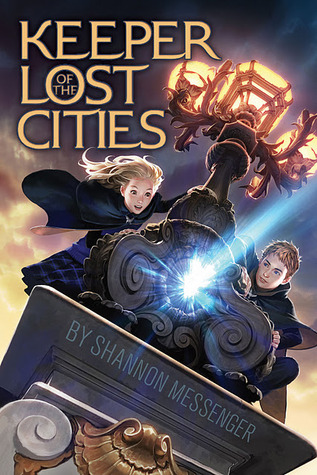
Book Review and Music Pairing: Keeper of the Lost Cities, by Shannon Messenger

keeper_lost_citiesKeeper of the Lost Cities is about a girl named Sophie Foster who learns that she is not human. Shocker! She is a 12-year-old senior in high school and has been admitted to the most prestigious Ivy League schools. It all begins when she is sitting in science class one day, with ear-buds in, listening to music. The teacher asks her a question that she is not expected to know the answer, but her very rare ability, her photographic memory, helps her. Later, on a fieldtrip to a museum, an odd-looking boy tells her the words of her fate, “It’s okay, Sophie. I’m here to help you. We have been looking for you for 12 years.”

She has no choice but to go with him. She learns that his name is Fitz, and she is amazed at the lost world of the elves they have entered. Messenger provides some history and explains that the Ancients, the governing body for the elves, had a fight with the Humans a long time ago. When I read this, I thought of the song “Revolution” by the Beatles. After reading further, I realized not only is this not a revolution, but also it is the start of a broken bond. If the two groups had actually agreed, perhaps the world would be much happier. But, they didn’t. The Ancients wanted peace; however, humans wanted to go to war. So the two were separated, and the elves became forgotten to the humans except for the ones believed to reside in the North Pole. The forgotten elves actually live in areas called the Lost Cities. The human cities are known as Forbidden Cities to the elves, because nobody except for the Ancients and the Council members are allowed to enter them.

Sophie Foster starts school at the most prestigious school for prodigy elves. She learns that she is a Telepath with impenetrable brainpower, an elf who is able to read minds and transmit thoughts without anybody reading hers. She has always been able to read human minds. However, elf minds proved more difficult. And, another thing, it turns out a group of elves are out to get her. If this book was turned into a film, the song “When you wish upon a star” from Walt Disney’s Pinocchio is a symbolic song for the credits. Sophie wished that she could belong and not stand out as the only prodigy. I give this first book in the trilogy 11 stars out of 10! I loved it and the series so much that it is now my second favorite book series next to Harry Potter! Kudos, Shannon Messenger.

-Maya Salem, 6th grade

Book Review and Music Pairings: Chinese Cinderella and the Secret Dragon Society, by Adeline Yen Mah

chinese_cinderella_secret_dragon_societyAs devastatingly drawn in Adeline Yen Mah’s autobiography, Chinese Cinderella, Adeline lived a terrible childhood in Shanghai (see my review here). However, to get away from the cruelty and the monstrosity of her upsetting life, she wrote stories about what she endured. One piece of writing was turned into a book: Chinese Cinderella and the Secret Dragon Society.

The story begins with Adeline seeing a wonderful acrobatics show in the park one day. They hand her a business card with some words scripted on it that foreshadows the next few chapters. She walks home to her beloved Aunt’s house to find a man talking to her. Adeline learns his name is Master Wu, and he teaches Kung Fu. This is the start of a new beginning for Adeline. Master Wu was speaking in English with Adeline and decides that the name CC for Chinese Cinderella would really fit Adeline. So she is referred to as CC from then on.

CC’s aunt leaves to take care of a family member on a far-off island. CC knows that she will miss her aunt, but it is not until she gets kicked out of her own house by her father that she realizes how homesick for her aunt she becomes. She keeps wandering all by herself, alone and afraid until she comes to the park where just the day before she had seen the amazing Kung Fu acrobats. She rushes to a gardener nearby and wonders when they would perform next. He leads her right into them via…The Secret Dragon Society of Wandering Knights. CC has found her “home.” At this point in the story, I thought of the song “I can go the distance” from the Disney movie, Hercules. After all of CC’s troubles and wanting to belong, she had found the place. While enduring the rigorous training to become a Kung Fu master, her father calls her and wants her back home. She pretends she’s dead.

In both Chinese Cinderella and Chinese Cinderella and the Secret Dragon Society, CC had some epic adventures. She is a character of great strength, and I admire her courage and potential. I felt like I was a part of her life while reading this story. Though I have never experienced devastating hardships like the ones she faced, I can draw inspiration from her promise to never give up and use it when I face my own challenges.

When you read a book about a character, real or not, who survives against all odds, how do you feel? Inspired? Moved? Motivated? And do you think you would be able to handle the situation? For example, I don’t think I would have the strength to survive being kicked out of my home and have the courage to join a Kung Fu society all within a day. Let me know your thoughts.

By the end of this book, I feel as though an uplifting song like “Everybody was Kung Fu Fighting” by Carl Douglas should be played in the movie version of this 10 out of 10 book. It reminds me of all of CC’s adventures as a Kung Fu fighter and her friends she made in the Society.

-Maya Salem, 6th grade

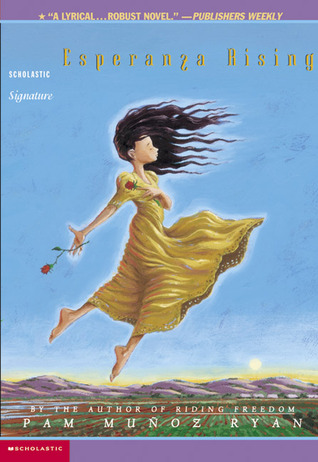
Book Review and Music Pairings: Esperanza Rising, by Pam Munoz Ryan

_206890SchEsperanza_0.tifThe story of Esperanza Ortega is a backwards Cinderella. Esperanza Ortega lives at a ranch called El Rancho de Las Rosas (The Ranch of the Roses) with her mother, father, and grandmother. Esperanza’s papa owns it until one day before her 13th birthday, Esperanza’s life is shattered when Alfonso and Miguel, servants of Papa, ride home in the wagon with Papa lying under a blanket in the back, dead

The most devastating part of this entire ordeal is that Papa died the night before little Esperanza’s birthday. Tio Louis and Tio Marco, Esperanza’s uncles, come to “grieve” for Papa. Tio Louis hints to Mama that Papa left the ranch to her , but it is not customary to leave a woman in charge of a household. He makes a proposal…of marriage! Mama is shocked and offended. She says no, of course! Tio Louis says that Mama will regret her decision. That night Esperanza is woken by Mama telling her the house on fire.

They finally agree to leave Mexico. It will be the best thing for them. It will be very tough on Esperanza who has never done an ounce of hard work in her life. They devise a plan to hoax Tio Louis. They follow the plan and leave for California. It is hotter, and the living conditions are worse. Esperanza goes through some more ups and downs in California just like her zig-zag blanket that her grandmother is teaching her how to make. At this point in the story, I had thought of the song, “Don’t Stop Believin'” by Journey. It shows that Esperanza needs hope. An interesting coincidence is that ‘Esperanza’ in Spanish means ‘hope’. The reason it reminded me of the song is Esperanza’s life is being torn apart. The line, “Hold on to that feeling,” reminded me that Esperanza needs to keep the feeling of love and the memory of Papa. But, by the end, unlike a backwards Cinderella, she feels rich at the end because she has her family, a roof over her head, and is surrounded by the people who love her.

At the end of the book, if the story were made into a movie, the song “We Didn’t Start the Fire” by Billy Joel should be played. At the beginning of the song, it describes the setting of the story: the Mexican Revolution. Then, as the song continues, more events happen just like Esperanza’s tragic life. But the biggest similarity between the two is the chorus. It says “We didn’t start the fire. It was always burning as the world’s been turning.” which relates that Tio Louis and Tio Marco set the fire in Esperanza’s house and through the rest of the story, there was always a fire burning in Esperanza’s heart where Papa used to be.

I would definitely rate this book a 10 out of 10 for its symbolism and its great literary quality. Esperanza Ortega was a real person, making this book based on an actual event. Esperanza was the author’s grandmother, and she told Pam a little bit of her life story. The rest Pam had to make up based on her grandmother’s personality. This book is also similar to Chinese Cinderella in the sense that they were both called Cinderellas by bullies.

Maya Salem, 6th grade

Book Review and Music Pairings: Chinese Cinderella, by Adeline Yen Mah

chinese_cinderellaThis was the most devastating book I have ever read!  This is the story about the torturous life of a little Chinese girl.  When she was born, her mother had a serious fever and died.  From then on, she was treated as the ‘bad luck child’.  Things got worse when she was four years old.  Her father remarried, and her step-mother was cruel, barely even noticing her.

Time passed until her first week of kindergarten where she was honored to be the ‘best student of the week.’  She got this award week after week, month after month.  Nobody congratulated her except for her kind aunt.  She and her aunt bonded and was the closest person to her.  Her aunt comforted her when nobody cared about her.  Then we learn the little girl’s name was Adeline.  Her father was very rich, but little Adeline shared only a tiny room with her aunt.  Unexpectedly, four of her siblings and her parents went on a trip.  It lasted almost a year!  When they were gone, it was paradise to be free of their strictness.  However, when they returned, Adeline learned that she and her family were moving to Shanghai.  Adeline was devastated.

In Shanghai, she attended a fantastic school and made a friend.  This became her new home where she felt  most comfortable.  However, her step-mother prevented any friends from coming over. Adeline’s home life was horrible because she lived on the third floor of the house in one room with all of her siblings.  The second floor was just for her new mom and father and their step children who received all of the attention.  No one from the third floor was allowed to enter the second floor.  During this part of the book, Adeline truly felt abandoned.  This reminded me of the song “Ring of Fire” by Johnny Cash.  It is as if Adeline had fallen into that ring of fire.

As depressing as Adeline’s life was, there is a bright spot in which she felt she could accomplish anything and escape her past.  The author does a great job engaging the reader.  If this book was turned into a film, during the credits the song “Cold as Ice” by Foreigner should be played.  It really depicts Adeline’s interactions with her cruel step-mother, Niang.  I really liked this book but was frightened to know that this is a true story.  The author, Adeline Yen Mah, lived this life and survived.

-Maya S., 6th grade

Audiobooks: A Different Way of Reading

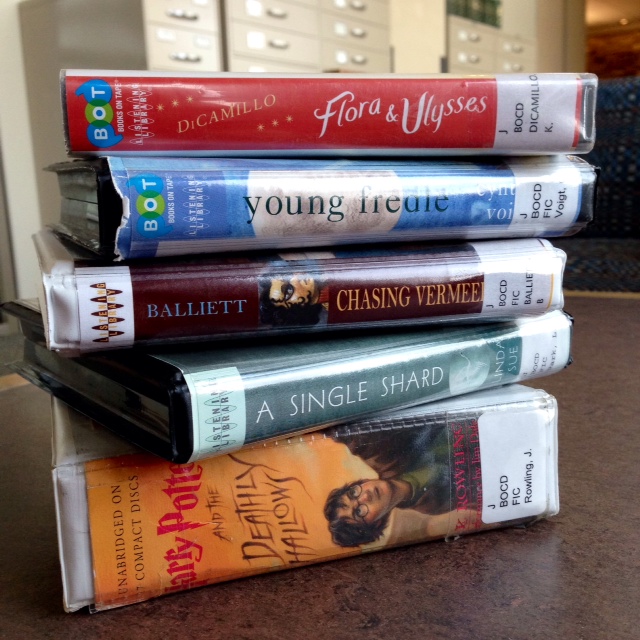
audiobooksIf you are like most kids and teens, you may think that audiobooks are for adults.  Perhaps they are learning another language or getting some information on a new subject.  Or maybe they are looking for a book to distract themselves from a long road trip.  However, in my family, audio books are an everyday treat.

It is really interesting to learn how audiobook recordings  are made.  First, the reader auditions for the voice(s).  Sometimes there is one reader doing all of the voices, and in other cases, there are separate readers for different characters or voices.  Once a reader is chosen, he or she records several takes of a few chapters at a time.  If there are sound effects, then the company will sometimes hire a semi-professional sound effects person from the movie business to make the sounds.  If a door is slamming, then the sound could be made from celery slapping against leather!  The last step is to add music.  The music can come from any music group.  (Music is typically heard at the beginning and end of the audio tapes.)  It can cost anywhere from $1,000 (for a small children’s book) up to $10,000 (for a larger book) to make an audio book.

I’ve been told that I’ve been listening to books on tape since I was strapped into a car-seat.  Some of my earliest memories of audiobooks include  “Junie B. Jones”; “The Magic Tree House”; “Skippy-jon Jones”; “The Mouse and the Motorcycle”; and “Ramona.”  Later we graduated to books like “Peter Pan”; “Poppy”; “The Doll House”; and “Harry Potter.”  One of my favorite voice actors is Jim Dale, the man who has recorded all seven books in the Harry Potter series.  In fact, he created and recorded 146 different character voices for one book, “Harry Potter and the Deathly Hallows.”  His British accent is amazing as well as his other unique voices.

In my opinion, the best strategy when concentrating on an audiobook is to stare off into space without taking anything in except hearing the words from the book.  If you like the actual feel of a book, you can read along with the CD.  However, if you’re a fast reader, you may find yourself accidently reading ahead if the audiobook narrator isn’t going quickly enough.

The best part of an audiobook is you can read your book on the go!  You can just insert the disk into the car and listen.  Or at home, while you are getting ready for bed, you can put the CD into a CD player and listen to your book as you are brushing your teeth.  If that’s not convenient,  you can go on eBooks or Kindle read (on an electronic device) and download the book and listen with ear buds.  If you haven’t experienced this way of reading, try it out and comment below.  If you are also an audiobook enthusiast, tell me your favorite book on tape, voice actor, and where you enjoy listening.

-Maya S., 6th grade

Book Review: The Giver, by Lois Lowry

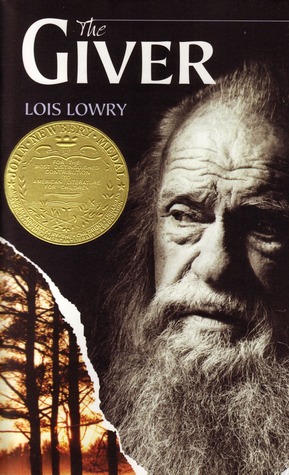
giver_coverLois Lowry does a great job of completely engaging the reader in this story.  The meaning of the “precision of language,” the odd recalled memories, and the speaker telling everyone what to do is quite odd at the beginning of the story.  Jonas, an eleven year old boy, is living in a futuristic town and is feeling… apprehensive, as he would call it… for the Ceremony of Twelve.  For each year as the people in his Community grow up one year, there is a ceremony where something happens to them.  At eight years old, you get a jacket with pockets signifying maturity to hold onto your own things.  At nine, you get a bicycle with your name on it.  (Bicycles are the only transportation within the Community.)  At Twelve, you get assigned your job; that is what Jonas is apprehensive about.

The ceremony goes more quickly than he thought and when each twelve year old boy or girl is assigned his or her role, the community elders skip over him.  Only at the end they announce his assignment.  He is assigned something very special… to work with The Giver.  Jonas learns that not only will he have his lifetime job to be with The Giver and replace his job, but also experience the pain of the memories transmitted to him.  Two big themes I found important in this story were love and conformity, which always remind me of the song “All you need is Love” by the Beatles.  This conveys the message being told in the story—all you really need is love and a bond between you and someone else.

When I finished this book, I was not completely satisfied, but very moved.  I felt that this is not how our future should look.  The conflict between Jonas’s knowledge and the transmitted memories was very interesting.  I would recommend this book to any middle and high schoolers who have some time on their hands to really get the gist of the book.  Have fun!

Maya S., 6th grade

6th Grade

Book Review and Playlist: This Book is Not Good For You by Pseudonymous Bosch

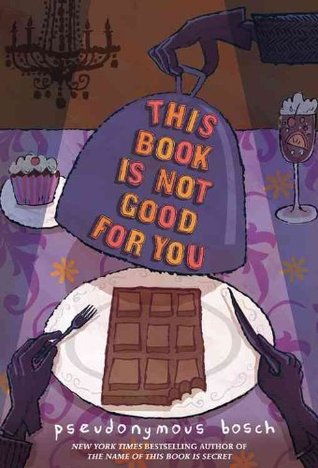
this_book_not_good_for_youWhenever you are reading a book, do you think of a song that represents the mood?  Then later, when you hear that song, does it evoke memories from that segment of the story?  I’d like to hear your thoughts in the comments below!

As the third book of this secretive series begins, the narrator puts a twist of his own likings in the book about chocolate tasting.  The three heroes, Max-Ernest, Cassandra (Cass for short), and YoYoji, wander into a zoo suspected to be run by the Midnight Sun and meet a master chocolate chef who was really working for the Midnight Sun.  Then they escape with an unusual person with them, Cass’s mother.  (She had been captured by the Midnight Sun earlier in the story.)  Like all of the others in this series, this book was fantastic.

One part of the story was significant  to me.  That part was when Cass, Max-Ernest and YoYoji freed the orphans from the Midnight Sun.  Then a song popped up in my head… Born Free!  This song perfectly sets the mood as the children run everywhere in the movie.  I would summarize this book as a tasteful adventure, literally!  This book was about tasting and the sense of the mouth, and it was an adventure, not to mention a great adventure between three heroine/heroes, Max-Ernest, YoYoji, and Cass.

At the end of the 10 out of 10 movie, I picture the song “Doesn’t Anybody Stay Together Anymore” by Phil Collins.  I envision the credits rolling by with that last scene of Cass and her Mother hugging yet Cass’s friends are in the distance.

See my reviews of the first two books in this series here and here, and don’t forget to comment and share the music you hear below!

-Maya S., 6th grade

6th Grade