
Book Review: Monster, by Walter Dean Myers

monster_coverThis book review is part of series of reviews written by students at St. Margaret’s Episcopal School for their 7th grade English classes.

Never in my life have I experienced what it is like in prison and in a court session. Walter Dean Myers made me feel like I saw everything that happened from spending nights in a prison cell to being accused of murder. The story takes place in a courtroom in the city of Harlem, New York, when Steve Harmon has been accused of murdering 55-year-old Alguinaldo Nesbitt and robbing his drug store. This book was written in the form of a film script along with some parts written as a journal entry of Steve’s life in prison.

Steve and his journal entrees are the main reason why I really enjoyed this book. These entrees take you inside the prison cells and show you what’s really behind those iron doors. “Two guys said they did [share a moment of prayer], and I was just about ready to say I would when Lynch, a guy who is going on trial for killing his wife, started cursing at the preacher and saying that everybody wanted to talk to him and act like they were good when they were all just criminals” (61). It’s moments like these are what made me want to continue reading this book.

James King is another character that you will come across in this book. King is the typical gang member who, in this book, planned the robbery and murdered the drug store clerk, Mr. Nesbitt. King is the one who encourages Steve that he should join in on this stick up which points out on of the major themes in this book, peer pressure.

Peer pressure is one of the three major themes of this book. Osvaldo Cruz, a young 14-year-old gang member of the Diablos, joins in on this felony all because of Richard “Bobo” Evans, the character who planned this robbery, who threatened and encouraged Osvaldo to tag along. Osvaldo then says that he only joined because he was scared of Bobo, but that did nothing.

Another theme in this book is the idea of what young black men in Harlem, New York are like. In the book it shows that Steve has these flashbacks that wanted to put in his movie, after all it is written in a film script format. In the many flash backs it shows what Steve has grown up with, from gang threats to experiences of what a ghetto town is like filled with poverty, fights and much more.

Introspection is the next theme. Throughout Steve’s journal entrees he really thinks about who he is at the moment, who he has become and who he truly is as well as what has and hasn’t done. “That is why I take the films of myself. I want to know who I am. I want to know the road to panic that I took. I want to look at myself a thousand times to look for one true image” (281). At the end of the book Steve’s question still hasn’t been answered.

The thing about this trial is that Steve knows that he isn’t guilty yet everyone thinks he is guilty. It seems as if the jury only thought he was guilty in a racist way; because of his skin color. The jury thinks that just because he is a young African-American boy he is more likely to have been apart of the crime. They say that everyone is innocent until proven guilty but in the eyes of the jury, it seems as if Steve is guilt until proven innocent.

The setting of the book is in the state of New York and the country of the United States where everyone is treated with equal rights. In a country like this, Steve should definitely be innocent until proven guilty. If you want to know what the jury has decided and what happens to Steve and King in Monster, you’re going to have to read the book for yourself.

-Justin M., 7th grade
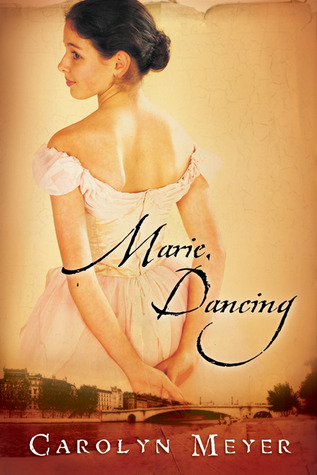
 

Book Review: Marie Dancing, by Carolyn Meyer

marie_dancing_coverThis book review is part of series of reviews written by students at St. Margaret’s Episcopal School for their 7th grade English classes.

“Dancing was truly the only thing that mattered” (27).  Marie strives every day to accomplish her dream of performing at the Paris Opera House and floating across the dance floor. She is a beautiful and talented dancer and there is only one thing standing in the way of her dream: poverty. Marie Dancing is a exciting and interesting novel. The author, Carolyn Meyer, tells a wonderful story about a young dancer named Marie Van Goethem and her hardships growing up in Paris while carrying her family on her back. She weaves a captivating tale while staying true to the historical background and incorporating the famous painter, Edgar Degas. Carolyn Meyer has written many successful historical novels for young readers. She lives with her husband is Albuquerque, New Mexico and continues to publish best sellers.

Marie Van Goethem is a kind hearted teenager who puts everyone before herself. I love the way the author describes her hardships and every day her will to survive. Marie wakes up every day in a small rusted bed next to her other siblings. She is up at the crack of dawn starving her stomach hungry and not fed for several days. She walks by herself to her only joy in life: dance. All day she works hard, her dreams high and pointe shoes ratted. Despite her aching feet and limbs, she is determined to going. She gets home at dark to an unhappy family filled with sadness and despair. Her mother takes Marie’s hard earned money and spends it on liquor to soothe her sorrows. With all that is going on, Marie must take care of her younger sister, Charlotte, and provide for her what she needs. On her father’s death bed he asked her “You- my good, sweet dearest Marie I’m asking you to hold the family together” (25). Trying to live up to the promise she made to her father, Marie feels obligated to put her family’s needs before her own.

One day, Marie is at dance class gliding across the smooth floor when Monsieur Degas sees Marie and asks for her to model for him. This changes Marie’s luck. Perhaps she does finally have a chance as a prima ballerina. If she chooses to model for Degas, everything could change when Marie.  The money she would earn would allow her to follow her dreams and break free from her family. Marie finally agrees to model for Monsieur Degas, and he promises to make her ùne étoile- a star.

Marie over comes many challenges in the book; hunger, sadness, and many losses plague her day to day life. The book is a great read, but I feel that the author does not express Marie’s emotion very clearly. However, I fully recommended reading this book. In the book Marie Dancing I love how the author told some of the story in French. Therefore, reading this book actually ended up helping me learn some new vocabulary in French! I also really enjoyed how Carolyn Meyer used details of the scenery. I felt as if I were actually in Paris!

I fully recommend reading this book. The author captures all the fascinating elements of dance and the will to survive. This book is a heart warming book that had me wondering what was going to happen next. I plan to start reading more of Carolyn Meyer’s books over the summer.

-Grace L., 7th grade

Book Review: The Devil Wears Prada, by Laura Weisberger

devil_wears_pradaHow would you feel if you got the job that a million girls would kill for, but you have a rude boss expecting you to fail? What would you do in the situation? At first Andrea Sachs was strong, but will these fashionable, uptight people get to her? In 2003 Lauren Weisberger wrote her first book, The Devil Wears Prada. The story became a best seller and a movie was made about the book. This book was about her own life experience with Vogue editor-in-chief Anna Wintour.

This story takes place in New York City, at a fashion magazine called Runway Magazine where Andrea works. Andrea Sachs is a hardworking girl who’s willing to do whatever it takes for her job. Andrea isn’t the most fashionable person and right when she steps foot in the office people start judging her. The boss Miranda Priestly judges her too, but she decides to give her a chance and hire Andrea as her new assistant. “The caller ID confirmed my worst fear: it was Her. Miranda Priestly. My boss” (9). Miranda gives her a very hard time, but Andrea keeps working hard to get what she came here for. Andrea starts acting different to her friends and boyfriend. Then she changes her whole look and personality. Now she’s just like everyone else in the office; rude, uptight, and stuck up. Will she lose those closest to her? Or will she have to quit her job?

This story is full of conflicts. The main conflict is that her boss always judges her and tries to make her fail. She tries to make her fail by giving her difficult tasks to do and making fun of her clothes. Also, she changes herself from her new clothes to her new ego. Her friends hate this new Andrea. Her boyfriend and her friends start slipping away, so now all she has is her job. “Yes, the hours are long and the work is tough, but it’s incredibly glamorous and a million girls would die to do it” (25). Will Andrea give up and quite her job to win her friends back?

There are three main themes in this book. First is independence because she is very indecent and tries to stay that way but her surrounds change that. Second is stressed and anger because Miranda is always on her case about everything. Andrea just feels stressed and angry about her job and her boss. She tries to ignore that and just work hard to get everything done. Lastly I choose feeling out of place because Andrea is like the rest of the girls in the office. She isn’t tall and skinny and she doesn’t wear designer clothes. Andrea feels awkward and weird when everyone gives her mean looks. So Andrea feels very out of place whenever she’s around these people.

In conclusion this book was very good. At first it was a little slow, but after that it’s very good. I suggest this to all girls in their teens. It’s a book about independence, perseverance, and fashion. This is a great book for girls who want to work for the fashion industry. This is good for girls to read, because it shows them that they have to work very hard to get what they want in life. Lastly they have to be willing to do whatever it takes.

-Gwen H., 7th grade


Book Review: Hotel for Dogs, by Lois Duncan

0-545-10792-XThis book review is part of series of reviews written by students at St. Margaret’s Episcopal School for their 7th grade English classes.

Hotel for Dogs is a heartwarming novel portraying a girl and her selfless devotion for saving helpless dogs. It displays how this commitment withstands even through separation from her beloved dog, and in turn inspires the other main characters to aid in protecting other helpless dogs. Written by Lois Duncan, author of several books for kids, this novel is a lively tale packed with action, sorrow, determination, and kindness.

 Hotel for Dogs is a phenomenal novel that had me captivated from the beginning to the end. Author Lois Duncan truly captures the themes of uncertainty, determination, kindness, and dedication through the eyes of a ten-year-old girl. Lois Duncan weaves the character’s personalities such that one feels as if they have known that person their entire life. Overall, I found it to be a very motivating tale.

When ten-year-old Andrea (Andi) Walker is forced to leave her dog, Bebe, due to her father’s recent job placement, she is heartbroken. Not only does she succumb to losing her beloved pet, she has to deal with starting a new life in this small New Jersey town. One day, when she is upset about being unable to help a stray dog, she later finds herself convincing her older brother, Bruce, to help her find shelter for that dog, who surprises them with a litter of three puppies. Bruce, keeping true to his word, soon finds shelter in an overgrown, shabby house down the street, “The whole backyard was overgrown with knee-high grass and brambles and vines gone wild from neglect” (44).

However, these kids are faced with the constant threat of keeping their secluded “dog hotel” a secret. They also must deal with Jerry Gordon, an unpleasant neighbor who is a constant threat. With help of their new-found friends Debbie and Tim, they somehow manage to provide shelter to these and other helpless dogs, and are able to get even with Jerry. The next hurdle is keeping their parents from finding out about their mini-hotel. This is nearly impossible especially after they decide to purchase that house, “Oh, Mom, no- we don’t want that house” (159). In order to find out how they ease out of this sticky situation, I strongly encourage reading the book!

I would strongly recommend this novel to readers of all ages. I would definitely rate it a five out of five. Personally, I feel that the author was able to successfully portray the characters through her vivid descriptions, and was able to effectively grasp the reader’s attention. It was a light, cheerful, and happy book. Overall, I truly enjoyed reading this story.

-Tarika G., 7th grade

Book Review: Vanishing Act, by John Feinstein

This book review is part of series of reviews written by students at St. Margaret’s Episcopal School for their 7th grade English classes.

vanishing_act_coverI would have never thought that one of the top seeds in the U.S. Open of tennis would be kidnapped just minutes before her first round match, but in the book Vanishing Act, the unheard of scenario became a reality. Nadia Symanova was kidnapped before her first round match, and kid sleuth’s Stevie Thomas and Susan Carol Anderson are up for the mystery.

The perspective of Stevie was interesting because his thoughts and feelings came to life. Stevie is a youth journalist who attends popular sports events such as the final four which was his last stop. He is a social boy who is a knowledgeable sports fanatic. He mostly enjoys golf, and can never stay away from his IM account, which he mostly uses to talk to his crush, Susan Carol. “He needed a shower, but as usual, he checked his IM first” (8).

Susan Carol, Stevie’s partner in crime, is a kind and energetic youth journalist, as is Stevie, who is very passionate about sports. Her uncle Brendan Gibson is an agent of one of the rising stars in tennis Evelyn Rubin, but is Brendan working with other tennis players behind Evelyn’s back… You will just have to pick up the book and see.Bobby Kelleher, Stevie and Susan Carol’s journalist friend from their last stop at the Final Four is at the tournament. Bobby gets into all of the players lounges and locker rooms, and that might be very helpful after the crime.

I believe that “the sky is the limit” is the major theme of this book because, Stevie and Susan Carol are both 13 and they are nationally identified as two of the greatest youth sports journalists in America. They worked hard on something they enjoyed and it led them to fame.

Even though this book was a fictitious sports mystery I believe there was a moral. The moral being if you want to do or finish something, put your mind to it and make the dream a reality.

Even for those who do not enjoy tennis, this book is a mysterious nail biter. It isn’t a book you can put down without finishing it.

John Feinstein is a sports writer and commentator and has written many fictitious sports mysteries. He incorporates some of the books he has written in the Vanishing Act, which is an unusual writing tactic.

I give this book 5 stars, there were no flaws and everything in my opinion was perfectly explained throughout the book. The resolution really surprised me, and If I were you I would pick up this book right now, find a comfortable chair, and dig into this unbelievable book!

-Peter G., 7th grade

Book Review: How to Build a House by Dana Reinhardt

house_reinhardt_coverThis book review is first in a series of reviews written by students at St. Margaret’s Episcopal School for their 7th grade English classes. We’re pleased to showcase these reviews on the Mission Viejo Library Teen Voice.

Have you ever wanted to run away from reality? Dana Reinhardt took me on an inspiring adventure with one of her five books, and a 2012 Abraham Lincoln Book Award nominee How to Build a House. This novel was written in the perspective of a teenage girl, Harper. Harper is sadly familiar with the term loss; her mother had died, and her beloved step mom had left, along with her two step sisters. She faces many struggles and heartache, yet she finds ways to get back to life past her losses.

Harper was only two years old when her mother passed away. I guess you could say she had been hiding behind her dad until the day he introduced her to his “special” friend. Harper came out of hiding. Along with Jane, her to-be step mother, came two daughters, Tess and Rose. They would become Harper’s sisters. Harper thought nothing could ever be better. When Harper was 17, she came home from school on one ordinary day and received the news from her dad that Jane and her daughters were gone.

Everything had come to sudden stop. There were no more family dinners. No more family movie nights or coming home to homemade cookies. No more slumber parties with her sisters. No more talking to her sisters at school.  Anything with the word family in it made Harper’s heart jerk. But most importantly the thought of there being no more Jane, Rose or Tess was what hurt her the most. What had she done to deserve this?  Harper had to get away. Someway, somehow just as long as she got away from this feeling of ultimate betrayal.

Then there was a charity trip she read about in the newspaper. Recently there had been a tragic tornado in Tennessee, leaving most of the homes ruined. The Homes from the Heart Program for Teens was an organization designed to rebuild houses for families who had lost their own. At first it did not sound appealing to Harper but she thought of the main reason she was doing it… to get away.

“We’re landing now.  Dusty brown has morphed into lush green” (8).  Harper had settled in, met her roommate, and the next morning they began to build. The summer friendships began to form. Harper met Teddy Write, the oldest son of the family they were building the house for. They told each other everything and he welcomed Harper into their family’s temporary home like she was part of it. This made Harper realize what she had lost. This family had lost so much more, but they still had the one thing Harper did not have, a family. Her body began aching “… Not for what they don’t have, [but] I ache for what they do have.”

Harper arrived home from that summer trip learning something no one could have taught her but herself. Dana Reinhardt captured me with this intriguing novel about a teenage girl overcoming one of the hardest things anyone could go through. What is the valuable lesson that Harper taught herself? You must read the book to find out. One of the truest and most heartfelt books I have read in a long time.

-Amelia E., 7th grade