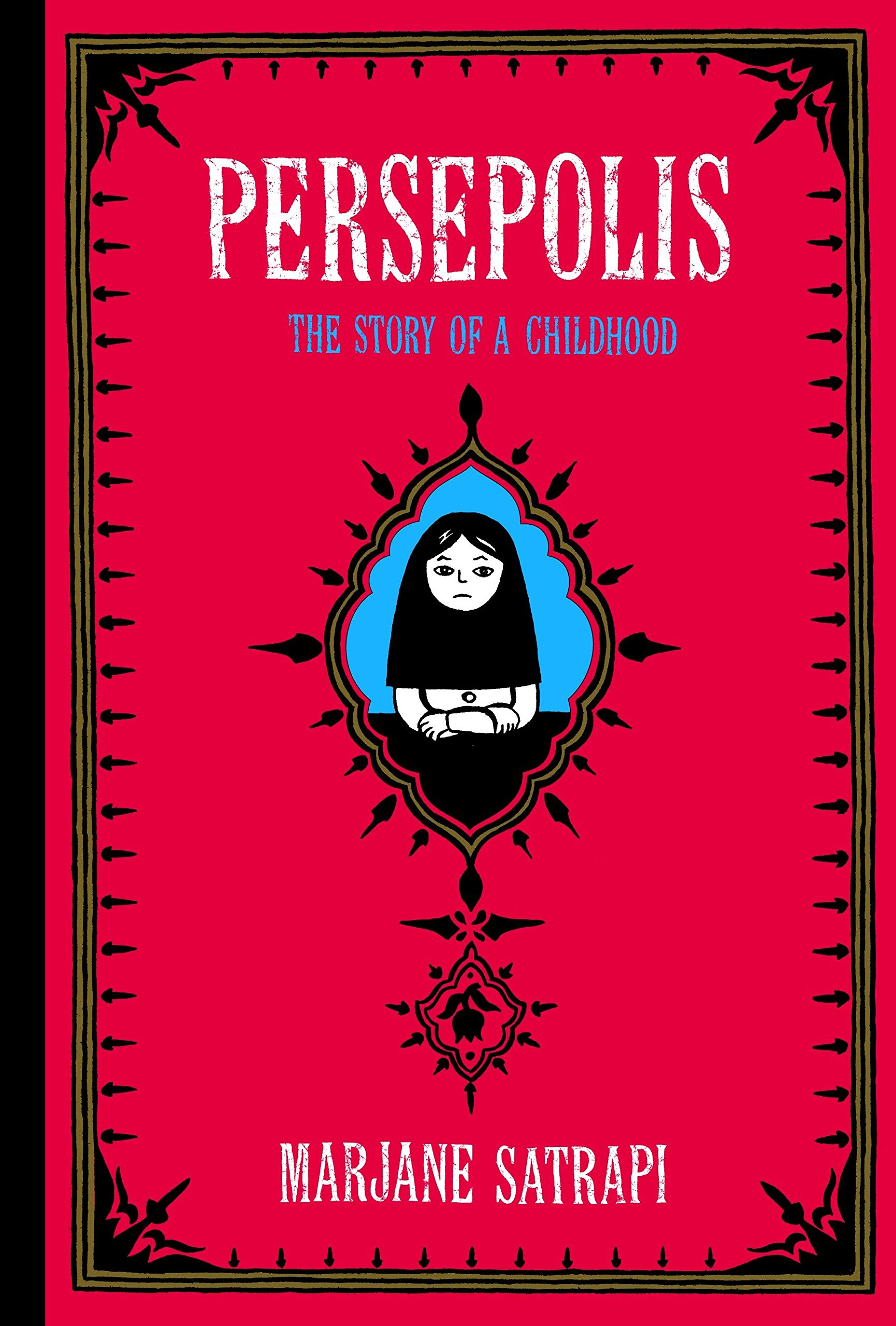
Disclaimer: There are two versions of Persepolis: the graphic memoir version and the literary memoir. The graphic memoir version is divided into two parts. I have only read the first graphic memoir book of Persepolis, not the actual memoir. Therefore, there’s still some of Satrapi’s writing that I haven’t been exposed to (yet). I will definitely try to find the second graphic memoir or the actual memoir soon, but for now, this review is based solely on the first graphic memoir.
Persepolis is both a graphic memoir and autobiography published in 2000. With the memoir originally written in French, Satrapi has received numerous awards for her work including the Cannes Jury Prize and the César Award for Best Writing.
The narration is written through the eyes of the main character—Marjane “Marji” Satrapi, the author herself—during her childhood at the time of the Iranian Revolution. A series of small stories are written in the memoir based on her own experiences, portraying political upheaval and how her own family was affected by the Iranian Revolution, Iraq’s oppressive regime, and the Iran-Iraq War. Marji’s accounts mainly focus on her and her family who live in Tehran, as well as how they attempt to rebel against the regime and take part in Iranian history.
As a daughter of immigrant parents but of non-Middle Eastern descent, I felt like I could connect with aspects of this memoir all while still learning more about Iran’s history. The memoir is a beautiful representation of Islamic and Iranian culture from the first-hand perspective of an Iranian citizen. The illustrations themselves are unique and drawn to perfectly fit the memoir, making Satrapi’s experiences seem more significant.
Although it’s a graphic memoir, I highly recommend Persepolis to high schoolers more than elementary or even middle schoolers. Some topics and drawings can be graphic, making the memoir a difficult read, and there are often parts that simply cannot be taken lightly. However, the book itself is unique at being able to broaden readers’ perspectives on other cultures as a memoir, historical account, and comic book all at once.
– Natisha P.
Persepolis by Marjane Satrapi is available for checkout from the Mission Viejo Library.
All Quiet on the Western Front, written by Erich Maria Remarque, is regarded to be the finest war novel ever written.
It starts (and ends) on Germany’s frontlines amid World War I. In this, context and atmosphere are revealed through description (at times quite graphic). However, since the story is told in first person, the most significant soldier is Paul Baumer – a young German who offers his services to his country and the Kaiser. Though most authors choose a main character to narrate their experiences to demonstrate war’s horrors, Remarque does notably well in its execution. This is likely due to the fact that his stories have a touch of personal truth – he was a reluctant participant in both wars, and had to face the cruelties and destruction head on. Thus, the terrors he witnessed (though vile), give new life and unexpected curiosity to his work. To put it simply: to get the full message, every page must be read twice.
Now, to the plot: it’s fairly simple. Paul and his friends have entered a war in which, without regard to survival, they have been physically and mentally scared beyond recovery. In other words, they can no longer return to innocence and the foolish years they spent as children – they’ve grown old faster in a three to four year span than for most. As such, Remarque is able to illustrate and weave themes still relevant to our time. For one, war’s terrible brutalities. As most novels tend to romanticize war and demonstrate honor and adventure, All Quiet does quite the opposite. To explain, the scenes that aren’t dedicated to hunger and filth depict even harsher conditions – corpses, lice infestation, mice, loss, and so on. Therefore, a more realistic ‘picture’ is represented, which clarifies to readers that war is indeed, not a matter to trifle with.
Moreover, the message above ties in with yet another lesson: its effect on soldiers. For instance, Remarque illustrates (I won’t spoil though!) war’s overall impact as “ruinous” and “severe.” In turn, his characters (such as Paul) must face emotion suppression and disconnection from reality in order to last the battles. To be entirely aware, Paul claims, would be impossible – there’d be too much to bear and fight through on a physiologic degree.
In short, All Quiet on the Western Front is, at most, a must read.
-Emilia D.
All Quiet on the Western Front by Erich Maria Remarque is available for checkout from the Mission Viejo Library.
The collection of books I have read because I needed to for English has definitely been different in some ways and similar in other ways. They are seen having connections to each other and reflecting upon the same ideology yet are seen to have their own individual themes and connections. First, I will be describing why or why not this book was interesting to me. Then, I will describe the symbolic sentiment behind the book and will elaborate on whether it is useful for me. Then, I will describe whether someone should read the book in total based on these categories and elaborate why I believed reading this book is worth it or a waste of time.
Slouching Towards Bethlehem by Joan Didion: I am going to be starting with this book first because it is the only nonfiction book I was required to read this year. Based on interest level, it was extremely boring in my opinion. The first chapter was very interesting because it spoke about how a wife was on trial for killing her husband and how it was a huge thing in the news but after that chapter, it became very hard to read without the looming threat of sleep within my proximity. However, the content in the book does make up for how boring it was. The book is a series of essays divided into three sections: Life Styles in the Golden Land, Personals, and Seven Places on the Mind. Each of these sections were informative in their own way. The first section described multiple things occurring in California, including events occurring in her own life. The second section talked more about how humans affect others and why we do what we do. The third section talks more about her and other people’s lives and how they struggle. So, as a book required to read for school, I believe that reading it is worth it as it is very enlightening and definitely allows us to reflect on our actions. If you were to read this book for the purpose of entertainment, you should have stopped right after the first chapter and move onto another book.
Slouching Towards Bethlehem by Joan Didion is available for checkout from the Mission Viejo Library.
The Grapes of Wrath by John Steinbeck: My teacher went more in depth in this book when we were discussing it in class, which could be why I have the opinion I do. But altogether, I love this book so much. The beginning was very boring to me but as soon as I reached more the time where the family begins their journey to California, I couldn’t wait to read what would happen next. This book basically describes a family in the era of the Great Depression and the Dust Bowl and how they must venture to California from their dear home in Oklahoma because they cannot make any money where they are. Not only did this book capture my attention but it also opened my eyes to the lives of people who I don’t relate to and who struggle so much to survive in our world. This book describes the greed of those who benefit from the desperation of these struggling families, otherwise known as large corporations. It shows how people could become families with anyone if they help each other through their heartbreaks and painful endeavors. And most importantly, it shows that people together in their anger could make a difference, like bundle of grapes filled with wrath. I would recommend anyone to read this if they can and think this book should be discussed more among people.
The Grapes of Wrath by John Steinbeck is available for checkout from the Mission Viejo Library. It is also available to download for free from Libby.
The Great Gatsby by F. Scott Fitzgerald: This is probably the book that most people know about and have read in high school. I have known about this book since I was 8 but never really knew what it was about until this year. Basically, it is about a man named Gatsby who is neighbors with a guy named Nick Carraway and wants to be loved by Nick’s cousin named Daisy Buchanan (yes, she is married). The plot of this book interested me but the characters ruined it for me. They basically had no personality whatsoever besides being rich and wanting to be loved but finding it in the wrong ways. Tom Buchanan is one of the few characters I believe is unredeemable when it comes to fixing and saying that is definitely extreme but it is true. This book has so many undertones of misogyny from the epigraph of the book: “Then wear the gold hat, if that will move her; If you can bounce high, bounce for her too, Till she cry ‘Lover, gold-hatted, high-bouncing lover, I must have you!'” Of course, we shouldn’t judge a book based on this since it came from another time and era but I believe teachers should definitely and directly tell their students about the more obscured sexism in the book so the students don’t adopt it as a normalcy in our society. There are many symbols and one could definitely make connections on the longing of being better and richer than someone else and competing with time before what you want is gone forever. But personally, I believe that this book doesn’t deserve all of the hype that it gets. It was a waste of time in my opinion and it could be part of the high school curriculum since it does talk a lot about class differences and how the rich use people who are poorer than they are. But I wouldn’t recommend reading until it is required for school.
The Great Gatsby by F. Scott Fitzgerald is available for checkout from the Mission Viejo Library. It is also available to download for free from Libby.
The Scarlet Letter by Nathaniel Hawthorne: This book differs from the ones I have talked about before because it is more outdated and more seen as a classic. Despite this, I really liked the book. This book is about a woman named Hester forced to wear an “A” on her chest because she has committed adultery with someone she doesn’t wish to confess and gave birth to a child as a result. It is set in a Puritan town where couples are to stay together until they die and even then, they must remain a widow and not try to be in a romantic relationship with anyone else as that would be a betrayal to their dead, former spouse. The author, Hawthorne, wishes to exploit the wrongdoings in Puritan society at the time and how they are seen as hypocrites, essentially, when it comes to someone who sins. This book definitely has some more older terms of symbolism shown through transcendentalist and romantic ideology but I found the plot of this book very interesting. The sentences don’t match the standard of grammar that we have today and the author does enforce his ideologies on the readers but I still enjoyed this book very much. I would recommend this book to people who like the forbidden love trope and like nature as a main symbol in a book.
The Scarlet Letter by Nathaniel Hawthorne is available for checkout from the Mission Viejo Library. It is also available to download for free from Libby.
A Streetcar Named Desire by Tennessee Williams: The people that have already read this book probably think I am going to say negative things about it and I am, definitely about Stanley Kowalski, but I would first like to highlight the entire book. This book is about a woman named Blanche DuBois who is forced to live with her sister, Stella DuBois, and her abusive husband, Stanley Kowalski, after she loses her childhood home, Bella Reive. This book starts off interesting and I liked the plot. I started to hate the characters and their doings but that means the person writing the book (or play, in this case) is so good at writing that they are evoking an emotion out of me. The characters are definitely bad and good in some ways, which I liked because it added complexity to the story and definitely connected symbols together. For example, Blanche DuBois avoids the light which stands for the truth and we all know her as a notorious liar throughout the story so it connects more. I continue and Stanley is a piece of trash and becomes the one of the other people that I find unredeemable and people who if existed in the real world, I would punch in the face. Then, the ending turns out to be very terrible. Again, one must not judge things in the past but still…I did not like the outcome of this book. I believe the ending should have taken another turn but for the book, it seems reasonable why it would be that way and still, I hate that. Despite my sayings of the book being interesting, I still wouldn’t recommend this book to anyone at all and would never read it a second time. I liked some things about it but the bad things about it outweigh the good things so I wish someone only reads this if they are forced to. However, the ending of the movie is way better and that should have been the ending of the play but alas, it wasn’t.
A Streetcar Named Desire by Tennessee Williams is available for checkout from the Mission Viejo Library.
I would like to end this article with how these opinions on these books are just that, opinions. You have every right to disagree with whatever I say, especially when it comes to A Streetcar Named Desire and The Great Gatsby. Let me know what you think about a certain book in the comments! Thanks for reading!
If you ask a group of high schoolers what they read in their English Lit. class, you’ll most likely hear very similar answers from all of them: A Tale of Two Cities, Shakespeare, The Great Gatsby, A Christmas Carol, the list goes on. For decades, most of what students read in their English classes has been the same.
While it is important to read and analyze classics such as the ones mentioned, many schools disregard representation in the chosen books for this said motive. When taking a look at the demographics of the authors that have written most of the books in the high school curriculum, you’ll find that almost all of them are men, and almost all of them are white. This results in many students’ English class experience being Euro-centric and lacking in diversity.
In my own high school career, I have only read one book written by a woman (out of 8, currently) and no books written by any POC authors. Writing is my passion, and while I hope to one day be able to use that in my career, it’s discouraging to not see a more diverse range of people representing this career path.
Not only is the diversity of authors important, but also the content that is in these books. A less diverse pool of authors means that the stories read will most likely not contain many different cultures and points of view. One of the main aspects of literature is being able to resonate with the story, and without diverse authors, many high school readers are left feeling disconnected from the lesson and unrepresented in their classroom.
Another important aspect is being introduced to new cultures. This is especially important in schools that are lacking in diversity. Being exposed to different values, religions, and ways of life in general through literature prepares teens for the world, and teaches them to be respectful toward others that have different lifestyles than they do. It helps to be knowledgeable of other beliefs besides one’s own, but this isn’t possible if English classes’ works of literature do not represent a wide variety of cultures.
We live in a world that is quickly changing, a lot for the better. English classes need to reflect this change and update curriculums so that students can learn from and resonate with what they’re reading.
Recently, the new trend is boba. Expanded past the Asian American community, boba is a new nationalized sensation. Boba is made from tapioca flour that is then cooked in a sugary syrup. The tiny black balls are then usually placed in various types of teas, slushies, or smoothies.I have grown up drinking boba and even have ratings of all the shops I have been to on my phone. I do not want to call myself obsessed, but it may be true. Nevertheless, the real question is, what is good or bad boba and where should you go?
Brown Sugar Milk
If it is either your first time at a boba shop or first time having boba, a good staple is getting the classic black milk tea with boba. If you dislike super sweet items I would advise lowering the sugar level to 75%. You usually cannot go wrong with classic black milk tea, making it a good sample to try. It is well balanced, sweet but not overpowering. Another good boba for a first timer is Thai milk tea with boba. Do not let the orange color scare you, it is simply strong black tea with various spices that is then sweetened with condensed milk. This drink is very creamy and compliments the boba pearls. If you dislike caffeine, most shops have black sugar milk. This drink is whole milk combined with a brown sugar syrup and boba. The combination is very delicious and does not contain caffeine.
Southern Orange Country is filled with many great boba shops. In the Mission Viejo area, the closest is Ding Tea. Ding Tea has a lot of the classic flavors and is pretty good for what it is. My personal favorite from there is the Wintermelon Milk Tea. If you want to stay as close to Mission Viejo as possible, Ding Tea is a great choice. Also centrally located is ShareTea in Lake Forest. Similarly to Ding Tea, ShareTea has great classics like their Thai Milk Tea. My personal favorite shop is OMOMO in Irvine. Their fruit drinks are made from fresh fruit and their boba is the softest and chewiest you can find. Any drink is a good choice there, especially the fruity drinks. The issue is that the line can be long, so be prepared. Another one of my favorites is Tastea. Also located in Irvine, Tastea has the best slushies compared to any other shop. I usually get the Lychee Freezie, which is a Lychee slush with Lychee jelly and bits combined with honey boba. Their drinks are fresh and their boba is nice and soft.
As a boba enthusiast, I hope this article encourages you to go either get boba or try it for the first time. Happy Boba-ing!
Many people know of the planets in our Solar System: Mercury, Venus, our own planet Earth, Mars, Jupiter, Saturn, Uranus, and Neptune. There are also dwarf planets, such as Pluto, Ceres, and Eris. However, there is one planet that is still hypothetical and completely based on mathematics and theory. Planet 9 is a possible 9th planet in our solar system. Hypothetically, it would be located far beyond Neptune, the reason it is currently an unconfirmed planet. If it were existent, however, Planet 9’s orbit around our Sun could take as much as 10,000 to 20,000 years, in comparison to Neptune’s 165-year orbit. However, it is important to remember that these estimates are all based purely on mathematics and theory, and nothing is currently confirmed. The theoretical planet is believed to orbit the Sun more than 10 times further from the Sun than Neptune, which orbits the Sun at a distance of 2.8 billion miles.
Far outside our main solar system, there is a strange gravitational effect on some relatively small celestial objects (like asteroids). The way they orbit the Sun suggests to some scientists that there is yet another large planet orbiting our Sun far beyond Neptune and Pluto. Still, some scientists also say that our perception of the orbits of those objects is simply caused by human error in calculating and ‘viewing’ their orbits. Until enough evidence is discovered, or the planet itself is spotted through telescopes or various other methods, we can’t really claim that it either exists or doesn’t exist. There may be some other explanation for this phenomenon, or perhaps there really is an undiscovered planet somewhere out in the furthest reaches of our solar system.
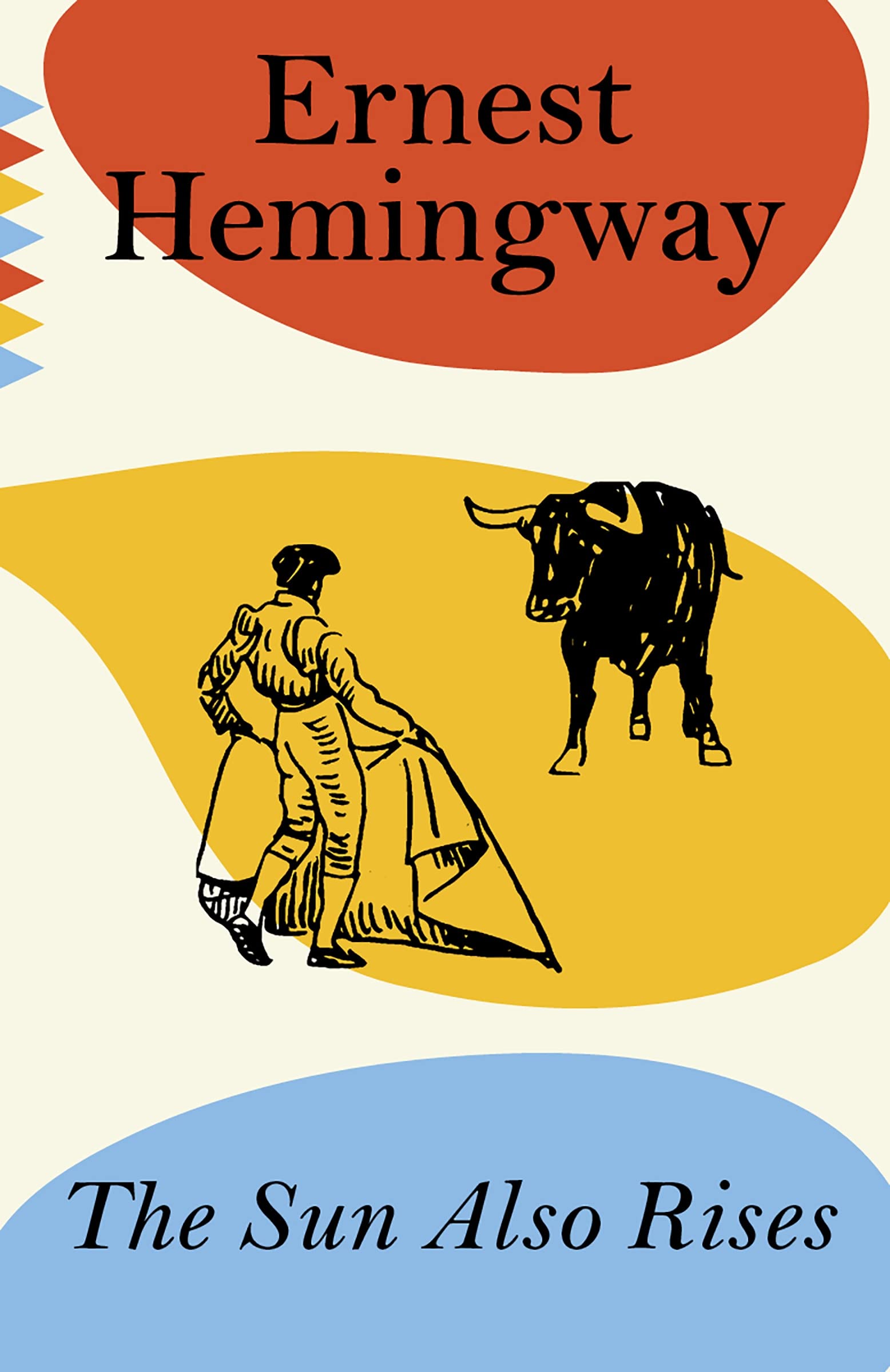
The Sun Also Rises, a novel written by Ernest Hemingway (an admired American writer and journalist), wrote this book for the “lost generation” impacted by WWI and its aftermath. As the plot is divided into three sections, I’ll split the review as per this format! Note: this book addresses mature topics that might make certain readers uncomfortable.
Book 1: Main characters Jake Barnes and Brett Ashly are introduced with injured yet carefree qualities. For one, they each played a role in WWI, both stationed on the front lines for different reasons (Barnes as a soldier and Ashley as a nurse). However, either have no qualms taking risks, as they often drink, make love, and celebrate. In turn, Hemingway demonstrates war’s unquestionable force, strong enough to arouse reckless behavior when one feels as though death is so near. In addition, while the plot is still sparse and unclear, certain love interests (which stem from various side characters) and fallouts are revealed. Their friends, despite their minor roles, are rather important in setting up tension as they compete for attention, romance, and passion. For the most part, their interactions take place in Paris, although Barnes eventually takes a trip to Spain with Brett and their colleagues to watch the famous bullfights.
Book 2: As one would expect, this part is dedicated to how characters interact and are shaped by the present culture (in this case, the Spanish customs they face upon arriving in Spain). Likewise, the main tradition Hemingway points out is bullfighting. Hence, it leads Brett to fall in love with a matador, which raises conflict between the other male characters when they fight to win back (or remain with) Brett. Thus, Hemingway illustrates friendship’s destruction at the hands of love, even when the attraction is shallow or is shaped through pressure, competition, or spite. In all, the events take place during a week-long spanish fiesta, with glamours that include dances, music, and drinks.
Book 3: In Hemingways’s last chapter, little more is accomplished; it serves to end the work. As a result, it leaves room for theme exploration and expansion. For example, a common topic revolves around morality, as Jake, Brett, and the others seem to have an empty lifestyle, and so fill their time with repetitive and menial activities, such as drinking, conversing, and dancing. In this, readers are forced not only to face the aimless goals and hostilities between the characters, but must realize that these attitudes were the norm in a time when war damaged individuals and communities both psychologically and morally.
In short, The Sun Also Rises opens our eyes to a world ravaged by violence, allowing us to appreciate life as is.
-Emilia D.
The Sun Also Rises by Ernest Hemingway is available to checkout from the Mission Viejo Library. It is also available to download for free from Libby.
Love has been a hot topic in poetry for a long time, being a common topic in poems and even used by names as big as William Shakespeare himself. T.S. Eliot, a British poet from the early 1900s, is no exception to this. In his poem, The Lovesong of J. Alfred Prufrock, the use of certain language and details throughout the stanzas of the poem helps indicate that the “You and I” mentioned at the beginning refers to Prufrock and a woman.
To start, Eliot uses the phrase “In the room the women come and go / Talking of Michelangelo” (Eliot lines 13-14 and lines 35-36) twice. The repetition of this phrase shows that women are on Prufrock’s mind, and it is something that he feels concerned over and pays attention to. Prufrock also notes that these women are talking about Michelangelo, which implies that they are talking about somebody who is very popular and prestigious: something that Prufrock is unlikely to be able to live up to. After the first time, this phrase is said in lines 13-14, Prufrock begins to talk about a yellow fog and smoke. The fact that the fog and smoke are yellow can be taken as an archetype for friendship, which may suggest that after hearing about Michelangelo, or somebody who Prufrock could never be better than, Prufrock feels that he may be seen as a friend rather than a lover, showing his loss in confidence. This same sense of lack of confidence can be seen after the second time this phrase is said in lines 35-36, where Prufrock begins to question himself about whether he should propose to this woman he is talking to, saying “‘Do I dare?’ and, ‘Do I dare?’” (Line 38). This questioning of himself represents how he feels that he may not be good enough for any woman, especially compared to the Michelangelo that these women seem to talk about. This observation followed by the loss of confidence in Prufrock implies that Prufrock refers to a woman in the phrase “you and I” through the fact that women talking about Michelangelo seems to have a genuine emotional impact on Prufrock.
Next, Prufrock acknowledges “lonely men in shirt-sleeves, leaning out of windows” (Eliot line 72). Lonely men in shirt-sleeves has a very unromantic implication to it, and this unromantic way of life seems unappealing to Prufrock. This unappeal is supported by the two lines following it, stating how Prufrock feels that he “should have been a pair of ragged claws / Scuttling across the floors of the silent seas” (Eliot lines 73-74). These lines represent how Prufrock has hit a low point in life, as the floors of the sea are some of the lowest points on Earth. Such highlights how Prufrock feels very lonely and longs for some form of a romantic relationship, as the sight of the lonely men makes him feel as if he has hit rock bottom. This continues the idea that the phrase “you and I” talks about Prufrock and a woman, as a woman is the only thing that could fill this romantic void that Prufrock is experiencing.
In addition, the image of the mermaids singing in line 126 can show how Prufrock’s dream of a romantic relationship and a change in life is killed. For most, the image of a mermaid singing has a feminine aspect to it, as mermaids are typically female figures. In the line following when mermaids are first introduced, Prufrock notes “I do not think that they will sing to me” (Eliot line 127). Such implies that women do not seem to notice the presence of Prufrock and that he is of no interest to them. This observation, similar to the women talking of Michelangelo, seems to have a negative emotional effect on Prufrock, as in the last line of the poem, Prufrock says “Till human voices wake us, and we drown” (Eliot line 133), which essentially says that Prufrock’s dream has been killed. A cause-and-effect relationship is established here, where the mermaids not singing to Prufrock leads to his dream being killed. Because of this, it can be inferred that the absence of interaction with women in his life leads to Prufrock feeling meaningless and having his dream killed, implying how the “you” mentioned at the beginning refers to a woman.
Prufrock is most likely to be referring to a woman with the use of the word “you” at the beginning of the poem due to the many hints of negative emotions caused by issues regarding women that are seen in the poem. These negative emotions could all be resolved by a drastic change in Prufrock’s life, which could include engaging in a romantic relationship or marriage with a woman.
Romeo and Juliet are madly in love after meeting for just a short time and are willing to give up many valuable things in their life to be with each other, which shows how blinding falling in love can be. The two discuss what is in a name, and agree that what “we call a rose by any other name would smell as sweet” (2:2:46-7). Romeo is a Montague, Juliet is a Capulet, and their two families have been enemies for an extensive time. If Romeo or Juliet gave up their last name, they would still be the same person, just as a rose would be just as pretty and sweet if it had a different name.
The name of an individual does not change who they are as a person. After hearing Juliet speak about her troubles and Romeo’s family name on her balcony, Romeo says, “Call me but love, and I’ll be new baptized” (2:2:54). Romeo is willing to give up his family to be with Juliet, which is surprising considering he just met her and he has been with his family for years. In addition, Romeo completely forgot about Rosaline, whom he professed his love to right up until he met Juliet. Romeo would “deny thy father and refuse thy name” (2:2:36), showing that he would abandon his whole life just to marry Juliet, which is a very bold action. Romeo’s surname not only signifies his relationship with his parents and family, but also their family’s reputation, their inheritance, and personal identities. Romeo and Juliet would both be giving up more than just a name if they decided to marry each other. This decision could affect and impact their future forever.
However, both Romeo and Juliet do not understand the significance of their names as Juliet says, “What’s Montague? It is nor hand, nor foot, nor arm, nor face, nor any other part belonging to man” (2:2:43-5). Juliet is right that a name is not identified with certain body parts and who one is as a person. However, giving up one’s surname does impact one’s future and relationship with their family, which could, in turn, end up affecting their life together.
An entertaining and humorous read, the play “A Midsummer Night’s Dream” by William Shakespeare incorporates a variety of figurative language to demonstrate a number of concepts, ideas, and opinions.
To begin with, Shakespeare skillfully develops the timeless aspect of love. In the very first scene, readers are introduced to Theseus and Hippolyta planning their wedding, as Hippolyta expresses that “Four days will quickly steep themselves in night; / Four nights will quickly dream away the time” (1.1.7-8). The story of Theseus of Hippolyta is quite unique: at first, Theseus kidnapped and beat Hippolyta in battle. By introducing these enemies-turned-lovers at the beginning of the play, Shakespeare foreshadows love issues and complexes, but also suggests a happy ending. Moments later, readers learn about Hermia and Lysander’s love, despite Hermia’s father Egeus’s desire that Hermia marry Demetrius. Hermia’s friend, Helena, is already in love with Demetrius, but as Helena explains, “The more I love, the more [Demetrius] hateth me” (1.1.204). The play is mostly centralized around the loves of Demetrius, Hermia, Helena, and Lysander. Love is universal and timeless–someone from ancient Egypt would feel the same butterflies as someone in 2050. The same applies to sadness, betrayal, and jealousy, all of which are prevalent in the play. In Demetrius, Hermia, Helena, and Lysander, readers understand the timeless complicated and uncontrollable nature of love. Cleverly, Shakespeare further expands on uncontrollability when the fairy king, Oberon, sends Puck to retrieve a flower, whose juice “[w]ill make or man or woman madly dote / Upon the next live creature that it sees” (2.1.177). For the audience, the flower challenges the uncontrollability of love. Demetrius and Lysander are both affected by a simple thing as flower juice, causing them to completely change their views, dispositions, and opinions. Upon analysis, Shakespeare’s incorporation of such a magic flower, which terribly exacerbates the love complex between the characters, represents the irrational, yet consuming aspect of love.
In addition, magic is a significant element of “A Midsummer Night’s Dream”, and it is not too different from love. Once again, the magical flower is a crucial symbol. Magic is often understood as the ability to do and control virtually arbitrary actions and events. As already discussed, love is a prime example of uncontrollability. With the magic flower, the fairy king and Puck are given greater power over the rest of the characters. They have a greater influence on the events that will ensue in the play. Magic’s influence is further exemplified by Puck, who turns Bottom’s head into a donkey’s head during rehearsal. Unluckily, Titania (who has been spelled with the magic flower) wakes up and instantly falls in love with Puck (3.1.131-164). This situation is especially significant in the theme of magic since it is a magical being herself (Titania, the Fairy Queen) who has fallen under a spell. First of all, the overtaking influence of magic is apparent; moreover, the influence of love is also portrayed. It can be argued that Shakespeare incorporates magic into the play to accentuate its likeness to love. Both magic and love cause troubles, yet they can both completely dominate a person’s actions and way of life.
Finally, the significance of the title “A Midsummer Night’s Dream” must be recognized. Dreams are random, irrational, and absolutely overtake one’s mind, very similarly to love. Moreover, dreams are repeatedly mentioned throughout the play. For example, Hippolyta expresses that “Four nights will quickly dream away the time” (1.1.8). Referring to the day of her wedding, Hippolyta uses “dreams” to describe her wait. The word “dreams” has a very positive connotation. In this manner, “dreams” recur to represent fantastic events, situations, and emotions.
Clearly, Shakespeare’s “A Midsummer Night’s Dream” well incorporates figurative language to develop a multitude of themes, lessons, and ideas.
-Ayati M.
William Shakespeare’s A Midsummer Night’s Dream is available for checkout from the Mission Viejo Library. It can also be downloaded for free from Overdrive.





 Mission Viejo Library Teen Voice