Book Review: Monster High, by Lisi Harrison

monster_high_coverFrankie Stein is not a average teenager. Aside from the fact that she’s only 15 days old and that she has bolts in her neck and a green tinge to her skin. Life does not seem hard for her,does it?
While she tries to be herself, Frankie’s parents send her off to `normie’ school (for regular, normal teenagers) to be like a normal human being. But Salem, Oregon is a monster-free zone, and Frankie soon finds other monster classmates, or RADs (Regular Attribute Disorder). There’s Lagoona Blue, Draculaura, Deuce Gorgon, D.J./Jackson Hyde, Cleo(patra) and Claudine (CLAWdeen, get it?).

Lisi Harrison’s book series is definitely aimed at the younger end of the teen market. `Monster High’ is a bit of unabashed pop-culture fun for tweens.

The monster kids rock out to Lady Gaga and the Black Eyed Peas. They have freaky fabulous wardrobes and say things like `that’s VOLTAGE!’ But if you read beyond the cool, unique stuff that they have, they have to face the fear of there group getting shown.

I really liked the character of Frankie Stein. She looks different, she loves to be her self and wants to show her greenness and she desperately wants to fit in. But she never sacrifices who she is for how other’s will see her. It’s a hard lesson she has to learn, but Frankie has a great sense of self, bolts, green skin and all! I recommend this book to about twelve and up because it is a little bit on the mature side but it is a fun book to read!

-Kate B., 7th grade

Book Review: The Hunger Games, by Suzanne Collins

hunger_games_coverIn The Hunger Games by Suzanne Collins, you learn about friendship, courage, and much more.

This whole book is about a young girl named Katniss. Her country is divided into 12 districts, and then the capital. Each year, one girl and one boy are sent to the annual Hunger Games from each district. She has to go to her country’s annual Hunger Games. The Gunger Games is an event where 24 kids are put into an arena and are forced to fight to the death.

She makes many new friends along the way, but she also makes many new enemies. She has many tragedies along the way. For example, one of her closest friends in the games gets killed. Katniss helps unite the districts slowly throughout the story.

Her story consists of betrayal, love, hate, and friendship. Her journey has many ups and downs and it ends with an unforgettable event. I would recommend this book to anyone from the ages 12 and up. I believe that even adults will enjoy this book. Although you may not like the science fiction genre, I’m sure you will enjoy this book. This book will just make you want to pick up the next one!

-Melika R., 8th grade

Book Review: Stormbreaker, by Anthony Horowitz

stormbreakerImagine what it would be like to work for a top-secret spy agency, let alone only being a teenager! This is the life of one unfortunate schoolboy, who is left orphaned at an early age. Written by Anthony Horowitz, Stormbreaker is an action-packed novel filled with adventure. Set in present-day England, a fourteen year old boy named Alex Rider is suddenly thrown into a deadly situation.

When Alex’s uncle mysteriously dies in a car accident, he is forced to take his uncle’s place as a spy in MI6, Britain’s top-secret spy organization. Little does he know that he is being tossed into a dangerous mission to spy on Herod Sayle, the mastermind behind the newest computer, Stormbreaker. Using pure instinct and his intelligence, Alex must fight for his life, as well as save the people of the Britain.

Anthony Horowitz writes Stormbreaker in a very unique way. He builds suspense in every inch of the book, is very descriptive in detail, and is very creative. From Alex being recruited as a spy to dodging bullets, this book makes your heart constantly race with anxiety. I thought Alex is a very brave and likable boy and if he were actually real, I would have liked to have met him. However, I thought Horowitz made this book a little too unrealistic. It is quite impossible for me to imagine Alex being able to escape from circumstances that most fourteen-year-old boys (let alone adults) cannot survive from. For example, how can Alex get caught in a fifteen feet deep and 30 feet long tank with a giant jellyfish and still manage to survive?

I would rate this book nine out of ten because it was fast paced and kept me on the edge of my seat the whole time. I recommend this book for kids ages ten to sixteen who love action, suspense, and mystery all mixed together in one book. I absolutely enjoyed Stormbreaker and will certainly read the rest of the Alex Rider series!

-Riley W., 6th grade

Book Review: Etiquette and Espionage, by Gail Carriger

etiquette_espionage_coverSophronia Angelina Temminnick does not act at all like a lady should. While her other sisters were acting grown up when they had company, Sophronia climbs into a dumb waiter to eavesdrop on her mother’s conversation. When she falls out and rips her skirt, she wreaks havoc on all occupants of the room. Immediately after this unfortunate event, her mother decides that it is time for Sophronia to go to finishing school and be presentable at her sister’s coming-out ball. This is not exactly Sophronia’s first choice… but she goes along with it.

When she gets into the carriage with Mademoiselle Geraldine, the headmistress of Mademoiselle Geraldine’s Finishing Academy for Young Ladies of Quality, she learns this woman is not who she says she is. In fact, she is actually only a member of the finishing school herself, sent to get the three children currently in the carriage. And also to retrieve a mysterious prototype, which happened to be the cause of a flywaymen attack.

After safely reaching the roaming blimp, which served as the school, Sophronia and the other students are escorted to a platform hanging under the school by a handsome werewolf. That is not the only non-human inhabitant of the school: one of the teachers is a vampire.

Once on the school premises, she gains a better understanding of the school’s purpose, which is apparently not as innocent as it appears. That purpose is not only to teach young ladies proper etiquette, but also to secretly instruct them on the subject of espionage…

If you like mystery and spies, you will enjoy Gail Carriger’s book. I would rate it a 9.5 out of 10, because it was such a captivating novel. I can’t wait until its sequel, Curtsies and Conspiracies, comes out on November 5th.

-Leila S., 8th gade

Book Review: Home: A Memoir of My Early Years, by Julie Andrews Edwards

home_memoir_coverJulie Andrews’ autobiography, Home: A Memoir of My Early Years, shares with the reader the hardships and rewards of becoming a famous Broadway and Hollywood star. This book is fascinating to me, because like Andrews, I love to sing, dance, and read. Although I do not dream of becoming a famous icon, I find those who follow the road to becoming one interesting and undeniably courageous.

Julie Andrews’ story begins in London, England during World War II. Julie Andrews spends her childhood constantly in voice lessons and traveling to perform with her parents, and she describes despising her voice lessons as a child. Little did she know that later- in her teen years- she would come to appreciate and use her voice as her ticket to stardom. Despite her parents’ painful divorce and her mother’s flighty behavior, Julie Andrews succeeds in becoming a well-respected performer in her home country.

Andrews writes that although she thoroughly enjoyed traveling with a company and performing, she always felt responsible for her family, and she hated to be away from them. Julie Andrews is admirable because when she is offered a two year contract to perform as Eliza Doolittle from “My Fair Lady,” she insists on making it one year so that she can come home to care for her siblings. Most girls looking to make it on Broadway would snatch up the offer and leave their family to fend for themselves.

Julie Andrews was a talented, compassionate, responsible, composed young lady; respected by many as one of America’s greatest icons. With the help of the much-loved Walt Disney, Julie Andrews became a star on-screen as well as on-stage. One might say Julie Andrews is best known for her perfect role as Mary Poppins, the beloved nanny; but I love her most for her role as Maria in The Sound of Music for her carefree attitude and loving heart.

I recommend this book to all who love Julie Andrews’ work, and find themselves, like me, in awe at those who take such risks to discover themselves.

-Kelsey H., 10th grade

Book Review: Fahrenheit 451, by Ray Bradbury

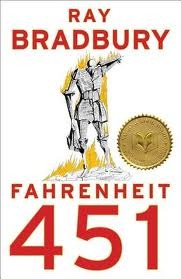
fahrenheit451_coverIn Fahrenheit 451 by Ray Bradbury, the main character, Guy Montag, is a firefighter. However, he is not a firefighter in the traditional sense of the word.  Instead of putting out fires, his job is to set them.

In the future that this novel is set in, millions of books are banned and the only way people are allowed to learn is through television and radio programs, comics, and other forms of entertainment that make people “happy.” In this society, making people happy and equal to one another intellectually is the main goal. It is believed that higher forms of learning, such as the knowledge gained from most books, would be detrimental to this objective. In order to keep this objective, books are banned and burned when found in people’s possessions.  That is where Guy Montag’s job comes in. However, when he meets a curious girl named Clarisse, who, unlike the rest of society, likes asking questions, he begins to ask some questions of his own.

The tone of this novel is a dark one. It deals with the main character discovering a new, not necessarily good outlook on the world he accepted before. It also features many issues that could occur if society could not advance due to lack of knowledge. The idea of censorship that is addressed in this novel is a difficult one, and that is proven when the main character himself goes against his societal rules, his job, and his family values to experience what it is like to read books.

Ray Bradbury seems to want the reader to feel like a world without books would be unexceptional and monotonous. Without the knowledge and expertise that can be gained from reading, society could never advance and people would be stuck in the same rut that Guy Montag realizes he is in when he talks to Clarisse.  At one point in the book, Clarisse says to Guy “It’s a lot of funnels and a lot of water poured down the spout and out the bottom, and them telling us it’s wine when it’s not” (33).  This quote shows how their society is full of dreariness and lies in order for them to feel “happy” and “equal”. In reading this book, I have fully realized that I never want to experience a life without books. Overall, I think that Ray Bradbury was successful in making his readers feel a connection to Fahrenheit 451’s world that is lacking knowledge and advancement.

While this book was a bit tedious to read due to the author’s style of writing, which is so unlike current writing styles, I still am walking away from this novel with a new understanding of how important books are to society. Readers definitely need to read between the lines in order to fully understand both the underlying meaning and what is occurring. It reads more like rambling thoughts, which in a way tells the story better than any structured writing style would. Bradbury started and completed this novel in nine days on a rented typewriter that he payed for per half hour, which I personally find extremely impressive. While I was not the biggest fan of this book, I still feel like I have learned a lot from Fahrenheit 451 and I recommend it to both teens and adults alike.

-Kaelyn L., 10th grade

Book Review: Unbreakable, by Kami Garcia

Kami Garcia/UnbreakableDo you believe in ghosts? Do they float around your room or take human form? Did you ever think they could hurt you? These are questions Kennedy Waters never thought she would ask herself, but that was before a spirit tried to kill her.

When Kennedy finds her mother dead in their own house, her future reveals itself. When her mother is pronounced dead of a heart attack, she is forced to go to a boarding school. She knows something is wrong. She thinks her mom was murdered, but she can’t prove it. Before she leaves, she wants to stay in her house for one last night. It holds all her memories, precious or not.

She soon finds it was a horrible mistake when identical twins Jared and Lukas Lockhart break into her room to kill an evil spirit sent to kill her. They tell her that her mom was part of an ancient secret society that protects our world from a vengeful demon. They also say the society’s five members were murdered on the same night.

Kennedy has to take her mom’s place in the society and join the Legion, if she wants to uncover the truth and survive. She meets new Legion members, Priest and Alara, on the way. The teens race to find the only weapon that can destroy the demon. With challenges along the way, they can only hope for the best.

Kami Garcia, co-author of the Beautiful Creatures series, has done it again. This book is an amazing thriller! I couldn’t put it down. I truly think it could be the next Hunger Games. It has everything: suspense, romance, and the paranormal! I would definitely want to see the movie. But because of some scary scenes, I would recommend this book for 12 and up. Look for Unbreakable in bookstores everywhere on October 1st.

-Sabrina C., 8th grade

Thank to Little, Brown Books for Young Readers for providing an advance readers’ copy of Unbreakable for review.

Book Review: Eragon by Christopher Paolini

eragon_coverDragons, magic, elves, dwarfs, and war are all common elements of many stories. Eragon was one of the first I have read that has a dragon that is actually a main character not a main supporting character. Excellent read for anyone who likes the things I listed above.

Eragon is the first book of a currently four-book series called The Inheritance Cycle written by Christopher Paolini.

 The book is about a boy named Eragon. Eragon has always believed he was just a normal farm boy with a normal birth. He knows nothing of his mother nor nothing of this father. He was raised by an uncle of his and lived with his uncle and his uncle’s son on their farm. Eragon lived a kind of shelter life from most of the outside world since the valley that he lived him was rarely visited from the outside. One day he finds a polished blue stone. This stone would bring him out of his simple life and the valley in which he lived. This stone would bring a dragon into his life that will lead him to magic, elves, and a whole host of other creatures and humans.

Eragon is a very well-written story. The story is very well planned out and detailed– not in the way that bores people but holds their interest. Each character seems to have some sort of mystery behind them that makes the reader want to discover more. The main character, Eragon, still makes mistakes like a normal person and admits that he does them. This makes him feel more like the reader. Another thing that is interesting in this series is the diverse amount of species in the story. There are not only plenty of different sort of humans but there are also things like Urgals (Read the story to find out more about these creatures).

In the end, this book is amazing. Well, at least for me. It has plenty of adventure and excitement for both male and female readers. This book and the complete series itself, I personally would recommend it to older or more advanced readers. The reason is that some of the more emotional side of the story can be hard to understand and take in some of the time. This series also deals with a lot of fighting, war, betrayal, and other slightly more mature things. This review is only my opinion. Really it is up to you. Have Fun!

Extra Note: If you would like to learn more about the author of the Inheritance Cycle series, check out Phillip X.’s post about Christopher Paolini.

-Sarah J., 8th grade

Book Review: Atlas Shrugged, by Ayn Rand

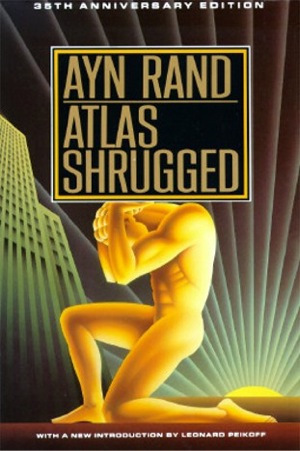
atlas_shrugged_coverIn this great nation of the United States, we have long maintained our democracy on a strict, two-party platform. In more recent times, these two positions have been filled by the left-leaning Democrats and right-leaning Republicans, but, aspiring to exercise to the fullest their rights as participants in the democratic process, smaller third parties have always managed to remain in existence. Among these more peripheral groups, one of the most prominent has long been the Libertarians who, in the opinion of this writer, offer a captivatingly stringent ideological adherence to the fundamental principles of liberty and small government.

Today’s brand of Libertarian represents a diverse membership, but many holding such a political ideology often cite in their political development one common influence. A Russian immigrant to the United States in the early 1900s, Ayn Rand, ceaselessly propagating her philosophy of objectivism, would later write one of the century’s most influential novels, an ideologically dense yet invigorating tale she named Atlas Shrugged, which appears to have become the gospel of the contemporary libertarian movement.

Set an ulterior, dystopian United States, in a world that is increasingly Marxist, the novel follows the events that surround Dagny Taggart, an executive of her family’s transcontinental railroad company. As her brother, James, the president of the corporation, increasingly engages in reckless and destructive business choices, seemingly sympathizing with the notion and proponents of a totalitarian state, Dagny becomes the real director of the company, attempting to extend its longevity to the greatest extent possible. Our protagonist finds solidarity with another rational man of business, Hank Rearden, president of Rearden Metal, whose innovative steel, the strongest and most durable of its kind, she utilizes for the construction of a new section of the Taggart rail network. Time progresses, and a trend of successful businessman leaving their corporations to fall into despair exponentially develops, yet Dagny and Hank fight on in their endeavor to merely remain above water.

While the world around them continues to grow grimmer and increasingly less hopeful, Dagny and Hank find one spark of hope in an abandon factory: a revolutionary engine that possesses the capacity to transform static electricity from the atmosphere into the energy needed to power a locomotive. Unaware of but desperate to discover the inventor of this engine, they embark on a quest that takes them to various places in a now hellish American country. Eventually, miraculously they find themselves in Galt’s Gulch, where they become acquainted with various figures, from business, medicine, art, and other important social spheres, including the aforementioned businessmen, all who have left their respective trades to join John Galt, with whom the reader, at this point in the story, is already somewhat familiar as the result of the novel’s widespread street phrase, “Who is John Galt?”

As the novel closes, the storyline wraps the mystery and uncertainty of why these people are present in Galt’s Gulch and what the future of the nation, and indeed the world, will be all together into a coherent, revelatory, and gripping ending, but that, as well as the answer to the question of Mr. Galt’s identity, is for you, reader, to discover for yourself.

In all verity, Atlas Shrugged is not an easy read. Its length alone might frighten some readers, but requiring even more mental faculty than that necessary to trudge through the nearly thousand pages is that required to pore the dense philosophical dogma that lies therein. Why, then, do I still maintain a positive opinion of and recommend this novel? The story is one that, though gripping, is even more so absorbing for its excellent use and conveyance of Rand’s beliefs. As it has affected countless others, Atlas Shrugged has similarly influenced my philosophical outlook and beliefs.

There will be those who will wholeheartedly disagree with Ms. Rand and her writings, yet the novel discussed here is worth the read even for the mental debate it will inevitably spark. If you are up for the challenge, as any good reader should be, and are open to intellectual growth, give Atlas Shrugged a shot.

-Sebastian R., 11th grade

Book Review: Teardrop, by Lauren Kate

Whenever I pick up a book with a gripping plot, action-packed adventure, and a swirl of romance, I feel like I’m in book heaven. That’s why I thought Teardrop (which is set to be published on October 22) would be an excellent book. Unfortunately, it fell short of my expectations.

Teardrop centers around a seventeen-year-old girl named Eureka who hasn’t cried since she was nine years old. When her mother dies in a car accident, Eureka turns emotionally unstable and suicidal. She misses her mother terribly and her only comfort is her best friend, Brooks. All she has to remember her mother by is a locket that is rusted shut, a special waterproof rock called a thunderstone, and a book written in an indecipherable language.

Eureka is followed by a mysterious blond enigma named Ander. He tells her that she is in danger. She decides to get her book translated by a woman who identifies the book to be about the lost island of Atlantis. The story tells of a heartbroken girl who cried until Atlantis was underwater. Eureka finds that the story is strangely relatable to her own life. To add to the unfolding mystery, Brooks begins to act hostile towards Eureka.

The puzzle pieces only begin to fit together after Eureka and Brooks suffer a near death experience and Brooks vanishes. Ander finds and tells her that she has the power to raise Atlantis with her tears. He also tells her that a previous inhabitant of Atlantis has possessed Brooks. Eureka is faced with life-changing choices as she is confronted and attacked by the Seedbearers, who will stop at nothing to keep Atlantis from rising again.

Although the idea of this book was extremely intriguing, I don’t think it was carried out very well. The plot launched into several promising directions, but didn’t follow through with most of them. However, there are a few pleasant qualities of this book. The characters are all very realistic, and the romance is electric. But the author spends too much time with minute details, and the bulk of the action is shortened to a few pages at the end of the book.

After reading Lauren Kate’s fantastic Fallen series, I expected Teardrop to be stellar as well. Admittedly, I may have set the bar too high. While Teardrop was only an adequate read, the rest of the series has great potential.

-Rabani S., 9th grade

This review was based on an advance reader’s copy generously provided by the publisher.