Romeo and Juliet Play

A few days ago, our class just finished reading Romeo and Juliet by William Shakespeare, and watched both movies. It was…an experience.

I have to put it out there, this was definitely one of the more boring sections in our English Curriculum Requirements. Almost everyone has heard the story of Romeo and Juliet: two children from feuding families fall in love, and love brings them both to a terrible end.

At first when we went to check out the play from the library, I flipped through a few of the pages, and to me (and most other people in my class), the language made absolutely NO SENSE. I tried to process what the author was trying to imply, but every interpretation of what I THOUGHT it meant, was actually very different from what the actual translation was.

Throughout the daily reading sessions we had, my mind always drifted. It was almost impossible for me to focus when the language was so confusing! More questions kept popping up in my head as we read, but the most prominent one was: “How did the people during this time period understand Shakespeare’s unique language?” As we read Shakespeare’s works, we can truly see HOW our language has changed throughout several hundred years (461 to be exact!). Of course, I was thinking this while we were reading during class, which made the homework we had after a lot harder for me, but it was worth it.

Okay, on to the movies. The original one that was published in 1968 was a decent movie. It captured a majority of the plot, and the dialogue was almost exactly the same. I can most definitely say that the new version of the Romeo and Juliet movie was NOT what I expected.

For those of you who don’t know, the new version is a spin-off of Romeo and Juliet, where they are (hear me out) part of different mafia gangs. Could they have captured this any worse? Additionally, the ending was a complete shocker. This movie was quite hard to watch for me, as I feel the director lost the true meaning of what William Shakespeare was trying to convey.

Out of 5 stars, I would give the old version a solid 4 out of 5. Pretty good, but not too great. The meaning was there, although they skipped a few parts. The new version? 3 out of 5. Lost the meaning halfway through the show, but they did a decent job on the spin off, I suppose. 

Romeo and Juliet by William Shakespeare is available to check out from the Mission Viejo Library. It is also available to download for free from Libby.

The Sun and the Star: A Review

Written by Rick Riordan and Mark Oshiro, the Sun and the Star dives into countless topics and genres– just as the main characters, Nico di Angelo and Will Solace, dive into Tartarus. One of the overarching themes is “fixing what’s broken,” and the process of doing so.

A quick plot summary: In a previous book, Bob the Titan sacrificed himself to let Annabeth and Percy escape from Tartarus. However, they neglected to think about or visit him afterward. In “The Sun and the Star,” Rachel Dare comes bearing a prophecy for Nico and Will, saying they need to save Bob. To do so, they must journey through the underworld and go to the heart, otherwise known as Tartarus. Though Nico, being a son of Hades and a previous Tartarus visitor, is an obvious choice, it’s different for Will, son of Apollo. However, he insists on coming with his boyfriend and facing the danger. Through their adventures, they find an overbearing plot and overturn it (and the primordial goddess leading it…).

One “broken” part they try to mend is Nico’s state of mind as he comes to terms with his PTSD. It’s a part of him, experiences he’s had, but it doesn’t mean he should be bound by his nature or past. In addition, he starts to understand feelings and PTSD are not weaknesses. They may be extremely difficult, but working with them is better than hiding them. Also, Will supports Nico during this time. To talk to your demons is scary, however, it’s better when you do it with someone you care about. In page 367, we see “[Will] wanted to understand Nico, even the parts that seemed difficult or sad. All Nico needed was to be seen and heard by someone he cared for, and Will was making the effort.” This also introduces the concept that relationships are a two-way street. No matter how different or similar the two may be, the most important part is accepting and working to understand one another.

Meanwhile, Bob, who also stars in the book, must work with his newly returning memories of his former self, Iapetus. Since he was dipped in the River Lethe, he became a better person (or Titan,) but he suffers from an identity crisis since remembering his dark past. Near the end of the book, he demonstrates his realization that he can never stop being a Titan, but it’s also completely possible for him to have changed.

Nico and Will are often respectively compared to darkness and light in the book. A key moral of the book, they realize they’re not just one or the other: “”There cannot be light without darkness, nor darkness without light. You must have the contrast for both to exist.”” (Riordan & Oshiro 244) Not everything is broken, even if it looks like it. Fix what’s actually broken, but treasure what isn’t.

The Sun and the Star by Rick Riordan and Mark Oshiro is available to check out from the Mission Viejo Library. It can also be downloaded for free from Libby.

THE BOY IN THE STRIPED PAJAMAS (SPOILER) BY JOHN BOYNE

Imagine moving to a new home where everything feels strange, and no one will tell you why. That’s what happens to Bruno, a curious nine-year-old boy, in The Boy in the Striped Pajamas by John Boyne. One day, while exploring, he meets a boy named Shmuel sitting on the other side of a barbed-wire fence. Even though they come from different worlds, they become friends—but Bruno doesn’t realize the terrible truth about where Shmuel lives. This is a powerful and emotional story about friendship, innocence, and the horrors of the Holocaust.

One of my favorite parts of the book was Bruno’s friendship with Shmuel. Even though they live very different lives, they understand each other in a way no one else does. Bruno is curious and doesn’t see why the fence should keep them apart, while Shmuel knows more than he can say. Their friendship feels real and makes you care about both of them.

The Boy in the Striped Pajamas by Boyne, John (2006) Hardcover

Bruno’s family also plays an important role in the story. His father is a strict Nazi officer in charge of the camp, his mother starts to realize something is wrong, and his older sister, Gretel, slowly changes as she begins believing in the ideas of the adults around her. Then there’s Lieutenant Kotler, a young soldier who is always at Bruno’s house. He is cruel and harsh, especially to the people on the other side of the fence, showing just how unfair and dangerous the world around Bruno really is.

As the story unfolds, we learn that Shmuel is a prisoner in a concentration camp during the Holocaust, a time when millions of Jewish people were taken from their homes and sent to camps where they were treated terribly. Bruno, who doesn’t understand what’s happening, thinks the people in striped pajamas are just living another kind of life. The fence between him and Shmuel is a symbol of the way the world separates them.

One of the most intense parts of the book is the ending, which is both shocking and heartbreaking. It makes you think about how unfair and cruel the Holocaust was, especially for innocent people like Shmuel. The story stays with you long after you finish reading.

What I liked most about The Boy in the Striped Pajamas was how it showed the world through a child’s eyes. Bruno doesn’t see enemies or differences—he just sees a friend. This makes the story even sadder, but also more powerful. If you like books that make you think and feel deeply, I highly recommend The Boy in the Striped Pajamas.

The Boy in the Striped Pajamas by John Boyne is available for checkout from the Mission Viejo Library. It can also be downloaded from Libby

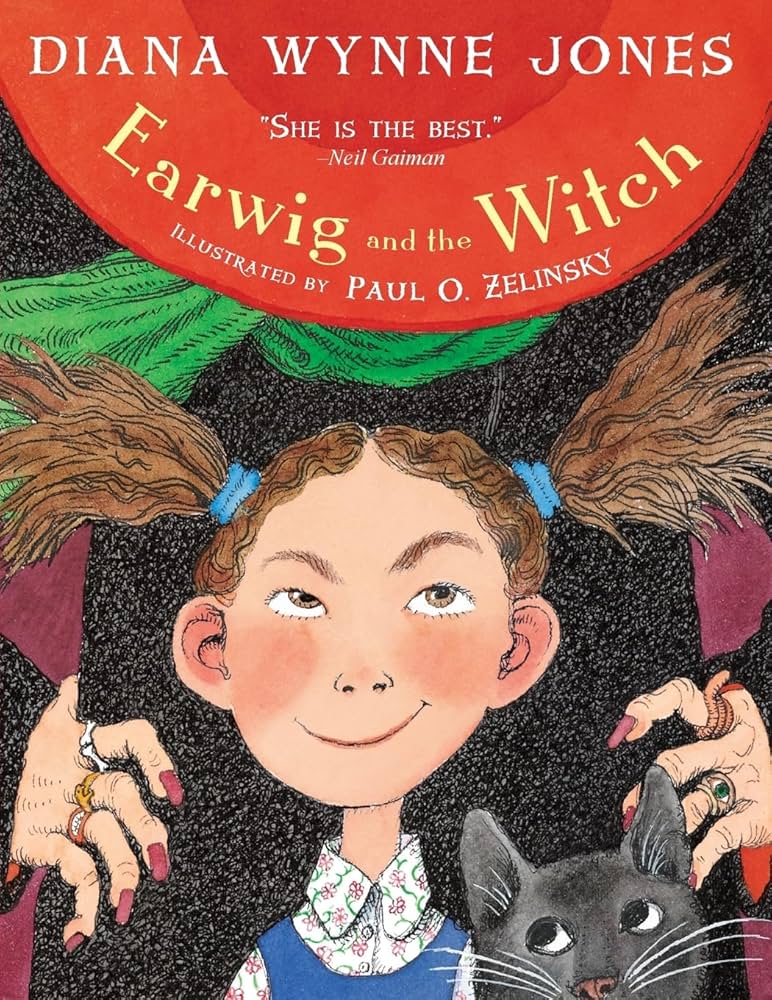
Earwig and the Witch by Diana Wynne Jones

Earwig and the Witch is a short novel by Diana Wynne Jones. This was actually the last novel written by the author, who is well-known for her books of fantasy and science fiction. This book is about a young orphan girl named Earwig who lives at St. Morwald’s Home for Children. Earwig is content living at the orphanage, so she is surprised when a peculiar couple visits one day and decides to adopt her. When she arrives at her new home, Earwig realizes that the couple is not even really human. Earwig is now living with a witch named Bella Yaga and a nine-foot-tall demon called the Mandrake. Bella Yaga immediately makes Earwig her slave, forcing her to do most of the work around the house. However, Earwig fearlessly accepts the challenge and adapts to her new surroundings in unexpected ways.

This book is quite entertaining and filled with many amusing surprises. I enjoyed the cleverness of Earwig and her ability to handle difficult circumstances with courage and resourcefulness. This book also has good illustrations by Paul O. Zelinsky. However, I was disappointed that this book did not live up to my expectations. I greatly enjoy most of the books of Diana Wynne Jones, but this one seems unfinished and lacking in details. The ending is quite abrupt. Also, I found the characters to be unlikeable overall, even though I was entertained by the Mandrake’s antics. To be fair, this book was published posthumously, so the author may not have been able to fully complete it. Despite its negative aspects, I find this to be an enjoyable book that just falls a bit short of its potential.

Earwig and the Witch by Diana Wynne Jones is available for checkout from the Mission Viejo Library.

Poached: Inside the Dark World of Wildlife Trafficking

Recently, I read a book called Poached: Inside the Dark World of Wildlife Trafficking. It was written by Rachel Love Nuwer, and it explores the illegal wildlife trade. Wildlife trafficking is  a crime that involves the illegal trading of animals, plants, and their products. I found this book both interesting and informative. 

In Poached, the author explores a variety of aspects of the illegal wildlife trade—literally! She travels to foreign countries such as Vietnam and China and interviews poachers, sellers, and buyers; exploring the issue of wildlife trafficking from all angles. This is a book that really emphasizes the human side of the issue. Nuwer focuses on individual people and their role in wildlife trafficking. Zooming in allowed me to get a deeper, more personal look at one of the world’s most profitable crimes. 

One thing I loved about this book is that Nuwer avoids oversimplifying the issue. While some may have taken a black-and-white approach, she treats the issue delicately and acknowledges the variety of factors that contribute to trade. Different financial and cultural aspects contribute heavily to wildlife trafficking. The fact that someone may participate in the illegal wildlife trade does not necessarily correlate with their individual character. For example, Nuwer speaks to a poacher in a rural part of Vietnam suffering from acidic water and soil, frequent fires, and low spirits. People in this area often make less than $1,000 a year. This particular poacher chose the profession due to the relatively high monetary potential in order to support his family. However, he does not enjoy his job. He often suffers from bouts of malaria and wishes he could do something else, “Eleven to thirteen dollars per trip [as a forest guide], and I’d quit hunting” (p. 21).

Overall, I would recommend this read to anyone who loves wildlife, is interested in conservation, or is just looking for an informative read.

Poached: Inside the Dark World of Wildlife Trafficking by Rachel Love Nuwer is available for checkout from the Mission Viejo Library.

The Black Pearl by Scott O’Dell

The Black Pearl is a novel by Scott O’Dell. The story takes place in a small coastal town in Baja California during the early 1800s. Ramón Salazar is sixteen years old, and he wants to become a pearl diver like his father. He learns about a mysterious black pearl that is believed to be the “Pearl of Heaven.” Ramón is obsessed with the idea of finding this pearl so that he can impress his father. After days of diving, Ramón finds a giant black pearl believed to be the legendary Pearl of Heaven. The pearl is extremely valuable, but it is also believed to be cursed because it belongs to an evil manta ray known as Manta Diablo. Ramón’s life is forever changed after finding the black pearl, and he must decide whether to keep it for himself or return it to the lagoon where he found it.

This book is filled with adventure and suspense. This is a coming-of-age story for the main character as he faces the challenges of his newfound wealth and the dangers it brings. This book warns about the destructive consequences of seeking riches and of being consumed by ambition. However, this book also teaches about the values of perseverance and courage. The characters are well developed and realistic, making the story vivid and engaging. I found the pacing to be somewhat slow, but this book is thought-provoking and rewarding. This may not be my favorite Newbery Honor book, but it is worth reading and could be inspirational for readers of all ages.

The Black Pearl by Scott O’Dell is available to checkout from the Mission Viejo Library. It is also available to download for free from Libby.

Dumplin’ by Julie Murphy

Dumplin’ is one of the few novels that I’ve loved both the book and film-adaptation. In both forms, Dumplin’ depicts the raw feeling of proving one’s self-worth, not based on outward appearances, but based on one’s self-respect and confidence in one’s capabilities. While capturing the jealousy, insecurity, and self-fulfillment of a teenager navigating the superficiality of teenage social-status and norms of beauty, Dumplin’ also left me with a message that will be prevalent throughout my life.

Julie Murphy’s Dumplin’ captures small-town Texas teen Willowdean Dixon’s path to finally feeling comfortable in her own skin. Through Willowdean’s, or Will’s, narration, she illustrates how being overweight affects her relationship with her former beauty pageant winning mother, Rosie Dixon, and her conventionally pretty best friend, Ellen. Will’s mother, being obsessed with maintaining physical beauty, never pursues a close relationship with her daughter, leaving her sister, Lucy, Will’s aunt, to take her place as a mother figure. Both Lucy and Will bonded over their love for country star Dolly Parton, an affection she also shares with Ellen. Through their idealization of Dolly Parton, a figure of confidence and glamour, Lucy encouraged Will to value and love herself despite being overweight.

To me, this was the part of the novel that stood out to me the most. Dolly Parton’s music in the novel inspires and influences Will to achieve the best version of herself and to approach that moment with the highest level of confidence. Dolly’s influence enforces the idea of figuring out who you are and doing it on purpose. While Will struggles to accept her plus-size figure due to her constant comparison to Ellen, Will chooses to compete in her mother’s beauty pageant, forcing herself to discover what real beauty is.

Today, beauty is very subjective. How we define beauty differs between cultures and the kinds of societies we live in. In my opinion, beauty is not what is aesthetically pleasing to the eye, but the confidence and goodness that a person carries within. It’s true that confidence makes someone more attractive, but what makes someone beautiful is when that confidence is real and grounded in self-worth; it is when that confidence cannot be shaken by any form of social comparison or deprivation. One cannot find worth in comparing oneself to others.

Will finds her beauty in self-worth, fulfilling her aunt Lucy’s wishes and proving to her mother that there’s more to beauty than being thin. Will stops blaming others for judging her and making her feel less than and looks within herself to build that esteem to feel good about herself. Being overweight does not define her; only Will can decide what defines her and how that will shape who she is and who she wants to be in the end.

Dumplin’ by Julie Murphy is available for checkout from the Mission Viejo Library. It can also be downloaded for free from Libby.

Persepolis: The Story of a Childhood by Marjane Satrapi

In my English class, we read the graphic novel Persepolis: The Story of a Childhood by Marjane Satrapi. The French-Iranian author of children’s books, graphic novels, cartoons, illustrations, and films created Persepolis as a memoir of her childhood when she lived in Iran during the Iranian Revolution.

To put the Iranian Revolution in perspective, the Islamic Republic of Iran, a theocracy ruled by Ayatollah Ruhollah Khomeini, was founded in 1979 after a series of riots and demonstrations that overthrew the Shah of Iran. The Shah was overthrown for a number of reasons, including political repression, economic difficulties, and public dissatisfaction with his rule (such as unrest brought on by the Shah’s westernization of the nation).

At the age of 10, Marjane Satrapi was forced to transfer from a coeducational French school to a girls-only school during the revolution. She was also required to cover her hair because the new Islamic regime enacted a law that, for religious reasons of modesty and dignity, required women to wear veils in public. The veil is a powerful symbol in the story because it stands for feminism, identity, and the oppression of women in Iran. Other struggles her family endured, like the Iraq War and her uncle’s execution for opposing the Shah and holding communist beliefs, are also covered in the book.

In AP World History, I formally learned about the Iranian Revolution and the overthrowing of the Shah. Once I read the book, I realized that people actually lived through the revolution and had to undergo the harsh conditions and the changes the new Islamic Republic established. Some of my friends’ parents experienced the revolution and describe it as fearful and deadly, and its long lasting outcome as a royal disaster for the Iranian people.

Persepolis: The Story of a Childhood by Marjane Satrapi is available to check out from the Mission Viejo Library.

Happy reading!

– Sophia B

My Brother Sam is Dead by Christopher Collier and James Lincoln Collier

About two months ago, I read a novel called My Brother Sam is Dead in my English class. At first, I thought I wouldn’t enjoy this book because I was being forced to read it. Instead, I actually ended up enjoying it a lot. I loved how it showed the side effects that war can have on society. Rather than showing the perspective of a soldier at war, it shows the perspective of a boy named Tim Meeker who has to face many challenges as a result of the war.

My Brother Sam is Dead takes place during the American Revolutionary War. The novel follows the story of a boy, Tim Meeker. While his brother, Sam Meeker, is fighting as a Patriot, Tim is forced to mature and change as he stays home and fights against the problems the war is bringing. As the reader continues throughout the story, they are able to witness the tragedies that Tim has to face causing him to go through very noticeable character development as the story goes on. They are also able to see how war brings other things rather than freedom and glory.

My Brother Sam is Dead is a well-crafted novel that has meaningful themes and topics. My favorite part of the book is its hidden message, which shows how war brings problems to everyone, not just those who are fighting in it. The novel does a great job at this by making the character development of Tim Meeker very apparent. The authors do this by making Tim go through life-altering events as a result of war, Causing him to mature quickly and to go through personal growth. Additionally, My Brother Sam is Dead has an entertaining story that will keep the reader engrossed in it throughout the story. The authors added very detailed scenes and emotions that have the reader feeling like they’re part of the story.

In conclusion, My Brother Sam is Dead is a novel that may seem boring, but is definitely the opposite. I recommend this book to anyone since it is not too long and has a story that is both engaging and thrilling. While this book may sound boring because it does not follow the perspective of a soldier at war, but instead a normal civilian, the authors do a great job at making it a very entertaining piece of literature. Using a civilian as the protagonist, the authors are able to tell the reader the side effects war has on the world. The authors are also able to explore topics such as personal growth with the use of Tim Meeker, a young boy who isn’t participating in the war, as the main character.

-Matthew R.

My Brother Sam is Dead by James Lincoln Collier and Christopher Collier is available for checkout from the Mission Viejo Library. It can also be downloaded from Libby.

Picture of Dorian Gray by Oscar Wilde Book Review

Oscar Wilde’s The Picture of Dorian Gray is a haunting and provocative exploration of vanity, morality, and the consequences of indulgence. First published in 1890, the novel follows the life of Dorian Gray, a handsome young man whose portrait, painted by artist Basil Hallward, begins to age and show signs of corruption while he himself remains youthful and unmarked by time. Dorian’s pursuit of hedonistic pleasure, influenced by the decadent philosophy of Lord Henry Wotton, leads him down a dangerous path of moral degradation, as he engages in a life of excess without facing the physical consequences. The painting, however, becomes a mirror to his soul, revealing the true cost of his actions.

Wilde’s writing is sharp, witty, and layered with profound insights into human nature. His exploration of aesthetics and the consequences of living a life dedicated solely to beauty and pleasure is both thought-provoking and chilling. The character of Dorian is a complex one—initially innocent and impressionable, he becomes increasingly corrupted by his own image and the pursuit of personal gratification. Lord Henry serves as a persuasive, almost sinister, mentor, embodying Wilde’s fascination with the idea of “art for art’s sake” and the rejection of conventional morality.

I personally enjoyed the Gothic themes of the novel and how the book evoked a sense of wonder for the world. I became fascinated by the mystical words of Lord Henry and I loved being able to understand why Dorian Gray took the Lord’s words so seriously. I enjoyed how thought-provoking Wilde’s writing was and loved the array of shocking moments within the story. Furthermore, I thought the development of Dorian Gray’s insanity was beautifully written and held strong symbolism for the world’s corrupt obsession with youth, beauty, and immortality.

I would recommend this book to anyone who enjoys classical literature and a short, yet influential read. I think Wilde’s writing would attract readers who enjoy beautiful and mystical writing as well as exciting plot twists! I personally recommend this book for everyone as it is a wonderful novel to discuss peers and leaves you with thoughts about society!

Kaiya T.

The Picture of Dorian Gray by Oscar Wilde is available to checkout from the Mission Viejo Library. It is also available to download for free from Libby.