Books Series to Read This School Year

This year we might have a lot of time on our hands because we may be doing online classes. So here are a few book series that I think you will be able to enjoy.

My first choice would be Magnus Chase and the Gods of Asgard, by Rick Riordan. This series is about Norse mythology, the main character is Magnus Chase who is killed and goes to Valhalla where he lives on a floor in a hotel with a bunch of unique and funny neighbors. Until he finds out about a quest for the Sword of Summer. In the first book which is The Sword of Summer, it is very entertaining and hilarious.

My second choice would be The Chronicles of Narnia by CS Lewis. This series is about four children named Peter, Lucy, Edmund, and Susan who are taken away from their parents because of a war. They are brought to an elder man’s house and they discover a wardrobe that teleports them to a different place. They meet many different creatures that they befriend and go on adventures. This series is definitely worth your time.

My third and final series that I recommend is A Series of Unfortunate Events. If you like happy endings and happiness I do not think you should read this. This series is about three children named Violet, Klaus, and Sunny Baudelaire whose parents die in a fire. They are sent to live with a rude and selfish actor named Count Olaf. He is after the Baudelaire fortune and will stop at nothing to get it. In this series accompany the Baudelaire children barely escaping Count Olaf and his evil theater troupe. This series is one of my favorite book series, and if you end up reading it, hopefully, you will enjoy it as well.

In conclusion these are my top book series to read this school year.

-Veronica S.

Return to Fear Street: You May Now Kill The Bride by R. L. Stine

Return to Fear Street: You May Now Kill The Bride is the perfect balance of mystery and horror. Two sisters separated by decades, will they all come to the same terrible fate or will the curse be lifted?

I am not an avid reader when it comes to thriller/horror mystery, but this was an exceptional case. The different pockets of time threw me off from time to time, but there was always a plot twist that would grab me back in. This book oddly shows extreme forms of family problems and toxic relationships, which sadly seems to apply more now than ever in a society.
As you venture further into the story, you realize how much sorrow and anger there is in the world, and how the stories between the sisters paint an ugly picture. This story made me think about if such a horrid tale happened in my family, it gave me chills and a reality check. The tragic truth is jealous and acrimony weaved throughout this tale is what some people experience every day. The poor decisions we make based on an unjust prejudice make me gag.
Aside from that, I highly recommend this book. It was a thrilling adventure that taught me a small lesson along the way. Reading some parts of the book aloud assisted my understanding of the character’s thoughts and emotions throughout the book.
There is no true main character because the baton is passed off between two similar girls almost a hundred years apart. However, the issues and emotions they faced were extremely related, and it relates to most of us today. Even though the extremity is not on the same level, we all have had our shares of lethal relationships and moments of inflamed passion, that lead to disastrous events.
Long story short, an electrifying drama that will keep you up late reading it.
-Coralie D.
You May Now Kill The Bride by R. L. Stine is available for checkout from the Mission Viejo Library. It can also be downloaded for free from Overdrive

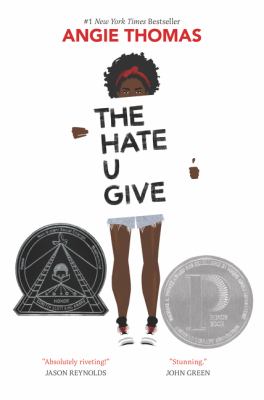
The Relevance of The Hate You Give

If you’ve been on any type of social media, or practically any corner of the internet, you are probably aware of the current Black Lives Matter movement and its impact. As a current activist writer, it only felt right for me to talk about this subject which I am very passionate about. So, I wanted to write a little something about one of my favorite books that address racial injustice – The Hate You Give by Angie Thomas. Its story follows the journey of a Starr Carter, a black 16-year old high schooler who witnesses her best friend, Khalil, become a victim of police brutality.

Reading this book and subsequently watching the movie made me feel incredibly emotional and break down into tears. It was a truly heartbreaking experiencing Starr’s inner turmoils and the fear she had about speaking out, and it highlighted the vast difference between privileged and underprivileged communities. This story was filled with all sorts of obstacles for Starr, from having to hide Khalil’s motives due to underlying gang conflicts, to deaingl with a racist friend who was insensitive and misinformed. As the story progressed, it was infuriating reading that the police officer who killed Khalil was not going to be prosecuted. However, this led to many protests that demanded justice for Khalil, a perfect parallel to current events that have been occurring all across the country, and all around the world.

Though, in the end, (spoiler alert for those who want to read it!), Khalil’s murderer does not end up being prosecuted, Starr still fights to keep his legacy alive and remains active in the fight against racism. Similar to today, people are continuing to fight for those who have not gained justice for being killed due to the prevalence of xenophobia. However, recognizing the importance of this book and the lessons and information it contains about our society can lead you one step closer to understanding how you can help raise awareness and demand change, especially in a world overrun by oppression. NO JUSTICE, NO PEACE!!

Helpful link for those who want to find ways to contribute: https://blacklivesmatter.carrd.co

-Julianne T.

The Hate U Give by Angie Thomas is available for checkout from the Mission Viejo Library. It can also be downloaded for free from Overdrive.

Fictional Food and Illustrations: Harry Potter and the Philosopher’s Stone

Nearly a year ago I wrote a post about my fascination with fictional food and its function within books (“Fictional Food: Harry Potter and the Philosopher’s Stone”). In the post, I discussed a few food items mentioned in the first Harry Potter book and how they contributed to the mood of certain scenes, the relatability of the characters, and the complexity of the story overall.

Here, I’d like to revisit some of the delicious food from Harry Potter and the Philosopher’s Stone that I included in that post (along with unmentioned items), this time with some illustrations to accompany them. I hope you enjoy this visual feast :).


At the beginning of chapter 2, Harry finds himself at the zoo with Dudley and his friend, Piers Polkiss, to celebrate Dudley’s birthday. While a visit to the zoo in itself is an unprecedented treat for ten-year-old Harry, Harry’s good fortune seems to persist: at the zoo, “The Dursleys bought Dudley and Piers large chocolate ice creams at the entrance and then, because the smiling lady in the van had asked Harry what he wanted before they could hurry him away, they bought him a cheap lemon ice lolly. It wasn’t bad either, Harry thought” (Rowling 33). The treats for Harry didn’t stop there. When Harry and the Dursleys ate lunch at the zoo, “Dudley had a tantrum because his knickerbocker glory wasn’t big enough, [and] Uncle Vernon bought him another one and Harry was allowed to finish the first” (34). I guess some good can come out of the spoiling of Dudley Dursley. 

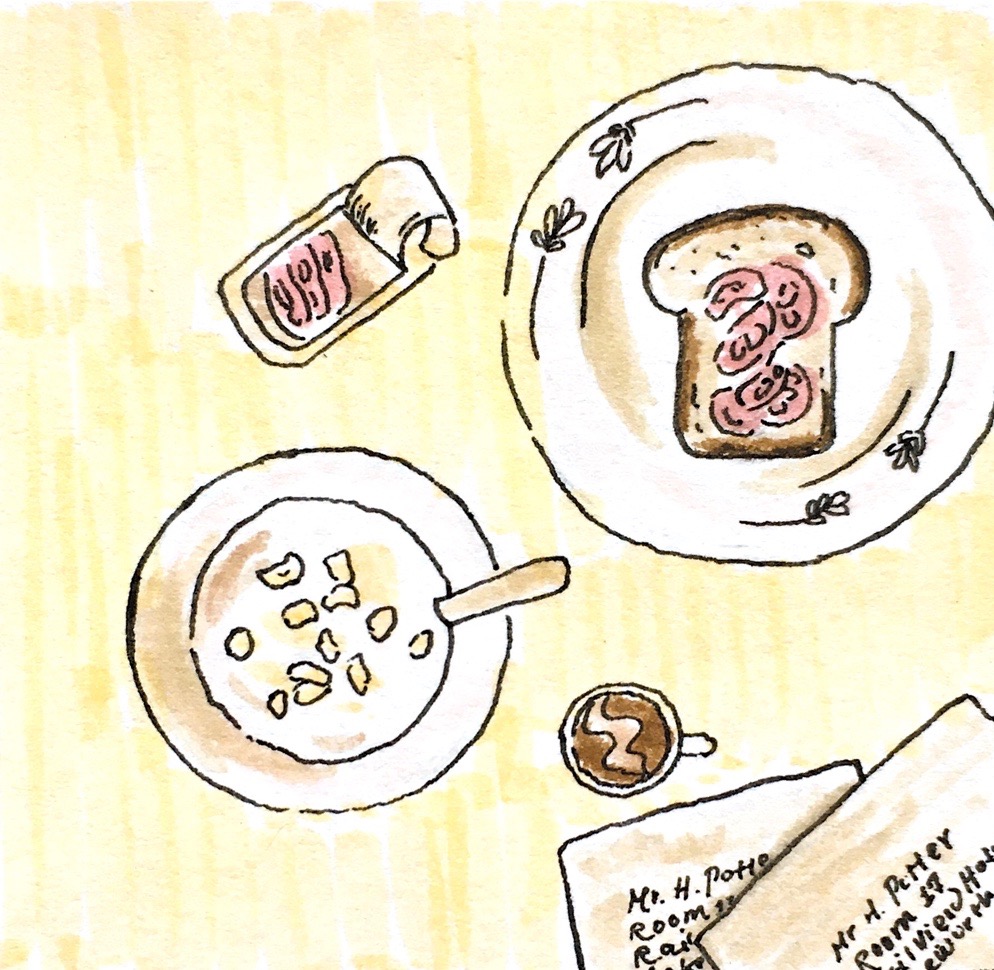
Chocolate ice creams, ice lollies, and knickerbocker glories are left behind when, overwhelmed by the persistence of the letters inviting Harry to attend Hogwarts, Uncle Vernon pulls his family on a wild excursion to “Shake ‘em off,” during which the Dursleys and Harry spend a night at “a gloomy-looking hotel” where they eat “stale cornflakes and cold tinned tomatoes on toast for breakfast” (50). At this same meal, the hotel owner informs them of a surplus of letters addressed to Harry with the exact number of the room he is staying in. At this point it looks as if, despite Uncle Vernon’s admirable efforts, it’s going to be a bit harder than he thought it would be to “shake ‘em off.”

Despite the apparent futility of his efforts, Uncle Vernon does try harder to escape the Hogwarts letters. His determination culminates in Harry and the Dursleys spending a night in a hut on a rock, stranded by turbulent waves and a storm of wind and rain. Did Uncle Vernon think this through? Not thoroughly. Though, to his credit, he did bring some rations: “a packet of crisps each and four bananas” (53). The insubstantiality of this meal makes the next food that enters Harry’s mouth extra delicious.

After Hagrid enters the hut (by breaking down the door) and deduces that Uncle Vernon is not going to offer him tea or a drink (or anything, for that matter), he takes a number of objects out of his coat, including “a copper kettle, a squashy package of sausages, a poker, a teapot, [and] several chipped mugs” and proceeds to cook the sausages over the fire. Soon, Hagrid offers “six fat, juicy, slightly burnt sausages to Harry, who [is] so hungry he ha[s] never tasted anything so wonderful” (57, 58).

While Harry meeting Hagrid is a defining moment in itself, Hagrid’s sausages may be the first tasty food offered solely to Harry out of kindness and care. This is one of Harry’s first tastes of a world where he is regarded as important and admirable and not as a messy-haired nephew who ought to be hidden in a cupboard under the stairs. 

The delights of Hagrid’s generosity continue when he buys Harry “chocolate and raspberry [ice cream] with chopped nuts” in Diagon Alley (89). Whenever I read this part, this ice cream sounds so delicious, and I marvel at the fact that the simple inclusion of these little details makes the story so much richer and entertaining. Where Hagrid bought these delectable desserts is not stated, but I think it’s reasonable to guess that they were crafted by Florean Fortescue, the owner of an ice cream parlour where Harry spends much of his time two summers later.

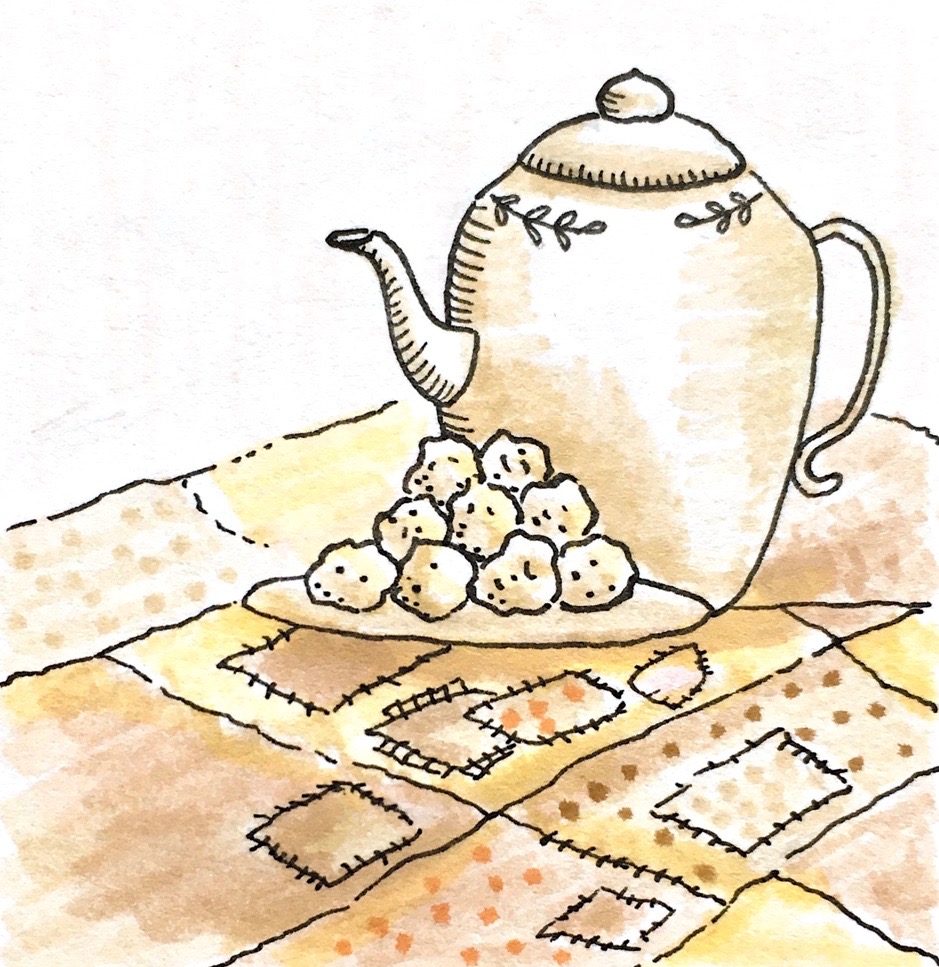
Once at Hogwarts, Harry enjoys more food with Hagrid at Hagrid’s cabin, though perhaps it’s not as tasty as the ice cream in Diagon Alley. On Harry and Ron’s first visit to Hagrid’s, Harry introduces Ron while Hagrid pours “boiling water into a large teapot and [puts] rock cakes onto a plate … The rock cakes almost broke their teeth, but Harry and Ron pretended to be enjoying them” (154). Although Hagrid’s rock cakes are not the most scrumptious or easy-to-eat delights, I think they’re still endearing and fitting to the story—Harry and Ron don’t visit Hagrid for the food. Plus, maybe if you soaked the rock cakes in tea or milk they would make a delicious treat (or at least a softer one). 

Here’s an illustration of the steak-and-kidney pie served at Hogwarts the night Professor McGonagall discovers Harry’s talent as a Quidditch Seeker (I’ve accompanied it with some pumpkin juice, though it’s not mentioned in the book). By the time Harry’s done telling Ron the news that he has been made Seeker on the Gryffindor Quidditch team, Ron has “a piece of steak-and-kidney pie halfway to his mouth, but [he’s] forgotten all about it” (166). We know a piece of news is important when it makes Ron forgets about food.

In his state of excitement from unwittingly finding himself on the Gryffindor Quidditch team, Harry probably does not forsee the state of his nerves on the morning of his first match. While “the delicious smell of fried sausages” pervades the Great Hall, Harry does not even want to eat the “bit of toast” Hermione tries to coax him to eat. His appetite is probably diminished further when Seamus reminds him that “Seekers are always the ones who get nobbled” while “pil[ing] ketchup on his sausages” (200). 

The last two illustrations are inspired by Harry’s first Christmas at Hogwarts:

“Harry had never in all his life seen such a Christmas dinner. A hundred fat, roast turkeys, mountains of roast and boiled potatoes, platters of fat chipolatas, tureens of buttered peas, silver boats of thick, rich gravy and cranberry sauce—and stacks of wizard crackers every few feet along the table … Flaming Christmas puddings followed the turkey” (220).

After a “happy afternoon having a furious snowball fight in the grounds” with the Weasleys and a chess game with Ron, Harry enjoys “a tea of turkey sandwiches, crumpets, trifle and Christmas cake” (221).

I really enjoyed illustrating these dishes and treats from Harry Potter and the Philosopher’s Stone, which wouldn’t have been possible without J.K. Rowling’s detailed and generous descriptions. I loved learning about new kinds of food when I looked up pictures and descriptions of Yorkshire puddings, rock cakes, steak-and-kidney pie, chipolatas, trifle, and flaming Christmas puddings for reference (if you’re interested and haven’t seen a flaming Christmas pudding, I would suggest looking up an image—they look so cool!). I hope these illustrations were entertaining for Harry Potter lovers and food lovers alike!

– Mia T.

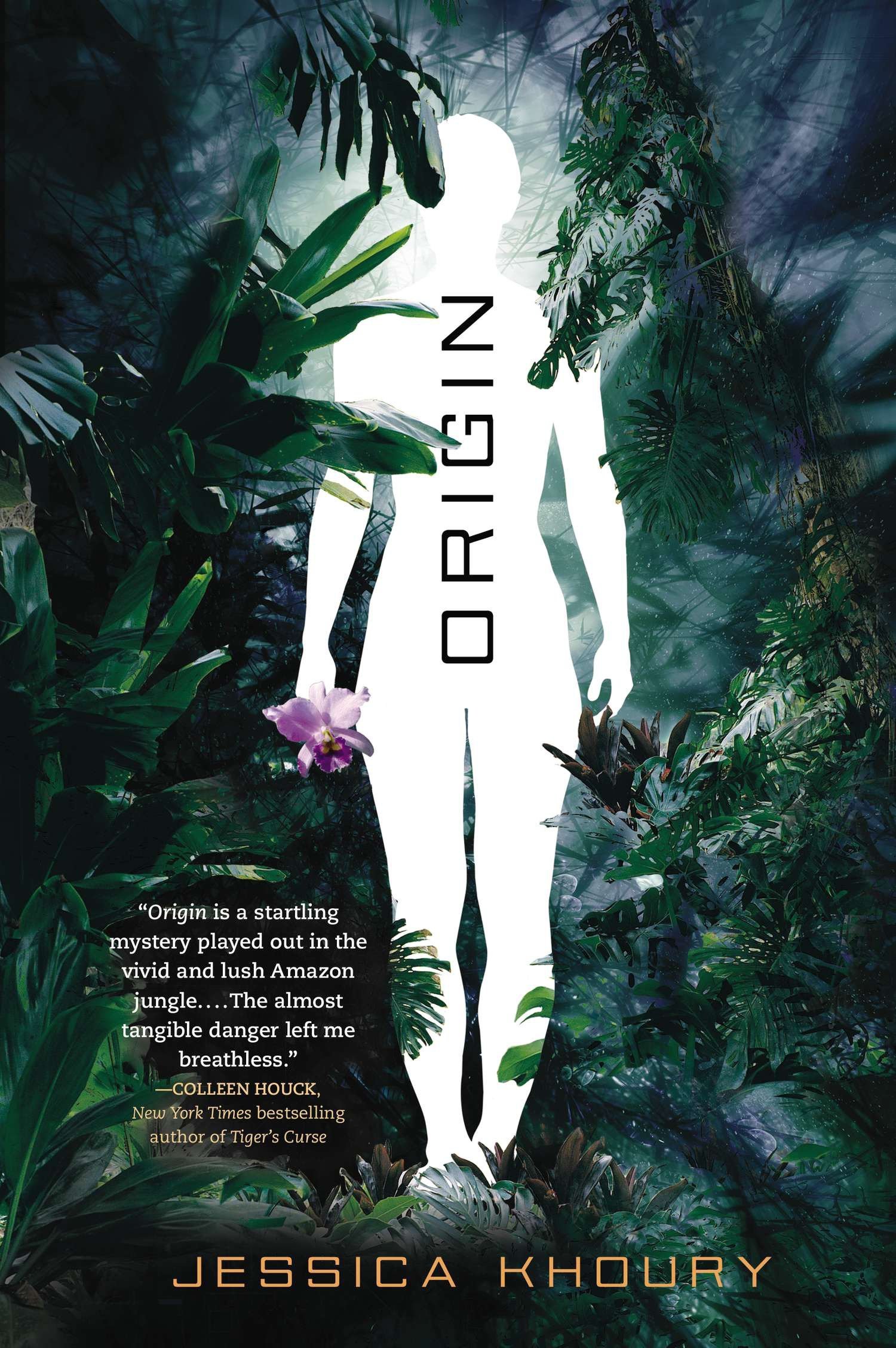
Origin by Jessica Khoury

Amazon.com: Origin (9781595145963): Khoury, Jessica: Books

Origin is a wonderful read for any fan of science fiction and romance. Based in the depths of the Amazon jungle, you will get immediately swept into the world of labs and scientists. The main character Pia, is considered perfect, because she is invincible, one of a kind, and extremely smart. At 16 years old, the only people she knows are her family, a team of scientists, and the non-scientist residents on the secret facility called Little Cam. With five generations and a magical flower found deep in the Amazon jungle, called Elysia. But Pia has to be kept on complete lockdown and doesn’t get most types of entertainment, like books magazines, or movies, unless they are science textbooks, with blackened out paragraphs. She hasn’t even met anyone under the age of thirty. But this all changes when she’s able to escape Little Cam, and meets Eio from a local village. They start to fall in love, but the risk of deadly consequences grows more.

I own this book, and I’m really glad that I do. It’s one of my personal favorites to read over and over again. It’s such an amazing secret world to fall in love with. The first time you read this book, you’re constantly wondering what happens next, and if Pia will ever be free from all the restrictions.  I highly recommend this book to anyone looking for a new read.

-Rebecca V., 11th Grade

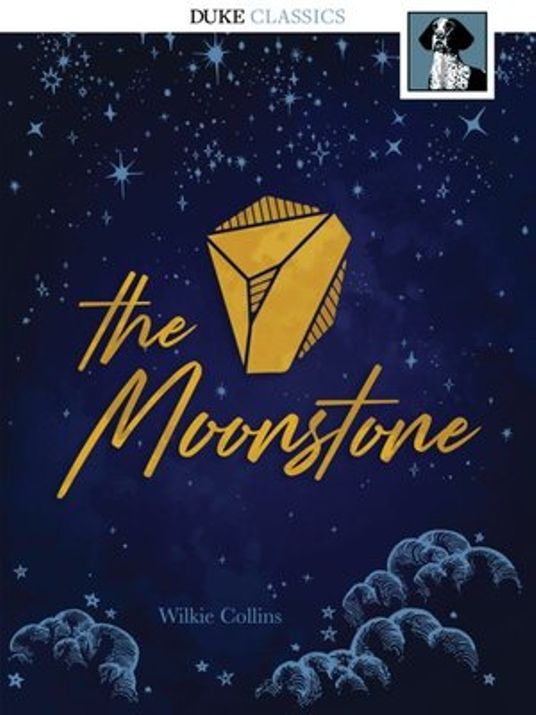
Book Review: The Moonstone by William Wilkie Collins

The Moonstone eBook by Wilkie Collins - 1230001902938 | Rakuten Kobo United  States

As a writer of the British Empire at the peak of the colonial era, Collins is immersed in the influence of colonialism and orientalism thinking mode. His image of the Eastern people inevitably shows the superiority of the subjects of the metropolitan country and the obvious racist attitude towards the colonial people. However, many factors in The Moonstone, such as the selection of time setting, plot arrangement, characterization and so on, can also be interpreted completely in the opposite way: Collins raises certain doubts and challenges to the colonial mentality. Collins’s choice of India as the setting is closely related to the Indian mercenary riots of 1857. The rioting started when the British authorities used butter and lard as lubricants for bullet clips that needed to be chewed through the mouth, and the mercenaries were mostly Hindus or Muslims. To them, touching the oil on these clips meant blasphemy against religion. Angry soldiers rioted, killing not only the British boss but also the innocent. Most of the reports in the British media distorted the facts of the case, and for a time, the name “bloodthirsty Indian” was constantly heard. Collins and Dickens collaborated on an article called “The Perils of Certain English Prisoners,” which exposed the insidious, cunning, and hypocrisy of colored people and praised the qualities of British soldiers. The Moonstone was written on the tenth anniversary of the riots, and newspapers and magazines are full of memories, memorials or reflections on the events. By this time, many British people had come to understand the truth and felt that the British authorities had been wrong to disregard the Indian soldiers’ religious beliefs, and Collins’s views had changed subtly. In the novel, his view of the relationship between Britain and India is no longer a simple tribute to the British empire, but an indirect expression of his deep reflection. The plot arrangement and characterization of the novel also reveal Collins’ questioning and criticism of the so-called noble morality of the colonists.

Several of the Englishmen involved in the jewel were from the upper middle class, but the cruelty and greed of Colonel Herncastle, who first grabbed the jewel, goes without saying, and the image of Abel White, the real black hand in the jewel theft, is ironic. The final collapse of the case exposed Abel White as a hypocritical English gentleman. He is the suitor of Rachel, the heroine. He is of noble birth, well-educated and has a noble career as a lawyer. He attends church regularly and is enthusiastic in organizing and participating in various charitable activities. He was a fine young man of uncommon appearance. He had a round, bright face, a ruddy complexion, and lovely blond hair. However, when the mystery is solved, his double identity is revealed: the bright surface conceals the dark inner heart, he not only leads a dissolved life, but also embezzles the client’s funds. After the financial crisis, in order to avoid ruin, he took the risk of stealing precious stones. It is intriguing that Collins has named such a sanctimonious figure Abel White. The image of an Indian was in stark contrast to Abel White’s imposing appearance. In the eyes of several narrators, the Indians are dark skinned, obtuse, and have a manner reminiscent of snakes. However, they had a clear goal and a firm belief. In order to retrieve the stolen holy moonstone, they broke the religious rules and sacrificed their lives to trace all the way to England, and finally returned the gem to its owner by tenacious perseverance, superhuman patience and shrewd calculation. The explorer concludes the novel by describing a grand Hindu religious ceremony celebrating the return of the jewel. His reverence rose to the page as he spoke of the three men going their separate ways, with the congregation around them making way for them in silence. The moonstone becomes a yardstick to measure the good and evil of human nature and a mirror to reflect the character’s morality.

Reflected in this mirror, the “barbarian” in the eyes of the Europeans became the guardian of virtue, while the English gentleman had forgotten what was virtuous. So when Abel White, the “capable white man”, is murdered by an Indian, the mood conveyed by the novel is not one of indignation, but of sympathy, admiration and relief that justice has been done. The moonstone is a sacred object of Hinduism. This gem is no longer just a physical indicator, but a spiritual and cultural sustenance. The twists and turns of its fate revealed that the economy of the English country estate was closely related to the colony. Events in the colony would eventually spread to the British mainland and cause social unrest in Britain. The moonstone exposes the brutality and greed of the colonists, reflecting their moral corruption and hypocrisy under the guise of religion and civilization. Moreover, through the influence of the gem on the family of the British gentry, the author implies that colonial affairs destroy the traditional social and family hierarchy order: only when the colonial gems leave the British mainland, the British family can restore normal order. Another theme of the novel is to celebrate Rachel’s pursuit of love, even though her pursuit is full of difficulties. She falls in love with Franklin before her birthday party, but on the night of the party, after witnessing him steal the moonstone, she begins to doubt their love. But no matter how sad she was, she chose to sacrifice her reputation for secrecy to protect Franklin. In the novel, there are three Indians who follow in the footsteps of the moonstone, and their task is to keep searching for the moonstone, without fear of sacrifice, even through generations of efforts, until the stone is returned to its original place. Rachel’s sacrifice was in the name of love, and the sacrifice of the three Indians was in the name of faith. The two kinds of sacrifice echoed and supported each other.

The horror and mystery reflected in The Moonstone is one of the important features of Gothic literature. Readers are always in the process of guessing the murderer, guessing wrong, continuing to guess and guessing wrong. Only by reading the ending did we discover who the real killer was. In The Moonstone, Wilkie Collins has a remarkably precise command of time and space, one of the basic abilities that most mystery novels have. In terms of narrative structure, the novel is just like drama and film shooting, which is divided into prologue, first part, second part and epilogue. In the second part, there are six stories to tell. The time of the narrative remains the same, and the gems are stolen one by one — the truth comes out, but after the jewel is stolen, the events in the second part are told separately by the six men, as if the police were looking for clues and inquiring about relevant personnel, and the parts of the six men’s separate stories seem to be independent. The overlap of time and the intersection of space weave an impenetrable web. Narration, flashbacks and interludes in space and time make the plot messy and complex, close and scattered, and the readers’ mood is controlled by the author. There are traps in Wilkie Collins’s narrative that draw the reader’s mind in mysterious and conspiring directions, yet he is so grounded in the goodness of human nature that, just when you want to believe in it, another well-reasoned accident pulls back a plot that has gone far. Finally, you seem to know how the gem came back to India, and you seem not to know. This kind of looming narrative is extraordinarily precise in its transformation of narrative vision. In the dialogue of the characters, the defects of the previous character are written back or made up, and the whole picture is reflected afterwards where random incident causes an uncontrollable scene.

-Coreen C.

Animal Farm by George Orwell

George Orwell’s composition of Animal Farm tells a story of real-life actions, in a form everyone understands, through the eyes of animals. The idea of communism, or in this case what the animals refer to as “animalism”, is a sensitive topic. But, Orwell was able to explain part of the issue that power leads to corruption.

In the beginning of the novel, Napoleon the pig is shown as a protagonist that helps end the animals suffering under the farmers. But as a shock to all, he slowly his idealism changes as the animals take over the farm. This event was one of the main problems that occurred in real life in some countries.

Orwell’s ability to link a compelling story to real event in time was a very interesting connection to make. He was able to explain actions that happened in countries like Russia, and put in how these people were able to rise to power through a story. Each character or event that occurred in the story portrayed different communist leaders and ideas, along with different ideas of totalitarianism.

Before getting into the novel, I was familiar to the ideas of communism and other neighboring branches of it. Once I started reading I could see some connections of these ideas as they were portrayed in a different form. But as the story continued and the characters growth was at a point in which their true attributes were finally being showed, I could see what Orwell was doing. He allowed each different sets of animals grow into separate groups, all with different views on the situation. Each group were essentially the different types of people during these types of Revolutions.

Overall, this book was very intriguing and I would rate it a 9/10. It was one of those books where once it was started, it had to be finished. My dad constantly told me of books that even his generation was urged to read. Animal Farm was one of the classic books that he would tell me about. It was very cool to be able to relate with my dad about a book he had also read when he was a teenager. This story by George Orwell was a very fascinating read.

-Lilly G.

Animal Farm by George Orwell is available for checkout from the Mission Viejo Library. It can also be downloaded for free from Overdrive.

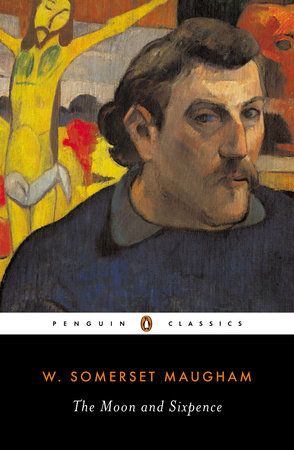
The Moon and Sixpence by William Somerset Maugham

The Moon and Sixpence by W. Somerset Maugham: 9780143039341 |  PenguinRandomHouse.com: Books

In his novels, Maugham deeply discusses the contradiction and interaction between life and art. The escapist theme revealed by the novel coincided with the pursuit of many people in the West and became a popular novel in the 20th century. Maugham’s novel The Moon and Sixpence, inspired by Gauguin, was undoubtedly more fiction than fact. For the next decade, Gauguin thought he would finally be able to enjoy the fruits of his success and reunite the family. By comparing novels with reality, we can find that Gauguin’s pursuit of painting has its causal relationship and process development. But Strickland’s departure is very abrupt and too intense. In addition to the author’s use of fictional plots and narrative techniques, he has created a so-called pure sense of the artist who is unworldly. Compared with Gauguin’s departure, Strickland’s departure is completely out of line with the logic of reality and is even more incomprehensible to the reader. There is a deeper reason why Maugham is writing this way: the virtual satisfaction of Maugham’s ego. Sixpence was the smallest unit of silver in England at that time. People often forget the sixpence at their feet when they look at the moon. The moon is the ideal high above, the sixpence is the reality. The modernity of The Moon and Sixpence is first manifested in its conceptuality. In the The Moon and Sixpence, Maugham ostensibly describes the fate and encounter of the protagonist, but in fact reflects his own thinking on the relationship between art and life.

The questions that haunt the protagonist Strickland are what is the nature of art, how to deal with the relationship between art and experience, whether traditional means of expression are reliable, and the exploration of new forms of modern thinking. After experiencing constant twists and turns, Charles Strickland finally realized that art was a thing with great autonomy and independence, and different narrative perspectives would lead to different endings. Real life is real, ugly, cruel and heartless. Therefore, the beautiful and elegant art on the surface is only the whitewash of reality, while the essence of art is false. In the novel, Strickland also showed his extreme distrust of traditional artistic means. This kind of feeling made him have many difficulties in painting performance, and he fell into the dilemma of silence and inaction, and had to find a new way of expression suitable for himself. Maugham added his thoughts on artistic issues into his novel, which gave the novel a strong conceptual nature. This conceptual nature endowed the novel with rich and complex meanings. Through the surface layer and the deep layer, the confrontation between narration and ideas, the novel has broad tension and connotation, showing the strong characteristics of modern novels. The modernity of the The Moon and Sixpence is also reflected in the fictions of the characters.

Its characters do not pay attention to the distinctive personality characteristics, nor is it the representative of a certain type of characters, but often is a symbol of passion and a spirit. The image of the character is vague and unsentimental, like the background of a distant mountain in ink painting, which is lightly blurred. The reader needs to guess and infer from the suspense, hints, details, inspirations, and general atmosphere that the author places, and then gradually discover the symbolic meaning behind the characters. This is evident in the case of Strickland. There was always an unconventionality of mystery in his conduct, a preventive abruptness, and a succession of extraordinary acts. He is taciturn in speech who always speaks with half-utterance and is short and fragmented, concise as a telegram, or simply avoids direct contact with the reader and gives indirect hints through other witnesses. This often gives people a vague impression of looking at flowers in the fog. This behavior of Strickland showed his distrust of established language. In his view, the connection between language and what it refers to has been broken by the erosion of ugly reality. Language has become a web of consciousness permeated with the bourgeois concept of utility, a withered material, unable to express their inner exploration of the true meaning of things, so he cannot speak without searching for the right words and hesitation. His behavior also shows his fear and anxiety about revealing his true self.

Every time when it came to the subject of the ego, he either hedged and dithered to conceal his true heart, or he pretended to be deaf and dumb and remained silent for a long time in deep meditation. Even forced responses were questions and answers, extremely brief, devoid of any passion for conversation or desire for expression. At the end of the novel, he tries to hide his true self by simply escaping from European civilization and fleeing to uninhabited islands. Both of these situations, whether the extreme distrust of words or the fear of revealing one’s true self, have strong modern meanings. The modernity of The Moon and Sixpence is also reflected in the exploration of the role of human irrational consciousness, especially the primitive wild force in civilized society. Throughout the 19th century it was believed that a healthy life could not be lived without a reverence for form, order, organization, and pattern. It became a fashion for writers at that time to seek for order and a certain mode of time in order to transcend the random events. Strickland in The Moon and Sixpence began to live for many years in the rational rhythm of rigid rules. But he soon discovers that in this quiet order of life he gradually drains himself of his talents, his spirit, his vitality, and his creativity. Therefore, he went to the other extreme of life, allowing irrational consciousness to overflow and attack the rational order on the surface of life with savage, primitive and merciless forces.

He had become a dark and haughty monster of unfeeling power, a voice from the threshold of eternal darkness. His whole life was encompassed with sin and wickedness. In the end of the article after constant exploration, he finally came to realize that extreme rationality and irrationality are not healthy life. A healthy life is a rhythmic oscillation and inertia, a transient equilibrium point in a constantly changing life. One should have sincere courage and a faithful attitude towards life to resist the dark, pitiless, vast and gloomy primitive forces of nature. Maugham’s application of the narrator “I” also makes his novels unique. The narrator, on the one hand, has the function of connecting several plates experienced by the protagonist in structure, connecting them, either explicitly or implicitly, intentionally or unintentionally, into a whole in structure. “I”, as the witness of the event, has a direct relationship with the characters in the book and plays a role in promoting the development of the plot. On the other hand, “I”, the narrator, also has a complex and subtle relationship with the author and the reader, which can be said to be a medium for the connection between them. The narrative examination may be either a prop for the author to convey his thoughts to the reader, or it may be a smokescreen that Maugham deliberately creates in order to bring the reader closer to his thoughts. In The Moon and Sixpence, Strickland’s wife is stricken with grief when she learns that her husband has left home.

Combined with the vitriolic, vicious and merciless abuse that the wife later hurled at her husband, Charles Strickland, it is natural that the reader would discern in the attitude of the observer, “I,” that her grief was a mask. The narrator’s manner, however, was so vague that no one dared to judge whether it concealed a deeper meaning, or whether observing the movements of the furniture might be an attempt to conceal his genuine sympathy. Because in fact the narrator, “I,” develops itself into a veritable outsider, a true observer. He has also become a victim of the vagueness and ambiguity of his own making, and has lost the power of interpretation of the life presented to him as the reader. This is the attitude of the narrator, both true and false, both believable and unbelievable, reflecting the essence of complex life. Then, suddenly confused and ignorant again, the narrator, “I,” is charged with persuading Charles Strickland to return to his family. Filled with shallow curiosity, he questioned Charles Strickland, seeking out more anecdotes, and using the exhortation as a kind of charity, trying to bring Charles Strickland back to a life he despised. The more stupid and ignorant the narrator is, the more ridiculous he seems. When the reader finally decipher the author’s trap and decipher the word “freedom” from the plot, he finds that the mad-looking narrator is only a tool for the author to urge the reader to think. In this way, Maugham flexibly adjusts the relationship between readers, author and characters by means of narrators, making readers unconsciously accept their guidance without damaging their independence and confidence, adjusting their ideas, understanding and finally getting in line with the author, and finally accepting the author’s thoughts.

-Coreen C.

The Last of the Mohicans by James Fenimore Cooper

This novel is truly my favorite novel that I have read so far, so my review might be a little long since I have so much to say. I’m not calling this a perfect novel, but the themes are very meaningful and important to Americans and people around the world today. Please bear with me and I promise you that you won’t be disappointed.

On the surface, this novel looks like a chivalric romanticism, but in essence, the first thing it tells the reader is that English and French colonialists are the root of all evil. They waged war to plunder this Indian land, and together they carried out a policy of fraud, brutality and even appalling genocide against the Indians. They bought the scalps of the Indians at high prices, anestheted their morale with “fire and water” and the Bible, deceived and coerced the Indians into using them as cannon fodder, and viciously incited the Indian tribes to kill each other to the death. Chingachgook was the great chief of the Mohican tribe, whose tribe was destroyed by the guns and treachery of white settlers. Unfortunately, even Uncas, his only heir, died by the sword of Magua, also an Indian. Like the Mohicans, the Wyandotte, who were exploited by the French colonial authorities, were completely wiped out in the last great battle on the shores of Lake George. This makes readers see vividly that the history of the development of the North American colonies is actually such a history of blood and tears of the Indians. America was originally the home of the Indians, but the white people killed and drove them away, and they found sufficient reason for themselves, that they represented God, to civilize this wild land. The author’s heart is heavy with deep sympathy and indignation over the killing of Indians and the extermination of Indian tribes. Through Hawkeye, he repeatedly admits the sins of the white men in his novels. He named the novel “The Last”, and with a sad tone describes Uncas’s heroic sacrifice and sad and touching funeral, which expresses his infinite sympathy and sorrow for the tragic fate of the Indians.

The death of the just and brave Uncas and the beautiful and good Cora is not without a deeper meaning: with their death, the virtue and purity of their hearts also died, leaving only the greed and the cruel malice and the evil thoughts that covered the land of America. Although Cooper realized the tragic fate of the Indians, he failed to break through the ideology at that time. He sympathized with the unfortunate experience of the Indians and partly attributed their tragic fate to their own ignorant backwardness. While describing the cunning and greed of the colonists, the author also makes no secret of the ignorance and savagery of the Indians. This seemingly contradictory description not only shows to the reader that the author advocates realism, but also reveals the author’s ambivalent feelings towards the Indians. In the author’s eyes, the conflict between the white people and the Indians is not only the struggle between colonization and anti-colonization, but also the conflict between different civilizations and religious beliefs. Especially in the novel, Hawkeye has a contradiction: he has a deep friendship with the “good” Indian, Uncas, and at the same time has a sense of superiority. He sympathizes with the Indians but ignores their lives. The advantage of Hawkeye in morality, knowledge and ability is also the historical necessity of whitewashing to swallow the Indian civilization. Faced with the dilemma of sympathy and disgust, reason and emotion, Cooper finally chose to use the law of the jungle to explain the miserable fate of the Indians who were almost exterminated. He called Hawkeye and the Indians forest dwellers, and the hunters living in the jungle were natural persons far away from society, who could not escape the natural law of “survival of the fittest”.

The existence of the two heroines in the book also reflects the complexity of the white hero image. On the surface, the book focuses on the capture and rescue of the two heroines. Almost all men’s actions point to them, and the book praises their nobility and grace to the utmost. On the other hand, the characters often use demeaning language. This contradiction helps to explore the meaning behind it. First, Cooper places two noble women in the wilderness, forest and battlefield. It is their “fear” and “shivering” that reflect the hero’s masculinity, though it is unrealistic. The value of heroines in the text can be said in a sense that they are the tools to express the myth of the white male. This overzealous promotion of masculinity is, so to speak, part of the whole white male myth. The author also described the Indians’ ability to survive and track in the wild in a commendable manner, but Hawkeye’s wise analysis and correct judgment always helped them to get out of danger in critical moments. In the plot arrangement, the author also fails to get rid of the influence of racial prejudice and social status on the concept of hierarchy. In dealing with Major Duncan Heyward and the Cora sisters, this thought is particularly evident. When Major Duncan Heyward learns that Cora is Munro’s child by a woman of black descent, he immediately turns to Cora’s sister, Alice. In comparing Cora with Alice, the author actually raises the question of how the white civilization views such fine qualities as intelligence, courage, perseverance, calmness and eloquence in women. By placing these qualities in Cora and arranging for her to be killed by her enemies, Cooper is likely to give the answer that in women, all these good qualities mean nothing.

After all, although Cora’s firmness, bravery, and perseverance set her apart from her vulnerable sister, on the battlefield, Cora and Alice could only be women, and both sisters were equally “defenseless.” When Magua considered exchanging Cora for the scout, the scout cautiously backed away, saying that a promising young warrior, even the best girl on the border, would not be equal. For the two sisters, it is conceivable that the surviving sister will live a happy life, because she is not only a woman, but also more white. Some even quipped that, using Cora’s special background, Cooper managed to keep Uncas from crossing racial lines to love the daughter of a British officer. Perhaps for the author, he pays attention to the status of female figures in the society, and also gives some consideration to the value of women under the domination of patriarchal culture. But he never broke through the cultural stereotypes of his own patriarchal standard, revealing his patriarchal values, believing that in the white world, a woman’s weakness is her strength, because it inspires men to fight for her. Women should give up the dangerous dream of an independent self and exist as a protectorate and appendage of men, and only in this way is there any value. The author is very good at using indigenous languages. On the one hand, he vividly embodies the characteristics of indigenous languages such as barbarism, vulgarity and non-standard. But at the same time, he also shows the vivid and multifigurative features of the native language. As the preface says, the Indians are good at snatching metaphors from the clouds, seasons, birds, beasts, and plant world. The flower symbolized the Mohican, which meant that Indian life had blossomed like a flower.

The withered leaves symbolized the death of the Mohicans. His inability to prevent his preordained fate is emblematic of the human tragedy of his inability to control his own destiny. Indians, for example, often refer to their companions by nicknames, such as Uncas, who is often called a fast-legged deer for his speed, and Chingachgook, who is called The Great Snake because he is as agile as a snake when he is lost in the jungle. Uncas with excellent reconnaissance and tracking ability, was dubbed Hawkeye. It is also argued that the frequent use of metaphors in indigenous languages reflects the lack of expressive power of the language. Cooper has succeeded in making every detail audible in a special way, through the description of native languages and gestures. Of course, this kind of combination will have some limitations, which are reflected in the incongruity of style and content, incoherence before and after speech, and incongruity of style. Hawkeye, for instance, often spoke in terms and phrases that did not coincide, and gave the impression that his speech had changed from elegance to vulgarity. Cooper has always been known for describing thrilling scenes and natural scenery, and “nature” has a special meaning here. It is the pronoun of “freedom” and “individuality liberation”; It is also the boundary of the ideal pursued by romantic writers.

In “The Last Mohicans,” he makes full use of the dense forests that threaten the unknowable and the mysterious ways of Native Americans for romance. In his writing, the forests and prairies infested by the Indians are richly colored, thus combining the romantic imagination with the material of the wild regions of America. Between the areas occupied by the English and French sides lay a vast, seemingly impenetrable forest frontier. It often takes months to climb mountains and wade through rivers, going through hardships to find a chance to play in a more intense battle. The forested frontier became the first object to be confronted, beyond the British and French belligerents. In Cooper’s works, the natural environment often plays a role of independent value. In the novel, there are high mountains, deep valleys and forests that swallow people. Nature has a majestic and fearsome sublime beauty. The grotesque branches and jagged tops of the trees dimly covered the stars, and everything below them was in a gloom. Behind them the river was winding and hidden from view by the dark trees. But ahead, a little way off, the river seemed to rise into the sky, and the water poured down into the cave. These descriptions construct the naturalness of the American frontier, where there are few people, in contrast to colonized, domesticated societies. Nature can make people feel small rather than confident in the omnipotence of civilization. When people feel fear, they will also have a sense of reverence for nature. But the description of the bleak nature of the American frontier also highlights America’s characteristic toughness, roughness and grandeur. The United States does not have a long history.

From the very beginning, the ghosts of the past linger in this country, namely the expulsion of Indians during white colonization and the enslavement of blacks brought by slavery. This pattern of hostility leads to paranoia about persecution and a loss of security. It was not only strange lands and mountains that were in danger, but nature concealed invisible enemies. The novel vividly depicts the fear of the white people through the natural environment. Even during the day, they need to tread carefully. For deep in the forest, behind every tree there might be Indians ready to hunt for their lives. The glistening wild fruit may be the glistening eyes of the natives. The wind whistling through the trees was probably an Indian gathering. The description of the natural environment in the novel is not only a nostalgia for the natural frontier. More important is the author’s historical representation of the relationship between white Americans and Indians. By this time, though, the Indians had disappeared from view, along with the jungle wilderness. However, the white people’s fear of nature and Indians in the unique frontier landscape of The United States conveyed the anxiety and uneasiness that they felt in the face of the original sin of history and overstepping, stealing and tampering. Through this description of the sufferings of the people living in this land, the landscape depicted in the novel is rather bleak. Bloody pools of water, dark skies, all bleak images remind the reader of a nightmarish world of pain. The main function of this style of writing in the novel is to reveal the uncertainty that afflicts the white man in a new and terrible environment.

They are inexperienced, insecure about their inability to understand and master the world around them, and their misunderstandings and misconceptions only bring fear, and they are the most vulnerable victims in the story. Even though the setting is an American wilderness, not a haunted castle, the enemy is a savage Indian, not a supernatural being. The fear of the Indians is the equivalent of the fear of the demons and ghosts of Gothic fiction, suggesting that Cooper has adapted the model thoroughly to the American environment. It also shows that without the vicissitudes of history, the castles and temples of European Gothic writers, the American landscape can produce Gothic works as well. The representation of American history and reality through gothic scenes and techniques is of great significance to Cooper’s creation and American literature. Cooper’s cultural system originated from the European continent. Although he tried hard to break away from it, he could not set the main characters and their destinies according to the established cultural cognition in his novels. For example, David Camus, the teacher of chants, gives readers the impression that he is a dispensary. There was a sense of incongruity in his appearance. There was no particular deformity in the figure, but it was very asymmetrical. It is not difficult to see from this that David is extremely ugly in both appearance and costume, and he is basically unable to play any active role in the development of the story. However, in literature, the composition of a narrative object, no matter how abnormal or unusual it is, is still a kind of social behavior and reflects the society behind or content of it, while what David embodies is the representative of Western culture — the Bible.

In the Indian tribe, the native people have the most primitive totem worship, each Indian warrior has the animal pattern closely related to their life to distinguish the different tribes. To the highly educated white eye, these images were ignorant, even terrifying. Cooper uses the words and deeds of David to describe the social life under the colonial environment in an acceptable and established way, and this cultural penetration in the way of Bible or hymn runs through the whole novel. In the whole work, David seems to stand outside the hero and heroine, observing the social norms of the Indian tribes and judging the people living in them according to established ways and principles. He used hymns to indoctrinate those in the “subcultural” system. After David had formally introduced his profession, Cooper praised the Bible as noble and irreplaceable. He never said anything but the thoughts and wishes of the king of Israel. This translation in the New England colonies greatly exceeds all others, and in its richness, correctness, and doctrinal purity approximates to the original greatness of the inspired writer. After expressing the worship of the Bible, in the novel, whenever there are scenes of blood or violence, the author tries to use the words of David to call these ignorant people in order to eliminate the evil nature of the wilds, as if no force can tame them except the omnipotent God. When he and the sisters fell into Magua’s hands, though the Hurons could not understand what he was singing about, out of awe of the madman, he was never in real danger and was treated better than any other captive with the right to free to move. After he and Hawkeye set Uncas free, the man in charge of Uncas found that the prisoner had been transferred and had not touched him at all.

It’s not hard to see the author’s own cultural inclinations in this far-fetched plot, and how they affect the whole book. Some of the details in the novel touch on key issues, some of the assumptions are too bold, some of the plots too stiff or quirky. For example, at the critical moment when father was defeated and captured, the sisters Cora and Alice went to visit him and gave him comfort and encouragement. It was a far-fetched assumption, but one could argue that they were motivated by father-daughter affection. But it is perverse to allow two weak women to be separated from the army and left to act alone in a wild and dangerous area, and the author does not provide a compelling motive or reason for doing so in the novel. In fact, if it weren’t for this “time travel,” there would be no novel, because the whole story is caused by it. In addition to the far-fetched coincidences and adventures, there are also many idealized factors in the characterization, such as the perfection of the positive characters and the cruelty, stupidity and malice of the negative characters. There are also some problems with character description, such as the vast majority of characters’ personalities, words and deeds are static and unchanged. They had desires, they had ideals, they had concerns, but they all stopped there. It is not because their desires and ideals, once satisfied and realized, change the things they care about and cause changes and development in their own character or words and deeds. The main character, Hawkeye, seems to be the same cool, brave “prince in the forest” from beginning to end. The novel was composed in 1826, the third year of the Seven Years’ War between Britain and France for the colonies in North America.

Britain and France expelled the Indians by force and carried out a cruel policy of genocide against them. The title of the work, “The Last”, has a strong practical significance, highlighting the theme of the extinction of Indian tribes. Cooper tells the reader the tragic fate of the native Indians. As the Native Americans who immigrated to North America, the Indians who created the glorious civilization of America became homeless due to the invasion of a large number of Europeans. They were forced to move west. Their culture is likely to wither away as external shocks dilute it. Rewriting history, Cooper expressed his sympathy for the plight of the Indians and gave them, and the world, a warning to Indians and other tribes or countries that were becoming assimilated into foreign cultures, languages, and customs. Today’s rise of the Mohican in some parts of the world may also be a reflection of the culture’s disappearance. The degree of civilization of the Indians lags far behind that of European nature, but they have formed a special coexisting relationship with nature in their long-term development. They saw the land as a common mother, and over time evolved a kind of nature worship, a worship of the mother earth that arose from the hunting and eating of the land. Like a fish swimming across the water or a bird flying through the blue sky, the Indians pass through the wilderness without leaving any trace. This harmonious relationship with nature and the Indian’s awe and worship of nature is also of significance for human civilization to deal with industrial development and environmental damage today.

-Coreen C.

The Island of Dr. Moreau by Herbert George Wells

H. G. Wells: The Island of Dr. Moreau: Dobbs, Fiorentino, Fabrizio:  9781683832034: Amazon.com: Books

In Dr. Moreau’s Island, Dr. Moreau uses his scalpel to transform the beast into a man with an ambitious plan to establish an empire on the nameless island in which he is the supreme ruler and creator. Dr. Moreau is a synthesis of scientific evolution and religious ideas. Using the scalpel as a tool to create humans, he plays the role of God and exerts both physical and spiritual control over the orcs. However, he fails miserably and both he and his assistant are killed. The novel condemns the endless expansion of life science that is not bound by the bottom line of morality, conveys the fear of human beings that they cannot truly control their creations, and is also mixed with the fear of Edward Prendick, the narrator, that he is not adapted to the strange island.

Back in the civilized world, Prendick is still haunted by fear, suspecting that the men and women around him are transformed orcs. Dr. Moreau’s provocative attempt to tamper with the laws of biological reproduction and evolution in nature ended in failure. His experiments also had devastating consequences for himself: he himself died at the hands of the monster he had created. And by the end of the story, the orcs are finally restored to their natural nature as animals. They began to disobey the “laws” that Dr. Moreau had made. Their physical features also began to return to their original characteristics. They become more and more unwilling to be bound by clothes, and finally become naked; Their limbs grew hairy; Their foreheads grew lower and their mandibles more prominent; Traits that were previously human-like are gradually disappearing without trace.

As the orcs’ nature was restored, the strange world that Dr. Moreau had created was destroyed by death. The failure of Dr. Moreau also proved that the law of nature is irreversible, the power of nature is strong, and any attempt to reverse or overstep the law of nature is doomed to failure. When human beings’ behaviors violate the ecological and ethical laws of nature, nature will punish the perverse actors with disastrous consequences. At the same time, nature will also use its own power to correct and tamper with it, making the whole ecological world move forward continuously in accordance with its inherent natural laws.

The progress of scientific and technological civilization in human society should be based on the integrity of the ecological ethical law of nature. The separation of scientific research from ethical laws, the neglect of ecological responsibility to nature, and the willful disobedience of the development laws of nature will eventually bring destructive consequences to the whole nature including human beings themselves. At the same time, once technology falls into the hands of those who seek power for personal gain and have no moral scruples, it will have disastrous consequences. Through the eyes of Edward Prendick, this novel depicts a miniature of the whole life, and mercilessly reveals the reality of the society.

Moreau brought the animals to the human level on a secluded island inhabited by humans, while creating a religion with himself as god and a harsh law to rule the orcs. This turned the orcs against him, and he died a violent death. The author uses this story to show the class antagonism in capitalist society. At the same time, the work gives a pessimistic outlook on social prospects. Wells referred to the Island as Noble’s Island, an obvious irony and yet another jab at the class system. Pronounce the name quickly and vaguely, and it is no blesses island.

-Coreen C.