The Iron Trial by Holly Black and Cassandra Clare

The Iron Trial by Holly Black and Cassandra Clare is the first installment of the Magisterium Series. The Iron Trials story introduces the main character, Callum Hunt. Throughout his whole life, he has been told the magic is bad and to stay away from it, despite his father being a mage. So when it’s time for Call to take the Iron Trials test to see if he can get into the magic school; the Magisterium, he tries to fail the test. And even though he does his best at failing, he still gets admitted to the Magisterium. Now the Magisterium is awaiting for him and he has to find his way through it. With the two other apprentices in Call’s group, Aaron and Tamara, they go through magic lessons, tests, and many different hardships throughout their first year at the Magisterium. 

The Iron Trial was an interesting and intriguing book. The three main characters in the book all had their own sets of personalities and different lives. Call was sarcastic and liked to talk back. He was always alone but liked being with friends. Aaron was kind and always tried to be the equal ground between everyone. He was loyal to his friends and stood up for them. Tamara was the smart one who knew more about magic than Aaron and Call did. She was independent and at first, very serious. As I read, I learned more about the characters and the different lives they live in. They were all very unique and great characters. Even the side characters were important to the story and stood out. Many of the characters had character development throughout the story which I really liked. There were a couple of plot twists in the story which were very relevant to the plot and changed a lot in the story. 

The Iron Trial is a fantasy book that wasn’t super long. The chapters were a good length and the book itself was a good length as well. At first, my expectations weren’t set very high and I thought it would be a normal magic book and that it wasn’t anything special. As I read, I found myself pulled into the story, wanting to find out what happens next. I finished the book in a few days and ended up enjoying the book more than I thought I would. The Iron Trial is only the first book out of five in the Magisterium Series. I enjoyed this book and I would definitely recommend this book to anyone who enjoys a good fantasy novel. 

-Nicole R. 

Iron Trials by Holly Black and Cassandra Clare is available to check out from the Mission Viejo Library. It can also be downloaded for free from Overdrive.

The Knight’s Ransom by Jeff Wheele

The Knight’s Ransom by Jeff Wheeler is the first book in the First Argentines series. The book is 433 pages long. The First Argentines series is currently made up of three books with a fourth to come. The whole series is a prequel to the six-book series the Kingfountain series. The book Knight’s Ransom is relatively new as it was only published on January 26, 2021.

The book follows Marshall Barton nicknamed Ransom, by his childhood friend and main female character Claire de Murrow. The book starts in a civil war over succession for the throne. It starts with young Ransom being abducted by the original king, and to make his noble father stay loyal an attempted hanging of Ransom takes place. However, ultimately the king doesn’t hang him. The story is then mainly about Ransom’s journey through knighthood as he looks to find who he is and what he wants. We see him growing up as it has multiple time skips allowing us to see Ransom get into his teens and twenties. One of the more enjoyable parts is the diary entries by Claire de Murrow as it talks about what’s happening to her and what her point of view is of the events that are happening.

This is a book I would highly recommend to people who like a fantasy about swords and magic as while as books set in the medieval era. The Knight’s Ransom has character development and has some mystery such as when Ransom hears rushing water in his ears. This book doesn’t always show a plain black and white picture allowing the reader to decide what is right. The book has fights and war, where blood is spilled and there is the point where characters drink alcohol. However, I did quite enjoy this book as it gets you intrigued into what’s going to happen.

-Luke G.

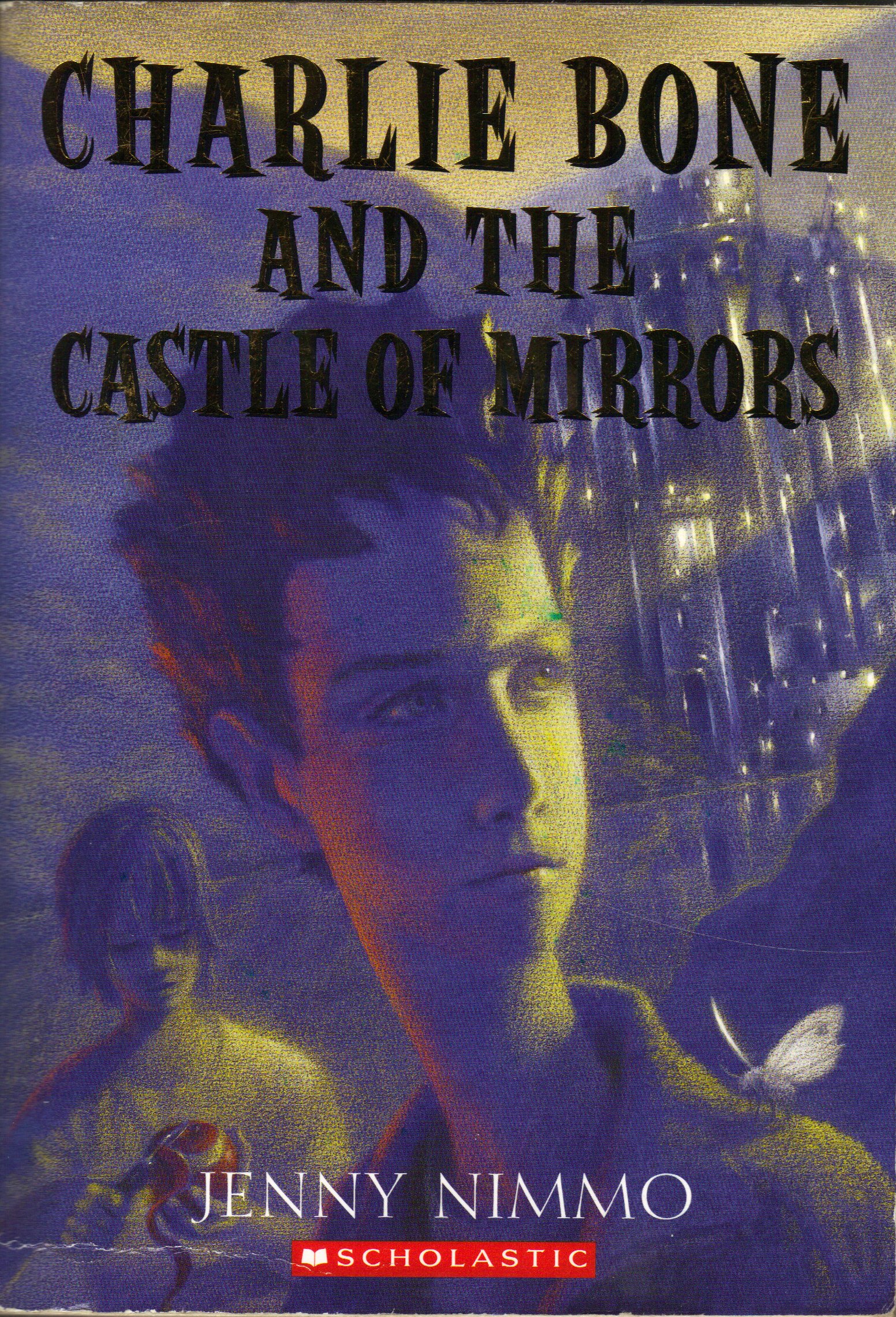
Charlie Bone and the Castle of Mirrors by Jenny Nimmo

Charlie Bone and the Castle of Mirrors is the fourth book in the Children of the Red King series by Jenny Nimmo.  I enjoyed this book, even though it is not my favorite in the series.  Charlie Bone is back for a new semester at Bloor’s Academy.  This is a school for students with magical powers.  Charlie Bone knows that he possesses magical ability, but he still has not fully learned the extent of his endowment. 

In this book, Charlie meets some new characters.  Billy Raven is an orphaned boy who has been adopted by a couple named Mr. and Mrs. de Grey.  The de Greys have magical powers, but it turns out that they are evil.  They force Billy to sign papers that contain oaths, which would compel him to do things against his will.  Billy becomes imprisoned in a mysterious place called The Passing House.  Mr. de Grey uses his magic to create a force field that prevents Billy from escaping.

My favorite part of the story is when Charlie Bone and his friends help Billy to escape from The Passing House.  They take Billy to the house of one of Charlie’s friends, named Gabriel Silk.  At Gabriel’s house, the papers with the oaths suddenly come to life, and attack Billy and his friends.  The friends need to join forces with their magical powers to rescue Billy from the evil magic of the de Greys.

One of my favorite things about this book is the development of the characters.  I especially liked to read about Charlie’s friends, Lysander Sage and Tancred Torsson.  They have special powers that prove to be very useful in this story.  This particular book may not be quite as exciting as some of the others in the series, but I definitely still enjoyed it.  I am not really sure why it is called The Castle of Mirrors, because that did not seem to be the most important part of the story.  Still, I am glad to have read this book, and I would recommend it to anyone who enjoys the Charlie Bone series.

-Simon H.

Charlie Bone and the Castle of Mirrors by Jenny Nimmo is available for checkout from the Mission Viejo Library. It can also be downloaded for free from Overdrive/Libby.

Keeper of the Lost Cities: Everblaze by Shannon Messenger

Everblaze, the third book Shannon Messenger wrote for this series (and the first one with a heart-wrenching cliffhanger, might I add), was the book Sophie found out her enemies were closer than they seemed. It begins with Sophie getting a request from the Council to heal Fintan, the leader of the now-named Neverseen. Fintan used to be on the Council, but after the Pyrokisis “incident”( involving 5 Pyrokinetics and some Everblaze), he was banned. Sophie and Keefe then go to check on Silveny, the sparkly alicorn.

They happen upon a tracker in her tail and immediately rush back home. A few days after, Sophie’s Linguistics Mentor Lady Cadence figures out that the tracker had Arrowmark on it. Arrowmark is an ogre technology/bacteria that is a homing device for their weapons. All of the school had to then be tested, and Sophie’s hand skin needed to be melted off (very gross, sadly it happens more than once).

With the 9th/10th book (Stellarlune) coming out in November, I re-read this series a lot. Each time, a find more details and funny moments I never knew were there. I recommend everyone to start reading this series, it is great fun and a good way to spend your spare time.

-Izzy W.

Keeper of the Lost Cities: Everblaze by Shannon Messenger is available for checkout from the Mission Viejo Library. It can also be downloaded for free from Libby.

Magnus Chase and the Gods of Asgard: The Sword of Summer

Magnus Chase and the Gods of Asgard: The Sword of Summer by Rick Riordan, is the first book in the Magnus Chase series. The book is connected to and placed in the same world Rick Riordan’s other popular mythological series Percy Jackson, Kane Chronicles, Trials of Apollo, Heroes of Olympus, and a few other books.

You might see some similar names in this book if you’re familiar with the Percy Jackson series. The Sword of Summer as you might expect is another mythological fantasy book this time about the Nine realms and the Norse Gods.

The book starts off with the main character Magnus Chase as a homeless guy, who dies. No, that is not a spoiler and is actually part of the title of the first chapter. By the way, The chapter titles can be very hilarious in my opinion at times. Anyways back to how the book goes. You have Magnus Chase who is a homeless orphan and ends up meeting his uncle. His uncle tells him of his godly heritage as Magnus is about to reach the age where monsters will start going after him. To not spoil the book that is as far as will go. I would recommend this book to any fantasy and mythology book lovers. It’s filled with action and world-building, however, be warned that it might take a while as it’s a 498 paged book.

-Luke G.

Magnus Chase and the Gods of Asgard: The Sword of Summer by Rick Riordan is available for checkout from the Mission Viejo Library. It can also be downloaded for free from Overdrive/Libby.

Odysseus: A Character Analysis

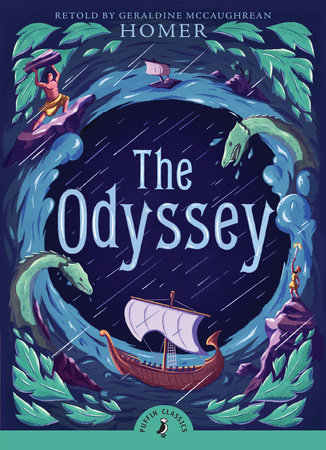
The Odyssey by Homer: 9780140383096 | PenguinRandomHouse.com: Books

Around 750 BCE, at the height of Greek civilization, a blind bard named Homer lived in Ionia, on the western coast of Turkey. Little is known about Homer, but his legacy lives on in his two great works – the Iliad and the Odyssey. While the former is formidable in its own right, it is in its sequel, the Odyssey, that Homer’s incredible craft is showcased. Detailing the adventures of Odysseus, the wily king of Ithaca, and his ten-year-long attempt to return to his country, the Odyssey explores lofty themes of human nature while remaining relatable to readers nearly three thousand years later. 

The poem can generally be split into three parts: immediately post-Trojan War, when Odysseus begins to set sail for home; the true odyssey, in which Odysseus must overcome many obstacles on his way back to his home; and the return to Ithaca, the chronicle of Odysseus regaining his rightful position as king. However, it is not the events of the poem that are worthy of note – instead, it is the behavior of the hero himself. Through the interference of the gods, whether to aid or hinder, Odysseus withstands harrowing experiences, all of which leave him a man and hero changed for the better. 

Odysseus is introduced to the audience as a god among men (in Ithaca, at least). However, this implies that Odysseus has never truly needed to better himself, making him vulnerable to hubris. Odysseus’ pride is justified to an extent, as seen when he and his crew are captured by the Cyclops, but Odysseus manages to trick the Cyclops and engineer their escape. However, just as they are about to sail away, Odysseus arrogantly stokes the rage of the Cyclops, not realising that the Cyclops he insults is the son of Poseidon, who then curses Odysseus. This is the catalyst for the change that Odysseus will undergo for the rest of the poem, because it makes it clear his pride will not serve him well in the future. 

In the ten long years between Odysseus’ departure from Troy and his arrival in Ithaca, Odysseus faces countless struggles that mold him into a character that is capable of overcoming his previously debilitating hubris. He meets characters who are equally as clever and wily as he is, forcing him to recognise people outside of himself. Famous characters who make an appearance during this arc are Circe, the wickedly powerful enchantress of the sea; Scylla and Charybdis, two sea monsters who devastate Odysseus’ crew; and Calypso, who successfully manages to trap Odysseus on her island for seven years. However, these experiences are mitigated by divine interference, notably via Athena and Hermes. 

By the final arc of the story, Odysseus has finally renounced his hubris and bowed to the will of the gods, while also being self-aware enough to understand his own worth. The situation in his country has deteriorated in his absence, and suitors of his wife, Penelope, have overrun the palace. Heeding the lessons of the past decade, Odysseus disguises himself as a poor beggar and wanders to the home of his loyal shepherd, Eumaeus, choosing to keep himself secret until he can determine who in Ithaca is truly loyal to him – a wise move, considering that the very next day, he is accosted by both one of his subjects and a suitor. By this point in his journey, Odysseus has learned how to let go of his pride with the knowledge that he will soon get his revenge. 

It is this that makes Odysseus a revolutionary hero: not that he is strong enough to kill all the suitors, but that he is clever enough to both withstand the abuse directed towards him while betraying nothing, and to trick the suitors into underestimating him until the fatal moment. Because of the way he handles the unfortunate situation he is in, although Odysseus does not fit the usual definition of a Greek hero (that is, all brawn and no brains), throughout his journey, he learns to be a more balanced heroic figure, which undoubtedly cements his status as one of the foremost heroes in literature for all time.

– Mahak M.

Homer’s The Odyssey is available for checkout from the Mission Viejo Library. It can also be downloaded for free from Overdrive.

Keeper of the Lost Cities: Flashback by Shannon Messenger

Shannon Messenger’s (soon to be 10) book series called Keeper Of The Lost Cities is a series about a 12-year-old girl named Sophie Foster who finds out she is an elf. She goes through many tribulations (with and without companions), makes and loses friends, and tries not to get killed when she leaves the safety of those she trusts.

In Flashback (the seventh installment and the book I’m reviewing), Sophie goes to a hearing for one of the Neverseen (the bad guys). The elf on trial, Alvar, was a spy from the most prestigious family, the Vackers. Since elves have an indefinite life span, the entire Vacker family was there. Also, there were Sophie’s best friends Fitz and Biana Vacker (siblings), and Keefe Sencen, whose mother is the leader of the Neverseen. Alvar claims that he has no recollection of anything, and he wants to prove himself worthy of earning everyone’s trust back. The Council (the governing system of the elves, consisting of 12 members) rules Alvar half-guilty for reasons of amnesia. Fitz (and his anger issues) finds this completely wrong and sore, so he stomps out of the trial chamber. Sophie follows him to a desert cave, where they start to train with weapons. 

As not to spoil the book, I won’t summarize anymore, but I give this book a 10/10. It is a fabulous book to read, and I highly recommend it to anyone who likes fantasy/fiction.

-Izzy W.

Keeper of the Lost Cities: Flashback by Shannon Messenger is available for checkout from the Mission Viejo Library.

Authors We Love: Elisabetta Dami

Although the most acknowledgeable authors tend to be writers of adult novels or even young adult books, it doesn’t mean that children’s book authors should get any less credit. At around age seven or eight, I remember my mom and I would visit the Mission Viejo Library practically every week. I would always go to the children’s section and look for another book to read—specifically any book from the Geronimo Stilton series. Only now in my high school years would I finally reminisce on my past and realize who was behind all of the stories that established my love for reading.

An award-winning author with her worldwide Geronimo Stilton and Thea Stilton books, Elisabetta Dami was born in Milano, Italy. Her father was a writer himself before she was born, so by the age of 13, Dami was already working for him as a book editor. At 19 years old, she began writing stories of her own but only began publishing them later in her life. In her 20s, she went through a series of adventures by earning her pilot license, traveling all around the world, running marathons, and even immersing herself in indigenous cultures.

With a passion for seeing the world, volunteering for sick children, studying different cultures around her, and creating once-in-a-lifetime experiences, Dami incorporated her love for adventure into stories for children. This was essentially the birth of the Geronimo Stilton series. The first book was titled, Geronimo Stilton: Lost Treasure of the Emerald Eye (2000), starring a shy mouse who owns a newspaper company, yet falls into the most dangerous situations and uses academic knowledge to find his way out.

As the popularity of the series grew, Dami continued writing more books that branched out to create a world of her own. Some of her best books include The Kingdom of Fantasy (2003), Cat and Mouse in a Haunted House (2000), and The Phantom of the Subway (2000). The author has written over 100 children’s books, published them in 49 different languages, and has sold 180 million copies globally. She continues writing at the age of 63 and helps kids all around the world develop a profound love for reading.

I used to be a huge fan of Elisabetta’s novels; as I look back on my childhood, I’m able to see how much of an impact her books had in my life. Although it’s relaxing to sit down with a nice book, I admit that my passion for reading has somewhat diminished. Perhaps it was easier to entertain children through the art of storytelling than in our modern age, or maybe it’s simply because I haven’t picked up an enticing book in a while. Nonetheless, it’s always nice to appreciate—and thank—the authors who hold a centerpiece of our childhood.

– Natisha P.

Book Review: Bridge to Terabithia by Katherine Paterson

Bridge to Terabithia by Katherine Paterson follows a young boy named Jess Aarons who aspires to be the best and fastest runner in the whole fifth grade. One day, a new family is moving into the old Perkins home and Jess meets the young girl, around his age, who is moving in with her family to the country. Leslie Burke is a city girl. She is strange to others, they say she dresses weird and she isn’t like all the other girls. Leslie and Jess then become friends over time during school. They talk about things and enjoy each others’ company. They spend their days together hanging out and they even create their own secret and special place just for themselves. A place where they can just be themselves and have fun together called Terabithia.

Together they ruled Terabithia, letting their imaginations roam free in their kingdom. On one morning, an upsetting and horrible accident strikes for the two kids. But because of this event, Jess gains the courage and strength to move forward. It shows Jess that he could be more than he thought he could be and it gives him a new goal and reason for living.

This story was beautifully written. The characters had great chemistry with each other and worked well. All characters, including the side characters, were well written and enjoyable even if we didn’t get to interact with them as much. The ending was unexpected and abrupt which I thought brought more impact on the story; especially since the accident can easily happen just like that in real life. Warning! This book is better for more mature readers because of the topics it will go over. Overall, I enjoyed this story very much even though it was a quick read. Even in such a short story, it got me attached to the characters and impacted me hard. I really enjoyed it and would recommend to those who would be interested.

-Nicole R.

The Bridge to Terebithia by Katherine Paterson is available for checkout from the Mission Viejo Library

Book Review: Candide by Voltaire

Comedic. Sarcastic. Dark. What is not to love about the classic novella by Voltaire? It integrates comedy with a whole lot of skepticism, and mocking of the wealthy…quite a unique take indeed! 

The story of Candide follows Candide himself, the main protagonist, who resides in his comfortable abode in Germany. The Baron Thunder-ten-Tronckh owns the property which Candide resides in, along with the Barons daughter Cunégonde and the philosopher, Pangloss.

The Baron, catches him kissing his daughter and subsequently kicks Candide out of his home. Almost immediately, Candide is forced to enlist in the army, yet returns home to find that it was invaded by the enemy, and his beloved Cunégonde was killed in the aftermath. However, luckily for Candide as he travels to other parts of the Europe, he encounters people who help him navigate his life once more… 

After finding out that his precious Cunégonde is alive, Candide sets out on a series of endeavors in order to find her. He encounters people of all faiths, backgrounds, nationalities, and demeanors.

All of these help Candide oppose the idea constantly reinstated by Pangloss, the all-knowing philosopher, that “all is for the best”. However, contrary to his belief in his teacher, Candide begins to form his own perception of the world around him and towards the end of the book realizes that all is not for the best. 

The novella is extremely fast-paced. It is good for individuals who like a quick, fast read. I loved it because I was never bored, and the story was always straight to the point. Voltaire does a good job at employing sarcastic bits here and there and constantly uses Candide and Pangloss to mock the status quo present during his time.

-Haana F.

Candide by Voltaire is available for checkout at the Mission Viejo Library.