Anthem by Ayn Rand

Anthem, a dystopian novel by Ayn Rand, is certainly a unique piece of literature. Described by herself as not a book, but a poem, and with a plot lasting less than 50 pages, Anthem is an ode to Objectivism. Written in 1937, imagined in the Soviet Union, Rand wrote the book in a time of political turmoil, which is reflected in her writing.

The story follows Equality 7-2521, a man who lives in an entirely collectivist society. Forbidden to think individual thoughts or exercise free will, Equality knows that something is wrong with the world he lives in. Since he was a child, he was different than his peers: he was always curious. When it is time for him to be assigned a job, he is not given the job of a scholar, as he wishes, but is sentenced to a life sweeping streets for this essential sin. However, this dark future opens up to light, quite literally, when he makes a revolutionary discovery.

Without spoiling the plot of the story, I can say that the book praises the human ego. Ego seems today to have a negative connotation, like a person obsessed with themselves. It can almost be confused with narcissism. Whatever picture that you have in your mind of “ego”, put it out. In this context, Rand praises man’s control over his own mind, man’s independence, and man’s freedom to learn, be successful, and make choices for himself. As shown in the book, ego is a beautiful thing that society falls apart without. Anthem is the perfect, short read for anybody who wants to have more food for thought than even some average length novels can provide.

-Mirabella S. Grade 9

Anthem by Ayn Rand is available for checkout from the Mission Viejo Library. It can also be downloaded from Overdrive

Taken by Erin Bowman

taken_erinbowmanIn the small town of Claysoot, enclosed by a Wall, lives a 17-year-old boy named Gray. Today is the day of his older brother’s 18th birthday.  However, in Claysoot, when a boy turns 18, he disappears. They all do. And, everybody just accepts it.  So, tonight, as it turns midnight, Blaine, Gray’s brother, will be Heisted.  But, Gray is not ready.  He is not ready for his best friend and brother to leave him.  He is not ready to see Blaine’s little daughter’s face when she sees her father will never come back.  But, how can Gray stop fate from happening?

Well, there is one thing.  But, anyone who has ever tried it comes back blackened and burned as a result of climbing the Wall.  Gray considered climbing over it, but always thought it to be too dangerous.  Instead, Gray spends his last day having as much fun as he can with his brother.  But, it didn’t feel real.  Every moment, he would think that just at this very time tomorrow, Blaine would not be there.  He would be gone.

Forever.

But, Gray had to accept it.  So, as he walked up to the stage during Blaine’s Heisting ceremony, he said his final goodbye.  At this point in the story, I was reminded of the classic Italian song, Time to Say Goodbye made popular by U.S. singers Bocelli and Brightman.  It’s heart wrenching chorus brings alive the emotion that Gray is feeling. As Gray gave his brother a hug, Blaine did something strange. He winked. This made Gray very confused, but the time had come for Blaine to be Heisted.  The ground rumbled, there was a flash and his brother was gone.

Forever.

Or so he thought… If this were a movie, here I would insert in the suspenseful tri-tone bum bom bam! to intensify the mini cliff hanger.  Read the book to find out what happens next!  I really enjoyed it!  And, I give the first book in this Taken trilogy a 9/10 for its intriguing dystopian literature.

-Maya S., 9th Grade

Taken is available for checkout from the Mission Viejo Library

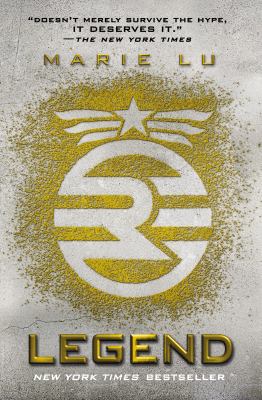
Legend by Marie Lu

legend_marieluAs we all know, traveling into the future is not easy. However, Marie Lu’s book, Legend, goes against this theory, by letting us interpret her version of a dystopian Los Angeles. Told in the perspective of two characters, this book introduces two different sides of society and how changes made in the present affect the future.

Day, from the poor areas of Los Angeles, is the government’s most wanted criminal. With cunning skill and determination, he steals medicine to treat his brother from a miserable plague that is killing civilians. June, on the other hand, is the government’s prodigy, whose brother appeared to have died at the hands of Day. To avenge his death, June goes out on a mission to hunt down this criminal and bring him to justice. However, the two enemies unexpectedly join together as allies through a little romance and shared curiosity of the government’s secrets. Together they realize that the government has been corrupting all of its people, and June and Day are only pawns in the entire plot.

Similar to that of The Hunger Games and Divergent series, Legend is set in a futuristic vision of the United States of America. Marie Lu really emphasizes her understanding of the book’s setting by describing the whole scene of the dystopian world and offers a little background to describe what happened between our present time and book’s future setting. In addition, the Legend series is much more intriguing to read than other dystopian series because the novella itself is easier to relate to and is as action-packed as The Hunger Games. Even better, the action occurs in the busy streets of LA rather than an enclosed arena. On a scale of one through ten, this book is a nine and a half because its description is wonderful. There are some cliffhangers, especially leading into the next books of the series (Prodigy and Champion). I would recommend this book to those who have read The Hunger Games or Divergent and would love to compare the stories and share what you think in the comments below!

-Riley W.

Legend is available for check out from the Mission Viejo Public Library

Earth Girl by Janet Edwards

earthgirl_janetedwardsEarth Girl is a dystopian novel set centuries in the future. Eight hundred years into the future, humans are able to travel through portals. These portals allow them to conquer the furthest stars. Unfortunately, not all of humanity gets to experience traveling in a portal. A fraction of humans have a genetic defect, which prohibits them from interplanetary travel, and are forced to live their lives on Earth. Jarra, the main heroine of the story, is one of them. After finding out about their child’s defect, most parents abandon their children who are often referred to as “throwbacks.”

Despite her limitations, she does not get discouraged of pursuing her dream. Creating a feigned military background story, Jarra joined a group of students from all over the galaxy in a practical Earth study class. Jarra plans to prove to “normal” people that “throwbacks” are capable of completing complicated tasks. She wants to surprise her classmates by revealing her identity as a “throwback.”

In this class, the students excavate remains from Earth’s ancient, abandoned cities. Jarra’s skills are tested when an unstable, ancient skyscraper traps another research team under it. Having practiced excavating rocks (called “tagging” in the novel), Jarra is the hero of the day when she helps dig out the team. Her rescue has put her into the limelight of her classmates, which is not something she needed for her plan. To see if her plan of tricking her classmates worked, I suggest reading this unique book.

I picked up this book because I found the plot intriguing. Interested in how Jarra would trick her classmates, I also thought that it would be cool how her classmates would eventually react. The setting was another aspect of the story that I enjoyed. Even though the story takes place on earth, the explanation of how their world was built is amazing. The only aspect of the book I did not like was were the class excavations because the author went a bit to deep with the history and science of the process. Well wrapped at the end, I cannot wait to start the second one and see what Jarra has in store for her life.

-Anmol K.

Earth Girl is available for check out from the Mission Viejo Public Library.