
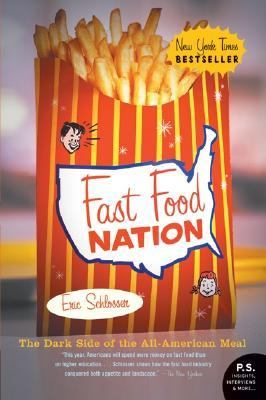
Fast Food Nation Book Review

“Twenty years ago, teenage boys in the United States drank twice as much milk as soda; now they drink twice as much soda as milk.” ~ Eric Schlosser

So, let’s talk about Fast Food Nation by Eric Schlosser. This book rips off the veneer and presents some harsh realities for anyone who has ever wondered what actually goes on behind the neon-lit drive-thrus and golden arches. The system that supports the fast food industry, from factory farms and worker exploitation to the hazardous meatpacking industry and the horrifying realities of food production, is more than just greasy food.

Schlosser delves deeply into how fast food spread around the world, influencing not only what we eat but also how we work, how we farm, and even how we view convenience. Indeed, there are some really unsettling parts of it. He reveals how fast food companies use marketing to target children, the hazardous working conditions in slaughterhouses, and how the industry’s drive for efficiency frequently comes at the expense of public health. Warning: You may want to reconsider your next burger.

What I appreciate about this book is that it’s not just a hit piece on McDonald’s (though they do take some heat). Schlosser connects the dots between corporate greed, government policy, and the way our food system has evolved into something pretty unrecognizable from the farms of the past. It’s like The Jungle but for modern times.

Is it enjoyable to read? Not precisely. However, it’s captivating. Schlosser blends factual information with true stories to give everything a personal touch, writing like a journalist who has done their research. This book is worth reading if you’re interested in environmental and public health issues or simply want to understand what’s actually in your food. But fair warning: It might not be a good idea to pick it up just before lunch.

Would I recommend it? Yeah, but with a warning: once you know this stuff, you can’t un-know it.

Fast Food Nation by Eric Schlosser is available for checkout from the Mission Viejo Library. It can also be downloaded from Libby.
Why Do We Love Fast Food?

Fast food is unique in American culture. Why is it so popular? The reasons- convenience, affordability, and societal influence. In every corner of every neighborhood, there’s always a convenience store, a McDonald’s, or other fast food restaurants. Our country is keen on fast food.

On every corner of every city and neighborhood, fast food chains dot the landscape because families like fast and familiar meals that have become a staple for many. What is the reason for this love of fast food? It has unparalleled convenience.

Fast food offers a solution in a society where time is a precious commodity. If you need a quick lunch and are short of time, these fast food places provide meals in minutes, require minimal effort and time commitment from buyers, and don’t taste bad either.

Affordability plays a significant role in the appeal of fast food. With menu items often priced competitively, they are so affordable that even young kids can afford a burger or fries.

Another factor that makes fast food a significant influence on our culture is the influence of advertising and marketing; this is the key factor in shaping the culture surrounding fast food. Fast food chains have successfully ingrained Americans from a very young age through strategic campaigns emphasizing convenience, taste, and value. TV commercials, social media promotions, or sponsorships make fast food popular among young children and teens. They have been ingrained in the American psyche as a quick, enjoyable dining experience.

Beyond practical considerations, fast food has become woven into the fabric of American social life. These restaurants also serve as gathering places for friends and family; students meet here for meals and study together.

The consistency and predictability offered by chain restaurants contribute to their enduring popularity. With standardized menus and quality control measures, we, as buyers, know what to expect when visiting our favorite fast-food restaurants. Fast food is a multimillion-dollar industry, and these restaurants are out to make the culture ingrained in our minds.

The love affair with fast food in America is complex due to convenience, affordability, marketing prowess, and social dynamics. It reflects changing dietary habits and broader shifts in lifestyle and consumer behavior. As fast food continues to evolve and adapt to new trends and tastes, its place in American culture remains secure and will only become more widespread.

My hope is that the widespread fast food trends will change according to our healthier lifestyle choices, help our population become more fit, and provide a means for younger generations to have fewer food-related illnesses.

Here’s to better, healthier fast food!

Bella H.

Chick fil A vs Raising Canes

Fried Chicken is one of the most iconic foods that almost everybody loves. However, everybody has different ways of obtaining fried chicken. One popular place that people get fried chicken is KFC. However, it is widely agreed that KFC is not the best friend chicken chain. So what is? There is no definitive answer to this, but most people agree that it is either Chick-Fil-A or Raising Canes, and I want to give my opinion on this topic.

Everybody loves a good chicken sandwich from Chick fil A on a Friday night. In fact, the only thing better is a box combo from Canes on a Sunday evening. Although Chick Fil A does a lot of things right, Canes has higher quality chicken and is cooked better. However, I will agree that Chick fil A does season their chicken better. Unfortunately, that is about as good as it gets for Chick Fil a, as Canes stands out in nearly every other perspective. One of which, is that Canes serves Texas Toast and their signature sauce with nearly every meal.

When it comes to fries, Chick Fil A’s waffle fries are about neck and neck with Cane’s crinkle cut fries. Both are usually cooked similarly, and is a very pleasant side to the chicken we order. However, Canes’ crinkle cut fries are better, as they are cut in a way that is less messy and easier to eat.

So that is why I believe that Canes is better than Chick Fil A.

~Jeremy

Teen Read Week: Fast Food Nation by Eric Schlosser

fastfoodnation_ericschlosserFast food has become an inescapable aspect of the modern world—especially for Americans. We drive along the freeway, see the recognizable Golden Arches, and think it’s typical to pick up an order of burger and fries after a long, stressful day since we are just too lazy to make the effort to cook a healthy meal. The obesity rate in America has soared in recent years. How can we escape the chains of fast food that have grown to be so normal in our daily lives?

In the non-fiction work, Fast Food Nation: The Dark Side of the All-American Meal, Eric Schlosser explores one of the largest industries in the United States, and perhaps, one of the most harmful. Focusing mainly on the McDonald’s corporation, Schlosser chronicles the rise of the fast food industry, which has grown at a remarkable rate. Why is it that ninety-six percent of American schoolchildren can identify the Golden Arches and Ronald McDonald before Mickey Mouse? How has the McDonald’s brand become so well-known throughout America and the rest of the world? From the farms where the cattle and potatoes are cultivated, to the meatpacking factories, to the restaurants, to our mouths, he explains the making behind the hamburgers and fries we consume. The aim of Schlosser’s book is to raise awareness of the unseen consequences of fast food and cause readers to contemplate “the dark side of the all-American meal.”

After reading Fast Food Nation for a summer assignment, my whole view on fast food has definitely changed. I’m sure everyone knows that fast food has dire consequences, but Schlosser brings to light many of the secrecies that are skillfully hidden from the public. The detailed account of dangers of working in the meat factories, as well as the sanitary issues of how meat is processed, is appalling. I usually don’t prefer to read non-fiction works, but Fast Food Nation was definitely a captivating, eye-opening read that I recommend to all Americans of any age, for it will forever make you question that burger you are about to chow down.

-Kaylie W., 11th grade

Fast Food Nation is available for check out from the Mission Viejo Public Library.