Persepolis: The Story of a Childhood by Marjane Satrapi

In my English class, we read the graphic novel Persepolis: The Story of a Childhood by Marjane Satrapi. The French-Iranian author of children’s books, graphic novels, cartoons, illustrations, and films created Persepolis as a memoir of her childhood when she lived in Iran during the Iranian Revolution.

To put the Iranian Revolution in perspective, the Islamic Republic of Iran, a theocracy ruled by Ayatollah Ruhollah Khomeini, was founded in 1979 after a series of riots and demonstrations that overthrew the Shah of Iran. The Shah was overthrown for a number of reasons, including political repression, economic difficulties, and public dissatisfaction with his rule (such as unrest brought on by the Shah’s westernization of the nation).

At the age of 10, Marjane Satrapi was forced to transfer from a coeducational French school to a girls-only school during the revolution. She was also required to cover her hair because the new Islamic regime enacted a law that, for religious reasons of modesty and dignity, required women to wear veils in public. The veil is a powerful symbol in the story because it stands for feminism, identity, and the oppression of women in Iran. Other struggles her family endured, like the Iraq War and her uncle’s execution for opposing the Shah and holding communist beliefs, are also covered in the book.

In AP World History, I formally learned about the Iranian Revolution and the overthrowing of the Shah. Once I read the book, I realized that people actually lived through the revolution and had to undergo the harsh conditions and the changes the new Islamic Republic established. Some of my friends’ parents experienced the revolution and describe it as fearful and deadly, and its long lasting outcome as a royal disaster for the Iranian people.

Persepolis: The Story of a Childhood by Marjane Satrapi is available to check out from the Mission Viejo Library.

Happy reading!

– Sophia B

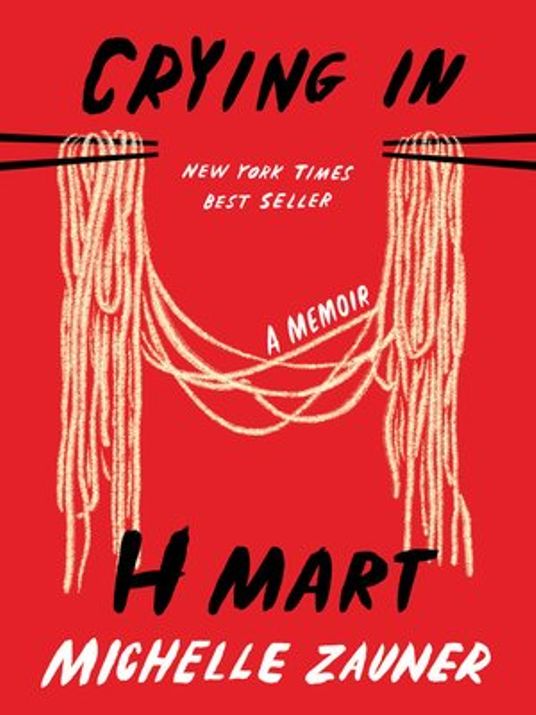
Crying in H Mart: How Food Connects Us

This summer, I had to choose a memoir to read for my AP Lang course. My friend and I chose Crying in H Mart so we could read and discuss the book together. Crying in H Mart has become one of my new favorite books.

When Michelle Zauner finds out her mother has been diagnosed with cancer, she puts her life in Philadelphia on hold to be with her mother. Told plainly and honestly, Zauner describes growing up Korean American, her strained relationship with her mother, and dealing with grief. At the center of it all is her and her mother’s shared love of food.

Reading this memoir was deeply thought-provoking as an Asian American. In the United States, when you can’t go back to your home country, food is the easiest way to connect to your culture. After all, what is the one thing all humans have to do? Eat. Our cultural recipes connect us to our ancestors and allow us to preserve the past. After Zauner’s mother’s death, she cooks Korean dish after Korean dish. All her life, she has never felt Korean enough. Cooking is how she reconnects to her heritage and her memories with her mother. Michelle Zauner provoked me to think about how food fits into my life and how it connects me to my heritage, especially when I feel torn between so many cultures. I know I’m not alone in the sentiment that I don’t feel Asian enough for other Asians and I don’t feel American enough for other Americans.

I am of Pakistani, Burmese, and Indian heritage. I have never visited these countries but when I eat my grandma’s shrimp biryani, or I slurp the broth of the Kaukswe my mom learned how to make from her dad, I feel as if I am home. Food is what ties my family together. We were all born in different countries: Burma, Pakistan, India, and America, but when we all sit down at the dinner table, we are all tied together by the same string. Food.

Crying in H Mart by Michelle Zauner is available to check out from the Mission Viejo Library. It is also available to download for free from Libby.

Crying in H-Mart by Michelle Zauner

I don’t usually read nonfiction. I’m more of a fantasy, love-story, novel, kind of person. But starting this year, my first assignment was to read a memoir. Any memoir of our choosing, so long it was about overcoming adversity. At first, I struggled to find a memoir that really interested me, but somewhere in the back of my mind, this one came to mind. I must have seen or heard about this memoir somewhere because once I found it, I immediately purchased it. 

Crying in H-Mart by Michelle Zauner is a memoir in which Zauner must deal with the grief of losing her mother from cancer and learn to come to terms with her own identity. Zauner recalls her memories of when she was younger, how she had once looked up to and thought so highly of her mother to when she grew and began to resent her instead. Zauner lists disagreements she had with her mother and her own personal battles she faced throughout high school. However, it is only when she is through college and away from her family does she get the call that her mother has cancer. As she watches her mother fade, Zauner worries that losing her could also cause her to lose much more. 

This memoir really made me think about my own life. I had never really once thought about what would happen when my parents are gone. It’s not a fun topic to think about and definitely harder to talk about. But hearing Zauner’s personal story, it seemed to connect to my life in a way. I am a musician myself and of Asian descent. However, what I really connected to were the family dynamics. Specifically the connection Zauner had with her mom. I’ve had my fair share of disagreements with my mom, many talks and exchanged opinions. But I’m always–still am–looking for her approval, her advice, and her support. My mom is the one I go to and have true heart-to-heart conversations and without her, I might lose myself–just as Zauner nearly did. In losing her mother, Zauner had a hard time finding her identity–in both her culture and path. Without the advice and ties to her mother, Zauner felt lost in what to do until she could find her again through other means. I’m scared to lose my mom; whenever I need to go to someone, the first person that comes to mind is usually my mom. So without her, I may feel just as lost, but perhaps with this perspective, I can find ways to accept the loss and carry on when it inevitably arrives.

I also connected to the familial ties. I usually see my dad’s side of the family since they live here in the United States. My mom’s side lives in the Philippines–like Zauner’s mom’s side lives in Korea. I don’t see them much and when I do, it’s way harder for me to warm up to them. But in reading Zauner’s experience, it is important to connect to those you can to help cope and grieve. And that while I may not see my mom’s side of the family much, they will come to my aid just as I would for them. 

Crying in H-Mart opened up my perspective, showed what my future could look like, and helped me raise my appreciation for my family, friends and the ones I care about. While we take each other for granted at times, this memoir has helped me remember that nothing is forever and they will leave someday. The only thing we can do is spend time with them, love them, and keep them in our hearts and memories. Crying in H-Mart is a fantastic true story on Michelle Zauner’s struggles and overcoming them. It is one that I found myself relating to and one I will highly recommend to everyone.

-Nicole R.

Crying in H Mart by Michelle Zauner is available to checkout from the Mission Viejo Library. It is also available to download for free from Libby.

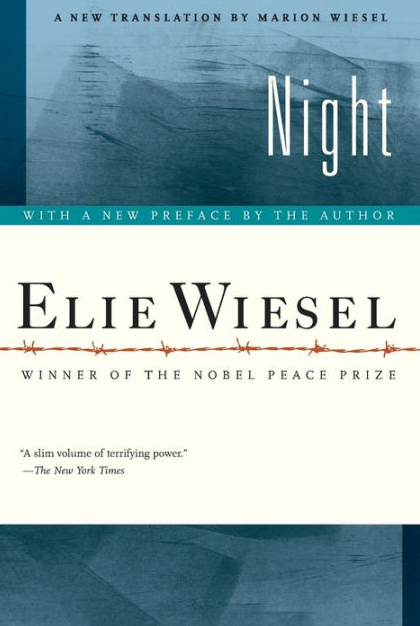
Night by Elie Wiesel

I must confess that when I first learned that we would be reading Elie Wiesel’s Night for my English class, I felt a mixture of anticipation and trepidation. But what can I say? It’s a requirement, so I read it with little to expect. I was wrong in many ways. Just a warning: this review contains spoilers.

It is a memoir that speaks about Wiesel’s experiences as a young Jewish boy during the Holocaust. Wiesel doesn’t just recount events; he invites us to walk beside him through the labyrinth of his memories, where each step is heavy with the burden of the past as he recounts his life in the small Transylvanian town of Sighet.

In the tranquil streets of Sighet, we glimpse the idyllic innocence of Eliezer’s childhood; young Eliezer’s world is filled with the simple joys of family, friendship, and the pursuit of knowledge.

He studies the Torah and the Kabbalah, taught by Moishe the Beadle. His studies are cut short when his teacher is deported. Months later, Moishe comes back, saying that the Gestapo took charge of his train, led everyone into the woods, and butchered them. Nobody believed him and called him insane. Then in the spring of 1944, the Nazis take over Hungary. The Jews of Eliezer’s town are forced into small ghettos within Sighet. They are herded onto cattle cars and forced to spend days and nights crammed into the car, exhausted and near starvation, until they arrive at Birkenau.

Wiesel recounts his journey through the terror of Auschwitz and Buchenwald, where he experiences the brutality of the concentration camps firsthand. Wiesel sees many horrible things that scar him for life, recounting his and the experiences of many who had tried to hide whatever happened. Wiesel doesn’t hold back and tells everything, all the terrible things he went through during the Holocaust. He doesn’t sugarcoat it or leave anything out. This honest account of his experiences helps us understand how awful it was and how much it hurt him and everyone else who went through this dark time in history. I found myself transported there with him as he struggled to survive.

In the end, Night is more than just a memoir; it is an essential memory of one of the darkest chapters in human history, the Holocaust, and what many had to go through during that tragic time. It’s also a reminder that even in our darkest moments, there’s hope to be found. The memoir is exceptionally well-written and retells an authentic and meaningful story. Through his assertive storytelling and unflinching honesty, Elie Wiesel ensures that Holocaust victims will never be silenced. If you want to experience this memoir, it is available at Mission Viejo Library.

Here’s to a new reading experience!
Bella H

Night by Elie Wiesel is available to check out from the Mission Viejo Library. It is also available to download for free from Libby.

Book Review: Blue Nights by Joan Didion

Blue Nights by Joan Didion explores the death of the author’s adopted daughter, Quintana Roo, by discussing her experience with parenthood and growing old.

Didion recounts many moments in her life in her memoir, filling each chapter with bittersweet memories of her daughter. Didion also shares many personal moments in her life, ranging from her early childhood until this memoir’s publishing. In recalling both her daughter’s life and her own, Didion questions whether she made the right decisions in motherhood while simultaneously grieving the loss of her husband. 

What makes Didion’s novels different from other memoirs is the way she puts her memories into words. The way she recalls remnants of her life and shares her every thought is unique from other writers; her work is so personal, it’s as if we are both watching her grieve her loved ones while also feeling sympathy for her. The writing in Blue Nights constantly reminds us that healing does not happen overnight. Despite the emotional premise of this memoir, Didion’s writing style remains consistent with her other works: beautiful and detailed. She brings so much emotion to her writing and executes each scene poignantly without holding her feelings back. Her ability to be vulnerable yet precise in writing is beyond admirable, making each of her memoirs beautiful in its own distinctive way.

In all honesty, I was hesitant about reading this book after hearing how saddening the premise was. However, I later found myself in awe of this memoir because of how powerfully Didion describes grief. Blue Nights is a perfect representation of grieving because her feelings shine through each passage, but also because the novel itself is her healing process. Whether she is writing symbolically or being straightforward, her hard-hitting words left me empathizing with her for every page turned. Didion and her daughter shared a very loving relationship, and she even references Quintana Roo’s love for Malibu when talking about her daughter’s childhood and marriage. Didion’s admiration for her loved ones is apparent throughout her memoir, but she allows them to live on even after their passing. The battle that Didion faces with grief is more than inspiring, and her unique writing demonstrates that. 

Blue Nights by Joan Didion is available to check out from the Mission Viejo Library. It is also available to download for free on Libby.

Crying in H Mart by Michelle Zauner

*this review may contain spoilers

I actually decided to read this book for my English class because we had to pick out a nonfiction memoir and decided that the cover looked cool. I’m forever glad I choose this book because I’ve never been touched by a book this much.

Michelle Zauner begins talking about her childhood and her association with supermarket chain, H-mart. The story follows along Zauner’s life story and specifically her relationship with her mother. Throughout the book, it’s been evident her mom has been experiencing health complications and Zauner touches back to her Korean roots to feel a connection with her mother. When her mother got diagnosed with cancer and ended up dying shortly after treatments, the readers get to feel Zauner’s emotions and her thoughts while all of these events unravel.

This story had me on the verge of tears especially since I’m also Korean so I felt connected with the author through the various Korean terms and phrases she used. She reminds me of myself and how we connect with our heritage. However, the relationship she had with her mother makes me want to feel more sympathetic towards my family and the time I have with them.

I highly recommend this book for those trying to branch out and look for new genres such as nonfiction memoirs. While reading this book, it felt like I was invading on her personal life but there is always a reason why someone shares their story. Take the message from the story with heart and keep reading!!!!

Crying in H Mart by Michelle Zauner is available to checkout from the Mission Viejo Library. It is also available to download for free from Libby.

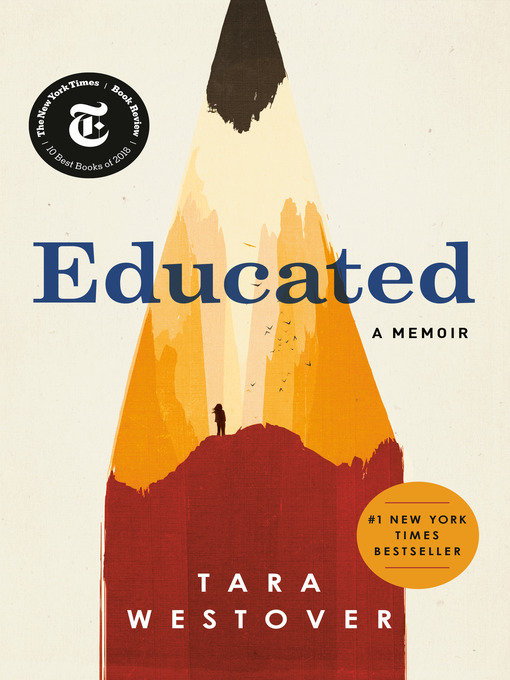
Educated by Tara Westover

With overwhelmingly positive reviews from Bill Gates, Barak Obama, as well as consistently winning the best memoir of the year in 2018 by multiple institutions, I had to see if this book lived up to all the hype it seemed to be receiving from everywhere. 

Needless to say, it went above and beyond my expectations. 

Educated is the author’s own story of growing up in a survivalist family that did not allow anyone, least of all Tara, an education. It is the journey of her breaking free from the destructiveness of her family and ending up studying at Cambridge and Harvard.

This memoir is easily one of my favorite books I’ve ever read, if not only for the powerfulness of it. Throughout the memoir, you go from pitying Tara, to pride for all that she’s accomplished. 

One trait I love about Tara is her determination. As she starts studying for the SAT, she knew almost nothing and had to learn almost all of it by herself. For example, when she started practicing trigonometry for the first time, she had the math level of a 5th grader. But as she studied more and more, and was so driven that she passed the SAT without receiving any instruction other than her brother Tyler and some books. 

This book affected me in such a deep way that I feel as if it will resonate with me forever. Now whenever I’m doing my schoolwork and feeling unmotivated, I think about Tara and how hard she had to work to just prove she had what it took without proper schooling to get into high prestige schools. She was very independent and as someone who is striving to do so, Tara is someone I look up to.

Now because of her upbringing she did have a lot of mental health issues. After discovering herself, she was pushed away by her family. Even though she had spoken out to her other family members about how manipulating and damaging her childhood was, almost no one believed her. Because of this, her family ignored her, and even though they have been the root of almost all her problems, she finds herself heartbroken over this. 

But the main thing her family has done to her was the manipulation of ideals they have put upon her. As she was growing up she was taught that the government and all of its institutions were part of the illuminati and were out to kill them. The only thing Tara’s parents willingly taught her about was religion. In fact, when she attended college she couldn’t write the way other student did because she learned to read and write only from mormon texts, she had almost no idea of how to function in a normal society. When going through with all this manipulation her parents justified it in their name of their faith, but it is clearly radicalism, and it is so, so frustrating to read about. 

And with that I leave with you a quote from the memoir that perfectly encompasses the idea of finding your own truth:

“Everything I had worked for, all my years of study, had been to purchase for myself this one privilege: to see and experience more truths than those given to me by my father, and to use those truths to construct my own mind. I had come to believe that the ability to evaluate many ideas, many histories, many points of view, was at the heart of what it means to self-create.”

-Asli B.

Educated by Tara Westover is available for checkout from the Mission Viejo Library. It can also be downloaded for free from Overdrive.

True at First Light by Ernest Hemingway

True at First Light eBook by Ernest Hemingway | Official Publisher ...

True at First Light: a novel written by Ernest Hemingway after a trip to Italy and his return from hunting in 1949. It reflects the author’s abhorrence of war, his concern for the future of mankind, and his reflections on the value of life, love, and death. The book’s title, taken from the dying words of Confederate General Thomas Jackson during the American Civil War, shows Hemingway’s tough-guy character — and that of himself — facing death. Although the novel is not his most famous work, it reflects the personal life of the writer incisively and vividly from one side, so that readers can have a comprehensive understanding of Hemingway.

Hemingway went on his second safari in 1953-1954 with his fourth wife, Mary Welsh. The couple, along with several locals who were working with them as their helpers, hunted a vicious lion. They also shot some gazelles, leopards, and sand hens on the way, which reflected the author’s pure and friendly sense of loyalty to the ignorant and loyal African indigenous people, Mary’s positive attitude towards learning shooting and training courage, and the happy atmosphere of their life together. Hemingway’s local girlfriend, Debba, is described in the book as “his fiancee” by Mary.

This girl was quite close to Hemingway, but she did not affect the relationship between the couple, showing a precious spirit of mutual consideration between people. An intricate counterpoint of alternating fiction and truth forms the heart of this memoir. In many passages, the author makes extensive use of this polyphonic tone, which will no doubt please any reader who enjoys this kind of music. True at First Light is a manuscript by Ernest Hemingway. The original was published in July 1999, just in time for the writer’s centenary.

What sets this book apart from many of his other novels is that it is an autobiographical novel written in the first person, so it feels intimate to read. It is a detailed and vivid account of the author’s second safari in Africa from 1953 to 1954 with his fourth wife, Mary Welsh, and reflects Hemingway’s affection for the uncomplicated natives.The book is permeated with a cheerful atmosphere, and appreciating this work is like tasting a cup of fragrant coffee which makes people have a sense of clarity and cheerfulness. In a way, this book is not so much a novel as a colorful travelogue or memoir, and many of its passages are beautiful prose pieces that add to Hemingway’s many works.

-Coreen C.

The Glass Castle by Jeannette Walls

The Glass Castle is a memoir by Jeanette Walls describing her turbulent childhood years, and how she and her siblings survived poverty and neglect against all odds. Her father was an alcoholic who she longed to trust, but who let her down time and time again. Her mother was an artist with her head in the clouds, with little grip on the realities of hunger and child safety. The Walls family lived a “nomadic” lifestyle, often voluntarily living without a roof over their heads. Despite the many struggles of their childhood, the Walls children became successful in life. They succeed in spite of their parents.

The tone of the novel is set when within the first chapter, Jeannette burns herself cooking food over an open flame (at age three) and her father subsequently breaks her out of a hospital. What follows are the many, some humorous, several depressing, exploits of Jeanette’s father Rex Walls. One of the main focuses of the memoir is Jeannette’s relationship with Rex, who cares for her deeply, but who can’t give up alcohol for his children. An ongoing question that the reader must ask is whether this love is genuine, and whether his stated care for Jeanette justifies his many flaws. Rex always promised his children that he would build them a house made entirely of glass- a glass castle. It is up to the reader to interpret whether this castle was ever intended to be built.

This book truly is a must-read. It is not simply a novel; it is a recording of real life. It is full of danger and emotion, and brimming with moments that will make you laugh, and (quite often) cry. If you are looking for a page turner of a success story, look no further.

-Mirabella S.

The Glass Castle by Jeannette Wells is available for checkout from the Mission Viejo Library. It can also be downloaded for free from Overdrive

Mom & Me & Mom by Maya Angelou

It’s said that a mother is one of the most important people in a person’s life. To Maya Angelou, her mother, Vivian Baxter, was no exception. As Maya Angelou said about her mother, “You were a terrible mother of small children, but there has never been anyone greater than you as a mother of a young adult” (197).

Mom and Me and Mom follows Maya Angelou through her journey learning to trust and love herself and the people in her life. After being abandoned and sent to live with her grandmother until her early teenage years, Maya was astounded that she would have to live with her “movie-star” mother. Maya just could not get used to Vivian Baxter; she was so different than her grandmother. It would take years before Maya would call her mother Mom, frequently referring to her as Lady or Mother. Also, though Maya asked for advice from her mother, she took no charity and moved out to live on her own as soon as she was able.

But thanks to her mother’s guidance, Maya led an extraordinary life, raising her son and working so many unique and varying jobs that took her all over the world.

This novel was incredible! Maya Angelou is such an inspiration, with what she made of her life, despite some of the situations she was dealt. My favorite part of the book was how easy to read it was, even when dealing with tough topics. Maya Angelou told it as it was, with a level of grace that was amazing.

I heard about this autobiography through Our Shared Shelf on Goodreads. Emma Watson, in tandem with her work for UN Women, created Our Shared Shelf to promote feminism and equality. Their current recommended novel is The Handmaid’s Tale, which I can’t wait to read next!

– Leila S., 11th grade

Mom & Me & Mom by Maya Angelou is available for checkout from the Mission Viejo Library.